
Cities / Ideas / Exchange
The room where coffee became public
From Ottoman gathering places to London's printed news, the coffeehouse became a place where information acquired company.
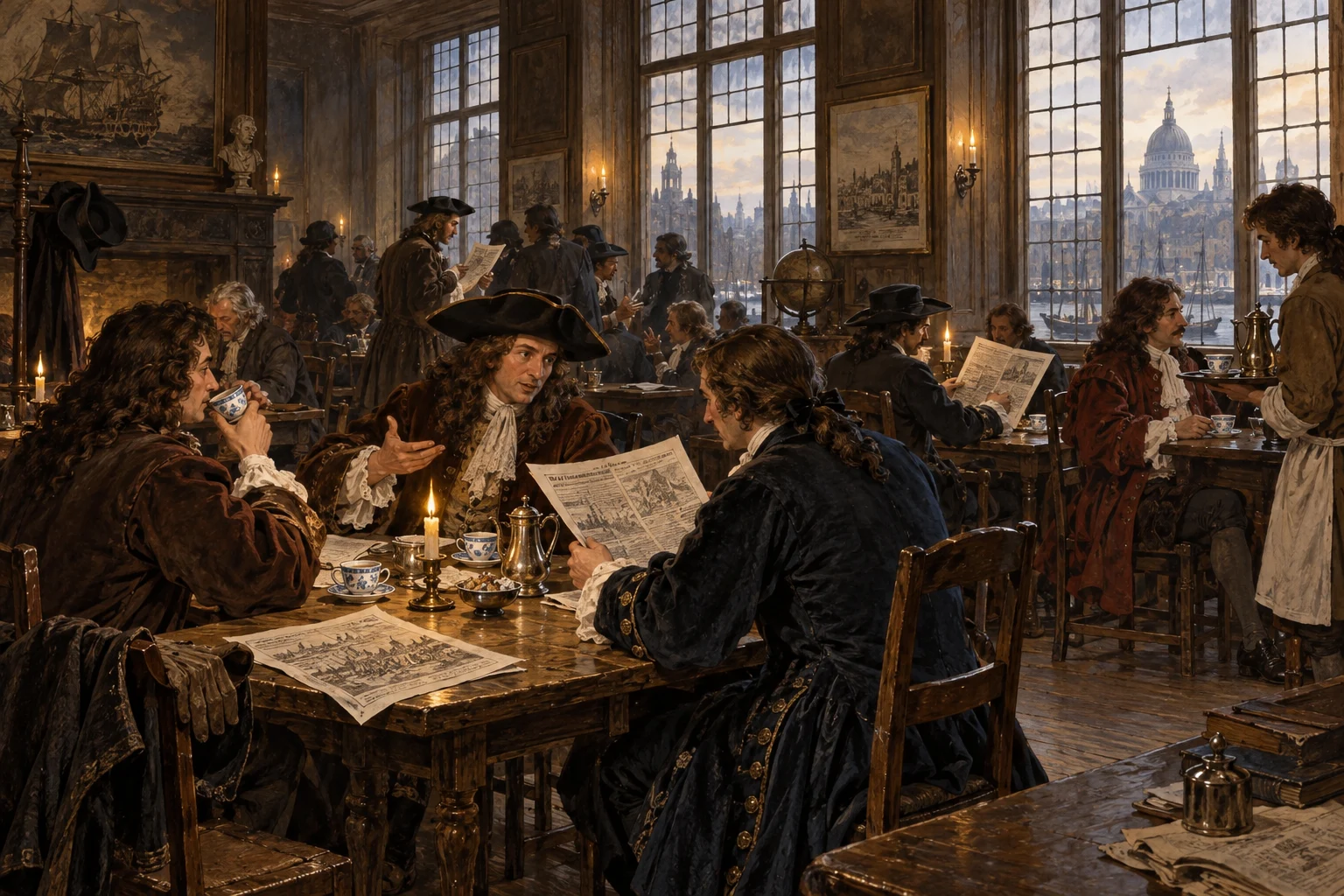
Original AI-assisted artwork by Coffeedant. Illustrative reconstruction; it documents no actual facility, visit or test.
The coffeehouse's great invention was not a new molecule or an espresso machine. It was an arrangement: a drink, a proprietor, a place to remain and other people who might know something you did not.
The cup needs company
A cup is portable. An institution is harder to move. When coffeehouse culture traveled, it carried an idea about how drinking could organize time: come in, stay awhile, hear something, meet someone. Historian Cemal Kafadar's account places coffee within changing early modern patterns of pleasure, leisure and social life. Coffee's history becomes more revealing when it includes those arrangements, rather than following only the bean's geographic progress. Kafadar, A History of Coffee.
There was no clean break between sacred and secular company. Kafadar discusses the early Yemeni association with Sufi devotion and the drink's subsequent circulation. Wakefulness served more than one purpose. A practice could move between devotional gatherings and commercial leisure without shedding every trace of its earlier setting. This makes a simple story of religion giving way to modern café culture misleading: the same beverage could sustain several kinds of collective attention. The early accounts of devotion and coffee.
The question for this article is consequently practical: what could people do together around coffee that was harder to do elsewhere? Reading, trading, listening and disputing are familiar answers. Their importance depended on the room, its customers and its city. A small neighborhood establishment and a shop frequented by international merchants could share a beverage while providing very different kinds of access. The useful comparison is between those social arrangements, not between imaginary, uniform 'Eastern' and 'Western' cultures.

An anonymous representation of a late-seventeenth-century London coffeehouse. A room of conversation, service and shared tables gives the drink a visible social setting.
Anonymous artist / Wikimedia Commons · Source · Public domain · Resized and converted to WebP.Smyrna to Cornhill
Around 1652, Pasqua Rosée opened a coffeehouse in St Michael's Alley, off Cornhill, in London. Courtauld's account identifies his employer, Daniel Edwards, as a merchant of the English Levant Company. Both had experienced coffee culture in Smyrna, now Izmir; Edwards imported the raw material, and the enterprise sought to reproduce that culture in London's mercantile center. This is a history of contact and adaptation, with the Ottoman trading world inside the London story. Courtauld, From East to West.
Rosée's personal background is described differently in historical accounts, so a definite ethnic label is unnecessary here. The better-established connection is professional and geographic: an employer, a servant, an imported beverage and firsthand knowledge of another city's custom. Cultural transmission becomes tangible in those relationships. It also resists a triumphal narrative in which London spontaneously invents a setting already familiar to people elsewhere.
The location is part of the argument. A commercial drink offered among merchants could become a commercial meeting place. That does not prove a predetermined destiny for the first shop, but it helps explain the fit between the imported custom and its new surroundings. Something useful was being adapted: the possibility of combining a modest purchase with a stay long enough for conversation to become an exchange of information.
The coffeehouse as an information network
News
Travellers, print and conversation
Commerce
Merchants and shipping information
Performance
Poetry, games and discussion
Knowledge
Reading and scientific exchange
A comparative schematic. These activities belong to different cities and periods; they are not a portrait of one room.
A newspaper with a room attached
In later seventeenth- and eighteenth-century London, the coffeehouse could place several media within reach at once: spoken report, printed news, a book and a knowledgeable acquaintance. Courtauld describes customers reading newspapers, debating events, conducting business and hearing travelers' news. The familiar term 'penny university' points to the affordability of that mixture. It should be read as a description of a social opportunity, not as proof that every room delivered accurate knowledge to every customer. Courtauld on Georgian coffeehouse life.
Oxford's history project documents proprietors providing newspapers, cooperating with printers to sell books and displaying share prices. It also describes physicians consulting patients and shipping business being arranged. These details suggest that information was part of the establishment's offering, even when the bill was for a drink. A customer was buying entry into a useful concentration of people and material, assembled by a proprietor. Oxford, Science in London.
In our interpretation, the table functioned as a place where reports could be compared before they were acted upon. Printed words could acquire explanation, endorsement or contradiction from the people nearby. The same arrangement could also amplify gossip. A room that makes information circulate does not automatically make it reliable. That tension is one reason the coffeehouse remains interesting: the pleasures of company and the hazards of collective certainty share the same furniture.
Science, shipping and specialized company
The Oxford project describes Royal Society figures using coffeehouses to exchange research and discussion, and experimenters presenting mechanical or chemical demonstrations to audiences. The activity belongs to London's developing scientific culture, not to every coffeehouse or every earlier century. Its significance is concrete: a demonstration could make an argument visible, and a gathering could connect a publication with people capable of responding to it. Coffeehouses and scientific exchange.
Edward Lloyd's establishment illustrates a different specialization. Lloyd's institutional history places the coffeehouse in Tower Street by 1688 and connects it with the demand for ship and cargo insurance. The useful company here was maritime: people who knew vessels, voyages and commercial risk. This example does not mean coffee caused the insurance market. It means a recognizable meeting place helped concentrate the participants whose knowledge and transactions formed that market. Lloyd's on its early premises.
Specialization also complicates the image of a room open equally to all. Knowing where to go, whom to recognize and which conversation to join could be as useful as possessing the price of a cup. Information has a social geography. A shipping room and a literary gathering did not offer interchangeable benefits, even if their customers drank something similar. The coffeehouse's flexibility allowed its identity to grow around the people who repeatedly used it.
| Function | Example | What to notice |
|---|---|---|
| Cultural adaptation | Smyrna to London's Cornhill, c.1652 | People carried knowledge of the custom alongside the coffee |
| Printed information | Later London coffeehouses | Newspapers, books and displayed prices added value to a visit |
| Specialist exchange | Lloyd's Tower Street coffeehouse, by 1688 | Maritime company concentrated knowledge of commercial risk |
| Contested assembly | Proclamation of December 1675 | Attempted suppression demonstrates political concern, not universal closure |
Who was in the room—and who governed it?
Scholars Özlem Çaykent and Derya Gürses Tarbuck warn against treating the coffeehouse as an uncomplicated modern 'public sphere.' They emphasize different kinds of establishments, the predominantly adult male character of the forum and the overlap between gatherings in homes and commercial spaces. Those distinctions matter. Social mixing was significant without being universal access, and private hospitality could also sustain intellectual exchange. Coffeehouse Sociability, pp. 208–210.
A broader examination of London likewise reveals participation beyond the customer at the table. An archival account of coffeehouse imagery describes waiters carrying pots and pipes and a woman managing the room behind a bar. The evidence concerns particular representations, not a census of establishments. It nevertheless makes a useful distinction visible: a predominantly male clientele does not mean women were absent from the labor, ownership or management that enabled its sociability. The archival discussion of coffeehouse interiors.
Authorities could see the same gathering as a problem. The University of Saskatchewan's Grub Street Project records the December 1675 proclamation to suppress coffeehouses and the opposition that led to its withdrawal. It is better described as an attempted suppression than as a neat number of days when all conversation stopped. A proclamation, its proposed implementation and its eventual retreat are different events. The episode reveals the political concern surrounding assembly and circulating reports. Grub Street's historical records.

A map published in William H. Ukers's All About Coffee (1922), reconstructing coffeehouse locations around Exchange Alley before the fire of 1748. Read it as a retrospective map, not an eighteenth-century survey.
William H. Ukers, All About Coffee (1922) / Wikimedia Commons · Source · Public domain (published 1922) · Resized and converted to WebP.A room with two histories
The celebrated history of exchange also has a material underside. Lloyd's research into its 1771 founding subscribers investigates their connections to slave trading, slave ownership and the wider slave economy. That is a precisely dated inquiry about a particular institution, not a charge that every coffeehouse customer occupied the same role. It does establish why the commercial achievements of coffeehouse culture cannot be told entirely as a story of liberating conversation. Lloyd's research on founders' links to slavery.
A good history keeps both views in focus: the room where people learned something and the economic world that supplied the room. Coffeehouses could support conversation, scientific exchange and practical cooperation while remaining embedded in unequal societies. Their influence becomes easier to understand once we stop asking them to be either flawless ancestors of today's cafés or mere scenery. They were working places, made powerful by repetition: people knew a cup and some useful company might be waiting.
A few good questions.
Were coffeehouses completely egalitarian?
No. Some encouraged social mixing, but access, clientele, gender, occupation and local hierarchies shaped participation. The price of a cup was only one condition of entry.
Did coffee cause the Enlightenment?
That overstates the evidence. Particular coffeehouses supported scientific and intellectual exchange, but a beverage is not a sufficient explanation for a broad historical transformation.
Follow the sources.
This research-led article draws on the sources below. Editorial interpretation is identified in the text. Dates, geographic scope and research limitations are kept alongside the claims they qualify.
- A History of Coffee ↗
Cemal Kafadar; early modern leisure, devotion and cultural circulation.
- From East to West ↗
Courtauld; Rosée, Edwards and the Smyrna–London connection.
- Georgian London's Coffeehouses ↗
Courtauld; newspapers, business and the penny-university idea.
- Science in London ↗
University of Oxford; scientific exchange and information services.
- Lloyd's buildings ↗
Institutional history of Tower Street premises and marine insurance.
- Coffeehouse Sociability ↗
Nuance on gender, status and public/private categories.
- Coffeehouse interiors ↗
SALT Research archival discussion of represented interiors and labor.
- Man's Coffee House ↗
University of Saskatchewan project; historical records and the 1675 proclamation.
- 1771 Founders' links to slavery ↗
Institutional research into a precisely defined founding group.
Sources checked 13 October 2026. Illustrated covers and original schematics: Coffeedant. Additional images and videos are individually credited above.