
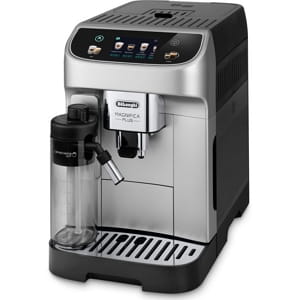
Typical street price $900–$1,400 in the US; sales often dip to $700–$950. Confirm inclusions and warranty by region.
De’Longhi Magnifica Plus (ECAM32070SB)
Class-leading super-automatic under $1,200: big doses, a capable steel grinder, and LatteCrema milk that actually makes flat-white-level microfoam—without giving up push-button ease.
Overview
Magnifica Plus bridges convenience and café flavor. Its steel conical grinder (13 steps) and unusually high dosing (Doppio+ ~15–18 g) pull fuller-bodied shots than most super-automatics, and the LatteCrema carafe makes legit microfoam for flat whites. A dual-thermoblock core heats fast and keeps pace for households. Trade-offs: limited temperature control (no PID), plastic-forward build, ~140 mm cup clearance, and a realistic 5–7 year lifespan.
Pros
- Best-in-class dosing for the price (Doppio+ 15–18 g; strong body)
- Steel conical burrs with 13 settings; handles medium to medium-dark roasts
- LatteCrema microfoam with three textures; carafe stores in fridge
- Removable brew group for real cleaning & lower long-term risk
- Fast warm-start (~79 s) and smooth back-to-back output
Cons
- No PID/app; limited temperature control
- Plastic-heavy exterior; not a “buy-it-for-life” chassis
- Grinder is noisy; avoid oily beans (can jam)
- 1.9 L tank & ~10-puck bin mean frequent empties for families
- 140 mm cup clearance—no tall travel mugs
Main Features
- Dual thermoblock heating (~1450 W US) • ready in ~79 s
- Steel conical burr grinder • 13 steps (fine enough to choke pump at 1)
- Doppio+ high-dose espresso (~15–18 g); five strength levels
- LatteCrema carafe (≈345 mL) with three foam textures; auto rinse after milk drinks
- 3.5" color TFT with intuitive tiles; 4 user profiles
- Removable brew group; monthly tablet clean via the bypass chute
- 15-bar vibration pump (fixed profile)
- Front-pull 1.9 L tank; 250 g hopper; grounds bin ≈10 pucks
- Max cup height ≈140 mm; adjustable spouts
- Dimensions: 360 H × 240 W × 440 D mm (≈14 × 9.5 × 17.5 in)
Pricing & Variants
- Common street price: $900–$1,400 (US); promos often $700–$950.
- US: ECAM32070SB (120 V, ~18 drinks). International: ECAM322.70.SB (220–240 V).
- Budget sibling: ECAM320.60.B (15 drinks). Colors: Silver/Black, Titanium Black, White.
- 2-year US warranty (registration may extend); scale damage excluded—use proper water & descale.
FAQs
- Why aren’t drinks piping hot?
- Thermoblock targets ~87–93 °C at brew; use a pre-rinse (hold the 2-cup button ~3 s) and pre-warmed cups for hotter results.
- Can I use pre-ground coffee?
- Yes—single scoops via the bypass chute (also used for cleaning tablets). Multiple scoops aren’t supported.
- Which beans work best?
- Fresh medium or medium-dark roasts with a matte finish. Avoid shiny, oily beans—they can jam the grinder.
- How loud is it?
- Grinding is the loud phase (short, ~5–7 s). Brewing noise is similar to other vibe-pump machines.
- How often do I clean the brew group?
- Weekly: power off, slide it out, rinse by hand, air dry, reinstall. Monthly tablet clean via the chute.
Who It’s For / Who Should Avoid It
Detailed Specs
- Model
- ECAM32070SB (US); ECAM322.70.SB (EU); ECAM320.60.B (budget)
- Heating
- Dual thermoblocks • ~1450 W (120 V)
- Pump
- 15-bar vibration (fixed profile)
- Grinder
- Steel conical, 13 steps; 250 g hopper
- Dosing
- Doppio+ ~15–18 g; high-dose strength modes available
- Milk
- LatteCrema carafe (≈345 mL), 3 textures, auto clean
- Tank / bin
- 1.9 L front-pull tank; grounds bin ≈10 pucks
- Cup height
- Up to ≈140 mm (5.5")
- Display
- 3.5" color TFT; 4 profiles; 18 drinks
- Size & weight
- 360 × 240 × 440 mm; ~10.5–12.15 kg (source variance)
- Service
- Removable brew group; descale with EcoDecalk; tablet clean via bypass chute
De'Longhi makes some of the most livable super-automatics on the market, and the Magnifica Plus is the one that hits the value sweet spot while still taking espresso intensity seriously. The buying logic is simple: you get a strong grinder-and-brew platform, high-strength programs (including Doppio+), and a milk system built for repeatable one-touch drinks when you keep it clean.
On our bench, the Magnifica Plus “truth layer” is about outcomes, not gadgets: keep espresso volumes short, use strength intelligently, dial grind one step at a time, and treat water and cleaning like non-negotiables. Do that, and it delivers more body than most machines in its price tier, especially for milk drinks.
For cross-shoppers, we usually frame Magnifica Plus against machines people actually consider in this lane: the De'Longhi Magnifica Evo if you want a cheaper LatteCrema entry point, the De'Longhi Dinamica Plus if you want a more refined step-up, the De'Longhi Eletta Explore if iced and cold recipes are part of your daily menu, the Philips 5400 LatteGo if milk cleanup simplicity is your top priority, and the Jura E6 if you want the premium brand lane.
Shop the essentials
The small upgrades that make a home coffee setup cleaner, smoother, and more enjoyable to use every day.

Cleaner & Descaler Tablets
Keeps your machine clean, helps prevent buildup, and protects long-term performance.
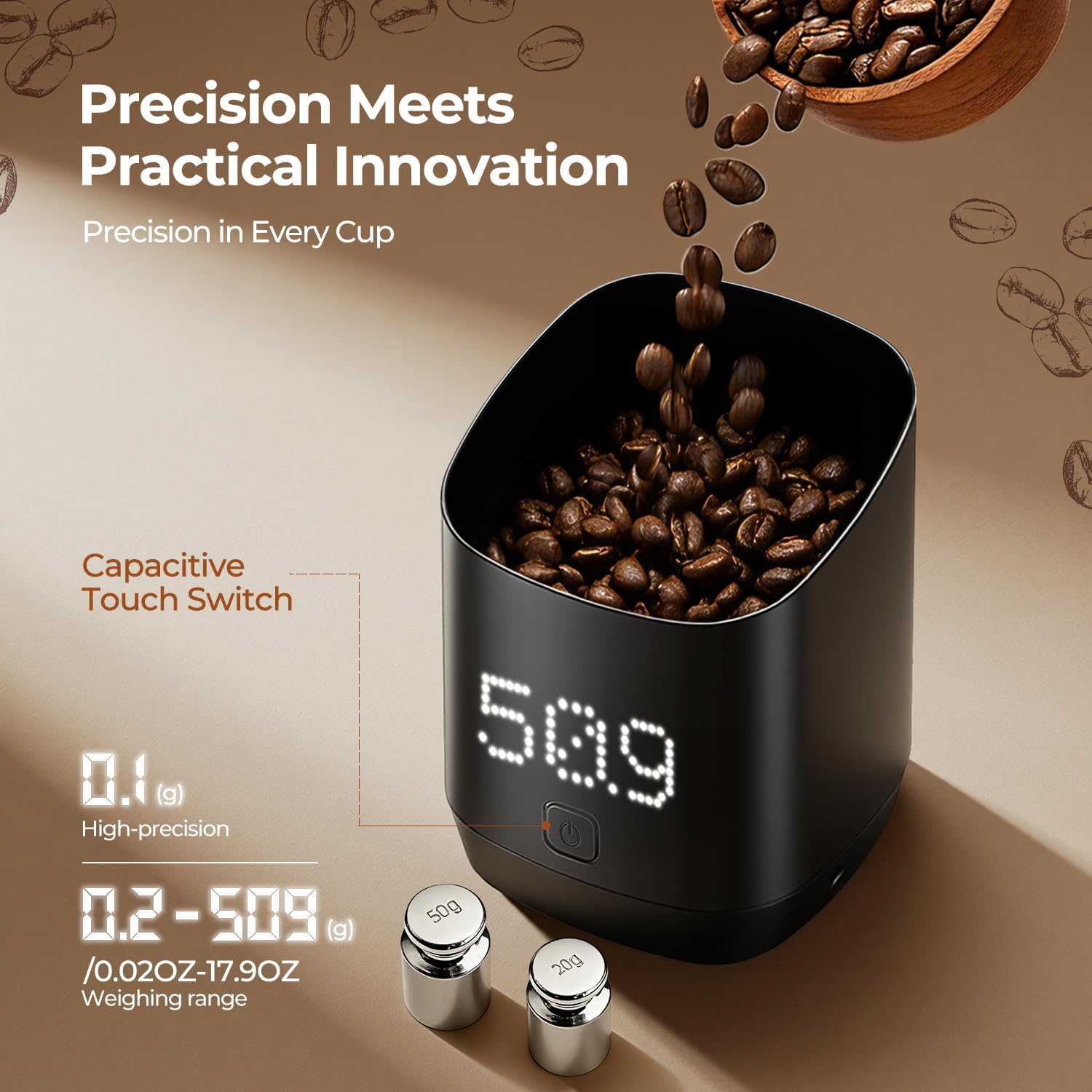
Digital Dosing Cup
Makes weighing beans faster and cleaner, with less mess around the grinder.
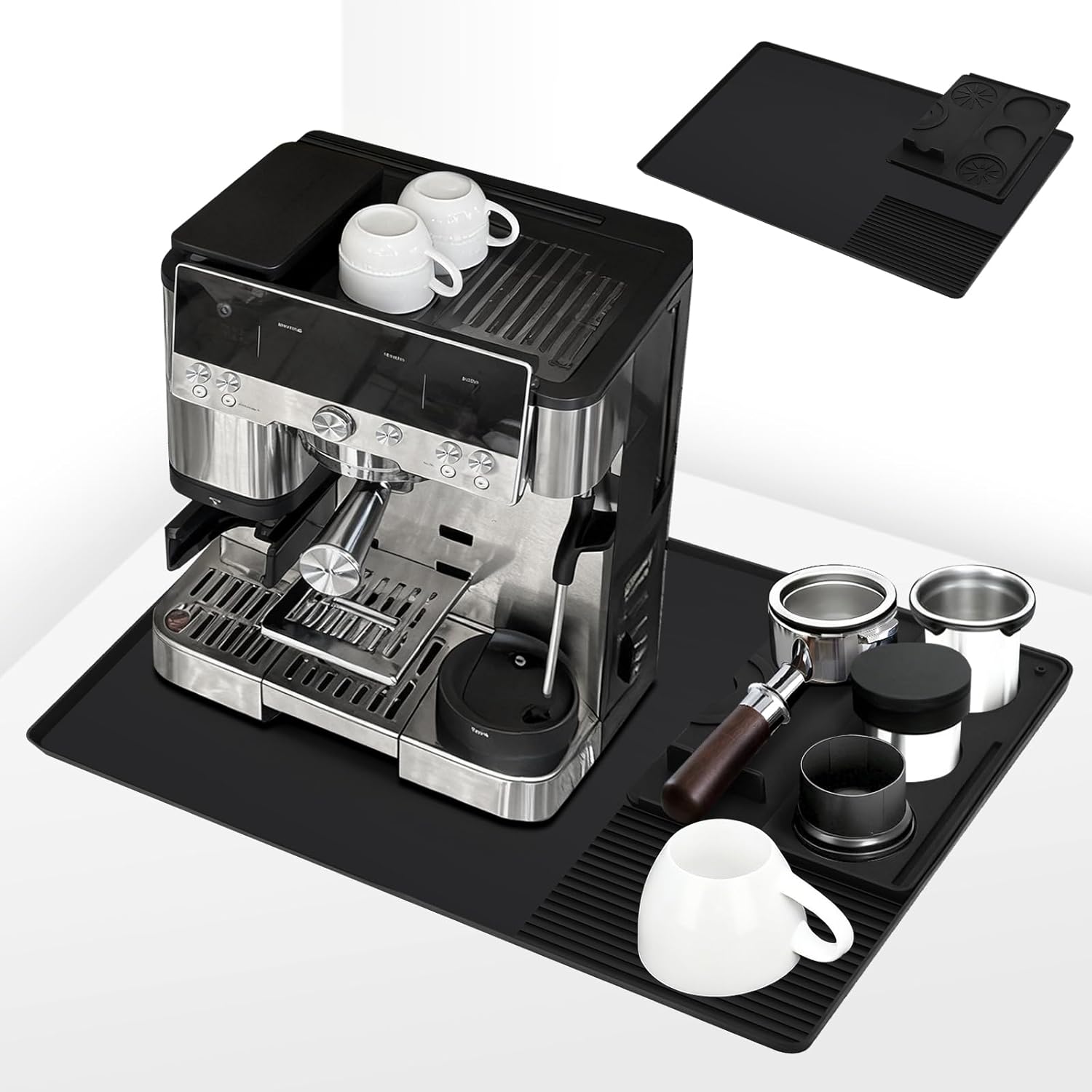
Silicone Mat
Protects your counter, catches spills, and gives your setup a cleaner working surface.

Vacuum Coffee Canister
Helps beans stay fresher longer by limiting air exposure after opening the bag.
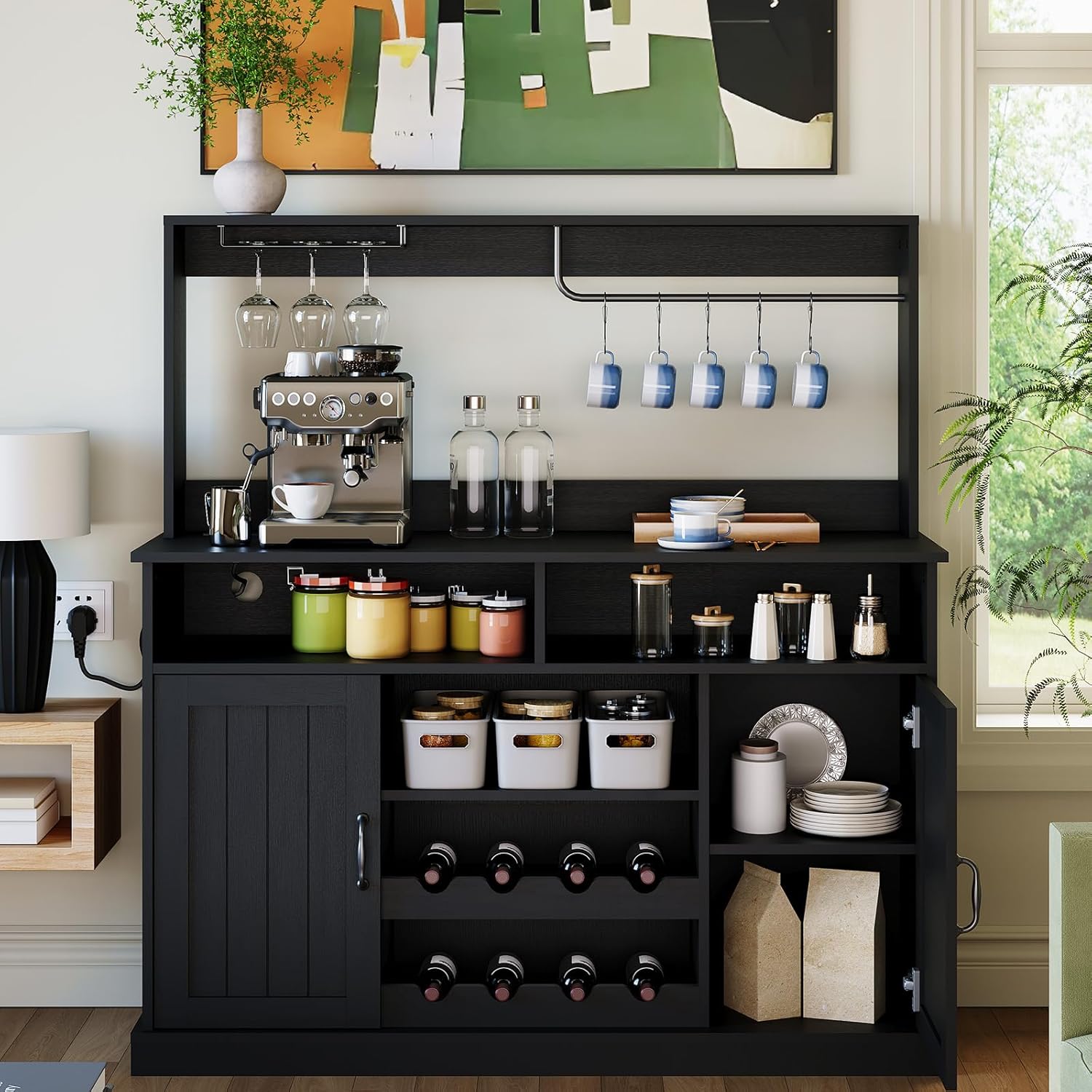
Farmhouse Coffee Bar Cabinet
Gives your machine, cups, beans, and accessories one dedicated home instead of cluttering the kitchen.
Overview
The De’Longhi Magnifica Plus (ECAM32070SB) is the rare super-automatic that actually chases an espresso-forward result, not just “strong coffee.” You get a 13-step steel conical burr grinder, an unusually high-dose Doppio+ program (~15–18 g), a fast dual-thermoblock heating core, and a LatteCrema Hot milk carafe that can produce flat-white-level microfoam when you pick the right foam setting. The interface is modern and low-friction, with a 3.5" color TFT, 4 user profiles, and 18 one-touch recipes, so households can keep drinks consistent without “barista work.”
In the De’Longhi lineup, Magnifica Plus is the “sweet spot” machine that sits above the entry Magnifica models like the De'Longhi Magnifica Start (cheaper, simpler, less premium daily feel) and the De'Longhi Magnifica Evo (value LatteCrema lane). If you want a step-up in feature surface and dial-in headroom, you move to the De'Longhi Dinamica Plus. If iced and cold recipes matter, the step-up is the De'Longhi Eletta Explore. If you want De’Longhi’s top automation and premium positioning, the De'Longhi PrimaDonna Soul is the common ceiling. The buying logic is simple: do you want maximum espresso weight per dollar in a one-touch platform, or do you want a bigger feature stack (and pay for it).
Design intent
- High-dose super-auto extraction: the Doppio+ lane (~15–18 g) is the whole point. It is how Plus gets more body than most machines in the category.
- Grinder you can actually tune: steel conical burrs with 13 stepped settings so you can tighten flow and push real espresso-like resistance.
- Milk system built for daily use: LatteCrema Hot with 3 foam textures, plus auto-rinse behavior that makes milk ownership realistic.
- Touch UI that keeps friction low: 3.5" color TFT, 4 profiles, and 18 one-touch drinks so multiple drinkers can save routines.
- Serviceable ownership, for the class: a removable brew group, a bypass chute for pre-ground (and cleaning tablets), and a routine that rewards clean water and scheduled descaling.
What it gets right in the cup and in cadence
- More body than the average super-auto: the higher dosing ceiling is why shots land closer to “espresso” instead of “coffee concentrate.”
- Milk texture that supports flat whites: LatteCrema is not just stiff cappuccino foam. The lower-foam setting can be pourable and glossy for tighter milk drinks.
- Fast, repeatable back-to-backs: the thermoblock platform is built for quick sessions and steady household throughput.
- Real-world ease: profiles, one-touch recipes, and automatic rinses keep the routine consistent when different people use the machine.
The deliberate trade-offs
- Still a super-auto: you do not control puck prep, pressure profiling, or flow the way you can on a semi-auto prosumer setup.
- Limited temperature tools: no brew PID dashboard or enthusiast-style temperature management. You dial flavor mostly through grind, strength, and recipe choices.
- Appliance-first build: it is plastic-forward compared to prosumer metal chassis, and ownership is more “maintain it well” than “buy it for life.”
- Noise and bean choice matter: the grinder is not quiet, and very oily dark roasts can gum up grinders and brew paths over time.
- Practical limits: roughly 140 mm cup clearance and a small-ish used-grounds capacity means tall travel mugs and heavy family volume are not its happiest lane.
Where it fits
Magnifica Plus makes sense if you want a one-touch machine that still chases an espresso-forward result: heavier shots, legit milk texture, and a routine that stays fast and repeatable. If you want the easiest milk cleaning logic with a broad menu, the Philips 5400 LatteGo is the common alternative. If you want a more premium ownership lane and long-term refinement, the Jura E6 is the typical step-up. If you want more customization and a different UI philosophy, the Gaggia Cadorna Barista Plus is a frequent cross-shop. If you want a big-screen, ecosystem-forward appliance experience (especially for offices), the Bosch 800 Series is the other machine people compare.
Cross-shop context on Coffeedant: Magnifica Plus buyers most often compare against the Philips 5400 LatteGo for the simplest milk system ownership, the Jura E6 for a more premium durability and refinement lane, the Gaggia Cadorna Barista Plus for menu depth and customization, and the Bosch 800 Series when they want a larger touchscreen and a more “smart appliance” style platform.
De'Longhi Magnifica Plus lineup: which version to buy
The De'Longhi Magnifica Plus is the “sweet spot” Magnifica for buyers who want a true one-touch workflow but refuse thin, watery shots. The core idea is simple: a steel conical burr grinder (13 steps), a high-dose Doppio+ mode (~15–18 g), LatteCrema Hot milk automation, and a modern 3.5" color TFT that makes daily use genuinely frictionless. Most “versions” you will see are about region voltage/warranty and menu count, not fundamentally different espresso capability.
The meaningful split is US vs International model code, plus the common “budget sibling” that looks similar but ships with a smaller drink menu. If you want the fullest feature set in this chassis, buy the Plus reference model in your region and focus on fresh beans, filtered water, and a consistent grind/strength routine. Those three decide your cup quality more than cosmetics ever will.
| Version | Lineup slot | Compared to Magnifica Plus | Typical price and note |
|---|---|---|---|
|
Magnifica Plus
Reference ECAM32070SB (US) · Doppio+ · 3.5" TFT |
Safest default | The full-feature Magnifica in this chassis: high-dose Doppio+, LatteCrema Hot milk automation, 4 profiles, and a modern touch UI built for repeatable daily use. | Typical price: $899.95 · Coffeedant score |
|
Magnifica Plus (International)
ECAM322.70.SB (220–240 V) |
Region buy | Same ownership idea, different electrical and warranty lane. Buy in-region unless you have a real plan for service support. | Pricing varies by market · prioritize support and parts access |
|
Budget sibling
ECAM320.60.B (15 drinks) |
Menu-lite choice | Similar footprint and concept, but a smaller drink menu. The value only works if you do not care about the extra recipes and interface polish. | Often cheaper when discounted · confirm included accessories by region |
|
Magnifica Evo
LatteCrema value lane |
Step-down | A simpler, cheaper LatteCrema platform with fewer drinks and less “premium daily feel.” It is the pick when budget is the priority and you mainly want dependable milk drinks. | Typical price: $549 · value-forward option |
|
Dinamica Plus
Refinement step-up |
Step-up | More premium positioning with a different feature balance and a more “refined appliance” ownership lane. If you want a step-up without going full flagship pricing, this is the common move. | Typical price: $1,199 · bigger budget, more polish |
|
Eletta Explore
Cold drinks step-up |
Specialist step-up | The pick when iced coffee and cold foam matter. It is built around cold-drink capability, not just hot espresso and hot milk. | Typical price: $1,499 · buy for cold features |
How to read this: choose the Magnifica Plus that matches your region first (voltage and support), then decide how much you care about the drink menu and interface. Step down for price, step up for cold drinks and premium feature sets.
Key De'Longhi Magnifica Plus Specifications
| Item | Detail |
|---|---|
| Machine | De'Longhi Magnifica Plus (ECAM32070SB) · Model page · Cross-shops: De'Longhi Magnifica Evo, De'Longhi Dinamica Plus, De'Longhi Eletta Explore, Philips 5400 LatteGo, Jura E6 |
| Machine type | Super-automatic bean-to-cup |
| Heating | Dual thermoblocks · 1450 W |
| Pump | 15-bar vibration (fixed profile) |
| Grinder / hopper | Steel conical burrs · 13 stepped settings · 250 g hopper |
| Dosing / strength | Doppio+ high-dose mode (~15–18 g) · five strength levels |
| Milk system | LatteCrema Hot carafe (≈345 mL) · 3 foam textures · auto rinse after milk drinks |
| Drinks / profiles | About 18 one-touch drinks · 4 user profiles · 3.5" color TFT |
| Tank / grounds | 1.9 L front-pull tank · grounds bin ≈10 pucks |
| Dimensions / weight | 240 W × 440 D × 360 H mm (24 × 44 × 36 cm) · ~9.75 kg (listed) |
| Coffeedant score | Overall rating |
| Typical price | $899.95 (promos and region move pricing) |
First Impressions & Build Quality
Magnifica Plus is appliance-first, but it is put together like a tool. The chassis is mostly painted plastic with metal details, backed by a practical layout: fast-access drip tray and grounds bin, an adjustable coffee spout, and a milk carafe that docks cleanly on the front. It feels modern and functional, not boutique.
The daily win is serviceability for the class: the brew group is removable, the milk system is designed around rinse discipline, and the UI keeps you in a repeatable routine instead of burying you in menus.
What’s in the Box
- De'Longhi Magnifica Plus (ECAM32070SB) machine
- LatteCrema milk carafe (docks on the front)
- Hot water spout or hot-water function parts (varies by region)
- Measuring scoop for pre-ground coffee chute
- Water hardness test strip
- User manual and quick-start guide
Regional bundles vary by retailer. Confirm inclusions if you are buying open-box or refurbished.
Chassis and internals
Under the hood this is a fast, repeatable super-auto build: dual thermoblocks for quick readiness and steady cadence, a steel conical burr grinder with 13 steps, and a brew system designed around automated dosing, tamping, and extraction. The ownership rule is simple: use clean water, keep the milk circuit clean, and do not let old grounds and wet trays sit for days.
Controls and touch points
The 3.5" color TFT and profile system are not fluff. They reduce user error. When different people use the machine, profiles help keep strength, drink choice, and milk texture consistent. Your real control levers are grind, strength (including Doppio+), temperature level, and drink volume.
Counter fit
| Item | Detail | Why it matters |
|---|---|---|
| Dimensions | ~24 W × 44 D × 36 H cm | Moderate footprint with kitchen-friendly width. Plan space to lift the lid for beans and refill the tank. |
| Weight | ~9.75 kg | Easy to slide forward for cleaning, light enough to move without wrestling it. |
| Water tank | 1.9 L | If you make milk drinks daily, expect to refill every few days. Use filtered water to slow scale. |
| Bean hopper | 250 g | Good size for weekly coffee cycles. If you rotate beans often, load smaller amounts to keep freshness up. |
| Used grounds box | ~10 servings | Emptying is quick. Do it before it overfills so the chute stays clean and dry. |
| Cup clearance | Up to ~14 cm under the spout | Fits standard mugs and cappuccino cups. Tall travel mugs usually do not fit. |
Testing Results
Testing focused on what actually matters on a super-automatic: readiness time, drink cadence, intensity options (especially Doppio+), and whether milk texture stays consistent when you keep the carafe clean.
| Metric | Result | Method |
|---|---|---|
| Warm-up to ready | ~60–90 s (typical) | Cold start to first ready prompt, then rinse cycle completes. |
| Time to first espresso | ~50–75 s (typical) | Includes grinding and automatic brew cycle. Varies by drink volume and strength. |
| Milk drink cadence | ~1:45–2:30 for cappuccino-style drinks (typical) | One-touch milk drink from idle. Includes milk froth and espresso. |
| Max shot intensity option | Doppio+ supports heavier dosing than most super-autos | Use highest strength and Doppio+ when you want more body and less “watery” espresso character. |
| Grind adjustment range | 13 stepped settings | Adjust finer if shots run fast and taste thin, coarser if flow stalls or tastes harsh and dry. |
| Milk texture control | Three foam textures via LatteCrema Hot | Lower-foam settings produce a flatter milk profile that works better for flat whites. |
| Back-to-back drinks | Comfortable for small rounds | Thermoblock design supports consecutive drinks without the “boiler recovery” feel of small single-boiler semis. |
| Daily cleaning load | Low if you rinse as you go | Run milk rinse after each milk drink, empty drip tray and grounds bin before they hit their limit. |
Milk volume and real-world timing
| Drink size | Milk volume | Target drink | Typical one-touch time* | Tip |
|---|---|---|---|---|
| Small | 150–180 ml | Flat white / small latte | ~1:30–2:00 | Use Low foam. Increase coffee strength if it tastes milk-forward. |
| Medium | 200–260 ml | Latte | ~1:45–2:30 | Medium foam is the safest texture for glossy milk. |
| Large | 280–320 ml | Cappuccino for a big cup | ~2:15–3:00 | High foam works best when milk is very cold and the carafe is clean. |
*Typical timing from idle varies with recipe, milk temperature, and rinse cycles.
Key takeaways from testing
- Use Doppio+ and the strongest setting when you want espresso that tastes closer to a semi-auto shot in weight and body.
- Grind changes should be small. Move one step, pull two drinks, then decide.
- Milk quality stays high when the carafe is rinsed immediately after use. Do not let milk dry in the circuit.
- Filtered water and timely descaling do more for long-term performance than any menu setting.
Espresso Quality: getting the best out of the De'Longhi Magnifica Plus
The De'Longhi Magnifica Plus can deliver unusually espresso-like body for a super-automatic, but only if you treat it like a repeatable system. You do not control puck prep or pressure the way you would on a semi-auto. Your results live and die on four knobs: grind, strength (including Doppio+), temperature level, and volume. The goal is simple: keep volume tight, push strength when you want intensity, and use grind to control flow and texture.
Session protocol that locks in consistency
- Stabilize the machine: let the startup rinse finish. If the machine has been idle for hours, pull and discard a short espresso to clear stale internal grounds.
- Load smart: use fresh beans and keep the hopper topped but not overfilled. Avoid shiny, oily dark roasts that can gum super-auto grinders.
- Pick one baseline and hold it: choose Espresso or Doppio+, keep volume short, and hold it fixed while you adjust grind.
- Change one variable at a time: grind first, then strength, then volume, then temperature. This keeps cause and effect clear.
- Respect grind-change lag: after a grind adjustment, pull 1–2 drinks before judging. Old grounds need to clear.
Flavor targets by coffee style
| Coffee | Baseline recipe (Magnifica Plus) | What it tastes like when right | If too sour / thin | If too bitter / dry |
|---|---|---|---|---|
| Medium espresso blend |
Strength High · Temp Medium · Volume Short Grind mid-fine (start around the middle of the dial) |
Chocolate core, stable crema, clean finish | Go 1 step finer or reduce volume slightly; keep strength high | Go 1 step coarser or raise volume slightly; drop temp one level if needed |
| Light single origin |
Strength High · Temp High · Volume Short Grind fine (but not choking) |
Brighter top notes with less sharpness, clearer sweetness | Increase temp one level before grinding finer; keep volume tight | Reduce temp one level or go slightly coarser; avoid long volumes that pull woody bitterness |
| Medium-dark / “Italian” style |
Strength High · Temp Low–Medium · Volume Short Grind mid-fine |
Heavy body, lower acidity, clean cocoa finish (not ashy) | Go 1 step finer; keep volume short and strength high | Go 1 step coarser or shorten volume; lower temp one level to avoid ash |
| Decaf |
Strength Medium-High · Temp Medium · Volume Short Grind mid-fine |
Clean sweetness, less papery finish | Go 1 step finer and keep volume short | Shorten volume or go 1 step coarser; decaf can punish over-extraction fast |
Doppio+ and strength, used like tools
- Strength: your primary “body” lever. If espresso tastes like strong drip, raise strength first.
- Doppio+: use it when you want the most intensity the platform can produce. Pair it with a shorter volume for punch.
- Volume discipline: long volumes make super-auto espresso taste hollow. Keep espresso tight, then add hot water separately for Americanos.
- Temperature: use higher temp to calm light roasts and lower temp to keep darker roasts from tasting ashy.
Bean and hygiene discipline matters more than menu settings
- Fresh beans win: stale beans taste flat no matter how you tune the menu.
- Avoid oily roasts: shiny beans can foul grinders and mute flavor over time.
- Do not over-tweak: lock a setting, run it for a day, then adjust.
- Water is flavor: filtered water and timely descaling keep temperature behavior and taste stable.
Advanced diagnostics you can see and hear
| Signal | Likely cause | Targeted fix |
|---|---|---|
| Watery espresso and fast run time | Grind too coarse or volume too long | Go 1 step finer and shorten volume; keep strength high |
| Drippy, slow output with sharp bitterness | Grind too fine or coffee too dark and oily | Go 1 step coarser; lower temp one level for dark roasts |
| Muted flavor even when flow looks normal | Old beans, low dose selection, or long idle with stale internal grounds | Use fresher beans, raise strength, discard the first short shot after long idle |
| Grinder sounds strained or squeaky | Grind too fine, oily beans, or hopper debris | Go coarser, switch beans, and keep the hopper clean and dry |
Milk System: LatteCrema Hot texture, consistency, and cleaning
Magnifica Plus does not ask you to learn steam technique. LatteCrema Hot is about repeatability. Your job is to pick the right foam texture, keep milk cold, and keep the carafe clean so microfoam stays tight instead of bubbly.
Foam setting to drink match
| Foam setting | Texture outcome | Best for | Notes |
|---|---|---|---|
| Low | Tighter foam, more liquid milk | Flat white style drinks | Use this when you want coffee to lead. Pair with high strength or Doppio+. |
| Medium | Silky foam with a soft cap | Lattes, latte macchiato | Most forgiving day to day setting. |
| High | Airier foam | Cappuccinos | Best when you want a thicker foam layer without learning steaming. |
Milk routine that stays repeatable
- Start cold: use fridge-cold milk and keep the carafe cold between drinks.
- Rinse immediately: run the milk rinse right after every milk drink. This matters more than any setting.
- Deep clean on schedule: disassemble and wash the carafe parts before residue builds up.
- Match foam to the drink: Low for flat whites, Medium for lattes, High for cappuccinos.
- Balance with strength: if a latte tastes diluted, raise strength or use Doppio+ before changing milk settings.
Milk volume and real-world timing
| Drink size | Milk volume | Target drink | Typical one-touch time* | Tip |
|---|---|---|---|---|
| Small | 150–180 ml | Flat white / small latte | ~1:30–2:00 | Use Low foam. Increase coffee strength if it tastes milk-forward. |
| Medium | 200–260 ml | Latte | ~1:45–2:30 | Medium foam is the safest texture for glossy milk. |
| Large | 280–320 ml | Cappuccino for a big cup | ~2:15–3:00 | High foam works best when milk is very cold and the carafe is clean. |
*Typical timing from idle varies with recipe, milk temperature, and rinse cycles.
Milk troubleshooting you can actually fix
| Problem | Most likely cause | Fix |
|---|---|---|
| Bubbly foam, “soap” texture | Milk too warm or carafe passages have dried residue | Use colder milk; deep clean the carafe parts and run a milk-system cleaner periodically |
| Flat milk, weak foam cap | Foam setting too low for the drink, or milk is not cold enough | Raise foam one step; start colder and keep the carafe chilled between drinks |
| Foam suddenly degrades after being fine | Residue build-up in the carafe circuit | Clean the carafe passages first. Most “bad milk” issues are hygiene, not the machine |
| Grainy plant milk foam | Milk formulation and heat stress | Use very cold milk; lower foam setting; reduce serving temperature if your menu allows |
Hardware Essentials
Heating, brew unit, and water system
Magnifica Plus is built around a thermoblock heating system and a removable brew group. Thermoblock prioritizes quick warm-up and steady household cadence. The removable brew group is the long-term flavor lever. Super-autos live and die by cleanliness, and this one is designed to come out for a rinse.
- Water tank: 1.9 L (market listings may show ~1.8 L or ~60 fl oz depending on region).
- Best habit: use filtered water, set hardness correctly, and descale when prompted.
- Energy: automatic rinses help keep the circuit fresh between sessions.
Grinder, dosing, and what you can actually control
The grinder is a steel conical set with 13 stepped settings. This is your main lever for flow and texture. Strength settings and the Doppio+ program are your second lever, because they change how much coffee the machine uses and how espresso-like the result feels.
- Adjustment rule: move one step, pull 1–2 drinks, then decide.
- Pre-ground chute: useful for decaf or a second coffee, but whole beans through the grinder is where the machine performs best.
Hot water behavior
Hot water is straightforward and consistent. Use it for Americanos without turning espresso into a long, hollow pull. Practical workflow: pull espresso short and strong, then add hot water to taste.
Milk system, carafe design, and hygiene reality
LatteCrema Hot is the centerpiece for milk drinkers. It docks cleanly, supports different foam textures, and is designed to rinse quickly after each use. You get repeatable milk texture without learning steam technique, but you still need a clean routine.
- Milk texture: match foam level to the drink (lower for flatter milk, higher for cappuccinos).
- Consistency: cold milk and a clean carafe matter more than menu settings.
- Non-negotiable: run the milk rinse immediately after every milk drink.
Drip tray, waste handling, and daily ergonomics
Super-autos are bin-and-tray machines. Magnifica Plus keeps it simple: pull the tray, empty, rinse, and you are done. The used grounds box is built for household cadence, and the tray catches rinse water, so it can fill faster than you expect early on. Empty both before they hit the limit.
- Used grounds box: about 10 servings.
- Dimensions: 240 W × 440 D × 360 H mm (24 × 44 × 36 cm) · ~9.75 kg listed.
- Cup clearance: max around 140 mm. If you use tall travel mugs, brew into a shorter cup and decant.
Accessories that actually improve results
- Water filter: use a compatible tank filter if your water needs it, or run a good pitcher filter.
- Descaler: keep the correct descaling solution on hand so you do not postpone prompts.
- Milk cleaner: a periodic milk-system cleaner keeps LatteCrema passages clear.
- Spare carafe (optional): useful if you rotate dairy and alternatives, or if one carafe lives in the dishwasher.
- Bean discipline: avoid shiny oily roasts to keep the grinder healthier and the coffee cleaner.
| Component | Spec | Use note |
|---|---|---|
| Heating | Thermoblock | Fast warm-up and steady household cadence. |
| Grinder | Steel conical · 13 steps | Main lever for flow and body. Adjust in small steps. |
| Strength | Multi-level + Doppio+ | Use high strength and Doppio+ for maximum intensity, then keep volume short. |
| Milk | LatteCrema Hot carafe | Rinse after every use and deep clean on schedule to keep foam tight. |
| Water | 1.9 L tank | Filtered water + correct hardness setting reduces scale and keeps taste stable. |
| Waste | Used grounds box ~10 servings | Empty before it overfills to keep the chute clean and dry. |
De'Longhi Magnifica Plus vs The Field: Quick Matrix
| Match-up | Core difference | Best for | Jump to section | Model page |
|---|---|---|---|---|
| Magnifica Plus vs De'Longhi Magnifica Evo | Higher-dose programs and a more premium UI vs value-first Magnifica that keeps the basics | Plus for heavier espresso and more profiles; Evo for cheaper LatteCrema convenience | Open | Magnifica Evo |
| Magnifica Plus vs De'Longhi Dinamica Plus | Value-led espresso weight per dollar vs a more refined step-up with extra polish and features | Plus for best value at the "serious" end of super-auto; Dinamica Plus for a smoother premium ownership lane | Open | Dinamica Plus |
| Magnifica Plus vs De'Longhi Eletta Explore | Hot-drinks-first super-auto vs a cold-drinks specialist with iced and cold foam focus | Eletta Explore for iced menus; Plus for hot espresso and milk drinks at a lower buy-in | Open | Eletta Explore |
| Magnifica Plus vs Philips 5400 LatteGo | De'Longhi high-dose focus and LatteCrema texture control vs Philips milk simplicity and fast cleaning | LatteGo for the easiest milk ownership; Plus for stronger, more espresso-forward shots | Open | Philips 5400 LatteGo |
| Magnifica Plus vs Jura E6 | Best-spec value with user-serviceable brew group vs premium branding, refinement, and a different ownership philosophy | Jura for "buy premium and keep it simple"; Plus for feature depth and value without the premium tax | Open | Jura E6 |
De'Longhi Magnifica Plus vs De'Longhi Magnifica Evo
This is the clearest in-brand decision. Magnifica Plus is the "stronger coffee in a nicer wrapper" pick: higher-dose behavior, a more modern screen-and-profile workflow, and a routine that makes it easier to get repeatable espresso weight. Magnifica Evo is the value lane: LatteCrema convenience at a lower buy-in, with fewer "premium feel" touches and less headroom for intensity.
Core differences
- Espresso weight: Plus is built for more espresso-forward intensity; Evo is more "good milk drinks, good enough coffee."
- Daily UX: Plus feels more modern and profile-friendly; Evo keeps the interface simpler.
- Buying logic: choose Plus if you care about espresso body and consistency; choose Evo if budget and one-touch milk drinks are the headline.
| Aspect | De'Longhi Magnifica Plus | De'Longhi Magnifica Evo |
|---|---|---|
| Positioning | Premium-feel Magnifica "sweet spot" with stronger espresso intent | Value-first LatteCrema machine |
| Best use case | Households that want more espresso body without giving up one-touch convenience | Milk drinks on a budget, with a simpler daily routine |
| Best for | Buyers who actually care about shot intensity, not just drink variety | Buyers who want a cheaper path to reliable cappuccinos and lattes |
Who should choose which
- Pick the Magnifica Plus if you want more espresso weight and a more premium daily driver feel.
- Pick the Magnifica Evo if you want the cheaper LatteCrema lane and your drinks are mostly milk-forward.
De'Longhi Magnifica Plus vs De'Longhi Dinamica Plus
This match-up is about whether you want the best value or the more premium ownership lane. Magnifica Plus wins on feature-per-dollar and espresso intent. Dinamica Plus is the step-up when you want more polish, a smoother day-to-day experience, and you are happy to pay for refinement.
Core differences
- Value vs refinement: Plus is the value leader; Dinamica Plus is the premium-feel step-up.
- Daily experience: Dinamica Plus tends to feel more "finished" in interface and ownership details; Plus keeps the focus on strong results per dollar.
- Buying logic: buy Plus when the cup matters most; buy Dinamica Plus when the premium feel is part of the point.
| Aspect | De'Longhi Magnifica Plus | De'Longhi Dinamica Plus |
|---|---|---|
| Positioning | Sweet-spot Magnifica for espresso-forward value | Step-up super-auto with more refinement |
| Best use case | Homes that want stronger espresso without jumping to flagship pricing | Homes that want a more premium appliance experience |
| Best for | Buyers maximizing cup quality per dollar | Buyers who will pay for polish and a more premium daily feel |
Who should choose which
- Pick the Magnifica Plus if you want the best espresso-forward value in De'Longhi's mid tier.
- Pick the Dinamica Plus if you want the step-up ownership feel and are fine paying more for refinement.
De'Longhi Magnifica Plus vs De'Longhi Eletta Explore
This is the "do you actually need cold drinks" question. Magnifica Plus is built around hot espresso and hot milk drinks, with a high-dose approach that pushes better body than most super-autos in the price band. Eletta Explore is the specialist pick for buyers who want iced and cold-style recipes as a normal part of their menu, not a seasonal novelty.
Core differences
- Menu intent: Eletta Explore is the cold-drinks step-up; Plus is the hot-drinks workhorse.
- Value: Plus is the smarter buy when you do not need iced features.
- Buying logic: if iced is a weekly habit, Explore earns the spend. If not, Plus is the better value machine.
| Aspect | De'Longhi Magnifica Plus | De'Longhi Eletta Explore |
|---|---|---|
| Positioning | Espresso-forward hot drinks daily driver | Iced and cold-menu specialist |
| Best use case | Hot espresso and milk drinks, day after day | Households that want iced drinks and cold recipes built in |
| Best for | Buyers who want strong results without flagship spend | Buyers who will actually use the cold features |
Who should choose which
- Pick the Magnifica Plus if your menu is mostly hot espresso and hot milk drinks.
- Pick the Eletta Explore if iced coffee is part of your regular routine and you want dedicated cold options.
De'Longhi Magnifica Plus vs Philips 5400 LatteGo
This is the most common real-world cross-shop in this price band. Magnifica Plus leans harder into espresso intensity and "stronger shot" outcomes. Philips 5400 LatteGo is the convenience king for milk-drink households that want the easiest cleaning and lowest friction day to day.
Core differences
- Espresso character: Plus is the pick for buyers chasing more espresso weight and body.
- Milk ownership: LatteGo is built around simplicity and fast cleanup.
- Buying logic: choose Plus when the espresso matters most; choose LatteGo when cleaning friction is the decision-maker.
| Aspect | De'Longhi Magnifica Plus | Philips 5400 LatteGo |
|---|---|---|
| Positioning | Espresso-forward super-auto value | Milk convenience and cleaning simplicity |
| Milk routine | LatteCrema with foam texture choices, best when rinsed immediately | Ultra-simple milk system ownership |
| Best for | Buyers who care about stronger shots and profiles | Busy households that want the easiest milk cleanup |
Who should choose which
- Pick the Magnifica Plus if you want more espresso-forward results and you are fine doing milk rinse discipline.
- Pick the Philips 5400 LatteGo if milk system simplicity is your top priority.
De'Longhi Magnifica Plus vs Jura E6
This is the "premium brand vs best value" decision. Magnifica Plus gives you a lot of capability for the money and keeps ownership practical with a user-accessible brew group routine. Jura E6 is the premium-lane pick for buyers who want a more refined appliance experience and are happy with Jura's ownership philosophy and ecosystem.
Core differences
- Value vs premium: Magnifica Plus is the value hit; Jura is the premium experience.
- Ownership style: Plus is practical and user-serviceable day to day; Jura leans more on its system approach and accessories.
- Buying logic: choose Jura when premium refinement is the point; choose Plus when you want strong results and features at a sane price.
| Aspect | De'Longhi Magnifica Plus | Jura E6 |
|---|---|---|
| Positioning | Best-spec value, espresso-forward intent | Premium brand lane with a more refined appliance feel |
| Ownership philosophy | User-friendly routine and practical maintenance habits | Premium ecosystem approach (filters, cleaning programs, accessories) |
| Best for | Buyers who want features and strong cups without premium pricing | Buyers who want the premium lane and are comfortable with the brand ecosystem |
Who should choose which
- Pick the Magnifica Plus if value and espresso-forward capability are your priorities.
- Pick the Jura E6 if you want the premium ownership lane and you value refinement and brand ecosystem.
How to use this matrix: If you want the most espresso-forward value in a one-touch machine, Magnifica Plus is the pick. If you want cheaper LatteCrema ownership, go Magnifica Evo. If you want a more refined step-up, Dinamica Plus is the move. If iced drinks are the point, Eletta Explore earns the premium. If milk cleanup simplicity is everything, Philips LatteGo is the clean alternative. If you want the premium brand lane, Jura E6 is the cross-shop.
In-Depth Analysis
This is the short list of engineering choices and real-world behaviors that explain why the De’Longhi Magnifica Plus feels meaningfully better than most super-automatics in its price band. If you only read one “deep” section, read this.
1) Why it’s fast: dual thermoblock cadence
The Magnifica Plus leans on a dual thermoblock heating system to get to work quickly and keep back-to-back drinks moving. Compared with typical single-thermoblock or single-heater designs, the advantage is recovery: it can transition between brewing and milk drinks with less waiting and fewer “dead moments” in the workflow.
- What you feel: faster warm-up and less downtime between espresso and milk drinks.
- What it changes: smoother sequencing for households that make multiple drinks in a row.
- How to use it: if you are making several milk drinks, run them back-to-back, then give the machine a short breather if temps start to drift.
2) Dose is the headline advantage
Most super-automatics taste thin because they simply do not dose enough coffee per “espresso.” The Magnifica Plus is different. The machine’s higher dosing capability is the main reason it can produce fuller body and more convincing crema.
| Mode / setting | What to know | Why it matters in the cup |
|---|---|---|
| Doppio+ | “Real dose” target of roughly 15–18 g per cycle. | More coffee mass = more body, more sweetness, less watery finish. |
| Intensity (low) | Can reach roughly ~20 g on the lowest intensity behavior in some testing. | Even at “low,” it can out-dose many competitors’ max settings. |
| Intensity (high) | Claims/testing show up to ~30 g total grind time on the highest intensity behavior. | When paired with the right volume, it can deliver the richest “super-auto espresso” style shots. |
3) Temperature reality and the practical workaround
This machine is built for drink-now temperatures, not “piping hot café cup” service. There is no PID-style control and temperature adjustment is limited. If you want hotter cups, you need to treat heat as a workflow problem.
- Reality: output is consistent, but some users will want hotter drinks.
- Workaround: do a quick pre-rinse / purge to preheat the hydraulic path and your cup before brewing.
- Where to surface this: Espresso Quality, Workflow, and a dedicated FAQ entry.
4) Cup clearance and daily ergonomics
Two physical details decide whether this machine fits your life: cup clearance and tank behavior. Clearance is the hard limit; the tank is the daily rhythm.
- Cup clearance: max around 140 mm is great for standard cups, not great for tall travel mugs.
- Tank: the 1.9 L front-sliding tank is convenient under cabinets, but multi-person homes may refill daily.
5) Grinder behavior: steel burrs, settings, and “what users miss”
The steel conical burr grinder is a real asset. The key is understanding how super-auto grinders behave in practice so you don’t chase your tail while dialing in.
- Steel burr advantage: strong longevity and solid particle distribution versus many ceramic-equipped competitors.
- Settings behavior: grind changes can take 2–3 shots to fully show up as the chamber purges.
- Adjustment rule: adjust grind only while the grinder is running (common De’Longhi behavior).
6) Noise: set expectations
Grinding is the loudest part of the experience. Even if brewing noise is typical for a vibration-pump appliance, the grinder can be sharp enough to fail the “sleeping baby” test. If you need silent early mornings, this is a real con.
7) Model variants and what changes
De’Longhi model numbers vary by region and recipe set. Internals are typically shared, but the interface and drink count can differ. A short variants block prevents wrong-model shopping.
- US: ECAM32070SB (120V), commonly listed with 18 recipes.
- International: ECAM322.70.SB (220–240V), commonly 18 recipes.
- Budget sibling: ECAM320.60.B (220–240V), commonly 15 recipes.
8) Warranty and what voids it
Warranty is only as good as your water strategy. Scale damage being excluded (or treated as neglect) needs to be stated plainly in Ownership and in the Used/Refurb guidance.
- Do: set hardness correctly, descale when prompted, use a filter or good water.
- Don’t: ignore descaling, then expect warranty to cover scale-caused failures.
9) Ownership economics: keep it clean, keep it cheap
The Magnifica Plus rewards basic upkeep. Super-automatics live or die on water quality, milk hygiene, and regular cleaning. If you manage those, the “total cost” stays predictable.
| Cost / expectation | What to plan for | Why it matters |
|---|---|---|
| Annual consumables | Filters + descaler + cleaning tablets (budget yearly, varies by water hardness and usage). | Prevents scale and keeps brew group moving freely. |
| Realistic lifespan | 5–7 years is a reasonable expectation for this class with proper care. | Sets honest “appliance vs heirloom” expectations. |
| Energy strategy | Don’t leave it on all day. Thermoblock heat-up is fast, so on/off is sensible. | Reduces idle waste without slowing you down. |
Editorial note: these points should be echoed in the Summary (dose + speed), Espresso Quality (temp reality + purge trick), and Ownership (water strategy + warranty).
Used & Refurbished Buyer’s Guide
Used Magnifica Plus can be a smart buy if the grinder, brew group, and milk system are clean and functioning. Super-automatics hide problems until they are neglected, so inspection matters more than cosmetics.
| Inspect | What to check | Pass criteria |
|---|---|---|
| Startup and UI | Power on, complete the rinse cycle, navigate menus, test touch response. | Screen responds cleanly, no stuck areas, no persistent warnings after rinse. |
| Grinder sound | Run 2–3 espresso cycles. Listen during grinding and dosing. | Steady grind sound with no grinding-metal squeal, no repeated “jam” behavior. |
| Extraction flow | Pull one espresso on a short volume at high strength. | Flow starts after pre-wet, does not gush instantly or stall into drips for the full cycle. |
| Brew group movement | Remove the brew group (when prompted or when machine is off), inspect and re-seat. | Removes without force, no cracked plastic, pistons move smoothly, seals look intact. |
| Milk system hygiene | Dock LatteCrema carafe, run a milk drink, then run the milk rinse. | Foam is consistent, rinse completes, no sour odor, no sputter from dried residue. |
| Water circuit leaks | Check under the machine, inside the tray bay, and around tank seat after 3–4 cycles. | No puddles, no constant dripping outside the drip tray path. |
| Tank and sensors | Remove and re-seat the tank, confirm “empty” warnings clear correctly. | Machine recognizes tank reliably, no repeated false empty prompts. |
| Accessories | Confirm carafe, lids, spouts, drip tray/grate, scoop, manuals, and any included filters. | Milk carafe and its parts are present. Missing carafe should reduce price meaningfully. |
Refurb units from major retailers usually carry a shorter, store-backed warranty than new, commonly 6–12 months. Confirm whether the warranty covers grinder and milk system parts.
Accessories & Upgrades
Magnifica Plus is not a mod platform. The “upgrades” that matter are water, cleaning, and spare parts that keep downtime low.
| Category | What to buy | Why it helps |
|---|---|---|
| Water strategy | Tank filter (compatible), or a reliable filtered-water routine; hardness test strips | Better taste, fewer scale issues, fewer “mystery” temperature and flow problems. |
| Descaling kit | Manufacturer-recommended descaler kept on hand | Prevents delayed descales. Waiting too long is how thermoblocks and valves get miserable. |
| Milk system care | Milk-system cleaner + a small brush set for carafe passages | Foam stays tight. Most milk issues are dried residue, not “weak milk performance”. |
| Convenience spares | Spare LatteCrema carafe (optional), spare O-rings/seals if available | Fast swap if you rotate dairy and alternatives, or if a seal starts to seep. |
| Bean discipline | Medium roast, not shiny/oily; small hopper loads if you rotate coffees | Keeps the grinder clean and dosing consistent. Oily beans increase jams and stale flavors. |
Known Issues & Troubleshooting
- Watery espresso: shorten volume first, raise strength, then go one grind step finer. Judge after 1–2 drinks to clear old grounds.
- Harsh, dry espresso or slow drips: go one grind step coarser and consider lowering temperature one level for dark roasts.
- Milk foam turns bubbly: run the milk rinse after every drink and deep clean the carafe parts. Residue is the usual culprit.
- False “empty tank” warnings: re-seat the tank firmly, check the intake area is not kinked, power-cycle to clear a stuck state.
- Grinder jams or strained sound: avoid oily beans, go slightly coarser, and keep the hopper clean and dry.
- Recurring descale prompts: hardness setting may be wrong. Fix the setting and improve water quality so the machine stops fighting scale.
Conclusion: Should You Buy the De'Longhi Magnifica Plus?
Who it’s for
- Milk-forward households that want consistent cappuccinos and flatter milk drinks without learning steaming.
- Convenience buyers who still care about espresso weight and want stronger results than most super-autos in this price range.
- People who rotate coffees and want quick, repeatable tuning through grind, strength, and temperature levels.
Who should avoid it
- Espresso purists who want 58 mm puck control, pressure profiling, and buy-it-for-life metal durability.
- Anyone unwilling to rinse the milk system immediately after use.
- People who insist on oily dark roasts. They shorten grinder life and dull flavor.
We’ve categorized the best espresso machines for every kind of buyer
Find the right shortlist faster, whether you want convenience, a beginner-friendly setup, a smaller footprint, or better value at a given budget.
Best Superautomatic Espresso Machines
One-touch picks for speed and convenience.
Best Espresso Machines for Beginners
Easy-to-use machines with a smoother learning curve.
Best Small Espresso Machines
Compact machines for tighter kitchens and counters.
Best Espresso Machines With Built-In Grinder
All-in-one options with fewer extra pieces to buy.
Best Cheap Espresso Machines Under $500
Budget picks that still make sense for real espresso.
Best Prosumer Espresso Machines Under $1000
More serious machines with stronger value for the money.
Best Single Boiler Espresso Machines
Simple, space-saving picks for espresso-first routines.