
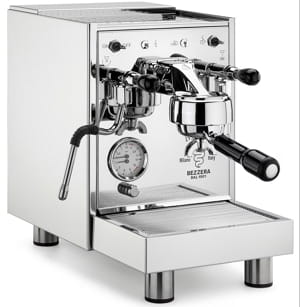
Typical street price (late 2025): $1,449 (US) • £999–£1,600 (UK) • €1,049–€1,358 (EU) • A$2,850–A$2,950 (AU).
Bezzera BZ10
Compact stainless HX with an electrically heated group that reaches shot-ready fast, delivers café-pace steam, and keeps a straightforward push-button workflow—no PID, no apps, just consistent espresso and quick milk.
Overview
The BZ10 is the practical compact HX: a 1.5 L copper boiler for real steam, a thermostatically heated BZ ring group that reaches shot-ready in about 10–14 minutes, and a 3 L tank with low-water protection. You manage brew temp with a short cooling flush after idle, then enjoy consistent extractions and back-to-back milk drinks. No PID, no shot timer—just a tidy routine that pays you back daily.
Pros
- Electrically heated brew group reaches readiness quickly and holds steady
- Strong steam from a compact 1.5 L HX with quick recovery
- Dual pressure gauge aids setup and diagnostics
- Hot-water tap & full-travel wand support café-style cadence
- Compact stainless case with durable feel
- Fair street pricing across regions
Cons
- No PID, shot timer, or app
- Reservoir-only: water care is on you
- Requires a simple but consistent cooling-flush routine
- Vibration pump noise (tolerable but present)
Features & Specs
- Format: Single-group heat-exchanger (reservoir only)
- Boiler: 1.5 L copper HX, pressostat-controlled
- Group: Electrically heated Bezzera BZ ring group, dual elements + 3-way solenoid
- Pump: Vibratory (gentle pressure ramp)
- Controls: Push-button brew; lever steam & hot-water valves; dual gauge
- Water: 3 L tank with low-water protection
- Dimensions: 250 W × 425 D × 375 H mm • ~19 kg
- Warm-up: ~10–14 minutes to shot-ready
- Power: 110–120 V 1200 W • 220–240 V 1100–1300 W
- Materials: Polished stainless case, copper boiler, 58 mm portafilter
Pricing (late 2025)
- USA: ~$1,449
- UK: ~£999–£1,600
- EU: ~€1,049–€1,358
- Australia: ~A$2,850–A$2,950
FAQs
- Does it have a PID?
- No. You manage brew temp with a short cooling-flush routine.
- Warm-up time?
- About 10–14 minutes to an honest shot-ready state.
- Plumb-in?
- No. It’s reservoir-only (3 L) with low-water protection.
- What pump?
- Vibration pump, which provides a gentle pressure ramp.
- What’s the group type?
- Bezzera’s electrically heated BZ ring group with a 3-way solenoid.
Who It Is For / Who Should Skip
Bench workflow (day one)
- Water plan: Fill the 3 L tank with softened / espresso-safe water.
- Warm-up: Heat 10–14 min; let metal equalize for longer sessions.
- Cooling flush: After idle, open the group until sputter steadies (2–4 s typical).
- Baseline shot: 18 g in → ~36 g out in 27–31 s; adjust grind first.
- Light roast path: Slightly longer flush & ~1:2.2 ratio, low-30s seconds.
- Milk cadence: Start with a 2-hole tip; move to higher-flow for 12–20 oz rounds.
- Cleanup: Purge/wipe wand; water backflush end of session; detergent weekly.
Competitive comparisons
- Lelit MaraX PL62X: Easier HX flush logic; BZ10 warms faster & feels tougher.
- Profitec Pro 400: Presets & E61 ergonomics; BZ10 = faster heated group.
- Rocket Appartamento: Style + E61 ritual; BZ10 = quicker, push-button practicality.
- Quick Mill Rubino: Quiet vibe pump; BZ10 still wins on warm-up speed.
- Bezzera BZ13: Same BZ group + PID; BZ10 is simpler, smaller, cheaper.
- Rancilio Silvia Pro X: Dual-boiler control; BZ10 = stronger steam per footprint.
Takeaway
The Bezzera BZ10 is the classic compact heat-exchanger that skips E61 theatrics for a faster, electrically heated brew group. You get a 1.5 liter copper boiler, a 3 liter reservoir, a vibration pump, a double manometer, and a stainless case that actually fits a small kitchen. The BZ group stabilizes quickly, which makes weekday shots realistic without a long idle. Steaming is the point of this platform; the boiler delivers real power and quick recovery for back-to-back cappuccinos. There is no PID, no shot timer, and no app. You run it like a tool, keep a simple cooling-flush routine, and it pays you back with consistent espresso and fast milk.
At a glance
- Format: Single group heat-exchanger, reservoir only
- Boiler: 1.5 liter copper HX, pressostat controlled
- Group: Bezzera BZ electrically heated ring group, dual heating elements
- Pump: Vibratory
- Controls: Push-button brew start/stop, steam and hot-water valves, dual pressure gauge on most current units
- Water: 3 liter tank with low-water protection
- Dimensions and weight: 250 W × 425 D × 375 H mm, about 19 kg
- Warm-up: Roughly 10 to 14 minutes to shot-ready
- Power: 110–120 V 1200 W, or 220–240 V 1100–1300 W depending on region
- Typical pricing by region, late 2025: USA around 1,449 USD at major retailers; UK commonly 999 to 1,600 GBP depending on dealer; EU about 1,049 to 1,358 EUR; Australia about 2,850 to 2,950 AUD.
Build and design
Bezzera built the BZ10 to be compact and durable. The bodywork is polished stainless with squared panels and clean seams. At 25 centimeters wide and 42.5 centimeters deep, it shares the counter with a mid-size grinder without crowding, and at 37.5 centimeters tall it parks under standard cabinets with headroom for a straight portafilter pull. The net weight is about 19 kilograms, which plants the chassis when you lock in. These numbers come straight from Bezzera’s spec sheet and line up with retailer measurements.
Inside sits a 1.5 liter copper boiler with a heat-exchanger circuit. Copper and insulation are a reliable pairing for this class; you get steady steam and predictable cooling-flush behavior without the energy appetite of a bigger commercial tank. Power draw lands in the 1100 to 1300 watt window on 220–240 volt markets, and around 1200 watts on 110–120 volt versions.
Shop the essentials
The small upgrades that make a home coffee setup cleaner, smoother, and more enjoyable to use every day.

Cleaner & Descaler Tablets
Keeps your machine clean, helps prevent buildup, and protects long-term performance.
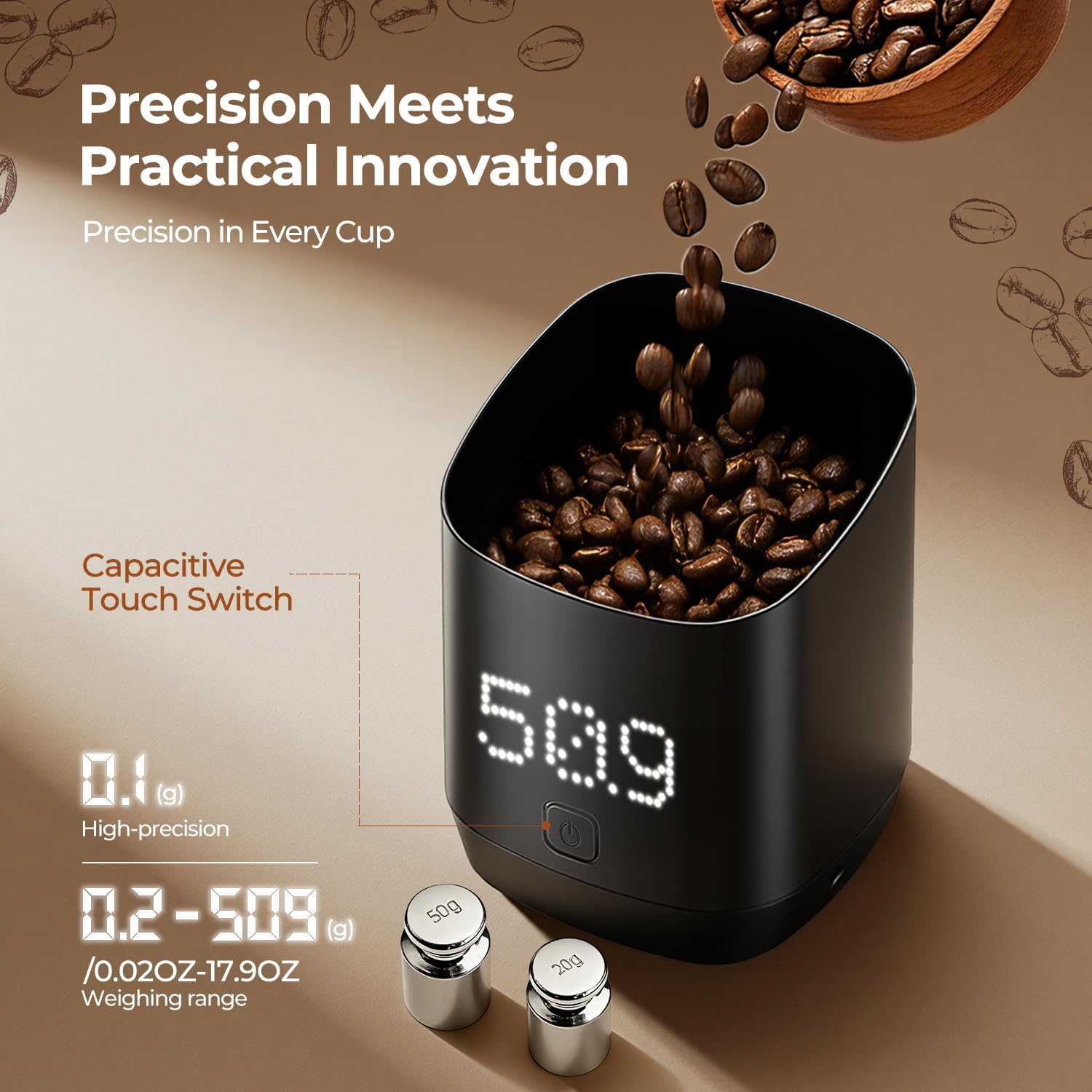
Digital Dosing Cup
Makes weighing beans faster and cleaner, with less mess around the grinder.
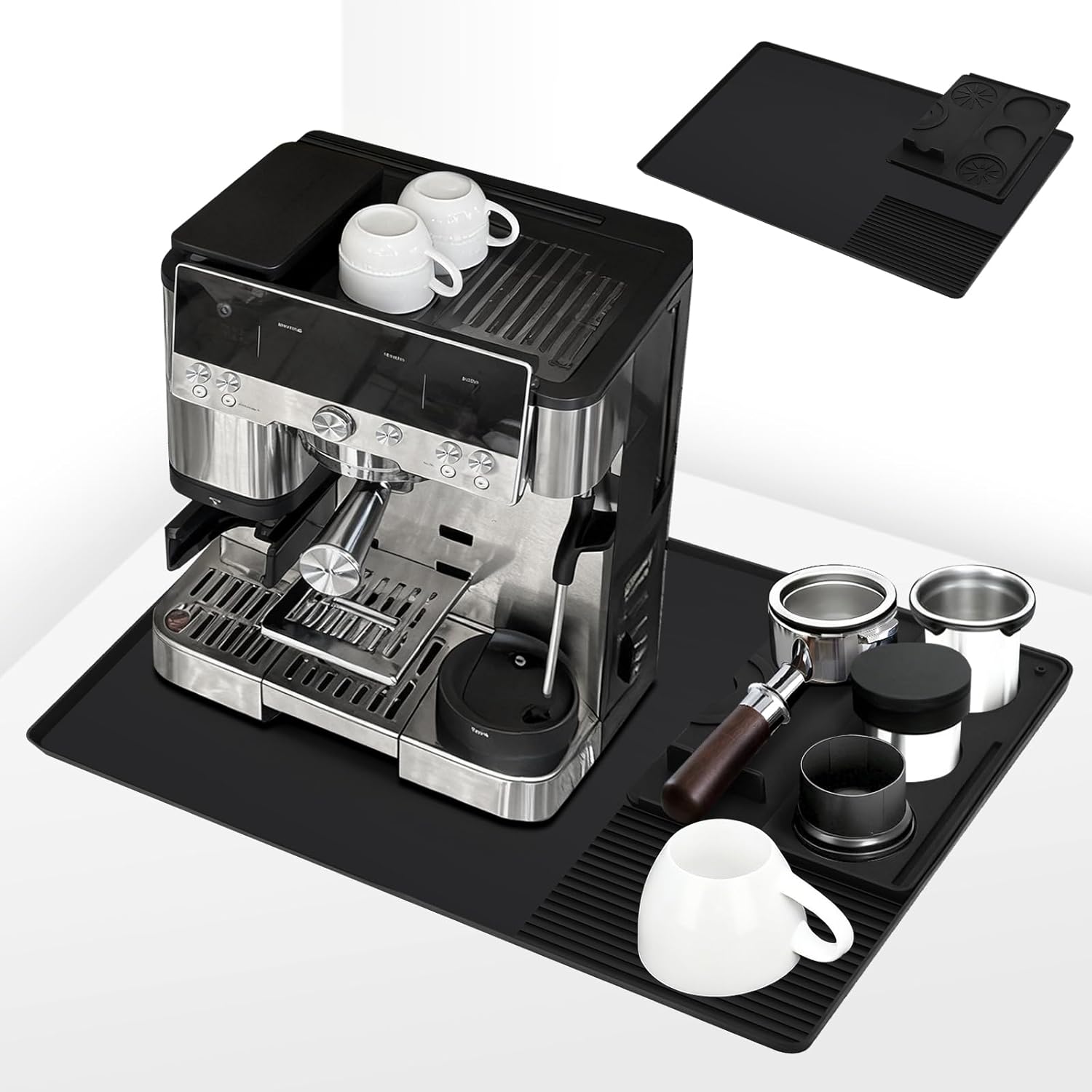
Silicone Mat
Protects your counter, catches spills, and gives your setup a cleaner working surface.

Vacuum Coffee Canister
Helps beans stay fresher longer by limiting air exposure after opening the bag.
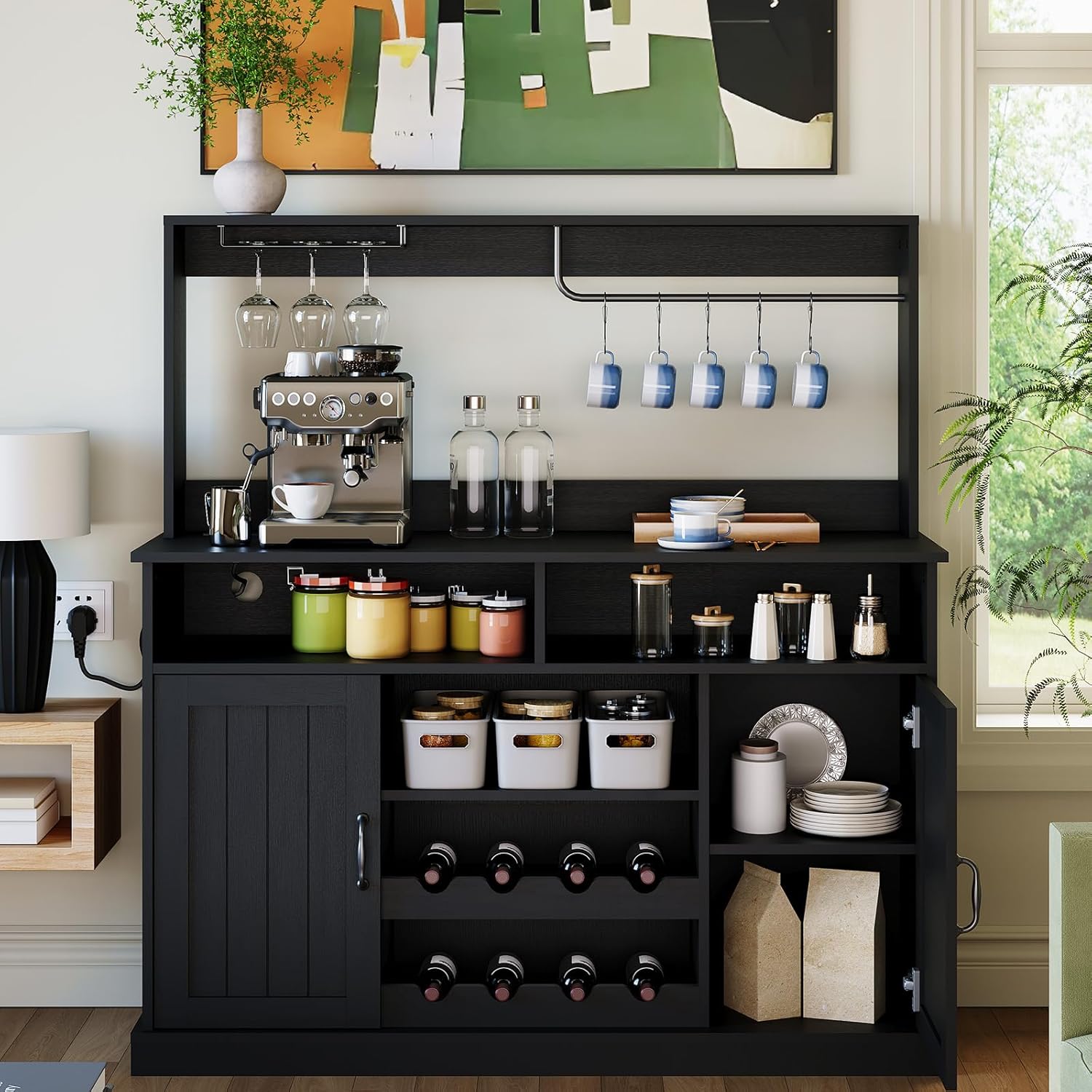
Farmhouse Coffee Bar Cabinet
Gives your machine, cups, beans, and accessories one dedicated home instead of cluttering the kitchen.
The headline is the brew group. This is not an E61. It is Bezzera’s electrically heated BZ group, a compact ring group with two small heating elements and a thermostat embedded around the water path. The design brings the group to temperature quickly, avoids the long metal soak E61 owners live with, and uses a three-way solenoid to cleanly dump pressure at shot stop. Several distributors document the two-element layout and the 3-way valve behavior clearly.
On the face you typically find a double manometer for boiler and brew pressure, a brew button, and two valves for steam and hot water. The reservoir under the cup tray holds three liters, and low-water protection shuts the machine down safely instead of letting the element run dry.
If your lists are short and practical, the construction checks the boxes: stainless case, copper boiler, a sensible pump, a dual gauge, and a fast-warming group. It is a prosumer layout built by a company that has been doing this a long time.
Workflow
Heat-up and readiness
The BZ10’s group warms itself, so shot-ready comes sooner than on thermosyphon E61 boxes. From cold, you can pull a usable espresso in roughly 10 to 14 minutes. For long sessions, give the case and portafilter extra time so metal temperatures match, then run a short cooling flush before the first pull. You do not need to babysit a heavy group; the embedded elements keep the head at target while the boiler holds steam.
Cooling flush, simplified
HX machines store overheated water in the exchanger when idle. The cure is a short cooling flush to bring brew water into the sweet zone. The routine here is simple. After idle, open the group until the sputter evens into a steady stream, often two to four seconds for medium roasts, a touch longer for very light roasts. Between back-to-back shots you can often skip the flush. Map the hiss to your grinder and you will stop thinking about it. This is standard HX discipline, and the BZ10 behaves predictably once you set your pattern. (Retailers that list warm-up time and group behavior support this workflow.)
Puck prep and ramp
The vibration pump gives a gentle rise to pressure. Paired with the ring group and three-way valve, that soft ramp wets the puck without the hammer-on feel you can get from a rotary on a small single group. It is not programmable pre-infusion; it is the steady vibe-pump character that helps new users land consistent shot times while they develop distribution habits.
Ergonomics and chores
The lever taps for steam and water are smooth, the wand articulation is generous, and the drip tray has real capacity. Top-fill is fast because the cup tray lifts without tools. The double manometer is not decoration. Boiler pressure tells you steam readiness and HX temperament. Brew pressure on a blind basket confirms your OPV setpoint and gives you a baseline when diagnosing channeling. Most current BZ10s ship with the dual gauge; verify on your market’s listing.
Espresso performance
Temperature behavior
You control brew temperature on a BZ10 with routine, not with a PID readout. The spec is a copper HX and a thermostatically heated group, which means the machine wants a short cooling-flush after idle and then settles into consistent extractions. With a medium roast, set dose and yield, flush two to three seconds, lock in, and pull to 1:2 in about 27 to 31 seconds. If the cup leans bitter, shorten the flush a hair and reduce yield. If it leans sour on modern light roasts, lengthen the flush a beat and run a slightly longer ratio around 1:2.2 while keeping time in the low 30s. These are classic HX moves, and the BZ10 executes them cleanly.
The BZ group advantage
The electrically heated group is the real differentiator at this price and size. It stabilizes faster than a heavy E61, it resists drifting when ambient temperatures swing, and it recovers quickly after your milk round. Several dealers note warm-up near the ten-minute mark specifically because of the BZ group’s internal elements. That is not marketing fluff; you feel it in weekday cadence.
Pressure sanity
Set your over-pressure valve with a blind basket to a sane nine bar, confirm on the brew gauge, and leave it. Chasing pressure for taste is how people get lost on HX platforms. On this machine, pressure is a baseline. Flavor moves with grind, dose, yield, and the small flush window you build. The dual manometer is there to keep you honest and to help you spot real changes, not to invite fiddling.
What it tastes like when it is right
BZ10 shots lean toward syrupy midrange with good weight, which makes sense on a well-tuned HX. Medium roasts taste dense and sweet with clean finishes when your flush is consistent. Light roasts hold floral clarity if you respect the longer flush and avoid dragging the tail too long. In milk, the espresso keeps shape through 8 to 12 ounce drinks. This is what buyers want from a compact HX: classic taste without a huge footprint.
Milk steaming
Milk is where the machine hides the bedtime story and gets to work. The 1.5 liter copper boiler produces a strong, stable head of steam and recovers quickly between pitchers. A two-hole tip is friendly for learners; a higher-flow tip makes 12 to 20 ounce rounds go fast for guests. The wand hardware is full-travel and cool to the touch on many current builds, and the lever action makes feathering air in the first seconds precise rather than twitchy. Several distributors and product pages emphasize the service-grade steam and hot-water tap on the BZ10 for exactly this reason.
In practical cadence, you can pull, steam a cappuccino pitcher, wipe and purge, and be ready for the next drink without waiting on pressure. That is the advantage of this class over small dual boilers with modest steam tanks. If your household lives on flat whites, you will feel the difference immediately.
Maintenance and reliability
Daily routine
Purge and wipe the wand right after steaming. Backflush with water at session end. Detergent backflush weekly if you pull daily. Drop and soak the shower screen on schedule. The three-way valve keeps the group dry and makes cleanup fast, which encourages good habits.
Water makes or breaks it
The BZ10 is tank-only. Feed the reservoir softened or properly remineralized water inside espresso-safe hardness and alkalinity. Bezzera’s copper boiler and stainless case will not protect you from scale by themselves. Most retail specs list three liters with low-water protection; treat that as license to refill promptly, not to run the tank to fumes.
Service and parts
This platform is common across Europe, the UK, Australia and North America, and parts streams are healthy. The pump is a standard ULKA vibe unit, the pressostat is a known quantity, and gaskets and valves are easy to source. If you ever need a tech, you are not betting on a boutique chassis. Regional listings and long-standing dealers back that up with current stock and spares.
Programming and controls
There is no PID menu or screen. Your control stack is intentionally short.
- Brew: One push-button for on and off. Program nothing, repeat everything. Multiple retailers describe it plainly as a manual push-button start.
- Steam and water: Lever valves with full wand articulation. Hot-water tap on the right for Americanos or rinses.
- Gauges: Dual pressure gauge on most markets reads boiler and brew. Use boiler pressure to gauge steam headroom, brew pressure to confirm OPV.
- Safety: Low-water shutoff tied to the 3 liter tank protects the element.
This is the appeal. You are not trapped in sub-menus. You develop a tidy routine and let the machine be a machine.
Bench workflow: how to run the BZ10 from day one
- Install and water. Place the machine with wand clearance. Fill the reservoir with filtered, softened or remineralized water that meets espresso specs. Confirm the low-water indicator behavior so you know what it looks like when it trips.
- Warm-up. Power on, purge steam and hot water briefly, lock in an empty portafilter, and let the machine heat. At the ten to fourteen minute mark, the group is workable for weekday espresso. For flights, give it longer so baskets and metal temperature equalize.
- Cooling flush. After idle, open the group until sputter evens, generally two to four seconds. This clears overheated HX water and establishes a repeatable brew temperature window.
- Baseline espresso. Start with 18 g in a standard 58 mm basket and 36 g out in 27 to 31 seconds from pump on. Adjust grind first, not pressure. Keep dose and ratio fixed for three back-to-back shots to confirm you are centered.
- Light-roast path. Extend the cooling flush slightly, raise brew ratio to about 1:2.2, and hold time in the low 30s seconds. If the finish goes astringent, shorten the tail.
- Milk cadence. Use a two-hole tip while you learn the stretch and the roll. Fit a higher-flow tip when you are making 12 to 20 ounce pitchers. The 1.5 liter boiler handles back-to-backs; recovery is fast when you keep purges short.
- Cleaning loop. Purge and wipe the wand immediately, water backflush at session end, detergent backflush weekly, and schedule a screen soak. The three-way valve leaves a clean puck and keeps the path tidy.
Competitive comparisons
Lelit MaraX PL62X
MaraX is the “easy HX.” Its thermostatic logic manages group temperature to minimize cooling-flush dependence. It is forgiving for beginners and quiet. The BZ10 counters with a faster electrically heated group, stronger steaming feel for its size, and a more compact width. If you fear flush timing, MaraX is clever. If you want a quicker warm-up with classic HX behavior and a tougher stance, the BZ10 makes sense.
Profitec Pro 400
Pro 400 is a compact HX with three boiler temperature presets, a pre-infusion toggle, and a dual gauge. It publishes a simple flush map in the manual, which flattens the learning curve. The BZ10 trades those presets for an electrically heated group that reaches readiness faster and feels more “switch it on and run” on weekday mornings. Choose Pro 400 for the convenience presets and E61 ergonomics. Choose BZ10 for the fast BZ group and a slightly smaller footprint.
Rocket Appartamento
Appartamento is the style leader, with an E61 group and a 1.8 liter copper boiler. It requires a classic E61 warm-soak and a slightly longer routine to normalize brew temperature. If you value Rocket’s finish and the lever ritual, it is a joy. If you value shorter warm-ups and a clean push-button interface, the BZ10 is the practical option in the same footprint class.
Quick Mill Rubino
Another compact HX with strong steam. Rubino uses an E61-style group and a vibe pump fitted with a pulsor to reduce noise, but warm-up is still an E61 game. BZ10’s heated group reaches readiness quicker, and the rest of the workflow is similar: cooling-flush cadence, vibe pump pressure, classic taste. Pick Rubino if you want E61 ritual with a quieter vibe pump. Pick BZ10 if you want electric-group speed.
Bezzera BZ13
If you like the BZ group but want PID temperature control, the BZ13 is the step up. It keeps the electrically heated group and adds degree-level brew control with either manual or volumetric variants depending on market. The BZ10 is the simpler, smaller, and cheaper path into the same design language.
Rancilio Silvia Pro X
A dual boiler with PID in a small body. It is espresso-first and offers degree control, but its steam pace is gentler than a 1.5 liter HX. If you pull straight shots and want numbers on a screen, Silvia Pro X is compelling. If your home leans milk-forward and you want fast steam at lower cost, the BZ10 wins.
Real-world numbers and notes
- Boiler and type. 1.5 liter copper HX, pressostat controlled.
- Group. Electrically heated BZ ring group with dual heating elements; three-way solenoid for clean shot stop.
- Reservoir. 3 liters with low-water protection.
- Gauges. Dual manometer for boiler and brew on common current trims.
- Dimensions and mass. 250 W × 425 D × 375 H mm, ~19 kg net.
- Warm-up. About 10 to 14 minutes to an honest shot-ready state thanks to the heated group.
- Steam hardware. Full-travel wand, hot-water tap present for rinses and Americanos.
- Price reality, late 2025. USA around 1,449 USD at major dealers; UK often 999 to 1,600 GBP; EU roughly 1,049 to 1,358 EUR; Australia about 2,850 to 2,950 AUD depending on retailer and promos.
Scores
- Build quality: 8.8
- Temperature stability: 8.6
- Shot consistency: 8.5
- Steaming power: 8.9
- Workflow and ergonomics: 8.7
- Maintenance and serviceability: 8.6
- Value: 8.9
Total: 8.7
Verdict
The Bezzera BZ10 is a compact HX that respects your time. The electrically heated BZ group gets you to shot-ready fast and stays steady through a home morning rush. The 1.5 liter copper boiler brings café-style steam without a deep chassis. It is a simple machine with a short control list, and that is the charm. You learn a repeatable cooling-flush, set a reasonable nine-bar baseline, and move taste with grind and yield. The double manometer keeps you honest, the hot-water tap tidies your workflow, and the stainless case takes daily use in stride. If your wish list includes a PID, volumetrics, or a data-rich interface, look at Bezzera’s BZ13, a compact dual boiler, or a modern profiling platform. If your priorities are fast warm-ups, strong milk service, and small-kitchen fit at a fair price, the BZ10 is the right kind of honest.
TL;DR
Compact stainless HX with a 1.5 liter copper boiler, an electrically heated BZ group that warms in about ten to fourteen minutes, a vibration pump, and a 3 liter tank. Dual pressure gauge, hot-water tap, and a push-button brew start make daily use straightforward. You run a short cooling-flush routine for temperature control and the machine rewards you with consistent espresso and fast milk. Typical price: about 1,449 USD in the US, roughly 999 to 1,600 GBP in the UK, 1,049 to 1,358 EUR in the EU, and around 2,850 to 2,950 AUD in Australia.
Pros
- Electrically heated brew group reaches readiness quickly and holds steady
- Strong steam from a compact 1.5 liter HX with quick recovery
- Dual pressure gauge helps setup and diagnostics
- Hot-water tap and full-travel wand support a café-style cadence
- Compact footprint and durable stainless case
- Fair street pricing across regions
Cons
- No PID, shot timer, or app
- Reservoir only, so water care is on you
- Requires a simple but consistent cooling-flush routine
- Vibration pump noise is present, even if tolerable
Who it is for
- Milk-forward households that want café-speed steaming without a large chassis
- Home baristas who prefer fast warm-ups and a straightforward routine over menus
- Small apartments and studios where width matters
- Buyers who value long-term parts support and a traditional tool over gadgets
Glanceable specs
- Group: Bezzera BZ electrically heated ring group with three-way solenoid
- Boiler: 1.5 liter copper HX, pressostat controlled
- Pump: Vibratory
- Reservoir: 3 liters with low-water protection
- Gauges: Dual manometer for boiler and brew pressure
- Controls: Push-button brew, lever steam and hot water
- Dimensions and weight: 250 W × 425 D × 375 H mm, ~19 kg
- Power: 110–120 V 1200 W, or 220–240 V 1100–1300 W
- Warm-up: About 10–14 minutes to shot-ready
- Materials: Polished stainless case, copper boiler, 58 mm portafilter
We’ve categorized the best espresso machines for every kind of buyer
Find the right shortlist faster, whether you want convenience, a beginner-friendly setup, a smaller footprint, or better value at a given budget.
Best Superautomatic Espresso Machines
One-touch picks for speed and convenience.
Best Espresso Machines for Beginners
Easy-to-use machines with a smoother learning curve.
Best Small Espresso Machines
Compact machines for tighter kitchens and counters.
Best Espresso Machines With Built-In Grinder
All-in-one options with fewer extra pieces to buy.
Best Cheap Espresso Machines Under $500
Budget picks that still make sense for real espresso.
Best Prosumer Espresso Machines Under $1000
More serious machines with stronger value for the money.
Best Single Boiler Espresso Machines
Simple, space-saving picks for espresso-first routines.