
Botany / Land / Labor
When the coffee plant became an empire
Behind the familiar names Java and Bourbon lies a history of plant movement, agricultural knowledge and coercion.
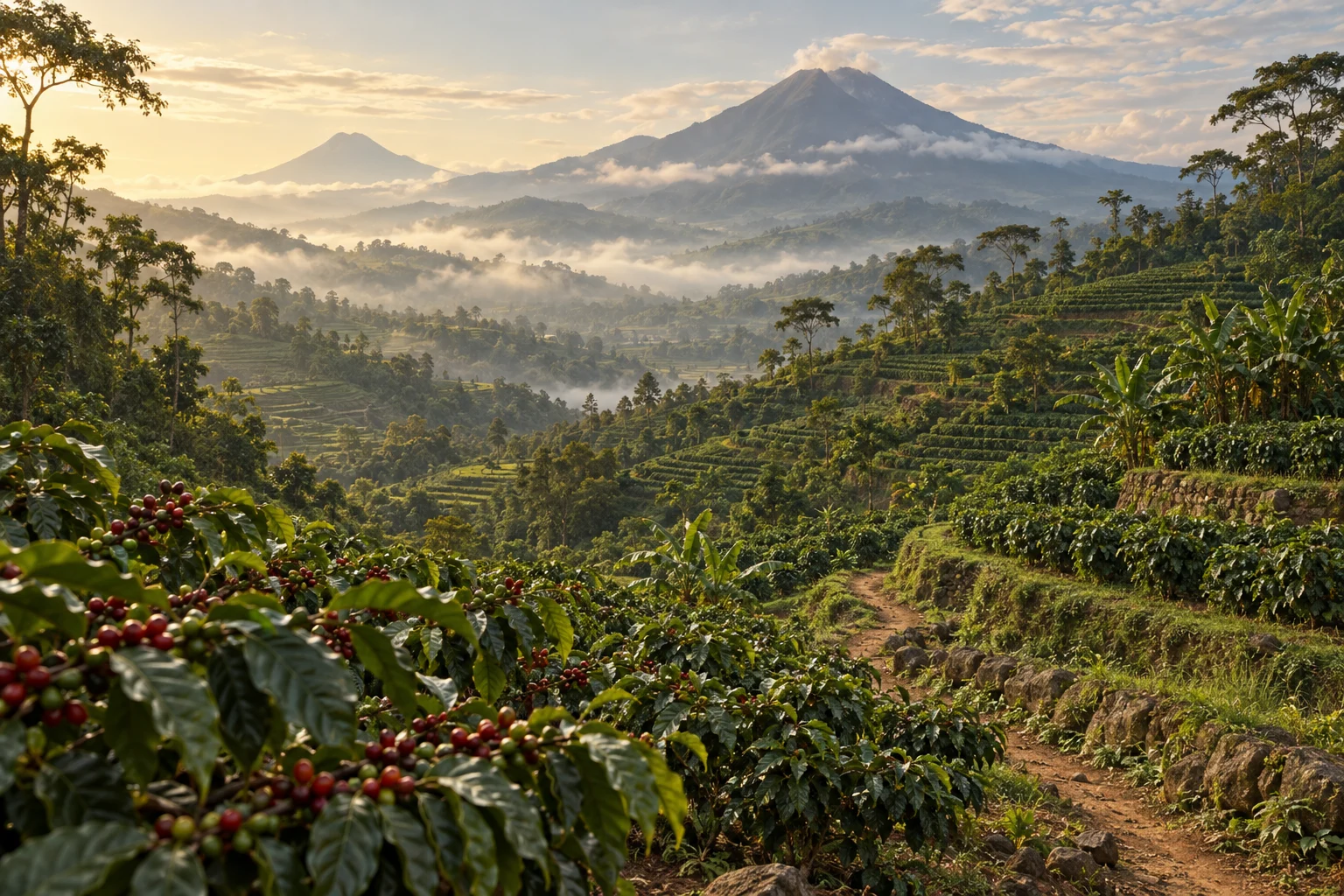
Original AI-assisted artwork by Coffeedant. Illustrative reconstruction; it documents no actual facility, visit or test.
Coffee's global journey is often told as a succession of daring people carrying precious seedlings. A seedling matters. So do the land it enters, the knowledge that keeps it alive and the workers compelled to produce its fruit.
A map is not a garden
Follow coffee across a world map and the movement seems effortless: an arrow departs one coast and lands on another. Growing a plant is less accommodating. The botanical starting point for Arabica is southern Ethiopia and South Sudan, according to Kew. Its introduced distribution now spans many tropical regions. That distance between native range and cultivated range contains a human history. A plant's presence tells us where it can grow; it does not explain how a society organized the growing. Kew's botanical account.
Yemen occupies a central place in that transformation. Intensive terrace cultivation and trading connections developed around the Red Sea, with production becoming a distinct economy during the later sixteenth century. Tuchscherer notes that subsequent plantation growth elsewhere reduced Yemen's share while the regional trading network persisted. Expansion did not make the earlier world vanish. Older producers and routes continued to operate alongside new centers of supply. Tuchscherer on continuity and changing production.
That is the first discipline of this history: distinguish botanical transfer from the establishment of an export industry. A tree can survive in a collection without supplying a market. A market can expand without rewarding its growers fairly. The two transitions require different explanations. The romantic seedling story attends to the first and too often rushes past the second, where agricultural skill meets property, taxation, commerce and power.

An archival Arabica plate from Köhler's Medizinal-Pflanzen shows the branch, flowers, fruits and seeds. The plant's anatomy helps explain what moved between growing regions; the plate itself cannot explain the labor systems surrounding it.
Köhler's Medizinal-Pflanzen / scan restored by CarolSpears / Wikimedia Commons · Source · Public domain · Resized and converted to WebP.The work before the port
The Danish expedition to Yemen in 1762–63 left unusually detailed botanical and commercial observations. An academic reconstruction describes cultivated coffee in the mountain environment and a collected specimen from Al Hadiya. It records harvested coffee moving toward Beit al-Fakih, a lowland caravan center, and then toward Mocha or other Red Sea ports. Those observations belong to the eighteenth century. They make that period's logistical world visible without supplying an itinerary for the first Istanbul coffeehouses two centuries earlier. The expedition's observations.
The same study distinguishes coffee shipped from Mocha from supplies moving through Hodeida and Loheja toward Jeddah and Suez. It also records European trading-company presence: an English East India Company establishment in 1691, a VOC post in 1696 and declining Dutch interest as Java production increased after 1720. The sequence helps explain why a port name alone cannot capture an entire system. There were alternative exits, overlapping markets and changing incentives. Coffee, ports and company trade.
Agricultural knowledge deserves equal space on the map. UNESCO's description of today's Khawlani cultivation in Saudi Arabia records shaded seedlings, water- and soil-conserving terraces, hand harvesting, drying and careful hulling. This is a living regional practice, not proof of an identical sixteenth-century Yemeni method. It is useful because it shows how much knowledge lies between planting a seed and producing a usable bean. The crop becomes commercial through repeated skilled decisions, not botanical movement alone. UNESCO on Khawlani cultivation.
Follow the plant. Then follow the labour.
Ethiopia & South Sudan
Arabica’s native range
Yemen
Cultivation and export knowledge
Java
Colonial forced cultivation
Saint-Domingue
Plantations and enslaved labour
Selected historical contexts, not a complete migration map. Plant movement and labour systems are separate histories.
The names on the bag
Java and Bourbon sound familiar because coffee names preserve pieces of that geography. World Coffee Research traces Bourbon's introduction from Yemen to Bourbon Island, now La Réunion, by French missionaries in the early eighteenth century. Its later movement extended into Africa and the Americas. A modern variety name therefore carries a history of transfer and cultivation, not simply an inherent flavor. Origin, variety and tasting description answer different questions, even when a retail label places them together. World Coffee Research on Bourbon.
The history of Réunion is also more complicated than one imported plant. Gwyn Campbell's study records wild Mauritiana coffee on the island in 1711 and its commercial evaluation alongside Mocha coffee. It distinguishes this local coffee from the wider development of production and later frontier movement toward Madagascar. That detail interrupts a tidy account in which an island's coffee history starts only when Europeans arrive with Arabica. Several botanical and commercial stories can share a landscape. Campbell on Réunion's coffee history.
Names are consequently useful clues, provided we do not ask them to explain everything. A word can survive after the commercial center that popularized it loses importance. A variety can spread beyond the place that gave it a name. The history behind a bag becomes more legible when we ask three separate questions: where did this plant lineage travel, where was this particular crop grown, and under what conditions was the work done?
Java: the quota and the household
Jan Breman's study describes Java's commercial coffee production beginning in the early eighteenth century as the Dutch East India Company purchased from peasant growers in the Priangan highlands. Its central subject is how the company mobilized land and labor and turned to forced cultivation. This was an agricultural system enforced through power. The transformation cannot be explained as a voluntary response by growers who happened to notice overseas demand. Breman, Mobilizing Labour for the Global Coffee Market.
Tania Murray Li's comparative study gives a measure of the later system's reach. Around 1840, more than 30 percent of households across Java were forced to grow coffee; in Priangan the proportion of landholding households was about 65 percent. Coffee accounted for over 80 percent of colonial profits in that context. Keep the date, geography and category beside those figures: they measure a particular colonial arrangement, not all coffee labor everywhere. Li on forced coffee production.
Li also distinguishes the especially severe Priangan regime from other parts of Java and discusses the use of landless labor to meet quotas. A household figure therefore does not describe only the work of people who held land. Obligations could pull additional workers into production. 'Forced cultivation' is a specific description with its own institutional machinery; it should not be casually treated as identical to the legal condition of enslaved people in the Caribbean. Comparison is useful precisely when the differences remain visible. The distinctions between labor regimes.
| Setting | Documented development | What the label can hide |
|---|---|---|
| Yemen | Later-sixteenth-century terrace economy; detailed observations in 1762–63 | Growers' knowledge and multiple trading routes |
| Bourbon / La Réunion | Early-eighteenth-century Arabica introductions | The distinction between a variety name and an entire island's coffee history |
| Java | Eighteenth-century export production; extensive forced cultivation by c.1840 | Compulsory household production and additional landless labor |
| Saint-Domingue | Late-eighteenth-century coffee expansion | Enslaved Africans' labor, colonial finance and plantation control |
Saint-Domingue: a coffee frontier built on slavery
In Saint-Domingue, the French colony that became Haiti, coffee's expansion depended on enslaved African labor. Crystal Nicole Eddins describes its rapid growth after the Seven Years War and the mountain environments that supported coffee estates. Compared with sugar, coffee could be established with smaller initial investment and smaller enslaved workforces. 'Smaller' is an economic distinction, not a softer description of enslavement: the workers remained people deprived of freedom and the value of their labor. Eddins on coffee and slave society.
Eddins uses P. J. Laborie's 1798 The Coffee Planter of Saint Domingo to examine planters' labor management. Wellcome preserves a digitized copy of the book. Such a manual is a source produced within the system it describes, not a neutral account of everyone who worked in it. The planter's categories tell us how production was organized from above; recovering the experiences and actions of enslaved people requires reading beyond those managerial preferences. Laborie's book in the Wellcome Collection.
Pernille Røge's study connects France's increasing sugar and coffee output with a plantation complex sustained by forced African labor and merchant finance. Production involved investments in land and workers, but also indebted planters and commercial privileges. The consumer's cup sat at the end of relationships that joined extraction, credit and colonial rule. This is why the story of coffee becoming abundant cannot be told solely as an achievement in transplanting trees. Røge on the French colonial economy.

Women processing coffee fruits in Java, 1906–07, in an anonymous print preserved by the Rijksmuseum. This later colonial-era image records work around the crop; it does not establish the individual workers' legal status or depict Caribbean enslavement.
Anonymous / Rijksmuseum, RP-F-F01188-CT / CC0 · Source · CC0 1.0 Universal · Resized and converted to WebP.Read the whole historical label
What connects these histories is not one uniform plantation model. Yemen's growers, Javanese households under compulsory cultivation and enslaved workers in Saint-Domingue occupied different social and legal worlds. A responsible global history connects those worlds through the commodity while preserving their differences. It also keeps the sequence clear: plant introduction, expanding exports and a mature coercive labor regime need not begin in the same year.
For a present-day reader, the practical lesson is a better set of questions. An evocative origin story can tell us something valuable about a coffee's ancestry, but it should not replace knowledge of the people who grew the crop. The map explains movement. The botanical drawing explains the plant. The labor history explains how production became possible. Coffee's extraordinary journey comes into focus when all three are allowed to tell their part of the story.
A few good questions.
Did all modern Arabica descend from one famous tree?
That is too broad. Plant lineages and documented introductions are more varied than a single heroic seedling story, and native African diversity must also remain in view.
Were Java's forced cultivation and Caribbean slavery identical?
No. Both involved coercion, but their legal conditions and institutions differed. The article compares production systems without equating all workers' status.
Follow the sources.
This research-led article draws on the sources below. Editorial interpretation is identified in the text. Dates, geographic scope and research limitations are kept alongside the claims they qualify.
- Arabica coffee ↗
Kew; native and introduced distribution.
- Coffee in the Red Sea Area ↗
Tuchscherer; continuity of Yemeni production and regional trading networks.
- Coffee and qat on the Royal Danish expedition ↗
Academic analysis of 1762–63 observations; these routes are not projected backward onto 1554.
- Khawlani coffee cultivation ↗
UNESCO; contemporary Saudi Arabian practices, clearly distinguished from early Yemeni cultivation.
- Bourbon ↗
World Coffee Research; variety history and introductions.
- Coffee Production in Réunion and Madagascar ↗
Gwyn Campbell; multiple botanical and commercial histories on Réunion.
- Mobilizing Labour for the Global Coffee Market ↗
Jan Breman; forced coffee cultivation in Priangan.
- The Price of Un/Freedom ↗
Tania Murray Li; dated household statistics and differentiated labor regimes.
- Homelands, Diaspora, and Slave Society ↗
Crystal Nicole Eddins; coffee production and enslaved labor in Saint-Domingue.
- The Coffee Planter of Saint Domingo ↗
Digitized 1798 primary source by P. J. Laborie; read critically as a planter's manual.
- Economistes and the Reinvention of Empire ↗
Pernille Røge; merchant finance and the French plantation economy.
Sources checked 13 October 2026. Illustrated covers and original schematics: Coffeedant. Additional images and videos are individually credited above.