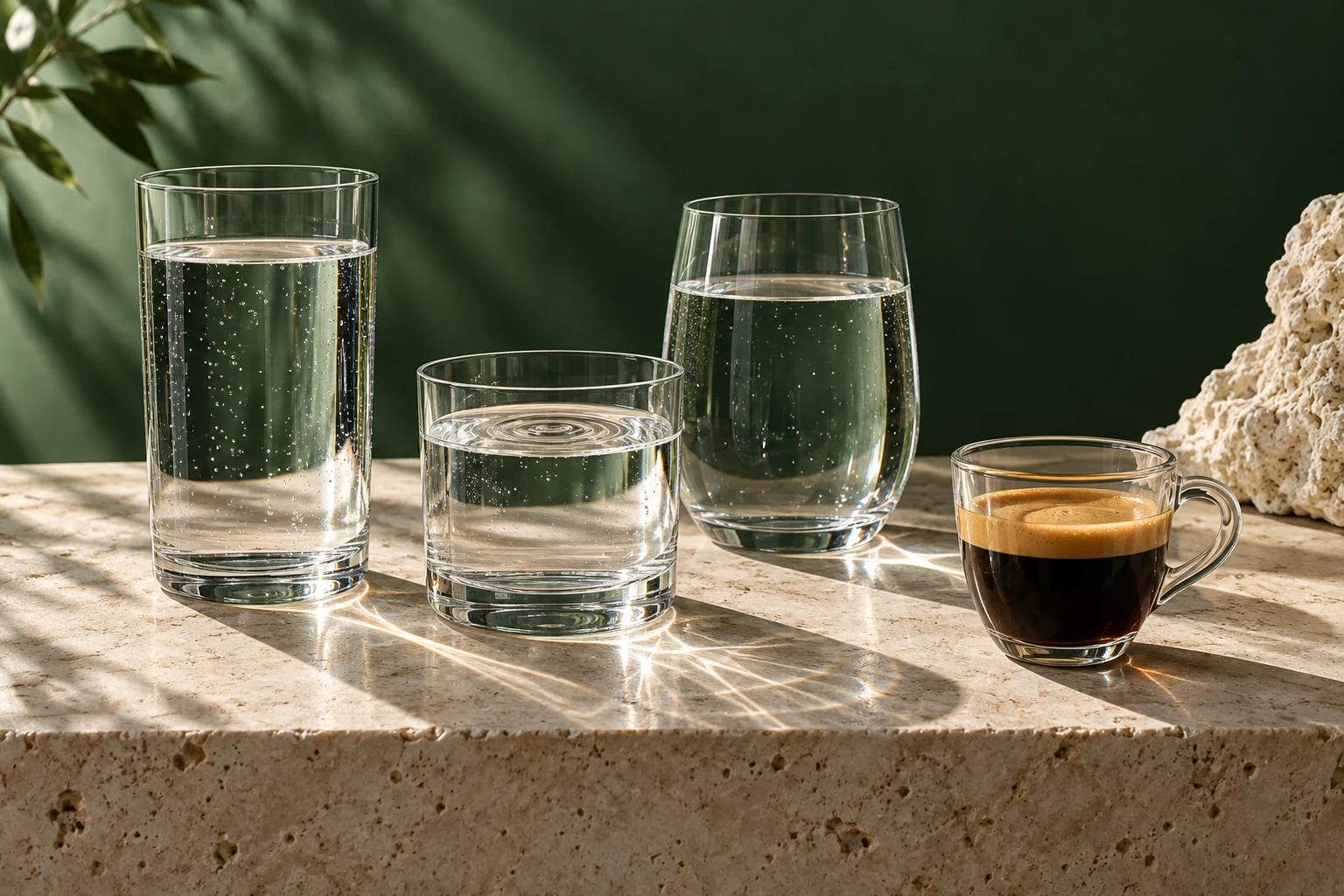
Hardness, alkalinity and the reason a bottle labelled “pure” is not a complete brewing specification.
Brew Lab · 5 min read · 13 October 2026
Original AI-assisted artwork by Coffeedant. Illustrative reconstruction; it documents no actual facility, visit or test.
Before replacing a grinder to fix a muted cup, look at the water. Its minerals influence flavour, but they also determine what builds up inside a hot machine. Good brewing water has to satisfy both the drink and the equipment.
GHtotal hardness
Alkalinityacid-buffering capacity
TDS ≠ GHdifferent measurements
01 /
Water arrives with a history
A glass of clear water can carry a surprisingly complicated record of its journey. What looks identical at the sink may have passed through different rock, treatment equipment and distribution pipes. That is the first reason a recipe copied from another city can behave differently in your kitchen. The coffee dose may match precisely while a large part of the recipe remains unspecified.
The SCAE water-chart report organizes brewing-water discussion around total hardness, alkalinity and pH. These are separate measurements, not three names for the same thing. A useful home-water record states each parameter with its unit and test method. A single “mineral content” label conceals information you need for both flavour experiments and machine maintenance.
The aim is not to turn every morning into a laboratory exercise. It is to identify the water you already use, learn whether it fits your machine’s requirements, and establish a consistent supply. A modest routine based on a supplier report and appropriate test kits is more useful than buying an expensive bottle because its label looks reassuring.
Everyday chemistry / photograph
Tap water looks clear, while its dissolved composition remains invisible. This photograph records an everyday water supply, not a hardness or alkalinity measurement.
Shixart1985 / Wikimedia Commons · Source · CC BY 2.0 · Resized and converted to WebP.02 /
Hardness counts one kind of dissolved material
Total hardness principally reflects dissolved calcium and magnesium. Test results are often expressed as milligrams per litre equivalent to calcium carbonate, written mg/L as CaCO₃. That convention allows different ion mixtures to be compared on a common scale; it does not mean every mineral exists as a suspended grain of chalk.
La Marzocco’s published specifications provide one concrete manufacturer example: total hardness of 70–100 ppm and alkalinity of 40–80 ppm. Check the original specification and your own model’s current instructions. These figures belong to that manufacturer’s guidance; they are not universal permission to use the same water in every espresso machine.
If you have a hardness test kit, measure the water after the filter you actually use. A reading of untreated tap water will not describe the reservoir once treatment changes its composition. Test again when you replace a cartridge or change the supply. Label results clearly so a household filter and a machine filter do not become confused.
Water lab / conceptual model
Two measurements. Different jobs.
Less acid buffering; lower calcium / magnesium context. Check the complete water analysis against your machine’s requirements.
Qualitative explanation only. This is not a calibrated taste predictor, mineral recipe or equipment-safe zone.
03 /
Alkalinity is the cup’s quiet editor
Alkalinity describes a water’s capacity to resist acidification. In a coffee context, it helps explain why two waters near the same pH can handle coffee acids differently. Researcher Marco Wellinger’s SCA water-and-acidity explainer emphasizes this distinction and the importance of beverage ratio. Coffee does not experience an identical amount of buffering water in concentrated espresso and a much larger filter brew.
A practical consequence is that apparently “flat” coffee deserves a water check before you make repeated grinder changes. This is a diagnostic possibility rather than a remote diagnosis: flatness also has other causes, including stale beans or a roast you do not enjoy. Use a controlled comparison to establish whether your water is contributing.
For a filter-brew comparison, choose two potable waters with documented, different alkalinity, keep coffee, grind, dose and water temperature the same, and taste both at comparable temperatures. Write down which cup preserves the qualities you want. Repeat before deciding. Use an external kettle for this experiment if either water falls outside your espresso machine’s requirements.
04 /
Why one meter cannot answer every question
A cheap TDS meter estimates dissolved ionic content from electrical conductivity. It cannot, on its own, tell you how much is calcium, how much is magnesium or how much acid-buffering capacity the water has. Two waters can register a similar number while having different compositions. Treat the meter as a consistency tool for a known supply, not a substitute for a full water analysis.
A label can be equally incomplete. Sodium, bicarbonate, calcium and magnesium entries are useful, but units and reporting conventions matter. “Bicarbonate, mg/L” is not automatically the same number as “alkalinity, mg/L as CaCO₃.” Avoid comparing the printed numbers as though the headings were interchangeable. If an important entry is missing, ask the supplier rather than filling the gap with a guess.
For your home record, save the supplier’s date alongside the chemistry. Water supply can change, and a filter cartridge ages through use. The reading that helped you last year is context, not a permanent specification for this month’s coffee.
What the measurements can—and cannot—tell you
Measurement
Useful for
Does not establish alone
Total hardness
Calcium/magnesium context
Full scale or corrosion risk
Alkalinity
Acid-buffering context
Total mineral content
pH
Current acid/base state
Buffering capacity
Conductivity / estimated TDS
Consistency of a known supply
Individual ions or hardness
Manufacturer specification
Model compatibility
Your preferred taste
05 /
The boiler has a vote
Water can be pleasant to drink and unsuitable for prolonged heating inside a boiler. La Marzocco’s water calculator considers multiple parameters and temperature when assessing scaling or corrosion tendencies. It illustrates why flavour targets alone are an incomplete equipment policy.
Carbon filtration, softening and reverse osmosis perform different jobs. A carbon cartridge may reduce certain odours or disinfectant-related tastes without producing the hardness reduction you assumed. A softener changes the relevant ions; reverse osmosis removes much of the dissolved material. The result depends on the actual system and its condition. Verify the output rather than inferring it from the word “filtered.”
Do not pour untreated distilled or reverse-osmosis water into an espresso machine simply because you want to avoid scale. Follow the manufacturer’s requirements for composition and any remineralization. Chloride, pH and other parameters may matter alongside hardness and alkalinity. The appropriate choice is the compatible water that also brews well, not the smallest reading your meter can display.
Inside the kettle / photograph
Limescale removed from a kettle. A useful view of what mineral deposition can leave behind, but not a diagnosis of any particular espresso machine.
Alexander Davronov / Wikimedia Commons · Source · CC BY-SA 4.0 · Resized and converted to WebP.06 /
A useful water routine in four moves
First, get the machine’s water requirements and the supplier’s report. Second, identify any treatment between the supply and reservoir. Third, measure appropriate parameters at the point of use. Fourth, record the result and choose a replacement or service interval based on the manufacturer’s instructions and your usage.
For a taste experiment, change water while holding the brewing variables steady. For a maintenance decision, compare measured output with the machine’s specification. Those are different questions with different evidence. A delicious cup does not establish corrosion compatibility, and a water inside the machine’s limits does not guarantee that it highlights your preferred flavour.
The interactive diagram below separates hardness from buffering conceptually. Its states are qualitative illustrations, not calibrated sensory predictions or a universal safe zone. Use it to remember which question each measurement answers. Once the water is stable, grinder adjustments become easier to interpret because one hidden variable has finally become part of the recipe.
A few good questions.
Is bottled water automatically better?
No. Read its analysis, compare it with the machine’s requirements, and taste it in a controlled brew.
Will any filter prevent scale?
No. Treatment systems have different functions. Verify hardness and other relevant measurements after the filter.
Should I copy the La Marzocco ranges?
Only as an example of a manufacturer’s specification. Use the current requirements for your own machine.
Evidence / method
Follow the sources.
This research-led article draws on the sources below. Editorial interpretation is identified in the text. Brewing quantities are suggested starting protocols, rather than Coffeedant laboratory measurements.
May we use Google Analytics cookies to understand which pages are useful? You can change your choice using Cookie preferences in the footer. Privacy policy
Your browser requests no optional tracking. Analytics will stay off while that setting is enabled.