
01 / 6
A repeatable name can cover changing coffees
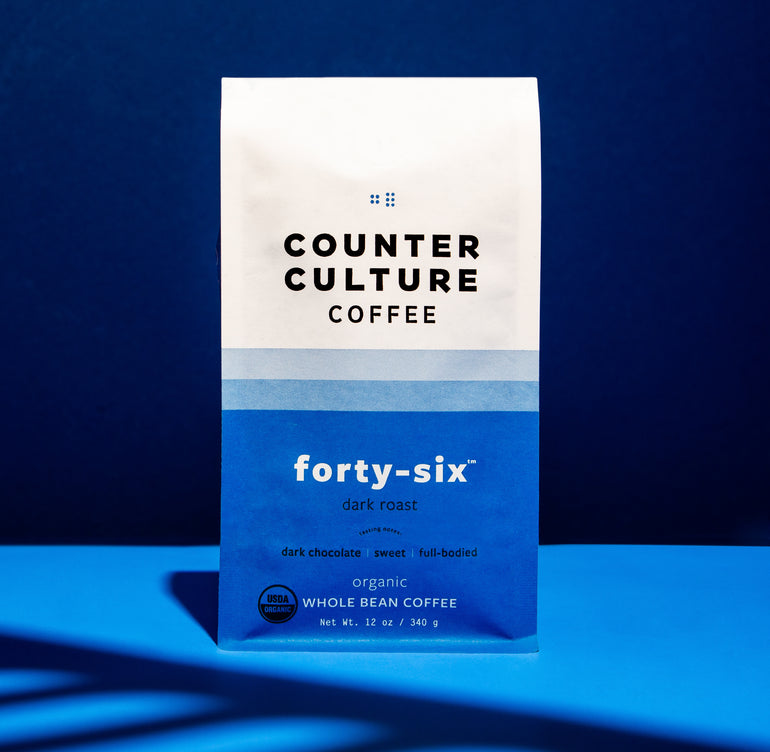
Forty-Six is the darker buying direction within Counter Culture's year-round range. The useful distinction is the recipe's intended role, rather than a claim that every bag comes from one permanent farm. Its current listing supplies roast-date periods for the component record. At this check, October 5–Present was the latest period. The extracted percentages were not reliably bound to that selected period, so we have not turned the page's combined historical records into a supposedly current recipe. Check the record against the date on your own bag. [1]
If origin transparency is your priority, look for a usable correspondence between package and record before subscribing. A list of attractive producer names is less useful when you cannot tell which shipment it describes. If consistency means the same ingredients to you, choose a documented current single-origin lot instead. A blend is a choice to pursue a flavor direction while allowing ingredients to move.
The listing identifies two processing approaches, but it does not establish a complete, fixed variety list. We leave that field unknown. Organic certification also answers a sourcing question; it does not establish the coffee's taste, ideal extraction or freshness after shipping. Treat each label as evidence for its own claim rather than a shortcut to a sensory score. [1]
02 / 6
Buy the dark direction for a reason
The front-label descriptors are Counter Culture's own tasting vocabulary. They are expectations to investigate in your cup, not results of a Coffeedant tasting. The roast designation supports putting this coffee on a shortlist for someone deliberately moving toward a darker flavor brief. It cannot tell us how much bitterness you will perceive with your water, grinder, recipe and milk. [1]
The most useful home trial has two drinks: one small black cup or espresso, and the milk drink you normally order. That separates the underlying coffee preference from the way milk changes the experience. If you like only the second, that can still be a successful purchase; it means the buying criterion is your latte, rather than an abstract ranking of straight espresso.
Do not buy a darker coffee merely to make a weak drink stronger. First check how much coffee and milk are in the drink, whether the grinder can reach an appropriate espresso setting, and whether the beans are fresh enough for your preference. Changing dose, yield, milk volume and coffee simultaneously produces an answer you cannot use for the next bag.
03 / 6
Use a filter recipe for filter and an espresso recipe for espresso
Counter Culture positions Forty-Six for espresso and milk as well as other methods. Its broad 1:17 advice belongs to ordinary brewing devices; the espresso recipe shown on the product page uses a different ratio. Do not carry a filter-water number into the portafilter and expect it to explain the coffee. [1]
For a trial, use a dose that fits your basket and record both dry coffee mass and beverage mass. If your existing recipe is repeatable, keep it for the first comparison. Taste before deciding whether a grind change or yield change is needed, and move one control at a time. A stopwatch is a useful record, but a matching time is not proof that this bag tastes right.
A darker preference does not remove equipment constraints. Check the bean restrictions in an automatic machine's exact manual, and inspect the bag rather than assuming every coffee with this roast label has the same surface oil. The Encore ESP manual specifically separates coffee-oil cleaning from burr washing. Grinder care is a separate job from descaling the machine. [6]
04 / 6
The small bag is the most informative first purchase
Start with the package's actual roast date and opening date. Stumptown's published advice is a useful example of how a roaster separates sealed-package claims from use after opening, but its shipping promise and freshness window do not become Counter Culture promises. For this coffee, use Counter Culture's record and the bag you receive. [2]
A 12 oz bag contains about 340 g of coffee. At an illustrative 18 g per espresso dose, that is about 18 complete doses before dialing-in waste; at two doses each day, it is roughly a nine-day purchase. Those are mass calculations, not a recommended expiry date. Use your actual dose and drink count to decide whether the 24 oz or 5 lb option improves the order.
Keep the coffee sealed, cool and away from light and strong food odors. Stumptown advises against repeatedly moving beans in and out of a freezer because moisture can be introduced; we cite that as attributed storage guidance, not a claim that Coffeedant has tested freezing Forty-Six. Follow a deliberate storage method rather than using a fridge as a substitute for sensible bag size. [3]
05 / 6
Compare the order you will finish
The checked US direct listing showed $20 for the 12 oz selection. Shipping, tax and subscription conditions are additional questions at checkout; there is no verified discount claim here. That pack size works out to about $0.059 per gram, or approximately $1.06 for an 18 g dose before waste and other costs. [1]
The first useful comparison is against your present coffee at the same dose and in the same drink. Write down the price, package mass and number of drinks actually made. A bulk order that looks cheap per gram can be poor value if the household loses interest halfway through it. Subscription convenience is valuable only once you know the profile and delivery interval fit.
For a less dark direction, compare Big Trouble's current listing and our full review. If you want a different purchasing route, the Peet's review distinguishes direct one-pound bags from other retail packs. These alternatives change a specific buying variable; they are not coffees we have tasted and ranked against this one. [7]
06 / 6
A first-bag plan that produces a usable answer
Open one bag at a time and retain its date and lot information. Choose the drink that accounts for most of your weekly use, write down the recipe and keep your previous coffee as the comparison only if it has a reasonably similar storage history. An old comparison bag can make any fresh order appear better for the wrong reason.
Spend the first few drinks learning the bag without turning every shot into an expensive experiment. Reserve a small amount for a second method only if that method matters to you. If the coffee is attractive in espresso but not in your drip brewer, it may be a dedicated espresso purchase rather than an all-purpose household replacement.
At the end, decide whether you would buy the same size again, a larger pack, or a different roast direction. Keep the reason concrete: the milk drink worked, the buying record was useful, the bag lasted too long, or you preferred the alternative. That is stronger evidence for your next purchase than adopting a numerical tasting score from someone else's palate. The brew-guide sources support method selection; they do not supply Forty-Six test results. [4] [5]
Evidence and limits
How this review was made
This is a research-led buying assessment. Product identity and sensory descriptors come from the named roaster; the interpretation of fit, consumption and costs is Coffeedant's editorial judgment. Other-roaster support articles are identified as attributed comparisons, never transferred shipping guarantees or product test results. We did not buy a bag, conduct a tasting, measure extraction or assign a sensory score.
Sources were checked on October 13, 2026. Package, roast date, blend components, price and seller stock can change. Verify the actual selection at purchase; dates and transparent calculations here document the assessment rather than promise a future offer.
Quick answers
Forty-Six FAQ
Has Coffeedant tasted Forty-Six?
No. This is a research-led buying assessment; the flavor descriptors belong to Counter Culture.
Is Forty-Six a fixed-origin coffee?
No. Match its changing blend record to the roast date on your bag.
Is it suitable for espresso?
The roaster positions it for espresso and milk. Dial in for your basket and grinder; a filter ratio is not an espresso recipe.
Does dark roast mean less caffeine?
This review has no product-specific caffeine measurement. Do not infer an exact caffeine dose from roast color.
Which bag size should I buy first?
Start with 12 oz when the profile is unfamiliar, then use your actual consumption to judge a larger size.
Can I put it in a superautomatic?
Check the exact machine's bean restrictions and inspect the actual bag. A roast label does not prove hopper compatibility.
Trace the claims
Sources
- Counter Culture Forty-Six: current product record
Identity, current US size/price, roast designation, blend-date selector and roaster brewing brief. Checked 2026-10-13.
- Stumptown: freshness advice
Attributed comparison of sealed and opened coffee; its shipping promises are not transferred to another roaster. Checked 2026-10-13.
- Stumptown: storage advice
General attributed storage context, with repeated-freezer-use caveat. Checked 2026-10-13.
- Stumptown brew guide
Method-selection context, not a test of this coffee. Checked 2026-10-13.
- Peet's brew guides
Alternative brewer guidance and method distinctions. Checked 2026-10-13.
- Baratza Encore ESP operations manual
Coffee-oil care and dry burr cleaning; no grinder taste measurement inferred. Checked 2026-10-13.
- Counter Culture Big Trouble
Current alternative buying direction; see its separate review. Checked 2026-10-13.
The choice
Let the first bag earn the next order
Choose Forty-Six when the job is a familiar dark-roast coffee for milk drinks and you are willing to follow a blend that changes its components. Start with a small bag and judge it in your normal drink. A dark label alone does not guarantee low bitterness, low caffeine or compatibility with an automatic machine.
Check Forty-Six at the roaster