
CULTURE / WILDLIFE / VALUE
The animal inside coffee’s most unforgettable story
Kopi luwak turned an unlikely production method into a global talking point. Its next chapter should begin with evidence about the beans—and the animals.
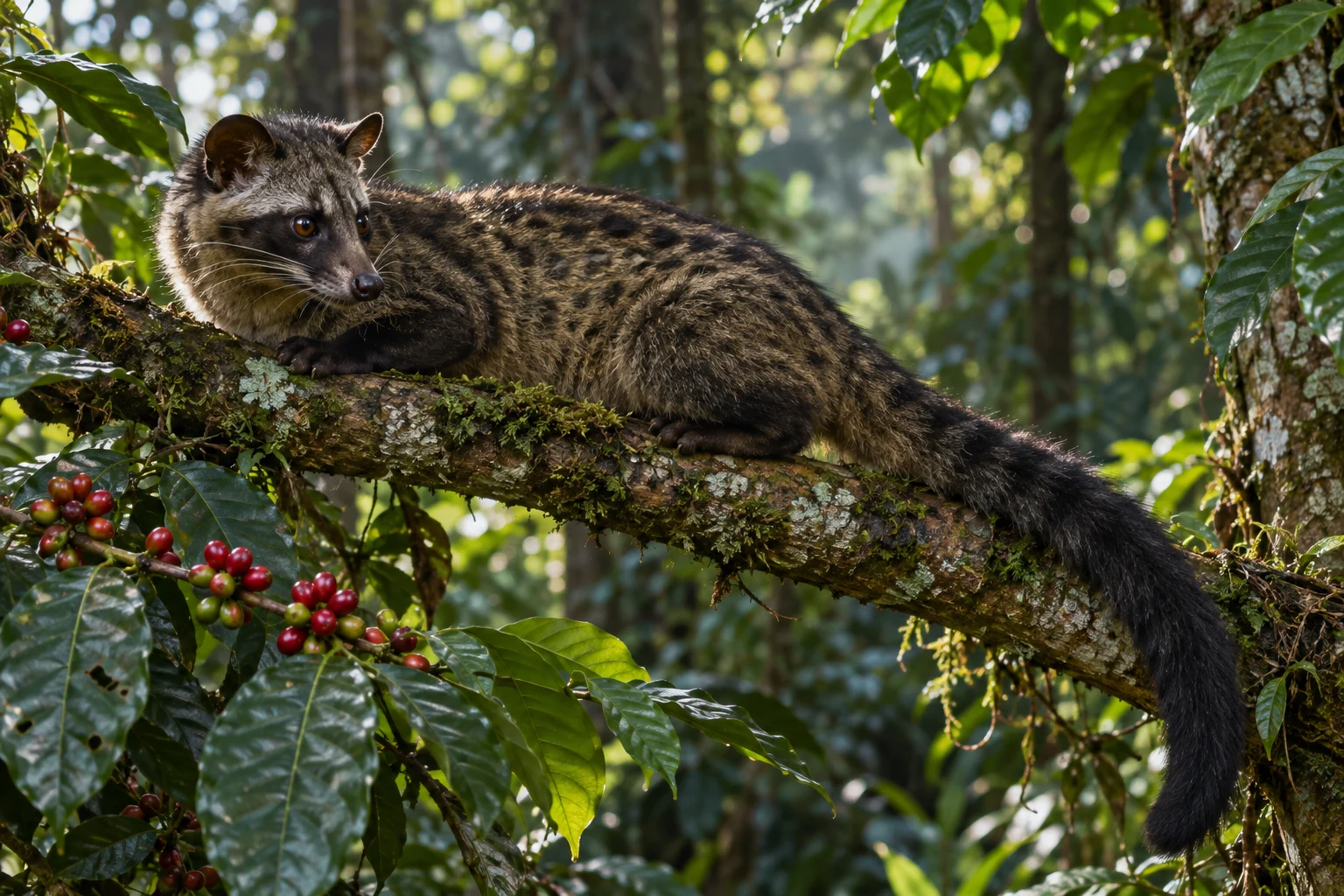
Original AI-assisted artwork by Coffeedant. Illustrative reconstruction; it documents no actual facility, visit or test.
Few coffee stories travel as easily as this one: an animal eats the fruit, people recover the seeds, and the resulting cup becomes a luxury. The story is memorable. Whether the coffee deserves its price is a different question, and whether the animal lived well is another. Research reviewed through 13 October 2026 makes those distinctions essential.
A story that almost tells itself
Kopi luwak is coffee made from seeds recovered after coffee cherries pass through civets. Despite the familiar expression “cat coffee,” the animals are civets, not domestic cats. The name describes a treatment of coffee, not a separate botanical species. That distinction matters: an unusual processing story cannot explain everything about the plant, the harvest or the eventual drink. A scientific review published in December 2024 treats the product as a combination of chemistry, authentication, market behaviour and ethics. Read the scientific review.
The narrative has the economy of a folk tale: a surprising animal, a hidden transformation and an expensive object. Coffeedant’s reading is that this structure helps explain why people remember it. That is an editorial interpretation, not a measured claim about an entire generation’s awareness. It is also an invitation to notice what disappears from a memorable story. A buyer can repeat the origin in one sentence while knowing almost nothing about the producer, the animal’s conditions or the lot in the bag.

An Asian palm civet photographed during a night ride in Mudumalai National Park, India, in January 2014. A wildlife photograph, rather than a coffee-farm record.
Davidvraju / Wikimedia Commons · Source · CC BY-SA 4.0 · Resized and converted to WebP.Two questions that a luxury label cannot answer
Start with two independent questions. First, did these particular beans pass through a civet? Second, how was that civet treated? Evidence answering the first does not automatically answer the second. The 2024 review describes laboratory approaches to authenticity, including spectroscopy, electronic noses, chromatography and statistical analysis of chemical profiles. Such methods concern product identity. They are not certificates of animal welfare, nor does a successful laboratory distinction establish that a coffee will taste better than another.
This separation changes the conversation with a seller. Rather than asking whether the product is “real,” ask what the word means in that transaction. Does the answer identify a farm or collection area? Can a dated lot be followed through collection, processing and sale? Is a laboratory result linked to that lot, or is it an attractive document about another sample? These are questions about the strength and relevance of evidence, not accusations. A story becomes more informative when its supporting records refer to the coffee actually being sold.
Two chains of evidence
Coffee cherry
Traceable origin and lot
Civet processing
Animal-management evidence
Collection & drying
Records of handling
Roasted coffee
Identity ≠ proof of welfare
Authenticating a bean cannot establish animal welfare. Both claims need their own evidence.
The animal cannot be edited out
A peer-reviewed investigation assessed 29 civet-coffee tourism plantations in Bali and eight wildlife markets. Researchers recorded 99 civets at plantations and 136 in markets. Diet, hygiene, water availability and mobility influenced body condition. None of the observed civets met all five freedoms used in the assessment. That is a serious finding about the sampled facilities; it is not a census of every kopi luwak producer. The sample and its limits should travel together whenever the result is quoted. See the welfare study.
For a reader, the implication is practical. A polished visitor experience and an animal visible beside a coffee counter cannot substitute for independently inspectable management information. A welfare discussion needs to be about the living animal, rather than the photographic appeal of its role in production. Coffeedant’s editorial recommendation is to ask whether the seller can explain care, diet, housing, sourcing and independent oversight in concrete terms. If the response stays with rarity and price, the central question has not been answered.
What the 2025–2026 research adds—and does not
A 2025 study presents a more optimistic view of potential sustainability practices among participating legal producers. Its method includes one focus group and 12 interviews. That can illuminate how participants describe their operations and the choices they believe matter. It cannot establish the conditions of an entire industry, and it does not cancel findings from direct welfare observations. Different studies may examine different businesses and different kinds of evidence. Read the 2025 qualitative study.
In 2026, a laboratory study compared fresh and dried Typica civet-coffee samples from seven animals. The researchers found changes in microbial and metabolite profiles during drying. Crucially, they did not conduct sensory evaluation. A chemical difference is therefore not a demonstrated advantage in the cup. This is an instructive example of how scientific novelty can become overstated in marketing: “different” is a description; “better” requires a defined comparison and evidence suited to that claim. Read the 2026 laboratory study.
| Claim on the label | Evidence worth requesting | What it cannot establish alone |
|---|---|---|
| Civet processed | Lot-linked sourcing records and relevant authentication | Humane animal management or superior taste |
| Wild collected | Named collection area, dated chain of custody and independent verification | Every welfare or environmental claim |
| Humane production | Specific care standards and independent observation | Whether this exact bag is chemically authentic |
| Exceptional quality | A transparent sensory comparison with identifiable coffees | Animal welfare or scarcity |
| Rare / premium | Documented availability and a clear price explanation | A reason that everyone should prefer the cup |
Rarity is a reason to look closer
An unusual route to a bean can justify curiosity without settling its sensory value. When reading a premium label, separate the claims into identity, production method, welfare, scarcity and taste. They ask for different evidence. A laboratory authentication result might support identity. A lot record might support provenance. Independent observation might support an account of animal management. A blind comparison could inform a personal judgement of taste. None is interchangeable with the others, and a high price does not do the work of all four.
A useful thought experiment is to hide the production story while comparing coffees. If the story were revealed only afterwards, what would you want to know about your first impression? This is a suggested tasting exercise, not a report of a Coffeedant experiment. Its point is to make room for both sensory pleasure and informed choice. A drink can be fascinating because of its story. The reader still deserves to understand how much of the attraction comes from the cup and how much comes from the narrative around it.

Arabica coffee seeds in civet scat, photographed in a coffee-growing region of Karnataka, India, in December 2005. The image documents the physical origin of the product; it does not certify a commercial lot.
Anand Osuri / Wikimedia Commons · Source · CC BY-SA 4.0 · Resized and converted to WebP.The next chapter needs a chain of evidence
For consumers, the strongest next step is not another superlative. It is a clearer chain from sourcing to the finished lot. Ask for the production location, collection method, dates, animal-management explanation and any independent assessment. Ask what the retailer has actually verified. The answers may be incomplete; incompleteness should remain visible rather than being filled with assumptions. A claim of wild collection is a claim to investigate, not an automatic shortcut to certainty.
This is why kopi luwak belongs in an editorial conversation about modern coffee. It exposes the power of origin stories and the limits of novelty as a quality signal. The responsible question is not whether the tale is entertaining—it plainly has an arresting structure—but whether the information behind it is as compelling as the tale itself. For Coffeedant, a luxury worth understanding should disclose its evidence with the same care it gives its packaging. Curiosity becomes knowledge when the animal and the actual lot stay in the frame.
A few good questions.
Is kopi luwak made by cats?
It involves civets, not domestic cats. “Cat coffee” is a memorable but misleading shorthand.
Does civet processing prove that the coffee tastes better?
No. A processing difference is not a universal sensory ranking. The 2026 drying study discussed here did not include tasting.
Can a chemical test prove humane production?
No. Product authentication and animal welfare require different kinds of evidence.
Follow the sources.
This research-led article draws on the sources below. Editorial interpretation is identified in the text. Dates, geographic scope and research limitations are kept alongside the claims they qualify.
- Welfare and Management of Civets in Civet Coffee Tourism Plantations ↗
Peer-reviewed observation of sampled Bali facilities; results must not be generalized to every producer.
- Advancements in civet coffee production and analytical techniques ↗
December 2024 review of authentication, chemistry and ethical concerns.
- Sustainable operations and the controversy of civet coffee ↗
2025 qualitative study: one focus group and 12 interviews; not a sector census.
- Comparative Microbiota and Metabolite Profiles of Undried and Dried Typica Luwak Coffee Beans ↗
2026 paired laboratory study from seven civets; no sensory evaluation.
Sources checked 13 October 2026. Illustrated covers and original schematics: Coffeedant. Additional images and videos are individually credited above.