
Selection method
Choose by the drink, then the decaf method
We included current US whole-bean products with an exact roaster listing, a named or at least described decaffeination route, a useful brew role, a verified 12 oz price and a full Coffeedant review. We excluded instant coffee, pods, half-caff blends, sold-out lots and products whose exact identity could not be checked. These five are not a blind sensory ranking: each solves a different purchase decision. [1] [2] [3] [4] [5]
Start with the brewer you use most. Intelligentsia Decaf Black Cat gives a specific espresso dose and output. Organic Decaf House gives a filter ratio. Stumptown explicitly discusses both espresso and drip. Counter Culture publishes several brew methods and its changing blend history. Equator gives unusually detailed current component origins and several filter recipes. A nominally versatile bag cannot make one grind setting work for espresso and drip.
We did not reward the most vivid flavor copy. Cocoa, apple, lime, citrus, graham, molasses and nutmeg are words from roasters, not Coffeedant tasting notes. Independent sample reviews and owner posts add bounded perspective where available, but their roast dates and recipes can differ from the bag delivered to you. Read the linked full reviews for each source and uncertainty.
Selection method
Water-process claims do not mean zero caffeine
Swiss Water is named on the Stumptown listing and on Counter Culture Slow Motion unless otherwise noted for the lot. Equator names Mountain Water. Intelligentsia says its two products are water processed, without naming a processing provider on the checked product pages. These are product and process disclosures, not proof that the five cups have equal residual caffeine or equal flavor. [1] [2] [3] [4] [5]
The US FDA says an eight-fluid-ounce cup of brewed decaf typically contains 2–15 mg caffeine. That range is useful context, but cannot be applied as a measurement of a specific coffee, espresso shot or serving. Swiss Water itself says residual caffeine in a brewed cup varies with dose and method. Buyers who need exact exposure should seek product-specific information and professional advice for their own situation. [6] [7]
A label calling water processing “chemical-free” describes the absence of added chemical solvents in that commercial process; water and the beans are still physical substances. We use the named method, not an implied health or sensory superiority. The best-for choices below follow documented brewing use and transparent buying facts.
Five different buying reasons
Quick comparison
| Coffee | Best for | 12 oz base price | Skip if |
|---|---|---|---|
| Intelligentsia Coffee Decaf Black Cat Espresso | Espresso-first | $18.50 for 12 oz | You need a roaster drip recipe |
| Intelligentsia Coffee Organic Decaf House Blend | Bright filter coffee | $18.50 for 12 oz | You need a darker, low-citrus decaf |
| Stumptown Coffee Roasters Trapper Creek Decaf | One bag for drip and espresso | $20 for 12 oz | You require published component origins |
| Counter Culture Coffee Slow Motion Decaf | Medium, cocoa-led multi-method use | $20 for 12 oz | You demand a fixed lot or guaranteed low acidity |
| Equator Coffees Decaf Equator Blend | Current origin and process detail | $19.50 for 12 oz | You chiefly want an exact espresso recipe |
Read the exact full review
Match the decaf to the main drink

Espresso-first
Intelligentsia Coffee Decaf Black Cat Espresso
Roaster notes: cocoa, turbinado sugar and apple; not Coffeedant tasting.
Method evidence: 18 g in to 45 g finished espresso, per Intelligentsia.
Tradeoff: The apple note may not suit a low-fruit espresso preference.
Think twice: You need a roaster drip recipe.
Image: Intelligentsia Coffee. Official bag-identification photograph.
Read the full review →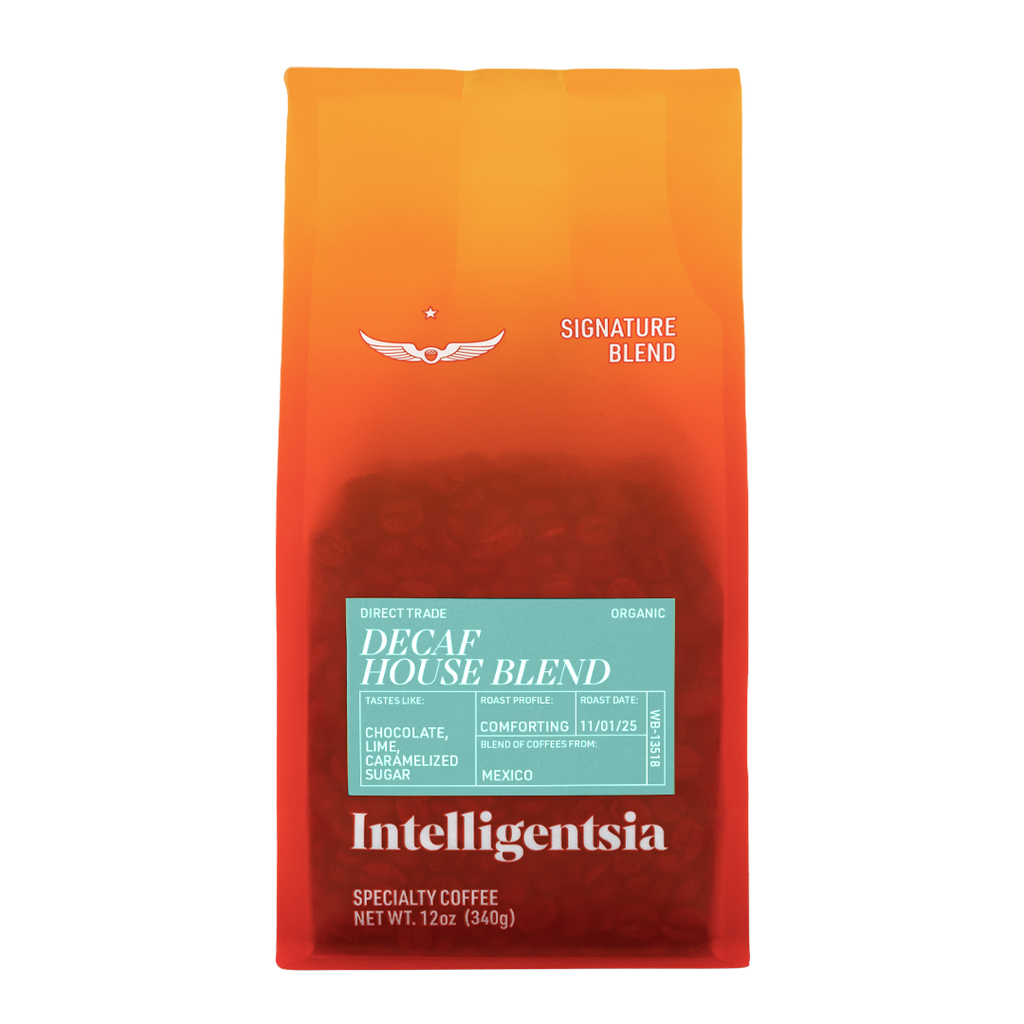
Bright filter coffee
Intelligentsia Coffee Organic Decaf House Blend
Roaster notes: chocolate, lime and caramelized sugar; not Coffeedant tasting.
Method evidence: 1:18 coffee-to-water for pour-over or automatic drip.
Tradeoff: Current washed Honduras record may change with future bags.
Think twice: You need a darker, low-citrus decaf.
Image: Intelligentsia Coffee. Official bag-identification photograph.
Read the full review →
One bag for drip and espresso
Stumptown Coffee Roasters Trapper Creek Decaf
Roaster notes: citrus, graham and cocoa; not Coffeedant tasting.
Method evidence: Stumptown provides separate drip and espresso starts.
Tradeoff: A switchable grinder and two saved settings are needed.
Think twice: You require published component origins.
Image: Stumptown Coffee Roasters. Official bag-identification photograph.
Read the full review →
Medium, cocoa-led multi-method use
Counter Culture Coffee Slow Motion Decaf
Roaster notes: molasses, cocoa and smooth; not Coffeedant tasting.
Method evidence: Counter Culture lists an 18 g, roughly 1:2 espresso start.
Tradeoff: Blend components and independent sample impressions vary.
Think twice: You demand a fixed lot or guaranteed low acidity.
Image: Counter Culture Coffee. Official bag-identification photograph.
Read the full review →
Current origin and process detail
Equator Coffees Decaf Equator Blend
Roaster notes: prune, cherry, cedar and nutmeg; not Coffeedant tasting.
Method evidence: Separate Equator drip, Chemex and French press starts.
Tradeoff: No comparably specific espresso target on checked page.
Think twice: You chiefly want an exact espresso recipe.
Image: Equator Coffees. Official bag-identification photograph.
Read the full review →Process and workflow
Detailed buying comparison
| Factor | Decaf Black Cat Espresso | Organic Decaf House Blend | Trapper Creek Decaf | Slow Motion Decaf | Decaf Equator Blend |
|---|---|---|---|---|---|
| Decaf process | Water processed; provider not named | Water processed | Swiss Water Process | Swiss Water unless lot states otherwise | Mountain Water Process |
| Brew evidence | 18 g in to 45 g finished espresso, per Intelligentsia | 1:18 coffee-to-water for pour-over or automatic drip | Stumptown provides separate drip and espresso starts | Counter Culture lists an 18 g, roughly 1:2 espresso start | Separate Equator drip, Chemex and French press starts |
| Current origin | Complete current blend origins not identified on the checked page | Current listing shows washed Honduras, Lempira | Blend; complete current component origins not published on the checked page | Organic Latin American coffees; exact components rotate by roast date | Current washed Colombia Popayán plus Brazil Cerrado natural/honey components |
| 12 oz price | $18.50 for 12 oz; US direct, Oct 15 | $18.50 for 12 oz; US direct, Oct 15 | $20 for 12 oz; US direct, Oct 15 | $20 for 12 oz; US direct, Oct 15 | $19.50 for 12 oz; US direct, Oct 15 |
| Main limit | The apple note may not suit a low-fruit espresso preference | Current washed Honduras record may change with future bags | A switchable grinder and two saved settings are needed | Blend components and independent sample impressions vary | No comparably specific espresso target on checked page |
Make a repeatable choice
Espresso and filter need separate evidence
Intelligentsia recommends 18 g coffee to 45 g finished espresso for Decaf Black Cat. That 1:2.5 ratio is a useful start if your basket can hold the dose. It is not a promise that a shot takes a particular number of seconds on your grinder. Its Organic Decaf House page instead recommends 1 g coffee to 18 g water for drip or pour-over. For a 20 g filter dose, that arithmetic gives 360 g water. Do not copy the filter ratio into a portafilter. [3] [4]
Stumptown gives a separate 1:17 drip starting ratio and an espresso preparation near 19.5 g. Counter Culture gives an 18 g espresso start around 1:2. Equator gives drip near 1:15, Chemex 1:16 and French press near 1:15. These are roaster recipe starting points, not Coffeedant extractions. Use your actual basket, water and grinder; save dose, yield and setting so each later bag can be assessed. [1] [2] [5]
If a household alternates regular and decaf, a hopper can retain beans and the grinding path can retain grounds. If it also alternates espresso and drip, you need repeatable adjustment. Those workflow costs may matter more than a small difference in 12 oz bag price. Our grinder reviews can help choose a setup, but no grinder automatically makes an unsuitable flavor direction fit.
Make a repeatable choice
Test 12 oz before committing to five pounds
All five had a 12 oz whole-bean option in the official product feeds on October 15, 2026. Counter Culture also listed 24 oz; Equator listed 2 lb; several listed 5 lb. A larger bag lowers the arithmetic price per gram in some feeds but adds a freshness obligation. A product photo and online stock flag do not tell you the roast date of the bag that arrives. Check the bag or ask the seller. [1] [2] [3] [4] [5]
Store an opened working bag sealed in a cool, dry place, away from moisture and odors. Stumptown cautions against repeatedly moving opened beans into and out of the freezer. If you use only an evening decaf several times a week, calculate grams per week before choosing a bulk bag. The real value of a large pack falls quickly when half goes stale or the flavor brief proves wrong for your brewer. [8] [9]
For a first trial, brew several cups with one 12 oz bag and a written recipe. Note the roast date, process disclosure, selected size, grinder setting and what you personally liked. This is a suggested reader exercise, not a claim that Coffeedant sampled the products.
Make a repeatable choice
Compare the same pack and currency
The verified US direct 12 oz base prices on October 15 were $18.50 for each Intelligentsia bag, $19.50 for Equator, and $20 for Counter Culture and Stumptown. Shipping, tax, subscriptions, promotions and checkout availability were not included. A 12 oz bag contains about 340 g; at an illustrative 18 g dose that is about nineteen theoretical doses before dial-in waste. Price differences of $1–$1.50 per bag are less useful than buying a flavor direction and brew role you will finish. [1] [2] [3] [4] [5]
A 5 lb option can be rational for a café or a high-use household, but only after the 12 oz trial establishes the recipe and consumption rate. Do not compare one roaster’s 12 oz price to another’s 5 lb unit price without accounting for use, storage and shipping. Direct and grocery stock may have different dates; verify the seller and actual bag.
The external DecafLife reviews cover older samples of Slow Motion and Decaf House. They inform expectations but do not justify moving a current product above another in a ranked tasting list. Equator’s external specification-led overview expressly did not taste that coffee. The ordering here is by use case, not a numeric sensory score. [10] [11] [12]
Make a repeatable choice
When these five are the wrong shortlist
If your goal is a dark roast regardless of caffeine, the existing dark-roast guide addresses that separate choice. If you want a fixed origin and variety, a current single-origin decaf with a fully documented lot could be better than these recurring blends; verify current stock and process before buying. If you need a half-caff routine, none of these five is a half-caff product. [13]
If a very low-citrus profile is essential, examine the roaster notes before choosing Trapper Creek, Organic Decaf House or Decaf Black Cat. Their citrus, lime or apple directions are not guarantees of acidity but are reasonable selection signals. For a bigger milk drink, Stumptown explicitly says Trapper Creek carries in milk; Equator says its blend is designed for black coffee or a splash of milk. Those claims do not prove how a particular latte will taste. [2] [3] [4] [5]
Keep the first decision small. Buy the exact 12 oz product that has evidence for your main brew, record a recipe, then compare your own result against an alternative only after you know what you wanted to change.
Evidence and limits
How this shortlist was built
This is a research-led US selection based on current official product identity, brew role, process disclosure, 12 oz availability and dated base price. Independent sample reports and owner accounts are attributed and treated as limited to those bags and brewers. Coffeedant did not taste, brew, measure caffeine, or rank these products by sensory quality. No affiliate link is required to read the full reviews.
Prices were checked October 15, 2026 in official roaster product feeds. Tax, shipping, subscriptions, discounts, future lots and checkout stock are outside this comparison. Check the current bag and seller before purchase.
Quick answers
Decaf coffee FAQ
Is decaf coffee completely caffeine-free?
No. The FDA gives a typical 2–15 mg per eight-fluid-ounce brewed cup; this guide does not measure any specific product or serving.
Which pick has the clearest espresso recipe?
Intelligentsia Decaf Black Cat publishes an 18 g in to 45 g out starting point. Check your basket and dial in the actual bag.
Which pick is most clearly aimed at filter?
Intelligentsia Organic Decaf House names drip and pour-over and gives a 1:18 starting ratio.
Can one decaf bag work for espresso and drip?
Stumptown explicitly positions Trapper Creek for both, and Counter Culture offers method-specific guidance. Save two grind settings and recipes.
Are these Coffeedant tasting winners?
No. These are research-led best-for picks based on exact identity, roaster use, dated price and evidence limits. Coffeedant has not tasted them.
Why start with 12 oz?
A small bag tests freshness, flavor preference and grinder workflow before bulk size increases the risk of waste.
Does the listed price include delivery?
No. US direct base prices were checked October 15, 2026; shipping, tax, subscriptions and checkout stock can change.
Trace the claims
Sources
- Counter Culture Slow Motion ↗
Blend, process, method and official variant feed checked October 15. Checked October 15, 2026.
- Stumptown Trapper Creek ↗
Swiss Water, multi-method claims, recipes and official variant feed checked October 15. Checked October 15, 2026.
- Intelligentsia Decaf Black Cat ↗
Water process, roaster notes, espresso target and official variant feed checked October 15. Checked October 15, 2026.
- Intelligentsia Organic Decaf House ↗
Current washed Honduras panel, roaster notes, filter recipe and official variant feed checked October 15. Checked October 15, 2026.
- Equator Decaf Equator Blend ↗
Current components, Mountain Water, brewing and official variant feed checked October 15. Checked October 15, 2026.
- US FDA: caffeine in decaf ↗
Typical brewed-decaf range, not an assay of the five products. Checked October 15, 2026.
- Swiss Water residual-caffeine context ↗
Process-provider context and variation by dose and brew. Checked October 15, 2026.
- Stumptown freshness advice ↗
Roaster freshness context. Checked October 15, 2026.
- Stumptown storage advice ↗
General moisture and freezer cautions. Checked October 15, 2026.
- DecafLife Slow Motion sample ↗
Older independent sample, not a current-lot result. Checked October 15, 2026.
- DecafLife Decaf House sample ↗
Older independent sample, not a current-lot result. Checked October 15, 2026.
- Coffee Guru Equator overview ↗
Specification-led external overview that discloses no hands-on test. Checked October 15, 2026.
- Coffeedant dark-roast guide ↗
Separate caffeine-neutral dark-roast decision. Checked October 15, 2026.
The first useful bag
Pick for the brew you make most
Buy one 12 oz whole-bean bag whose roaster documentation matches your main method. Save a recipe and check the delivered roast date. Only then decide whether another decaf, a different grinder routine or a larger pack would improve the next purchase.
Explore all bean reviews →