
02Start with the decision
Espresso Series 1 in one honest frame
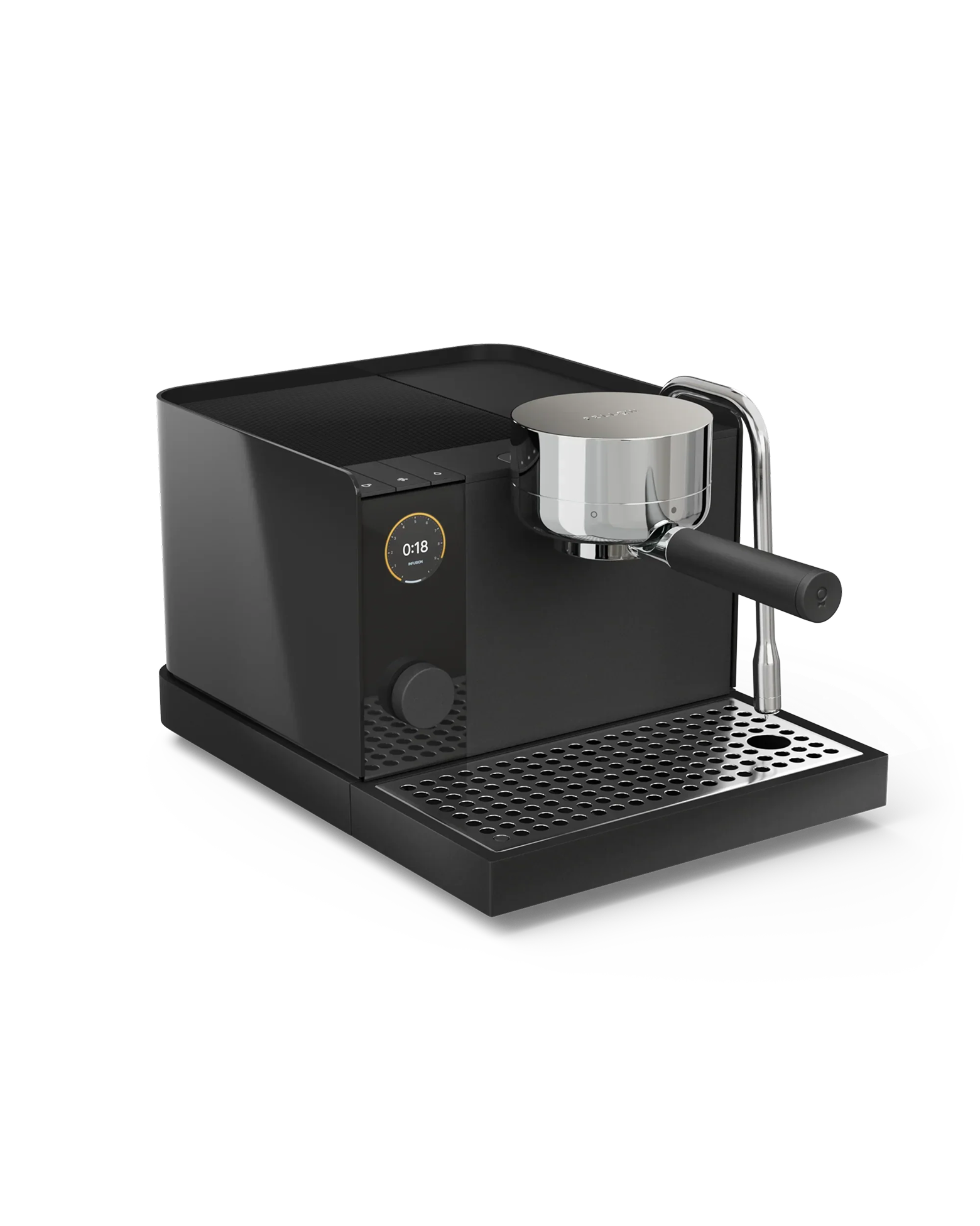
This assessment is for the black US Series 1 listing and its checked accessory package. Do not transfer price, voltage, finish-specific stock or future firmware behavior from another region or revision. The 15 bar pump number does not mean a 15 bar extraction recipe, and the published temperature range is a setting range rather than a measured puck-temperature result. This is a research-led buying assessment of the exact US black machine and current package. [source] [source]
Strength: A newcomer can start with guided recipes, then keep the same machine while learning pressure, temperature and milk choices. Limit: At this price a grinder is still necessary, and an app-assisted product introduces software and support questions alongside ordinary water and coffee maintenance. Dimension scores below express supported editorial judgments, not Coffeedant bench or sensory measurements.
03The first week
Set up the whole station, not only the machine
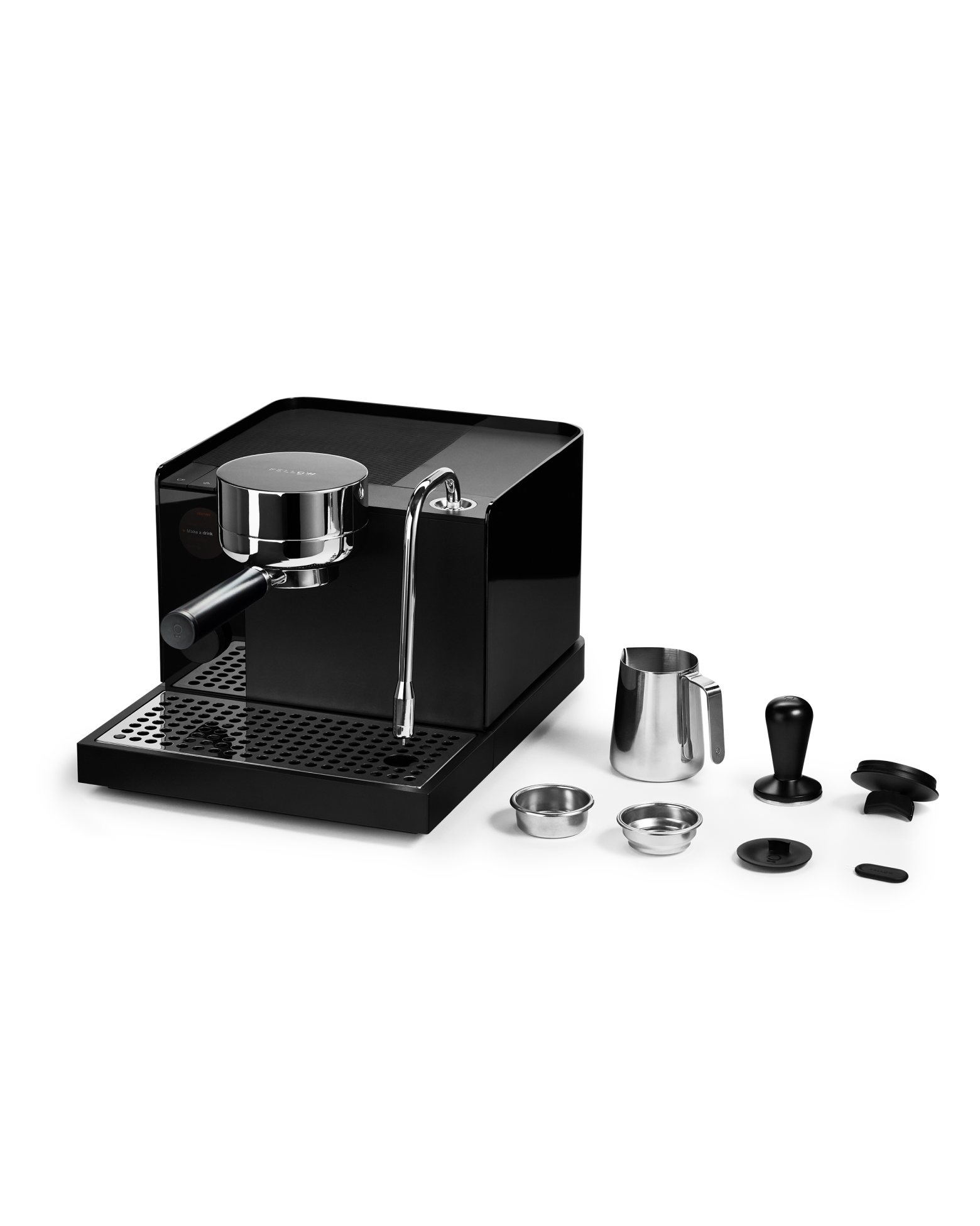
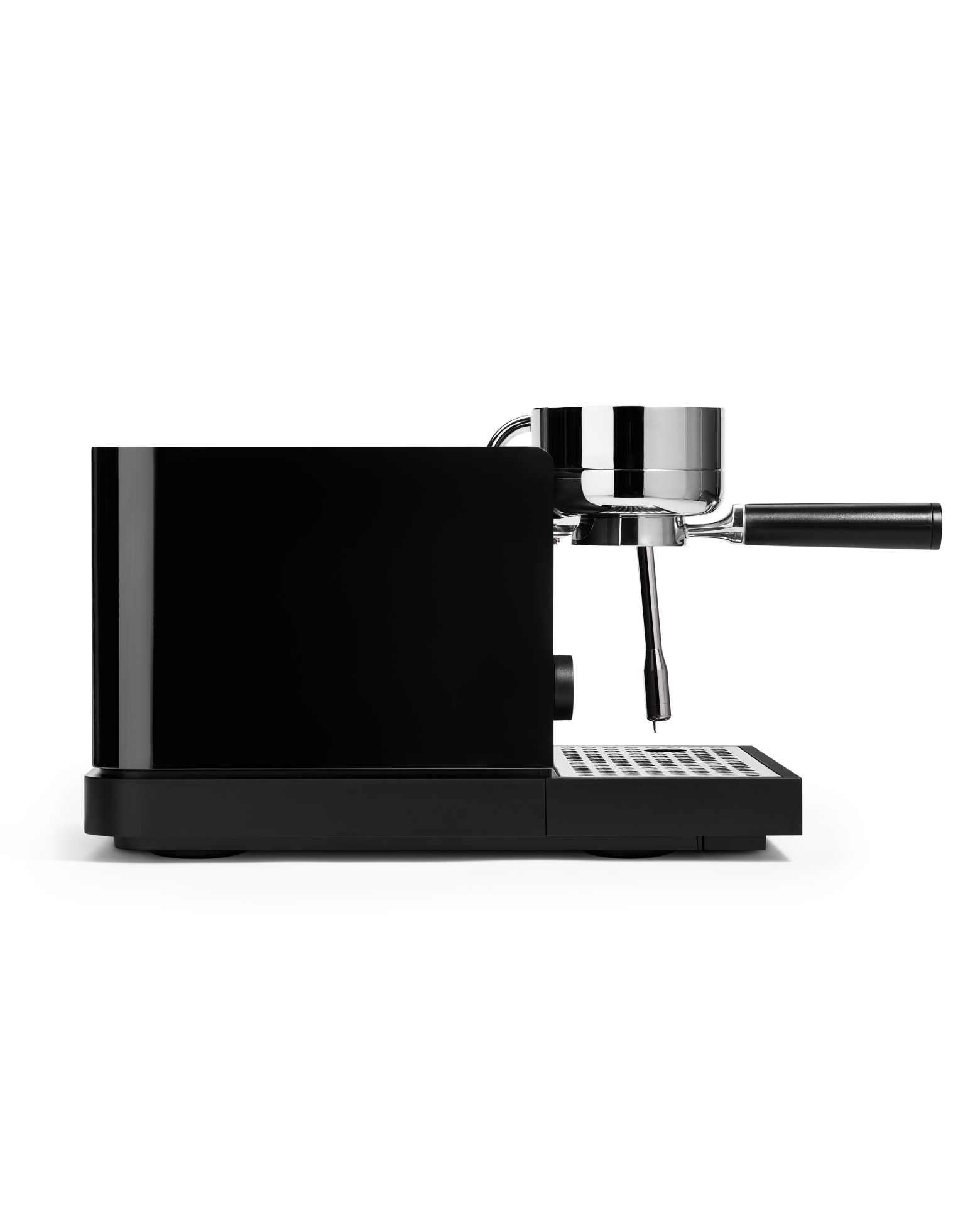
Begin with the exact US electrical rating and a stable counter. Fellow lists a body 12.4 inches wide, 17.24 inches deep and 10.98 inches high; the 21.5-inch working depth with portafilter and roughly 24-inch vertical tank access matter more than the closed-machine height alone. Inventory the 58 mm bottomless portafilter, 18 g single-wall and double-wall baskets, splitter, tamper, backflush disk, 10 oz pitcher, hardness strip and cleaning items. Choose the basket that suits the grinder and coffee. Test water hardness using Fellow’s procedure and avoid using distilled or reverse-osmosis water as if it were automatically appropriate. Install current firmware per the product guidance, then try one guided recipe before changing several variables. The official sub-two-minute heat-up is a manufacturer claim; practical warm-up and cup temperature can vary with use. [source] [source] [source]
04Rating deep dive
Espresso: control the variables the machine leaves to you
The standard 58 mm format and included single-wall basket make the Series 1 a serious espresso platform when paired with a capable grinder. The double-wall basket offers a more forgiving route for less precise grounds, but it should not be confused with the single-wall path that reveals grind adjustment. Fellow states a 50–94°C setting range and a 15 bar pump calibrated for up to 9 bar at extraction; those specifications describe available control, not a measured cup result. In his August video, James Hoffmann measured around 10 bar at the puck on a nominal nine-bar profile and found the ramp-down control less gradual than its name suggests on his sample; he also found lower-pressure profiles useful. That independent result is a real control caveat, not a Coffeedant measurement or a universal calibration claim. Begin with dose, yield and grind, then adjust temperature or pressure only when the result consistently needs it. WIRED, Tom’s Guide and Good Housekeeping describe their own shots and experiences on samples; their tasting cannot become Coffeedant tasting. A profile menu does not replace fresh coffee, grinder quality or puck preparation. [source] [source] [source] [source]
A useful first-week test is consistency across several cups with the same bean and dose. Record input, output and setting, then alter grind before chasing elaborate pressure shapes. If a recipe stalls or runs quickly, inspect the coffee and basket before blaming the pump specification.
Espresso assessment
Espresso evidence translated into daily use
The Espresso Series 1 score is an editorial judgment from documented design, independent demonstrations, owner context, and the dated market position. It is not a bench result from Coffeedant.
| Signal | What the evidence says | Buying consequence |
|---|---|---|
| Brew architecture | 58 mm single-wall basket. | Guided recipes and configurable profiles create real learning room. |
| Control available | Adjustable temperature and pressure. | A separate grinder and imperfect pressure tracking on one independent sample limit the control promise. |
| Recipe consequence | Hoffmann measured overshoot on his sample. | Treat this as part of the Espresso Series 1 buying decision, not a promise of identical results in every kitchen. |
Evidence note: Unknowns stay unknown. Variations in coffee, water, milk, setup, firmware, regional package, wear, and technique can change the experience described by these sources.
05Rating deep dive
Milk: speed only matters when texture stays controllable
Assisted milk texturing reduces the wand-position learning curve, and the supplied 10 oz pitcher helps start with the intended vessel. It still requires correctly filled, cold milk, jug placement, an appropriate setting, purging and wiping the wand after each drink. Independent evaluations report useful foam on their samples, while their milk choices and operator habits differ. A straight-espresso buyer should not pay for automation it will rarely use. A milk-drink household should compare the time to repeat two drinks, milk waste and cleaning with a dual-boiler machine or a conventional manual wand. Follow Fellow’s exact cleaning prompts rather than allowing dried milk to accumulate. An assisted cycle is a convenience feature, not proof of a particular texture across dairy and plant milks. [source] [source]
Milk assessment
Milk evidence translated into daily use
The Espresso Series 1 score is an editorial judgment from documented design, independent demonstrations, owner context, and the dated market position. It is not a bench result from Coffeedant.
| Signal | What the evidence says | Buying consequence |
|---|---|---|
| Steam or milk system | Assisted milk program. | Assisted texturing reduces the initial wand-learning burden. |
| Operator input | 10 oz pitcher included. | Milk choice, jug handling and immediate cleaning remain necessary. |
| Queue consequence | No universal texture guarantee. | Treat this as part of the Espresso Series 1 buying decision, not a promise of identical results in every kitchen. |
Evidence note: Unknowns stay unknown. Variations in coffee, water, milk, setup, firmware, regional package, wear, and technique can change the experience described by these sources.
06Rating deep dive
Workflow: count every touch from cold start to a clean counter
The practical sequence is fill and check water, grind on a separate machine, distribute and tamp, lock in the portafilter, choose guided or custom recipe, watch the shot, empty the puck, rinse, then texture and clean milk if used. Guided recipes help with choice but do not move grounds or wash tools. WIRED noted app and hot-water frustrations on a three-week sample, and Tom’s Guide described a strong core routine with its own limitations. Those reviews are dated snapshots: firmware may change, so verify the current interface during a return window. Confirm whether the tank can be removed under cabinets and whether the portafilter projects into a walkway. A small kitchen may find the separate grinder plus 17.24-inch machine depth more consequential than the tidy front-facing design. [source] [source]
Test the actual morning sequence with the grinder in place, especially the clearance needed to refill water and handle the portafilter. Keep the software at the documented version and note whether the household depends on an app feature rather than simply admiring its possibility.
Workflow assessment
Workflow evidence translated into daily use
The Espresso Series 1 score is an editorial judgment from documented design, independent demonstrations, owner context, and the dated market position. It is not a bench result from Coffeedant.
| Signal | What the evidence says | Buying consequence |
|---|---|---|
| Cold-start routine | Guided recipes. | The guided-to-custom interface serves both first routines and experiments. |
| Drink sequence | 17.24 in body depth. | Separate grinding, long tank-clearance need and software quirks add friction. |
| Cleanup load | App and hot-water caveats. | Treat this as part of the Espresso Series 1 buying decision, not a promise of identical results in every kitchen. |
Evidence note: Unknowns stay unknown. Variations in coffee, water, milk, setup, firmware, regional package, wear, and technique can change the experience described by these sources.
07Rating deep dive
Build and service: judge access, support, and failure response
Fellow identifies a stainless boiler and baskets, an ABS painted outer wrap, a BPA-free tank and other specified water-path materials. The 21.7 lb stated weight and clear dimensions help with placement, but they do not establish internal serviceability or a durability rate. The current US standard warranty is two years subject to exclusions and purchase conditions; retain proof of purchase and check the exact seller. Inspect the reservoir seal, steam behavior, portafilter fit, pressure response, display and software connection promptly. A self-selected owner thread reports boiler-fill, steam and software trouble; it merits a practical inspection, not a population failure claim. WIRED encountered quirks in its sample too. These observations should make return and support terms part of the purchase decision. [source] [source] [source]
Coffee oils, milk residue and mineral scale require different care. Backflush and clean the portafilter on the prompts and instructions for the exact Series 1; wipe and purge the wand after milk use. Fellow says the machine tracks use and water conditions and gives maintenance prompts, with descaling roughly every three months in its general guidance rather than a universal deadline. Test water hardness and follow current water instructions. Avoid assuming distilled or reverse-osmosis water is safe for the system without Fellow’s specified mineral guidance. Keep cleaning supplies in the cost estimate and do not open powered components to resolve a software or boiler-fill warning. [source] [source]
Build assessment
Build evidence translated into daily use
The Espresso Series 1 score is an editorial judgment from documented design, independent demonstrations, owner context, and the dated market position. It is not a bench result from Coffeedant.
| Signal | What the evidence says | Buying consequence |
|---|---|---|
| Core construction | Stainless boiler. | Published materials, dimensions and warranty make initial inspection concrete. |
| Access and care | Two-year standard US warranty. | Owner and reviewer issues leave durability and future service uncertain. |
| Support boundary | No population reliability data. | Treat this as part of the Espresso Series 1 buying decision, not a promise of identical results in every kitchen. |
Evidence note: Unknowns stay unknown. Variations in coffee, water, milk, setup, firmware, regional package, wear, and technique can change the experience described by these sources.
08Rating deep dive
Features: separate daily help from brochure decoration
The useful distinction is guided versus custom operation, not the number of menu entries. Profile editing and adjustable temperature let an experienced user run repeatable experiments, while recipes give a first-time owner a baseline. Hoffmann’s sample did not trace a smooth long pressure decline when programmed to ramp down; he judged a simpler lower-pressure sequence useful. That difference between a profile graph and the delivered curve matters most to buyers paying specifically for precise profiling. Fellow’s boosted-boiler and fast warm-up claims should be treated as product specifications until a buyer checks the behavior in their own routine. The 58 mm portafilter and interchangeable basket approach leave room for different beans; the machine does not grind them. An app or software feature may evolve, and a review written today cannot promise future compatibility. Use a cup scale if tracking actual beverage yield matters; the setting screens alone cannot tell the drink’s measured mass or taste. [source] [source] [source]
Features assessment
Features evidence translated into daily use
The Espresso Series 1 score is an editorial judgment from documented design, independent demonstrations, owner context, and the dated market position. It is not a bench result from Coffeedant.
| Signal | What the evidence says | Buying consequence |
|---|---|---|
| Useful control | 50–94°C setting range. | Temperature and pressure profiles are useful once a basic recipe is stable. |
| Missing control | Hoffmann pressure and ramp-down observation. | One independent sample did not execute a smooth programmed ramp down. |
| Buyer relevance | Software-assisted guidance. | Treat this as part of the Espresso Series 1 buying decision, not a promise of identical results in every kitchen. |
Evidence note: Unknowns stay unknown. Variations in coffee, water, milk, setup, firmware, regional package, wear, and technique can change the experience described by these sources.
09Rating deep dive
Value: compare complete ownership on the same date
Fellow listed the black US Series 1 at $1,499.95 on October 14, 2026, before tax, shipping, beans, grinder, scale and water-care supplies. Compare complete setup prices rather than putting this bare machine against an integrated-grinder model’s sticker. Its appeal is long-term learning room: guided recipes can be used immediately and profiles remain available later. The two-year standard US warranty has conditions and is not a durability forecast. A buyer who wants low-cost milk drinks may get better value from a Bambino Plus and a sensible separate grinder. A buyer who prioritizes conventional dual-boiler steam and less software may consider a Rancilio Silvia Pro X. Neither alternative is directly interchangeable; compare real delivered prices and maintenance obligations. [source] [source]
Value assessment
Value evidence translated into daily use
The Espresso Series 1 score is an editorial judgment from documented design, independent demonstrations, owner context, and the dated market position. It is not a bench result from Coffeedant.
| Signal | What the evidence says | Buying consequence |
|---|---|---|
| Checked price | $1,499.95 machine listing. | The $1,499.95 direct machine price buys guidance and control in one platform. |
| Total station | Separate grinder required. | A grinder, scale, consumables and the full setup push the real cost higher. |
| Long-term fit | Two-year standard warranty. | Treat this as part of the Espresso Series 1 buying decision, not a promise of identical results in every kitchen. |
Evidence note: Unknowns stay unknown. Variations in coffee, water, milk, setup, firmware, regional package, wear, and technique can change the experience described by these sources.
10Put the alternatives beside it
Espresso Series 1 versus the closest practical choices
A useful comparison keeps architecture and buyer intent visible. A cheaper product may demand more technique, a faster product may expose fewer controls, and a traditional product may ask for more warmup and care. The rows below summarize the decision rather than pretending every specification carries equal weight.
| Machine | Price position | The quick decision |
|---|---|---|
| Fellow Espresso Series 1 | $1,499.95 US machine only | Choose for guidance now and adjustable profiles later. |
| Breville Bambino Plus | Lower-priced machine plus grinder | Choose a smaller and cheaper machine with a separate grinder. |
| Rancilio Silvia Pro X | Prosumer machine plus grinder | Choose conventional dual-boiler control and manual steam. |
| Breville Barista Touch Impress BES881 | Integrated system | Choose an integrated grinder and assisted puck preparation. |
DetailsOpen the technical and workflow comparison
| Machine | Dimensions | Heating | Coffee setup | Milk workflow | Best fit |
|---|---|---|---|---|---|
| Fellow Espresso Series 1 | 12.4 in W × 17.24 in D × 10.98 in H | Boosted boiler; manufacturer fast warm-up claim | Separate grinder, 58 mm baskets, guided/custom recipes | Assisted texturing | Learning into control |
| Breville Bambino Plus | Compact body | Fast ThermoJet | Separate grinder, simpler controls | Automatic or manual steam | Compact value |
| Rancilio Silvia Pro X | Traditional countertop body | Dual boiler | Separate grinder and manual puck work | Manual steam | Hands-on milk drinks |
| Breville Barista Touch Impress BES881 | Larger all-in-one footprint | ThermoJet | Integrated grinder and tamp assistance | Automatic milk options | Guided all-in-one |
Compare complete delivered setups. Series 1 and the Bambino or Silvia routes each need an espresso grinder; the Touch Impress integrates one. Price and region change, so the listed Fellow check is a dated anchor, not a promise. Cabinet clearance and preferred level of software involvement are as material as the feature list.
11Owner evidence in proportion
What owner discussions add, and what they cannot prove
A recent self-selected owner discussion includes reports of software, steam and boiler-fill trouble. The sample is small and drawn from people motivated to post; it cannot tell us how many Series 1 units develop those issues. In his August video, Hoffmann did not identify a common fleet issue from what he had seen, while cautioning that he did not know the installed population. Independent reviewers found positive espresso and milk results while documenting practical quirks. That combination supports a focused first-month checklist: repeat guided shots, change profiles, texturize several normal milk drinks, remove and refill the tank, test any app function the household expects, and document any repeatable warning. [source] [source] [source]
Do not describe forum reports as a failure rate, and do not assume an early independent review predicts years of service. Firmware version, water hardness, region and user technique can matter. Keep the seller receipt and contact Fellow with exact symptoms if a fault repeats. A return window is the best time to establish whether the machine’s documented workflow, cabinet fit and support meet the household’s needs.
12Choose by routine
Four routes from this decision
There is no universal upgrade path. Choose the card that fixes the most important daily mismatch, then read the full review before treating it as a recommendation for your counter, coffee, region, and budget.
Compact value
Breville Bambino Plus
Start with a smaller separate-grinder setup when pressure profiles are unnecessary.
Read Bambino Plus reviewConventional dual boiler
Rancilio Silvia Pro X
Take direct manual control of espresso and milk with a more traditional platform.
Read Silvia Pro X reviewGuided integrated setup
Breville Barista Touch Impress BES881
Include grinding and tamp assistance in one machine if component integration suits the household.
Read Touch Impress reviewChoose the coffee
Coffee bean reviews
Match fresh whole beans to a grinder and the drinks this setup will make.
Browse bean reviews13Questions before buying
Espresso Series 1 FAQ
Does Fellow Series 1 have a grinder?
No. The checked US package includes brewing accessories but requires a separate grinder for whole beans.
Are the baskets standard 58 mm?
Fellow lists a 58 mm bottomless portafilter and 18 g single-wall and double-wall baskets. Verify any third-party basket or accessory fit before purchase.
How much cabinet space is needed?
Fellow lists a 10.98 in closed height but recommends around 24 in of vertical clearance to remove the water tank.
Does its 15 bar pump pull 15 bar shots?
No. Fellow says the pump is calibrated for up to 9 bar at extraction; a pressure profile can use different targets.
Is the heat-up under two minutes?
Fellow states a sub-two-minute warm-up. Independent sample timing and cup-readiness can differ; we have not timed the unit.
Does the app have issues?
WIRED documented an underdeveloped app during its three-week test. Firmware may change, so check the functions you need on current software during the return period.
What does the US black machine cost?
Fellow listed it for $1,499.95 on October 14, 2026, before tax and a separate grinder. No dated offer expiry was shown.
How long is the warranty?
Fellow publishes a standard two-year US warranty subject to its terms. Confirm authorized seller and purchase proof.
See the machine in use
An independent video perspective
James Hoffmann
The Fellow ES1 Espresso Machine Review
Independent exact-model evaluation. His sample showed pressure overshoot and abrupt ramp down, while simpler lower-pressure profiles remained useful; not Coffeedant testing or a population reliability study.
Watch on YouTubeWhy I trust the verdict
What the evidence lets me say with confidence
I began with the exact model identity and official documentation, then separated factory claims from independent observation and self-selected owner reports. Conflicting regional or revision details were not averaged. Price was checked on October 14, 2026; stock, finishes, tax and warranty can change. Video supplies visual context, not Coffeedant testing. Community material informs questions, never failure rates. Missing measurements and long-term incidence data remain unknown.
Check the evidence
Sources and further reading
- Fellow US Espresso Series 1 product page
Exact US black model, guided/custom functions, manufacturer media and $1,499.95 direct price checked October 14, 2026; no dated offer expiry.
- Fellow included-parts support
58 mm bottomless portafilter, two 18 g baskets, splitter, tamper, backflush disk, pitcher and cleaning accessories.
- Fellow size and clearance support
12.4 × 17.24 × 10.98 in body, 21.7 lb, 21.5 in with portafilter and about 24 in tank-removal clearance.
- Fellow temperature and pressure support
Published 50–94°C setting range and 15 bar pump calibrated for up to 9 bar extraction, not independent brew measurements.
- Fellow maintenance guidance
Use-based maintenance prompts, backflushing and approximate descaling advice; follow actual water and machine prompts.
- Fellow water-hardness guidance
Hardness testing and caution on distilled or reverse-osmosis water.
- Fellow material disclosure
Manufacturer account of stainless, ABS, tank and water-path materials; not an independent durability test.
- Fellow US warranty terms
Standard two-year product service warranty and conditions; verify seller and region.
- WIRED Series 1 hands-on review
Independent three-week sample assessment; praises profiles and warm-up, notes app, hot-water, volumetric and tank-clearance frustrations at its test date.
- Tom’s Guide Series 1 review
Independent June 2026 sample use; flavor and milk observations belong to reviewer, while official Fellow dimensions govern this review.
- Good Housekeeping Series 1 hands-on
Independent use of guided and custom routine; observed heat-up is sample-specific.
- Selected Series 1 owner discussion
Self-selected software, steam and boiler-fill concerns; no inference about population failure rate.
- James Hoffmann Series 1 video
Independent August 13, 2026 exact-model evaluation; nominal nine-bar profile measured around ten bar at puck and ramp down was abrupt on his sample. He found lower-pressure profiles useful. These are his measurements, not Coffeedant testing.
The buying decision
Choose Series 1 for a guided path into deeper espresso control
The Series 1 makes most sense for a buyer who wants a guided start without ending at a fixed, beginner-only workflow. Its 58 mm hardware, adjustable profiles and assisted milk offer a genuine path to learn.
The machine needs a separate grinder, space to remove the tank and ordinary coffee, milk and water care. Independent software concerns and selected owner faults deserve inspection during a real return window, without exaggerating their frequency.
At the October 14 US $1,499.95 machine-only listing, compare the full grinder-inclusive cost with a compact Bambino Plus, a conventional Silvia Pro X and an integrated Touch Impress. Buy the Fellow when the guided-to-custom progression is the feature the household will actually use.
Search Amazon