
02The buying decision
The Plus automates milk, not espresso preparation
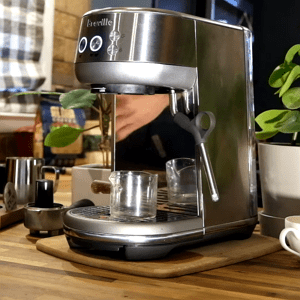
The Bambino Plus makes sense when you want to grind, dose, tamp, and judge espresso yourself but would gladly delegate milk texture. It offers three automatic milk temperatures, three texture levels, and manual steaming. That is meaningful assistance, but it is not bean-to-cup automation.
This page covers the US Breville Bambino Plus BES500. The standard Bambino is BES450. UK Sage evidence can explain the family’s workflow, but its price, voltage, accessories, and support terms do not define a US purchase.
| Feature | Buyer consequence |
|---|---|
| ThermoJet heater | Breville claims readiness in three seconds; preparing coffee and warming the working parts still take time. |
| 54 mm portafilter | You handle a removable basket and need a separate grinder for fresh-bean espresso. |
| Automatic or manual milk | Beginners can start with repeatable presets while retaining a manual path. |
| Sequential heating | Espresso and milk happen one after the other, not at the same time. |
Breville documents low-pressure pre-infusion followed by nine-bar extraction from a 15-bar-rated pump. Those are design claims, not Coffeedant measurements. [1]
Features assessment
Useful control or missing control?
A feature earns its place when it changes a repeated decision. The Bambino Plus concentrates on startup, shot volume, and milk automation rather than exposing every brew variable.
| Feature | What it helps with | Limit | Who should care |
|---|---|---|---|
| ThermoJet | Removes most heater waiting | Does not grind coffee or warm every working part | Anyone making a drink on a short morning. |
| Shot programming and manual pre-infusion | Supports a repeatable yield and more direct control | A saved button cannot adapt to a different coffee | Buyers willing to use a scale while dialing in. |
| Single- and dual-wall baskets | Supports fresh-ground coffee and a preground fallback | The dual-wall basket cannot restore freshness or grind choice | Beginners moving toward an espresso grinder. |
| Automatic plus manual milk | Lets a household choose convenience or technique | No simultaneous brewing and steaming | Homes with different milk-skill levels. |
| Fixed brew temperature; no gauge | Keeps the interface simple | Removes two forms of feedback and adjustment | Lighter-roast and experiment-focused buyers. |
03Before the first coffee
Budget and place the complete station
The machine is compact, but the station also needs a grinder, scale, milk jug, cup space, and somewhere for a wet portafilter. The 1.9 L tank lifts from the rear, while the compact tray pulls forward. Confirm real access before fitting the machine under a low cabinet.
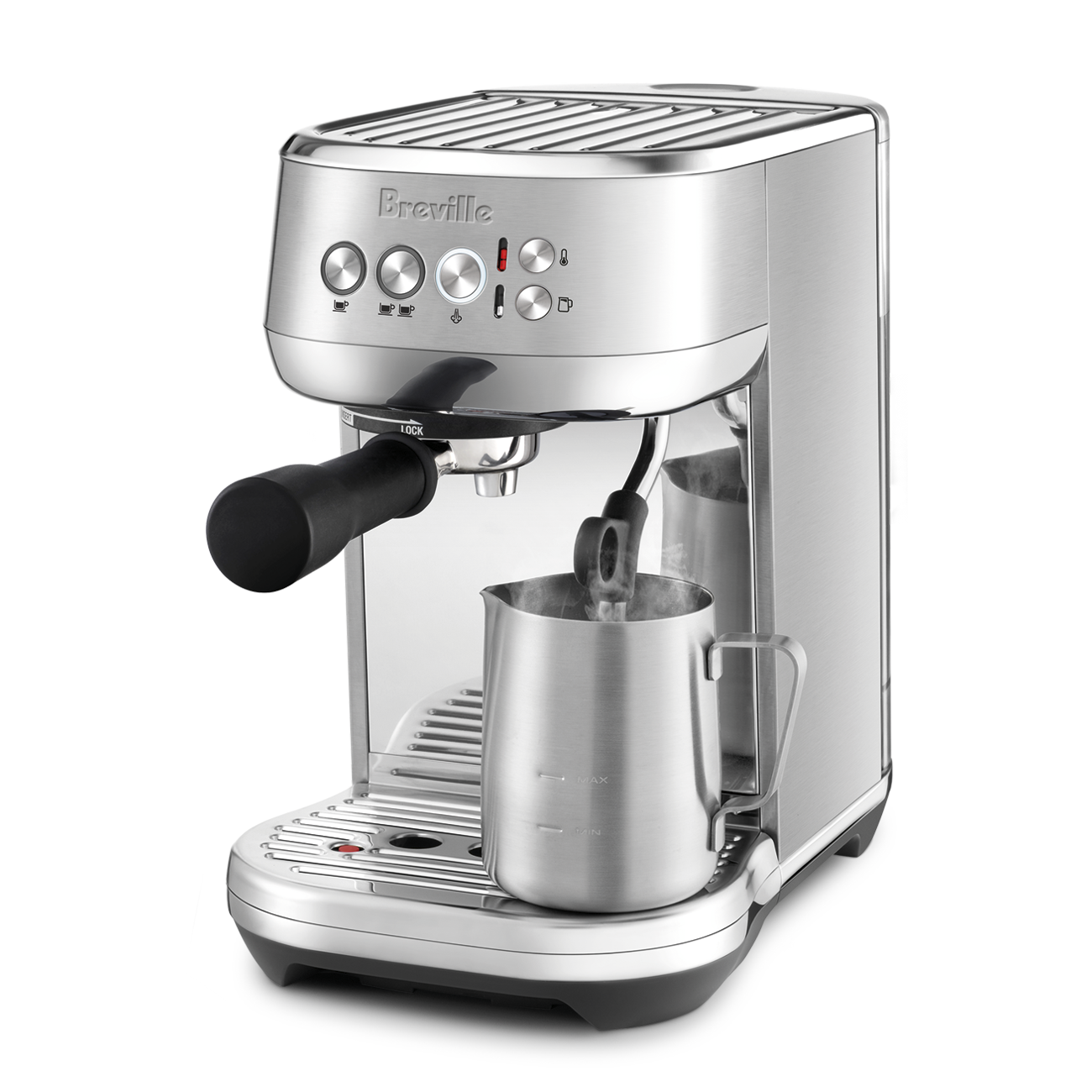
The current US package lists a stainless 54 mm portafilter, one- and two-cup single-wall and dual-wall baskets, tamper, Razor tool, 480 ml jug, cleaning tool, and cleaning disc. Single-wall baskets make grind control important. Dual-wall baskets add restriction and offer a practical start with suitable preground coffee. [2]
Official dimensions are currently labeled 11.9 × 7.4 × 14.3 inches in W×D×H order, but longstanding third-party figures disagree about the axes. I would measure the ordered unit for a tight recess instead of silently reordering the manufacturer’s numbers.
Begin with one coffee, the supplied equipment, a repeatable dose, and a dry basket. Changing beans, basket, grind, and dose together creates too many explanations for one disappointing shot.
Build assessment
The build choices you will notice at the counter
Build quality is more useful when translated into access, stability, compatibility, and repair options than when reduced to whether a panel feels premium.
| Area | What is established | Daily consequence | What remains uncertain |
|---|---|---|---|
| Footprint | Compact body; official axis-labeled dimensions conflict with longstanding listings | Easy to place only after the grinder and tank access are included | Verify a tight recess against the exact unit. |
| Portafilter | 54 mm removable portafilter | A real manual espresso workflow with model-compatible tools | Accessories need an exact fit check. |
| Tank and tray | 1.9 L removable tank and a compact drip tray | Useful capacity, with tray emptying increased by wand purging | Usable cup clearance was not verified. |
| Support and parts | Breville provides support and a BES500 parts route | There is a defined first contact when something fails | Comprehensive internal-part stock and repair cost were not established. |
04Daily use
Fast readiness still leads to a manual sequence
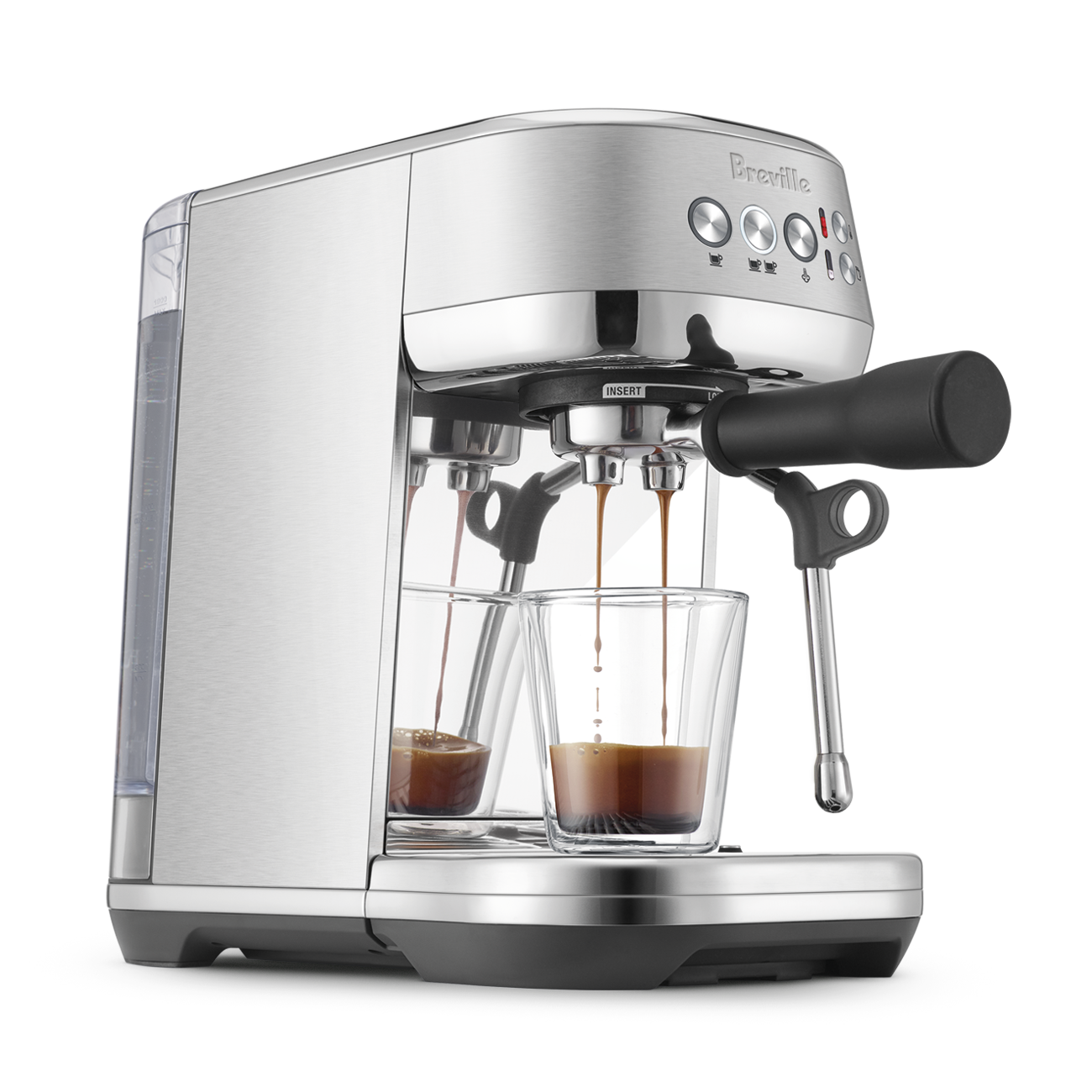
A practical drink sequence is simple: prepare the station, run the manual’s short group purge, dry and fill the basket, tamp level, extract, then texture milk. The heater removes most warm-up waiting, but the full drink still includes coffee preparation and cleanup.
The one- and two-cup buttons offer preset or programmable volumes, and manual control remains available. Serious Eats found the convenience useful but its tested volumetric results less accurate than desired. A scale is therefore valuable while dialing in because it separates a changed drink weight from a changed grind. [10]
For two milk drinks, every coffee and milk step remains sequential. Decide whether to finish one drink at a time or prepare both espressos before milk. A household regularly serving a queue should compare this cadence with a dual-boiler or more automated category, rather than judging only the three-second heater claim.
Workflow assessment
What changes as the drink queue grows
The heater is quick. The complete routine still contains coffee preparation, extraction, milk, and cleanup, so cadence should be judged by the whole sequence.
| Scenario | Machine behavior | Likely bottleneck | Practical response |
|---|---|---|---|
| Cold start | Breville claims the ThermoJet heater is ready in about three seconds | Grinding and warming the working parts | Prepare the station and follow the manual’s purge guidance. |
| One espresso | Programmable or manually controlled volume | Dose, distribution, and grind | Use a scale until the saved volume proves repeatable for your coffee. |
| One milk drink | Espresso first, milk second | The two jobs cannot overlap | Prepare the jug while watching the shot, then steam. |
| Two milk drinks | Each coffee and milk cycle remains sequential | Basket clearing, redosing, and milk cleanup | Group similar tasks or finish drinks one at a time, depending on who is waiting. |
05Espresso
The grinder and recipe set the practical ceiling
Breville gives a 16–19 g range for the double basket. An editorial starting point is 18 g of coffee to 36 g of espresso. That 1:2 target is a diagnostic baseline, not a Coffeedant-tested optimum or the factory button volume.
Keep dose and target yield steady while adjusting the grinder. If the drink is thin and runs much faster than the previous attempt, try finer. If flow nearly stops, move coarser before changing several other variables. Taste, flow, and preparation together are more informative than a rigid time rule.
The machine regulates a fixed brew target but does not give the user a temperature setting. Coffee Kev treats that as a limitation for light-roast specialists, while Tom’s Guide reported a pleasing light-roast result from its sample. The defensible conclusion is limited adjustment, not that one roast style is impossible. [12] [13]
Espresso assessment
Starting recipes and first adjustments
Use these as controlled starting points, not promised flavor results. Hold dose and target yield steady while changing the grind, then let taste decide the next move.
| Coffee | Starting recipe | Useful target | First adjustment |
|---|---|---|---|
| Medium blend | 18 g in, 36 g out | Balanced sweetness and body | Thin and sharp: grind finer. Dry and harsh: grind coarser. |
| Light roast | 18 g in, 40–45 g out | More sweetness with less sharpness | Preheat the working parts, then change grind before changing dose. |
| Decaf | 18 g in, 34–38 g out | Sweetness without a papery finish | Keep the yield controlled and make small grind changes. |
Evidence note: The manual supports a 16–19 g dose in the double basket. The yields above are Coffeedant starting guidance, not tested BES500 results or factory volumetric settings.
06Why Plus exists
Automatic milk reduces technique, not maintenance
Automatic mode needs the supplied jug, cold milk within its marks, contact with the temperature sensor, and the wand lowered into position. You choose one of three temperatures and textures; the machine stops automatically. Manual mode remains available when you want direct control.
Repeat the milk quantity, jug position, and settings before judging consistency. GearLab found automatic milk useful but preferred some settings over others; Tom’s Guide wanted less foam for its flat-white target. Those are unit-specific observations, not proof that one preset fits every milk or drink. [11] [13]
Wipe the wand immediately and lower it for the automatic purge. Purge water lands in the small tray, so easy tray access matters. If everyone in the household wants to learn manual steaming, the cheaper BES450 deserves priority because the Plus premium is paying mainly for automation.
Milk assessment
Choose a milk starting point, then change one thing
The sensor can only repeat a comparable setup. Use the supplied jug, begin with a consistent amount of cold milk, and keep one temperature and texture choice long enough to understand it.
| Drink or goal | Starting approach | Watch for | First adjustment |
|---|---|---|---|
| Flat white-style drink | Lower texture preset with a repeatable milk fill | More air than you want | Reduce texture or move to manual mode for finer control. |
| Latte | Middle texture and temperature choices | Milk masking a weak espresso | Stabilize the espresso recipe before increasing milk. |
| Cappuccino | Higher texture with the same milk quantity each time | Foam separating from liquid milk | Lower texture or swirl the jug more thoroughly before pouring. |
| Alternative milk | One conservative preset with a consistent brand and volume | Different heating and foaming behavior | Change one setting at a time; the manual warns alternatives may need different choices. |
Evidence note: These are workflow starting points based on the documented three temperature and three texture choices. Milk type, quantity, and personal preference still determine the right setting.
07Value
Judge the machine inside the full setup budget
Breville US displayed the Bambino Plus at $499.95 on September 25, 2026. The standard Bambino was $299.95 at the same check. These are dated manufacturer prices, not automatically refreshed offers. A separate grinder, scale, coffee, and care supplies belong in the first-year budget.
| Option | Best reason to choose it | Main compromise |
|---|---|---|
| Bambino Plus BES500 | Automatic milk with a separate grinder | Highest machine price in this family |
| Bambino BES450 | More budget left for the grinder | Manual milk only |
| Gaggia Classic E24 | Traditional 58 mm, single-boiler workflow | More manual heat and milk management |
| Barista Express BES870 | Grinder integrated into one body | Less grinder upgrade flexibility |
Open the technical comparison
| Machine | Coffee setup | Milk | Control limit | Best fit |
|---|---|---|---|---|
| Bambino Plus | 54 mm; separate grinder | Automatic or manual | No user brew-temperature setting | Frequent milk drinks |
| Bambino | 54 mm; separate grinder | Manual | No automatic texture or temperature | Lower total starting cost |
| Classic E24 | 58 mm; separate grinder | Manual single boiler | Switch and cool between steam and brew | Hands-on traditional workflow |
| Barista Express | 54 mm; grinder included | Manual | One-body grinder path | Integrated station |
Value assessment
When the premium earns its place
The Plus is not automatically better value than the standard Bambino. Its value rises or falls with how often the automatic milk system replaces work you genuinely do not want.
| Buyer pattern | What the premium buys | Cost that remains | Value verdict |
|---|---|---|---|
| Frequent milk-drink household | Automatic temperature and texture choices | Separate grinder, scale, coffee, and cleaning supplies | Strong when several people use the milk automation. |
| Mostly espresso or Americano | Little that changes the core coffee preparation | The same grinder requirement | The standard Bambino usually protects more grinder budget. |
| Manual milk learner | Automation you may bypass | A $200 dated price gap versus BES450 | Weak unless another regular user wants automatic milk. |
| One-button convenience seeker | Milk help, not bean-to-cup automation | All portafilter preparation remains | Choose a fully automatic category instead. |
Evidence note: The 9.2 score reflects fit at the dated US price, not a universal bargain claim. A different price or workflow should change the value judgment during the next refresh.
08After the novelty
Cleaning and support are part of convenience
Milk residue, coffee residue, and mineral scale are separate jobs. Wipe and purge the wand after milk, rinse the basket after coffee, and follow the indicated group-cleaning and descaling routines. Breville says the group-cleaning reminder follows 200 extractions; that flushing cycle uses the supplied cleaning disc and a cleaning tablet. Descaling is a separate mineral-scale routine: the manual calls for descaling agent and removing the tank's water filter before adding it. Do not treat one alert or cycle as a substitute for the other. Breville also warns against distilled, demineralized, or highly filtered water. [2]
The official support hub, warranty route, and BES500 parts navigation provide places to begin when something fails. They do not prove comprehensive internal-parts stock, a repair price, or easy decade-long service. The current documents retrieved for this review did not establish an exact model-specific warranty duration, so confirm the seller’s applicable coverage and keep proof of purchase.
For used or refurbished units, ask for a demonstration of espresso, automatic milk, and manual steam. Check for leaks, warning lights, missing accessories, and written return terms. A lower sticker price should still leave a clear remedy if the machine arrives faulty.
09Owner context
Convenience and control explain the divided reactions
Owner discussions support a useful pattern, not a reliability statistic. Convenience-first users value the short start and milk presets. Control-first users more often question the premium, choose manual steaming, or want more brew adjustment later.
Reports include satisfied multi-year use, returns, and individual failures. There is no common region, verified-purchase sample, or denominator from which to calculate a failure rate. Treat the automatic milk system as added complexity, confirm return and warranty terms, and avoid turning a vivid anecdote into a population claim.
The decisive question is whether you want to learn espresso while keeping milk easy, or learn both. The Plus is coherent for the first buyer. The standard Bambino or a more traditional manual machine better serves the second. [15] [16] [17] [18]
10Before you order
Breville Bambino Plus FAQ
Does the 54 mm basket make it inferior?
No. Diameter affects geometry and accessory compatibility, not a simple quality ranking. Grind control, preparation, coffee, and recipe matter first.
Can it make an Americano?
Yes. The Plus manual documents hot water through a button combination, or you can use a kettle. The BES450 has a dedicated hot-water control.
Will a travel mug fit?
Verified usable clearance was not established. Measure the mug with any scale beneath it and confirm the combination with the seller.
Can I add a grinder later?
You can begin with suitable preground coffee and a dual-wall basket, but delaying a capable grinder limits recipe control. Price the complete station before ordering.
Does another basket add brew-temperature control?
No. A basket cannot add a missing machine setting. Choose a different machine if user-adjustable temperature is already central to your plans.
Can it brew and steam together?
No. Espresso and milk are sequential. Automatic milk reduces attention during the second step but does not create another heating circuit.
Are single-wall baskets included?
The current US package lists one- and two-cup single-wall and dual-wall baskets. Verify older or used stock against its exact box and booklet.
Does three seconds mean a complete drink?
No. It is Breville’s heater-readiness claim. Grinding, dosing, extraction, milk, and cleanup still add time.
See the machine in use
An independent video perspective
Coffee Kev
Sage (Breville) Bambino Plus review after nearly four years
Coffee Kev’s long-term perspective adds context beyond a short review. His UK Sage experience is separate from the US specifications and buying terms used here. This is an external review, not Coffeedant testing.
Watch on YouTubeWhy I trust the verdict
What the evidence lets me say with confidence
I built this review from current US documentation for the Breville Bambino Plus BES500, five independent hands-on or long-term evaluations, and three owner-discussion pools that include clearly labeled UK Sage context. I rechecked the official model, manual, support, comparison products, and displayed US prices on September 25, 2026.
This is a research-led review, not a Coffeedant hands-on test. Manufacturer specifications, external observations, and editorial advice remain distinct. The evidence does not support invented Coffeedant measurements, taste results, ownership duration, or failure rates.
Check the evidence
Sources and further reading
- [1] Breville US: Bambino Plus BES500
Official US features, included equipment, and $499.95 displayed price. Checked September 25, 2026; the dimension-axis disagreement remains unresolved.
- [2] Breville BES500 US/Canada/Mexico manual
Current product-linked booklet covering baskets, dose range, controls, milk, water, cleaning, and maintenance. Cleaning and descaling instructions rechecked October 13, 2026.
- [3] Breville BES500 support hub
Official setup, extraction, cleaning, manual, support, warranty, and parts route. Checked September 25, 2026.
- [4] Breville North American warranty terms
Official claim route and terms. Checked September 25, 2026; exact BES500 duration was not established.
- [5] Breville BES500 parts route
Official navigation checked September 25, 2026; model-specific stock, internal availability, and repair costs were not verified.
- [6] Breville US: Bambino BES450
Official base-model comparison and $299.95 displayed price. Checked September 25, 2026.
- [7] Breville BES450 US/Canada/Mexico manual
Current product-linked base-model booklet confirming 1.4 L tank and manual milk. Checked September 25, 2026.
- [8] Gaggia: Classic E24
Official current E24 architecture, controls, and regional documentation. Checked September 25, 2026.
- [9] Breville US: Barista Express BES870
Official integrated-grinder and manual-milk features. Checked September 25, 2026.
- [10] Serious Eats: Jesse Raub’s Bambino Plus review
Updated December 12, 2025; US-context hands-on evidence for controls and sequential brewing and steaming. Rechecked September 25, 2026.
- [11] GearLab: Bambino Plus review
Lesley Robinson with Jason Wanlass, April 16, 2024. Purchased-unit handling and milk observations; measurements remain theirs.
- [12] Coffee Kev: Bambino versus Bambino Plus
Long-term first-hand comparison in UK context, updated May 18, 2026. Regional prices and instructions were not transferred.
- [13] Tom’s Guide: Bambino Plus review
Erin Bashford, May 8, 2025. Original UK-context testing; results remain attributed.
- [14] Coffeeness: Bambino Plus review
Arne Preuss, updated April 15, 2025. Purchased-unit handling perspective used cautiously.
- [15] Reddit r/espresso: beginner Bambino Plus experience
Self-reported Plus ownership; grinder named, region and duration not established. Anecdotal, not verified-purchase research.
- [16] Reddit r/espresso: How good is the Bambino Plus?
Mixed original ownership reports across regions. No failure-rate inference.
- [17] Singletrack: Before I buy a Sage Bambino
One explicitly Plus-specific multi-year comment in UK Sage context; not a representative sample.
- [18] CoffeeBlog owner comment
One Bambino Plus owner comment about wanting more control; duration and exact region were not established.
- [19] Gaggia Classic E24 US/Canada manual
Official RI9380 / SIN035R booklet documenting manual steaming and boiler cooldown before returning to coffee.
The buying decision
Breville Bambino Plus review: choose it when automatic milk earns the premium
I would buy the Bambino Plus for a household that wants to prepare espresso and make frequent milk drinks with fewer milk decisions. Its fast start and automatic texturing solve clear daily jobs, while a separate grinder can improve independently.
I would choose the cheaper Bambino when manual milk appeals, another semi-automatic when brew-temperature adjustment is essential, or a fully automatic model when handling grounds is the work you want removed.
Check Amazon price