
PROCESS / CULTURE / COFFEE AFTER CAFFEINE
Decaf deserves a place at the tasting table
The more interesting decaf story is about identity, choice and a clearer explanation of processing—not miracle growth rates or solvent scares.
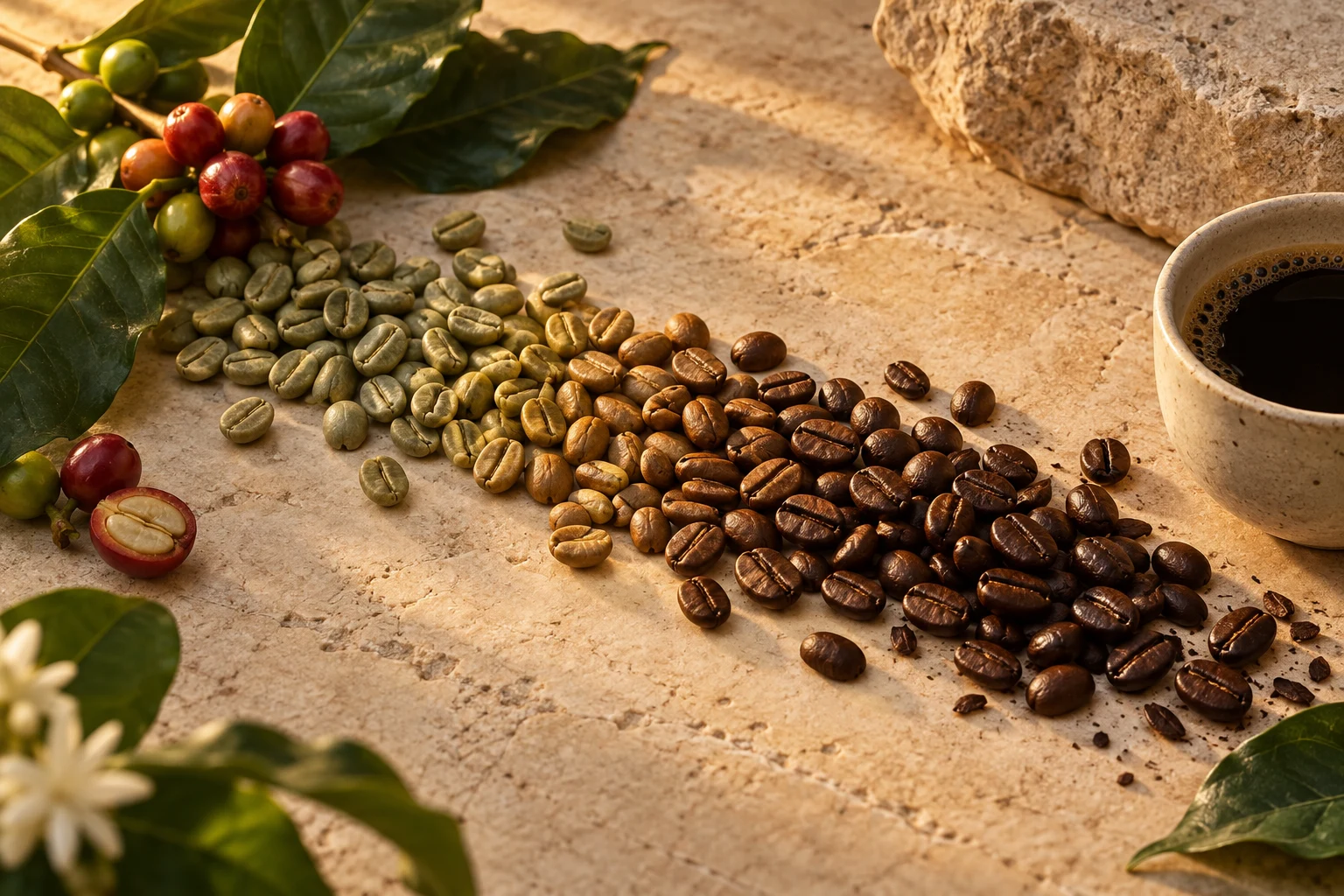
Original AI-assisted artwork by Coffeedant. Illustrative reconstruction; it documents no actual facility, visit or test.
A serious coffee menu can treat decaf as a coffee with an origin and a processing history. That is Coffeedant’s editorial proposition, not a claim that every decaf tastes exceptional. To understand the current conversation, follow how caffeine is removed, what the labels actually say, and where the evidence stops. Research checked through 13 October 2026.
Begin with the coffee, then ask about the caffeine
Imagine a menu that gives its decaf the same descriptive space as its other coffees: producer or origin, handling, roast and the method used to remove caffeine. This is a design proposal for better information, not a report of a universal industry shift. It changes the reader’s starting question from “Why would anyone choose this?” to “What is this coffee, and how was it made?” The choice becomes easier to understand when the product has an identity.
That approach also keeps preference personal. Someone can be interested in the ritual, the flavour or the freedom to choose a different caffeine level without needing a story that makes decaf virtuous. Coffeedant’s reading of the current moment is that the category deserves a more demanding vocabulary. It should be possible to discuss an ordinary decaf honestly, an excellent one enthusiastically and an unclear label critically—using the same care that applies to other coffees.

A partially filled sack of green Brazilian coffee, photographed in July 2011 and identified by its photographer as decaffeinated using the Swiss Water process. Decaffeination happens before roasting.
Jkafader / Wikimedia Commons · Source · CC BY-SA 3.0 · Resized and converted to WebP.Read the renaissance without inflating the numbers
Swiss Water’s annual results, released on 12 March 2026, offer a useful reality check. The company reported 2025 processed volume up 2% and revenue up 49%, while fourth-quarter volume declined 2%. Those figures describe one decaffeination business. They do not measure the entire global decaf market, and a revenue increase is not equivalent to people drinking that much more coffee. Read the 2025 full-year results.
A thoughtful trend article should hold those distinctions in view. One company’s investment, marketing and results can reveal attention to a category without establishing its universal trajectory. “Renaissance” is an editorial frame for reconsidering the product; it should not be disguised as a percentage lifted from an opaque forecast. A claim about more sales, a claim about better taste and a claim about changing social attitudes would each need evidence of its own.
The useful next question is therefore what makes the product more legible to its buyer. Better descriptions, explicit processing information and identified lots can improve the conversation even before a market-wide growth rate is available.
Four paths to less caffeine
Water process
Extract + carbon filtration
CO₂
Compressed extracting medium
Ethyl acetate
Solvent extraction
Methylene chloride
Solvent extraction
These are process families, not a ranking of flavour. All converge on drying green coffee before roasting.
Four labels, four routes to the same question
An industry explanation from the Coffee Association of Canada describes decaffeination as moistening green coffee, applying an extracting agent and drying the beans afterwards. It lists water, carbon dioxide, ethyl acetate and methylene chloride among the agents used. These are ways to remove caffeine before roasting; they are not four new coffee species. Read the process overview.
Swiss Water’s own process explanation describes green coffee extract and carbon filtration. Caffeine moves from beans into the extract, and filters capture it. A useful original diagram follows that movement rather than decorating the word “water” with purity imagery. Coffeedant calls this water-based decaffeination. The company’s familiar “chemical-free” language is marketing shorthand, not literal chemistry. See the manufacturer’s process explanation.
Compressed carbon dioxide is another extracting medium. Technical research examines the relationship among caffeine, water and CO₂ under processing conditions. A label naming CO₂ tells you something about the extraction route; it does not by itself tell you how a particular coffee will taste. Likewise, the phrase “sugarcane decaf” should lead to a specific explanation of the ethyl-acetate process, not an assumption that the beans were simply sweetened. Read the CO₂ technical paper.
Replace alarming names with useful context
The current US rule permits methylene chloride as a residue from decaffeination at no more than 10 parts per million in decaffeinated roasted coffee and instant-coffee extract. A separate US rule permits ethyl acetate as a decaffeination solvent under good manufacturing practice. These are specific US regulations, not a claim about every jurisdiction or every product. 21 CFR 173.255; 21 CFR 173.228.
Process literacy means being able to state those facts without converting a chemical name into a health verdict. A frightening association is not a measurement of exposure in the coffee being discussed. Equally, a reassuring adjective on a bag is not a complete account of the process. This article does not claim that a label can determine an individual health outcome; it explains how to read a production description without substituting slogans for evidence.
For a shopping decision, ask the seller to identify the method and the processor if available. If avoiding a particular method is your preference, a clear answer allows you to act on it. There is no need to turn that preference into a universal ranking of coffees or people who drink them.
| Label / method | What to understand | Useful question for the seller |
|---|---|---|
| Water-based / Swiss Water | Green coffee extract and carbon filtration in the branded process | Who processed this lot, and is the method specifically identified? |
| CO₂ | Compressed carbon dioxide is the extracting medium | Which processor and which coffee are in this bag? |
| Ethyl acetate / sugarcane | Ethyl acetate is an extracting solvent; explain the actual process | Does the producer identify the process and the solvent source? |
| Methylene chloride | US rules specify a maximum residue of 10ppm | Which market’s rules and processor records apply? |
| Decaf, unspecified | A category label with limited process information | Can you name the decaffeination method? |
Decaf does not mean caffeine-free
The FDA says an eight-US-fluid-ounce cup of decaf coffee typically contains 2 to 15 milligrams of caffeine. That is a range, not a measurement of the cup beside you. Product and serving details matter. “Decaf” should therefore not be read as “zero,” and a larger serving should not be assumed to have the same total as the reference cup. Read the FDA explanation.
A useful graphic shows the reference serving and its range, with the caption doing as much work as the number. It should avoid a tiny precise-looking marker labelled “your coffee” when no test was performed. The underlying lesson applies beyond decaf: a category average or typical range is valuable information, but it does not become an individualized result merely because it is placed in an interactive calculator.
This distinction also changes the language of a menu. “Lower-caffeine choice” is more informative than implying complete absence. Where a reader needs a specific caffeine amount, the next step is to seek product-specific information rather than treating any decaf label as an analytical certificate.

A decaf latte photographed at Trading Post Coffee Roasters in Brighton in March 2025. A documented everyday café drink, rather than a claim about a particular decaffeination method.
Andy Li / Wikimedia Commons · Source · CC0 1.0 · Resized and converted to WebP.Give the cup a fair, specific comparison
To evaluate a decaf at home, begin with a question you can actually answer: do you enjoy this identifiable coffee in the preparation you use? Record the coffee, roast information, recipe and your own observations. If comparing two products, note the differences you cannot control. An origin change or a different roast means the exercise is not a clean test of decaffeination methods. This is a suggested reader exercise; Coffeedant has not conducted a blind tasting for this story.
Use the process label as one line of information rather than as the conclusion. A method can be explained beautifully while a specific product disappoints you. Conversely, finding a coffee you enjoy does not prove that its method must always win. The fairest judgement keeps the product, preparation and preference together.
That is the editorial case for decaf’s place at the tasting table. It deserves neither a diminished set of expectations nor automatic praise for existing. It deserves an identity, a clear explanation and a reader free to choose. The conversation becomes richer when removing a stimulant does not remove the questions we normally ask about coffee.
A few good questions.
Is decaf completely caffeine-free?
No. FDA gives a typical range of 2–15mg in an eight-US-fluid-ounce cup. An individual product can differ.
Is water-based decaf literally chemical-free?
No. That phrase is marketing shorthand. Water-based describes the extraction approach more clearly.
Does one method always taste best?
No universal ranking is established here. Compare identifiable coffees and account for other differences, including origin, roast and recipe.
Follow the sources.
This research-led article draws on the sources below. Editorial interpretation is identified in the text. Dates, geographic scope and research limitations are kept alongside the claims they qualify.
- Swiss Water reports 2025 full-year results ↗
Released 12 March 2026; volume and revenue are distinguished; company data are not global market data.
- Coffee Association of Canada: Decaffeination ↗
Industry overview of extraction agents and processing sequence.
- Swiss Water process explanation ↗
Manufacturer description; marketing terms are attributed and translated into process language.
- CO₂ phase-equilibrium research ↗
Technical University of Lübeck research on decaffeination extraction conditions.
- 21 CFR 173.255: Methylene chloride ↗
Current US residue limit for the specified decaf products.
- 21 CFR 173.228: Ethyl acetate ↗
Current US permission under good manufacturing practice.
- FDA: How much caffeine is too much? ↗
Typical decaf caffeine range; not a product-specific assay.
Sources checked 13 October 2026. Illustrated covers and original schematics: Coffeedant. Additional images and videos are individually credited above.