
BOTANY / CLIMATE / THE CHANGING CUP
Robusta’s second act has a water problem
A neglected species is gaining attention, breeding investment and export volume. The exciting story becomes more useful when we stop calling it climate-proof.
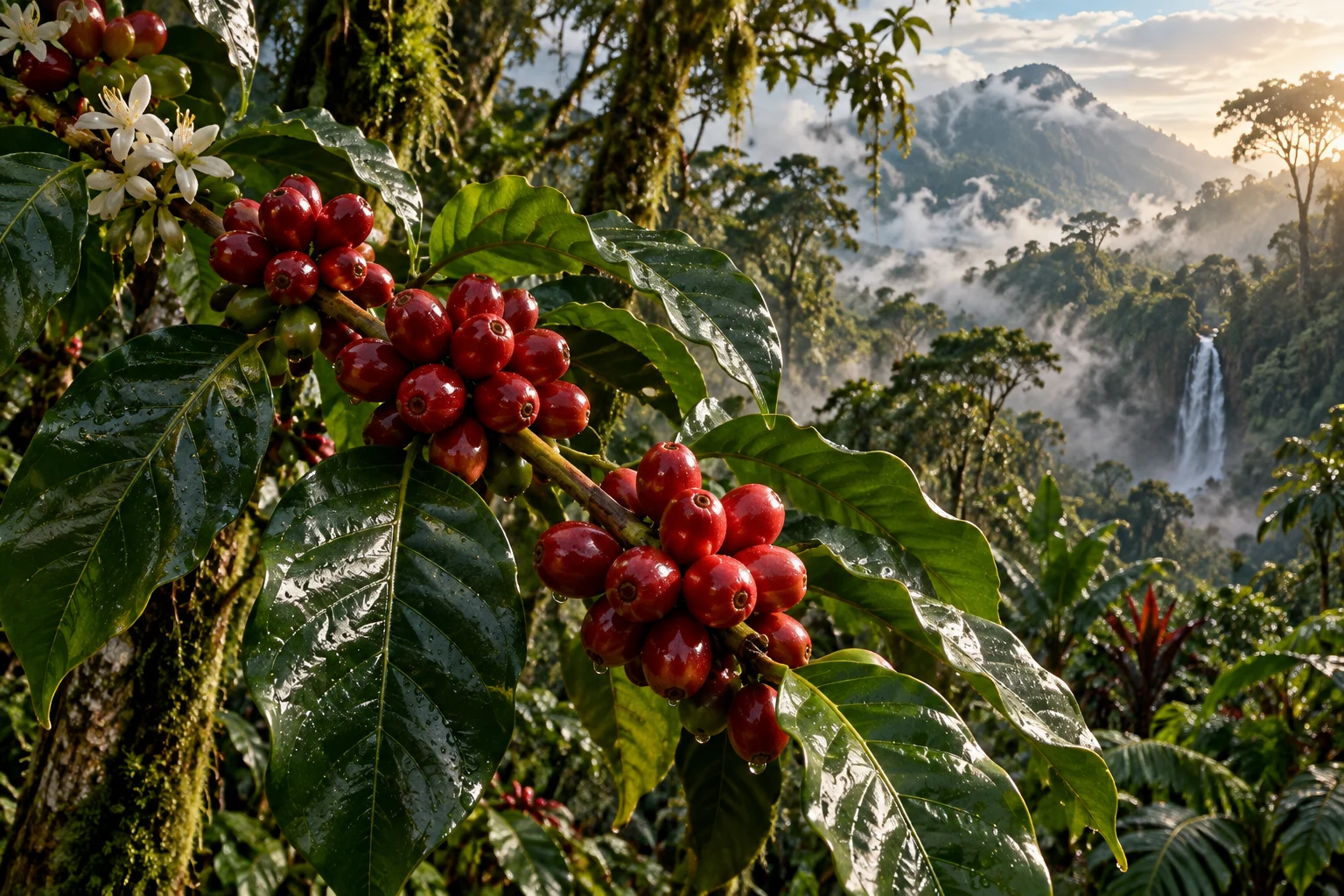
Original AI-assisted artwork by Coffeedant. Illustrative reconstruction; it documents no actual facility, visit or test.
The coffee conversation is making more room for Coffea canephora, commonly called robusta. That shift deserves curiosity. It also deserves precision: new breeding candidates are not finished varieties, rising exports are not a specialty-market census, and warmth tolerance is not a guarantee against drought. A major August 2026 scientific review brings water back into the picture.
Meet the plant before judging the cup
World Coffee Research describes Coffea canephora as originating in central and western sub-Saharan Africa. Its wild populations occur mainly in humid evergreen forest understory, across elevations of approximately 50 to 1,500 metres. This is a better starting point than treating robusta as a flavour stereotype. It is a plant with a geography and a range of growing environments. A species name gives a reader useful information, but it is not a complete description of an individual lot. Explore the WCR botanical catalog.
When approaching an unfamiliar coffee, ask which details are being offered and which are being left to your imagination. A named producer, harvest, processing method and roast provide a more informative introduction than a single word on a bag. Coffeedant’s recommendation is to make the question smaller: not “Do I like robusta?” but “What can I learn from this identifiable coffee?” That formulation makes room for preference without turning one encounter into a verdict on a whole species.

Unripe Coffea canephora berries photographed in July 2009. Robusta is a coffee species with its own cultivation and processing choices.
Siddharth Patil / Wikimedia Commons · Source · CC0 1.0 · Resized and converted to WebP.The numbers show movement, not the whole story
In November 2024, World Coffee Research placed robusta’s share of global production at about 40%, compared with 25% in the early 1990s. Those are dated figures, not a live October 2026 estimate. They nevertheless describe a substantial change in the production mix over time. The organization’s research agenda includes quality for different markets, from commercial through specialty. The story is broader than a sudden fashionable rediscovery. Read The roots of Robusta.
The ICO’s current summary adds a recent trade signal. In the twelve months ending August 2026, robusta exports reached 61.05 million 60-kilogram bags, against 54.48 million in the comparison period. Arabica exports were 81.39 million, against 85.97 million. These numbers measure export volume, not fine-robusta demand or consumer approval. Calling them proof that specialty robusta has conquered the market would answer a question the data did not ask. Read the ICO market summary.
That distinction is the foundation of a useful trend report. One can observe more trade and more research attention while leaving the size of a specific premium segment unresolved. The uncertainty does not weaken the story; it tells the reader where the next meaningful evidence should come from.
Resilience is a system, not a species name
Heat
Temperature and exposure
Water
Rainfall, soil water, irrigation
Farm
Shade, soils and management
Plant
Genetics and local adaptation
Conceptual layers; no climate projections or measured yields are encoded in this drawing.
A thousand candidates are a beginning
World Coffee Research’s July 2025 update reported progress with controlled crosses and clonal propagation after breeding work began in 2024. A September 2026 update describes 1,000 clones selected as a founding population and being multiplied for national partners. The precise word is candidates: this is a breeding population, not an announcement of 1,000 proven new commercial varieties. Read the July 2025 update; read the 2026 clone update.
For an editorial reader, the interesting change is the seriousness of the question being asked. Which combinations of traits should future planting material pursue, and how should farmers’ needs shape the work? A promising candidate can be worth studying without being ready to recommend everywhere. When a brand cites a breeding project, ask whether it is describing a research objective, an experimental result or a variety already evaluated for the stated conditions.
These stages should stay distinct in visual explanations too. A seedling image beside the phrase “future of coffee” is evocative, but a clear caption should tell us what stage we are seeing. Coffeedant’s interpretation is that sustained breeding attention is a stronger signal than a fashionable claim of instant transformation.
The 2026 challenge to an easy climate story
A review published on 27 August 2026 in Sustainable Development challenges broad claims of climate resilience for farmed robusta. It emphasizes soil and terrestrial water availability, irrigation, shade and farming inputs. The authors argue that some climate analyses overlook water relationships and the extent to which cultivation depends on irrigation. This is a substantive critique to attribute to its authors, not a reason to declare every farm or climate model equivalent. Read The Sustainability of Robusta Coffee Under Global Change.
The distinction it brings into focus is simple: enduring warm conditions and delivering dependable harvests when water is limited are different propositions. Coffeedant would therefore avoid “climate-proof” altogether. Such a label compresses a landscape into a promise. The reader needs to know what stress is being discussed, under which management conditions, and what evidence supports the claim.
A more informative illustration places rainfall, soil water, irrigation and shade beside temperature. The point is not to invent a universal formula for farmers. It is to prevent a single thermometer from representing every condition a crop faces. The most credible climate story leaves room for local questions rather than making a global guarantee from a species name.
| Signal | What it can support | Question it leaves open |
|---|---|---|
| Higher export volume | A change in measured coffee trade | How much belongs to premium or specialty lots? |
| New breeding candidates | A research pipeline and selection work | Which candidates perform well in which conditions? |
| Warm growing conditions | An observation about a defined environment | What water and management inputs were required? |
| A favourable tasting | A judgement of an identified preparation | How comparable were species, roast and processing? |
| A species label | Botanical identity information | Who produced this particular lot, and how? |
Give quality a more precise vocabulary
Species, processing and roast should be separate entries in a coffee description. If a label blends them into one identity, it becomes difficult to know what a comparison means. A heavily roasted blended coffee and a differently handled single lot are not a tidy species experiment. This is a principle for interpreting comparisons, not a claim that one treatment is intrinsically superior. Useful editorial tasting begins by naming the question and the variables that remain different.
At home, an approachable exercise is to compare two identifiable coffees while recording the recipes and your own preferences. Keep expectations visible. Write down what you thought the name would mean, then describe what you actually noticed without forcing the notes to match the label. This is a suggested reader activity; Coffeedant has not conducted a tasting for this article.
The resulting judgement can be modest and still valuable: “I preferred this lot in this preparation” is more informative than “this species is good” or “this species is bad.” It also gives a retailer something practical to respond to when recommending the next coffee.

Robusta coffee shown after harvesting on the right and after drying on the left, as documented by the photographer. The photograph illustrates processing stages, rather than a graded fine-robusta lot.
DXLINH / Wikimedia Commons · Source · CC BY-SA 3.0 · Resized and converted to WebP.The next signals worth watching
For the next chapter, watch for named varieties evaluated in named environments, rather than broad announcements that coffee has been saved. Watch for a transparent distinction between export growth and premium-market development. In descriptions of individual lots, watch for producer, harvest and handling information that survives beyond an attractive origin paragraph. These are editorial criteria for reading new claims; they are not a forecast of which origin or business will succeed.
The same curiosity should extend to resources. If a climate claim depends on irrigation or another management practice, that dependence belongs in the story. Omitting it makes the system appear simpler than the evidence suggests. A sophisticated coffee culture can celebrate a plant’s possibilities while asking what makes those possibilities practical.
Robusta’s second act is compelling precisely because it is unfinished. There is a substantial crop, a changing trade picture, new breeding work and an active scientific debate about resilience. The reader does not need a heroic species to stay interested. A clearer account of the plant, the people evaluating it and the conditions they must contend with offers something better: a trend that can be followed intelligently as the evidence develops.
A few good questions.
Is robusta climate-proof?
No such guarantee follows from the species name. The August 2026 review challenges broad resilience assumptions and stresses water and farming conditions.
Does export growth prove a specialty robusta boom?
No. Export totals combine market segments and do not isolate premium demand.
Are WCR’s 1,000 clones ready-made commercial varieties?
No. They are a founding breeding population undergoing multiplication and further evaluation.
Follow the sources.
This research-led article draws on the sources below. Editorial interpretation is identified in the text. Dates, geographic scope and research limitations are kept alongside the claims they qualify.
- World Coffee Research Robusta catalog ↗
Botanical origin and wild habitat information.
- The roots of Robusta ↗
November 2024 historical production share; figures dated to publication.
- Robusta breeding: a year later ↗
July 2025 breeding progress.
- Robusta breeding update: 1,000 clones advancing ↗
September 2026 research candidates; not released cultivars.
- The Sustainability of Robusta Coffee Under Global Change ↗
Peer-reviewed review published 27 August 2026; broad resilience claims critically examined.
- International Coffee Organization market summary ↗
Twelve-month export comparison to August 2026; not specialty-segment data.
Sources checked 13 October 2026. Illustrated covers and original schematics: Coffeedant. Additional images and videos are individually credited above.