
PROCESS / SCIENCE / TRANSPARENCY
When coffee tastes like strawberry, what happened?
Anaerobic, inoculated, co-fermented, infused: the exciting new vocabulary of coffee works best when the method is as clear as the flavour.
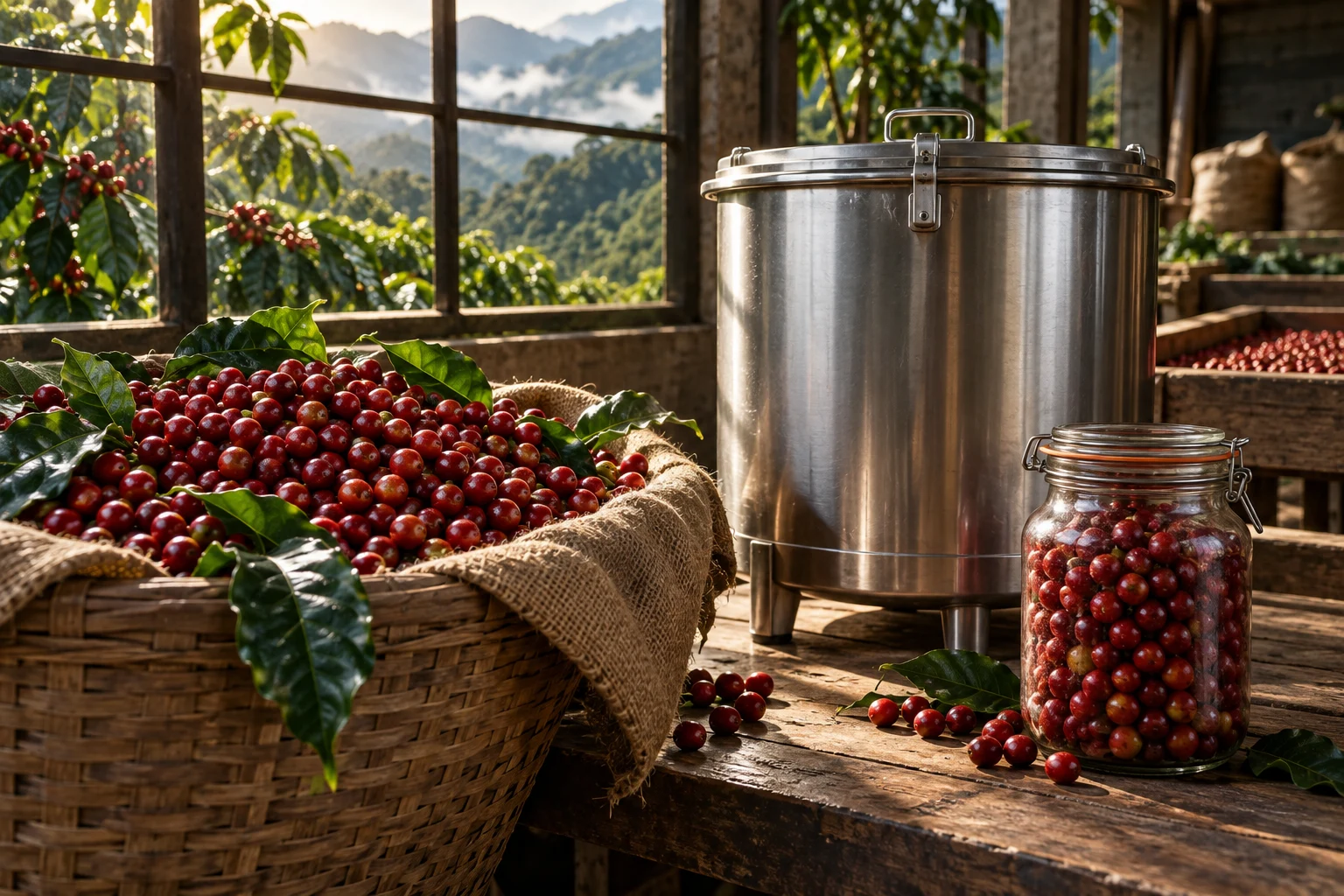
Original AI-assisted artwork by Coffeedant. Illustrative reconstruction; it documents no actual facility, visit or test.
A vivid fruit note can be an invitation to explore, but it is not a laboratory test of how a coffee was made. In January 2026, the Specialty Coffee Association published a substantial report about coffee with added ingredients and the language around it. The emerging frontier is not simply stronger flavour. It is a more transparent account of how that flavour was pursued.
A long name is not a complete process record
Anaerobic fermentation describes conditions with limited or absent oxygen. It does not, on its own, tell you that another fruit was added. Fermentation also occurs in conventional wet and dry coffee processing; it is not something invented by a label with an experimental ring. The Specialty Coffee Association’s scientific explanation links microorganisms, metabolites, bean metabolism and the precursors that matter during roasting. Outcomes depend on processing conditions and the coffee itself. Read The Fermentation Effect.
This is a useful place to slow down. An elaborate process name can convey ambition while leaving basic questions unresolved. What material entered the tank? What was deliberately introduced? Which conditions were controlled, and which were simply observed? A readable label need not describe every production detail, but it should give the buyer enough information to understand the kind of intervention being discussed.
Coffeedant’s editorial recommendation is to replace a ladder of impressive terms with a set of independent questions. Oxygen conditions, added microorganisms, other ingredients and timing can be described separately. The result is easier to interpret than assuming every new word represents a higher level of quality.

Coffee fermentation bins from an archival photograph uploaded in 2005. The source identifies the equipment but supplies no farm location or named fermentation protocol.
Ronchy~commonswiki / Wikimedia Commons · Source · Public domain (author dedication) · Resized and converted to WebP.What the science can support
A 2025 review of coffee fermentation and sensory quality searched research through March 2025 and synthesized findings from 22 studies. Its scope illustrates that fermentation is an active research subject with multiple processing variables. It should not be reduced to a promise that a named technique improves every coffee. A literature review can summarize studied outcomes; it cannot substitute for knowing the conditions of an individual commercial lot. Read the 2025 research review.
That distinction makes an experimental label more interesting, not less. The producer’s question can be specific while the marketing becomes broad. A reader should ask whether a described result belongs to a particular coffee, a controlled experiment or a general claim. The wider the claim, the more carefully its evidence needs to be examined.
Treat flavour language similarly. A tasting note describes a perception or an intended profile; it is not automatically an ingredient declaration. A vivid descriptor and a detailed process record can coexist, but they do different jobs. One invites you to imagine the cup. The other tells you what was done to the coffee before you bought it.
Read fermentation on four independent axes
Oxygen
Open / oxygen-limited
Microbes
Resident / inoculated
Ingredients
Coffee alone / additions
Timing
Stage, duration and control
A process can combine several choices. “Anaerobic” alone does not specify ingredients or microbes.
Co-inoculation is not co-fermentation with fruit
A March 2025 study investigated selected yeasts and lactic-acid bacteria individually and in combination during self-induced anaerobic wet coffee fermentation. Co-inoculation in that context refers to introducing a combination of microorganisms. It is not another way of saying strawberries or another fruit were added. The study is an example of a particular experimental design, not a prescription for any producer or an explanation of every coffee bearing an anaerobic label. Read the co-inoculation study.
This difference matters when asking a retailer for clarification. “It uses fermentation” does not tell the reader whether the intervention involved microorganisms, a non-coffee ingredient, or both. A useful answer names what was introduced and at what stage. The category can still be exciting without blurring the description.
For original explanatory media, show microorganisms as one input and other ingredients as another. Leave room for either input to be absent. Avoid drawing an ingredient arrow into every anaerobic tank, which would teach the wrong association. The graphic should help a reader formulate a better question, not make a disputed commercial label look more standardized than it is.
The 2026 report puts transparency in the foreground
The SCA’s January 2026 report, What’s in My Coffee?, documents local terms spanning targeted wild fermentation, inoculation, supplementation, co-fermentation and flavour addition. Its Colombian research involved 30 stakeholder interviewees. An estimated 620,000 kilograms of infused, co-fermented or flavoured green coffee were produced in Colombia in 2024. This combines several styles and is an interview-based estimate, not a representative global market census. The report includes draft communication guidance, not a binding universal classification. Read the SCA primary report.
The word “draft” deserves to stay visible. It tells readers that an industry is working through a vocabulary, rather than announcing that every bag already belongs to an agreed category. A transparent seller can still describe the actual method while terminology develops. Waiting for a perfect label is not necessary to answer a straightforward question about ingredients and timing.
The market figure should be read just as carefully. It gives scale to a defined investigation in a defined place and year. It does not justify a claim that most experimental coffee uses added flavour, or that every intense fruit note has the same origin.
| Dimension | Ask the producer or seller | Do not infer from this alone |
|---|---|---|
| Coffee material | Which lot, and what material entered processing? | Overall quality or a guaranteed flavour |
| Oxygen | What oxygen conditions were used or controlled? | That another fruit was added |
| Microorganisms | Were particular cultures deliberately introduced? | That fruit or flavouring was introduced |
| Other additions | What non-coffee ingredients, if any, were used? | The timing or full mechanism of the effect |
| Timing | At what stage did each intervention occur? | That a familiar label has one universal meaning |
| Evidence | What records support the process description? | Proof from a fruit-like tasting note alone |
A flavour impression is not an accusation
In September 2026, UK roaster Scenery published its position on undocumented additions and outlined a more explicit way to present coffees with added flavourings. The statement is valuable as a primary example of one business responding to the issue. It is not an independent prevalence study or evidence against unnamed competitors. Read the roaster’s September 2026 statement.
This is where a reader’s curiosity must remain distinct from suspicion. An unusual cup can motivate a question without proving misconduct. Do not turn “this tastes remarkably like fruit” into an allegation that a producer concealed an ingredient. Ask for a process explanation, then evaluate the explanation and its supporting records. If the answer is incomplete, report the incompleteness rather than inventing the missing facts.
The same principle applies to enthusiasm. A charming producer story should not resolve every uncertainty either. Readers benefit from a culture in which clear questions are welcome and honest disclosures do not require defensive language. Innovation is easier to appreciate when the buyer understands what is being offered.

A coffee pulping machine and washing tank on a Tanzanian farm, photographed in August 2024. Pulping removes cherry flesh; this image does not document an experimental anaerobic process.
Harald Ulver / Wikimedia Commons · Source · CC BY-SA 4.0 · Resized and converted to WebP.Build a process passport for the coffee you choose
A concise process passport can contain four entries: the starting coffee material, oxygen conditions, deliberate additions and when those additions occurred. This is Coffeedant’s proposed reader framework, not a new certification. It works because it leaves the actual method visible. The seller can supply a narrative explanation alongside the entries, and the reader can decide whether that product matches their curiosity or preference.
Begin with your own question. If you want to explore selected microorganisms, say so. If you are interested in fruit additions, ask which fruit and at which stage. If you prefer coffees without other ingredients, request that clearly. None of those preferences needs to become a verdict on every other approach. What matters is that the product description allows a meaningful choice.
The flavour frontier will remain attractive because it promises discovery. Its editorial challenge is to make discovery informed. A striking coffee can be discussed as a collaboration of raw material and method, without pretending that a tasting note reveals the whole production history. The strongest next step is a better explanation beside the vivid descriptor: enough information for the reader to enjoy the surprise and understand how it was pursued.
A few good questions.
Does anaerobic mean that fruit was added?
No. It describes oxygen conditions; additions require a separate explanation.
Can a strawberry note tell me the ingredients?
A descriptor is not an ingredient declaration. Ask how the coffee was processed rather than inferring a hidden ingredient.
Are the SCA’s 2026 recommendations a universal certification?
No. The cited report includes draft guidance and documents terminology still under discussion.
Follow the sources.
This research-led article draws on the sources below. Editorial interpretation is identified in the text. Dates, geographic scope and research limitations are kept alongside the claims they qualify.
- The Fermentation Effect ↗
SCA scientific explanation of fermentation in wet and dry processing.
- Unraveling the impact of coffee fermentation ↗
2025 research review; search through March 2025 and synthesis of 22 studies.
- Differentiation of sensory descriptors through co-inoculation ↗
March 2025 experimental study of selected yeasts and lactic-acid bacteria.
- What’s in My Coffee? Review and Outcomes of Spotlight 2025 ↗
January 2026 SCA report; interview-based Colombian estimates and draft communication guidance.
- The Market Demands Boiled Frogs ↗
11 September 2026 primary commercial statement from one UK roaster; not a prevalence study.
Sources checked 13 October 2026. Illustrated covers and original schematics: Coffeedant. Additional images and videos are individually credited above.