
01 / 6
Exact bag and current component boundary
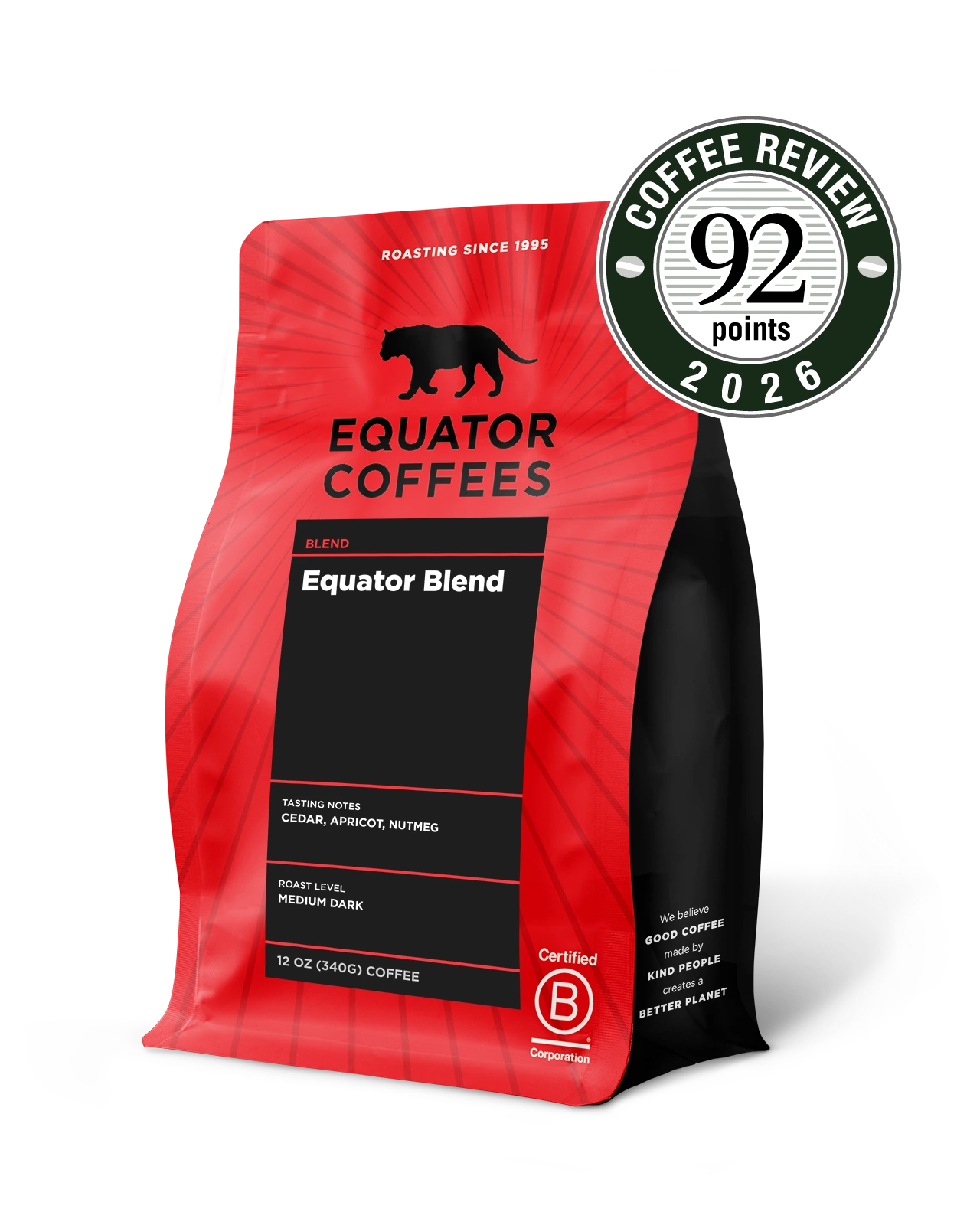
Equator’s current namesake blend panel names wet-hulled Sumatra, washed Kenya, washed Colombia and washed Guatemala. It lists component regions and several varieties, including Sumatran Onanganjang and Sigararutang, Kenyan SL28/SL34/Ruiru 11 and Colombian Caturra/Castillo. This is unusually useful buying detail, but it is still the current panel of a recurring blend, not a guarantee of every later bag. An older owner post named Brazil instead of Guatemala, illustrating why dated sources must not be merged into one supposed permanent recipe. [1] [4]
The direct US listing offered whole bean, several grind choices, and 12 oz, 2 lb and 5 lb. The 12 oz base was $18.50 on October 16. The product image identifies the bag; printed notes and component graphics can lag the current web panel. Check the actual label and roast date. [1]
02 / 6
What flavor evidence can and cannot say
Cedar, apricot, marzipan, milk chocolate and nutmeg are Equator’s current flavor words. Equator’s director of coffee culture describes a medium-dark coffee that can take cream and sugar while remaining drinkable black. This is an attributed roaster judgment, not a Coffeedant tasting. The Kitchn’s older Equator article mentions a household impression of Equator Blend, but its bag predates the current component panel and cannot validate this harvest. [1] [3]
The combination is less single-note than a pure chocolate brief. Cedar and apricot might appeal to someone who wants a little lift; they may deter someone seeking only a heavy dark espresso. We cannot infer note intensity or rank it against a different coffee without a shared tasting protocol.
03 / 6
Choose the brew and keep its recipe separate
Equator publishes 1:15 starts for drip, French press and V60 on the current page, including 24 g coffee to 360 g water for a V60. That is unusually specific for a house blend and lets a filter buyer start with a reproducible recipe. Its espresso-grind selector is not an espresso extraction recipe; a home portafilter needs its own dose, yield and grind. [1]
If one person makes drip and another makes a latte, whole beans and an adjustable grinder give more control than pre-ground “espresso” selected at checkout. For a first trial, make the dominant household brew according to the roaster’s method, note the result, then decide if the second method merits a separate dial-in.
04 / 6
Roast date, storage and pack size
An Equator café bag, direct-shipped bag and grocery bag can have different roast dates. Check the actual package, and store opened whole beans sealed and dry away from heat and odors. Do not treat the page’s current component panel as evidence of the bag on a shelf. [1] [5]
A 2 lb or 5 lb order is sensible only after you know the blend and your weekly consumption. The 12 oz choice gives a lower-risk answer to whether the medium-dark profile and current component mix work for your household.
05 / 6
Dated US value without a taste score
At $18.50 for 12 oz on October 16, Equator Blend’s simple bean cost is about $0.054 per gram. A 24 g V60 dose contains about $1.31 of beans before shipping, tax, waste, filters and water. The roaster’s 24 g/360 g recipe is a start, not a Coffeedant measured cup. [1]
The base price is slightly below the $19.50 Eye of the Tiger listing at this check, but the buying roles differ. A dollar difference should not override whether you mainly need filter instructions or a bright espresso target. Compare current shipping and stock before ordering.
06 / 6
Choose a different bag for a different reason
Eye of the Tiger is Equator’s brighter seasonal espresso with an explicit 18 g/46 g shot start. Decaf Equator Blend is a separate product with different processing and caffeine scope. Keep the names and bags distinct when comparing seller offers. [7]
For milk drinks, the medium-dark Equator Blend has the roaster’s direct cream-and-sugar claim. Our separate guide contrasts that with espresso-first and decaf options instead of calling one coffee a universally best latte bean.
Evidence and limits
How this review was made
This is a research-led US assessment. The exact roaster listing controls identity, current component description, base price and brew advice. Independent and owner reports are attributed to their own sample, date and recipe. Coffeedant has not bought, brewed, tasted, measured or photographed this coffee. We assign no numeric sensory score.
Sources were checked October 16, 2026. Recheck the delivered roast date, component panel, selected size, stock and checkout total. A packaged roast direction or flavor note is not a controlled comparison across bags.
Quick answers
Equator Blend FAQ
What is Equator Blend?
The current panel lists Sumatra, Kenya, Colombia and Guatemala; recheck the bag and live page for future iterations.
What does Equator Blend taste like?
Equator Coffees describes cedar, apricot, marzipan, milk chocolate, nutmeg. Coffeedant has not tasted this coffee.
Which brewing method fits Equator Blend?
Equator gives 1:15 starts for drip, French press and V60. The page does not provide a comparably specific espresso shot target.
Which pack should I buy first?
Start with 12 oz, verify its roast date and your main recipe, then assess whether a larger bag would stay fresh at your use rate.
Is the listed price guaranteed?
No. The US direct base for 12 oz was $18.50 on October 16, 2026; shipping, tax, promotions and stock can change.
Are the origin and notes fixed for future bags?
No guarantee. Check the current roaster page and delivered bag, especially for a rotating blend.
Trace the claims
Sources
- Equator Coffees: Equator Blend product listing
Exact current identity, notes, roast, components where available, sizes, brew and US direct base price. Checked 2026-10-16.
- Counter Culture on year-round components
General explanation of how recurring blend components change; use with date-specific product record. Checked 2026-10-16.
- The Kitchn: older Equator coffees report
Older household impression of Equator Blend within an Eye of the Tiger report; not a current-lot test. Checked 2026-10-16.
- r/espresso: older Equator Blend owner account
Older self-selected account names a different origin mix; not current composition evidence. Checked 2026-10-16.
- Counter Culture coffee freshness guidance
Roast-date and opened whole-bean storage context. Checked 2026-10-16.
- Stumptown whole-bean storage guidance
Independent roaster context on moisture and freezer handling; not product-specific. Checked 2026-10-16.
- Equator Eye of the Tiger Espresso Coffeedant review
Exact alternative product with a separate source boundary. Checked 2026-10-16.
- Equator FAQs
Ordering and product context; verify current delivery details at checkout. Checked 2026-10-16.
The choice
Buy Equator Blend for its documented role
Equator Blend is a practical one-bag candidate for medium-dark drip and French press, with an unusually detailed current origin panel and Equator’s own cream-and-sugar positioning. The page also offers espresso grind, but gives filter recipes rather than a portafilter target; espresso buyers should be ready to dial in without a roaster shot recipe. Start with the 12 oz whole-bean option and let a saved recipe on the actual bag decide the next order.
Check Equator Blend at the roaster