
01 / 7
A seasonal espresso with its own current components
Equator calls Eye of the Tiger a seasonally evolving espresso blend and says the component profile may change about every three months. The accessible product page checked October 16 currently names Costa Rica Tarrazú honey-processed Catuai from Hermanos Monge Ureña and washed Bourbon from Rwanda’s Nyampinga Cooperative. A separately indexed version of the same URL showed Guatemala, Colombia and Papua New Guinea. That is evidence of change or indexing lag, not two compositions to merge. Use the live record and the delivered bag for your roast date. [1] [2]
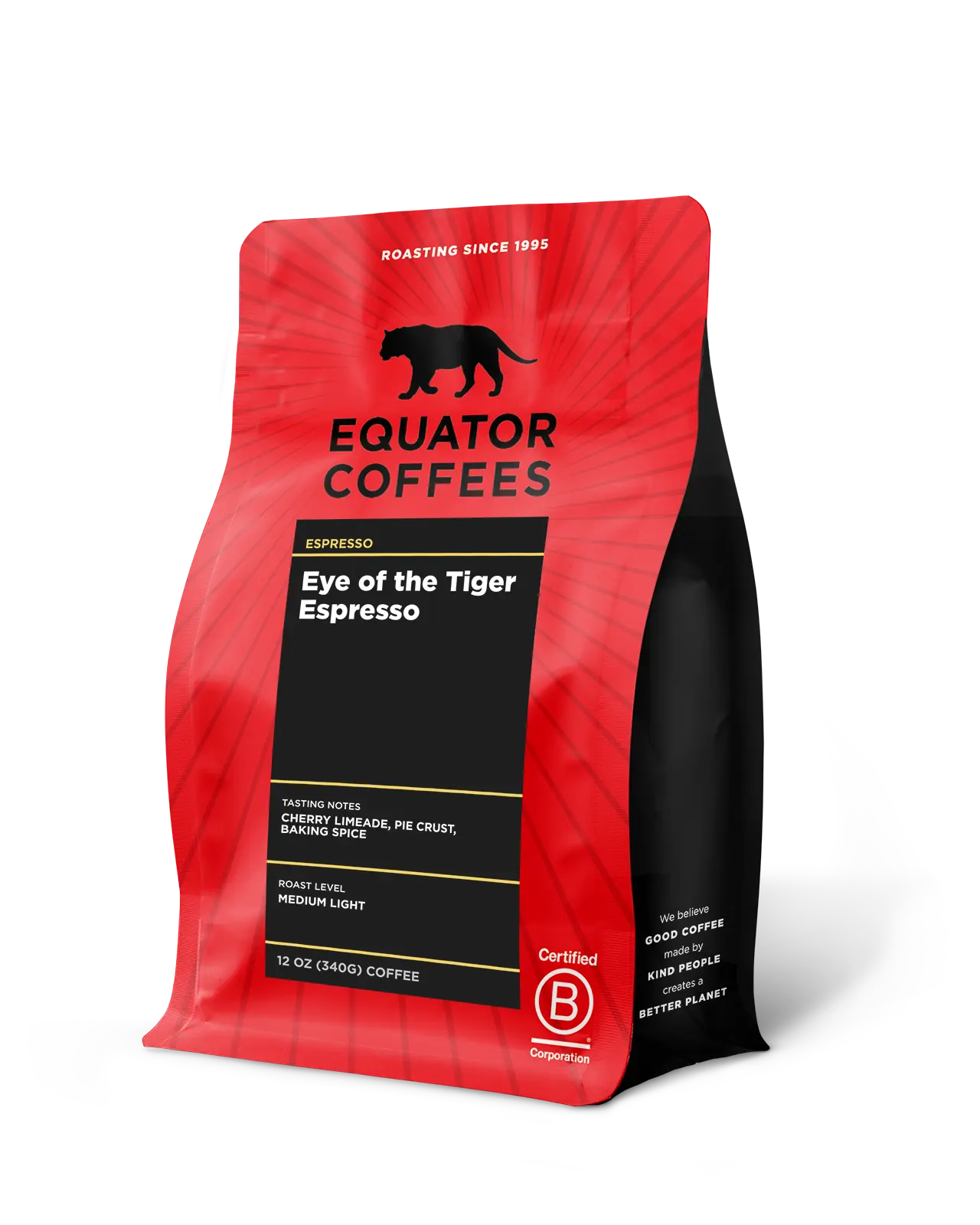
The official US selector listed whole bean and several grinds, with 12 oz, 2 lb and 5 lb sizes; 12 oz was $19.50 before shipping and tax. The credited bag photo has its own older printed notes. It identifies the product line, not the current component panel or the contents of a future bag. [1]
02 / 7
A brighter espresso brief needs a willing palate
Cherry cola, gingersnap and chocolate are the current roaster notes. Equator describes a light, bright espresso and says the Costa Rican coffee contributes body and sweet fruit, while the Rwandan component adds citrus and spice. These are the roaster’s descriptions, not a Coffeedant sensory finding. The Kitchn tasted an older Eye of the Tiger bag in a home espresso context; its favorable impression cannot confirm today’s components or our cup. [1] [3]
An owner thread describes using Eye of the Tiger for home drinks, but its recipe, date and bag are not controlled. The evidence supports an adventurous flavor target and a useful recipe, not a comparative sensory ranking or consistency rate. Buyers who dislike a brighter espresso should treat the stated direction as a reason to skip.
03 / 7
Start from the published 18 g to 46 g shot
Equator’s current espresso panel uses 18 g coffee and 46 g beverage, labeled 1:2.5, with a 23-second example on a Barista Express. The masses are an actionable start if your basket accepts 18 g. The time and grind are not promises on another machine. A scale and fresh whole beans allow you to compare the actual shot with the roaster’s target. [1]
Equator also gives moka-pot and AeroPress starting recipes. Those are different devices and ratios; the “espresso grind” purchase option is a convenience, not proof of a perfect grind for your machine. For milk, begin with a smaller drink if you want to assess whether the cherry-cola direction remains clear, then adjust from your own tasting.
Eye of the Tiger's current roaster page gives different starts if espresso is only one use for the bag: its moka-pot guide lists 30 g coffee to 300 g water for a six-cup Bialetti, and its AeroPress guide lists 18 g to 200 g with a 50 g bloom and a two-minute stir-and-plunge point. Neither is a portafilter shot, so the page's separate 18 g to 46 g espresso example should not be transplanted to them. With a seasonally changing blend, note the bag date and device before comparing a later cup; these are Equator recipes, not Coffeedant extractions. Checked October 21, 2026. [9]
04 / 7
Seasonal detail belongs with the received bag
Seasonal blend changes make the roast date and product panel especially useful. Record the component summary and recipe with a first 12 oz bag. If a later bag changes origin, start the dial-in again instead of treating a saved grinder number as universal. [1]
Equator offers 2 lb and 5 lb, but the larger bag ties you to one seasonal iteration and a freshness plan. Keep opened whole beans sealed, cool and dry. An office or café may finish a bulk pack quickly; an occasional home espresso drinker may not.
05 / 7
Compare espresso value using a complete shot
The October 16 US direct base was $19.50 for 12 oz. At an illustrative 18 g dose, the bean portion is about $1.03 before dialing waste, milk, water, tax or delivery. This is arithmetic from the displayed pack price and a common 340 g conversion, not a measured drink cost. [1]
A 2 lb or 5 lb price-per-ounce saving is useful only if the current recipe and changing profile fit and the pack will be consumed at an acceptable freshness. Do not apply a retailer’s old sample review to a bulk order without checking the lot.
06 / 7
Let a straight shot answer the bright-espresso question
With a suitable basket, record a first shot around the roaster’s 18 g to 46 g start and taste before adding milk. The question is whether you enjoy the brighter direction enough to keep dialing in. If you mainly brew drip or press and want explicit filter instructions, Equator Blend is the more direct same-roaster comparison.
07 / 7
Equator Blend has the stronger filter-method case
Onyx Monarch is the existing full-review alternative for a darker, cocoa-and-fruit espresso brief. Intelligentsia Black Cat Classic is another recurring espresso blend. Eye of the Tiger makes a distinct case through explicit seasonal component disclosure and an 18 g/46 g recipe. [7]
Equator Blend is the namesake medium-dark coffee with detailed filter recipes and a cream-and-sugar claim. It is a better first look for a household that mainly makes batch drip and only occasionally makes espresso.
Evidence and limits
How this review was made
This is a research-led US assessment. The exact roaster listing controls identity, current component description, base price and brew advice. Independent and owner reports are attributed to their own sample, date and recipe. Coffeedant has not bought, brewed, tasted, measured or photographed this coffee. We assign no numeric sensory score.
Sources were checked October 16, 2026. Recheck the delivered roast date, component panel, selected size, stock and checkout total. A packaged roast direction or flavor note is not a controlled comparison across bags.
Quick answers
Eye of the Tiger Espresso FAQ
Are the origins fixed?
No. Equator says the blend is seasonal, and older indexed versions name other component origins.
What does Eye of the Tiger Espresso taste like?
Equator Coffees describes cherry cola, gingersnap, chocolate. Coffeedant has not tasted this coffee.
Which brewing method fits Eye of the Tiger Espresso?
Equator gives 18 g coffee to 46 g beverage as a starting espresso recipe. Adjust grind and yield for the delivered bag and basket.
Is the listed price guaranteed?
No. The US direct base for 12 oz was $19.50 on October 16, 2026; shipping, tax, promotions and stock can change.
Trace the claims
Sources
- Equator Coffees: Eye of the Tiger Espresso product listing
Exact current identity, notes, roast, components where available, sizes, brew and US direct base price. Checked 2026-10-16.
- Counter Culture on year-round components
General explanation of how recurring blend components change; use with date-specific product record. Checked 2026-10-16.
- The Kitchn: Eye of the Tiger home espresso sample
Independent tasting of an older seasonal iteration; not current-lot confirmation. Checked 2026-10-16.
- r/espresso: Equator espresso discussion
Self-selected café and home comments; no controlled current-bag assessment. Checked 2026-10-16.
- Counter Culture coffee freshness guidance
Roast-date and opened whole-bean storage context. Checked 2026-10-16.
- Stumptown whole-bean storage guidance
Independent roaster context on moisture and freezer handling; not product-specific. Checked 2026-10-16.
- Onyx Coffee Lab Monarch Coffeedant review
Exact alternative product with a separate source boundary. Checked 2026-10-16.
- Equator brew guides
Device-specific brewing context; not a Coffeedant extraction. Checked 2026-10-16.
- Equator Eye of the Tiger multi-device brew guide
Current page distinguishes Barista Express espresso, six-cup Bialetti moka and AeroPress starts. Research-led clarification; no Coffeedant tasting or price claim. Checked 2026-10-21.
The choice
Choose the espresso-first Equator for an espresso-first routine
Eye of the Tiger is compelling when seasonal espresso and an explicit starting shot are what you want. The namesake Equator Blend answers a different medium-dark filter brief. Keep those roles visible when a small price difference makes the two look interchangeable.
Check Eye of the Tiger Espresso at the roaster