
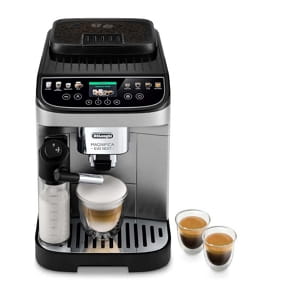
Price reality: MSRP $799 to $899. This is a conditional buy. It makes sense mainly on sale around $700 to $750. At full price, it sits too close to Magnifica Plus.
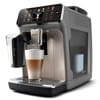
De’Longhi Magnifica Evo Next
A capable mid-range super-automatic that makes consistently good espresso with easy milk drinks, but it lives in an awkward price band. It is hard to recommend at full price when Magnifica Plus is usually a small step up.
Overview
The Magnifica Evo Next is basically the Magnifica Evo platform with a better front end and a bit more dosing headroom. You get a color display, more one-touch recipes, three user profiles, and a longer grind window that can push doses to about 13.5 g. Espresso quality and crema are strong for a super-automatic, and LatteCrema makes milk drinks easy. The catch is positioning: it costs too much to be the obvious value pick, and it is too close to Magnifica Plus to be the obvious performance pick.
Pros
- Consistently good espresso with thick crema for the category
- LatteCrema Hot makes creamy milk foam with minimal effort
- 13 one-touch recipes plus 3 user profiles for households
- Steel conical burr grinder with 13 settings
- Removable brew group for real cleaning and easier ownership
- Fast thermoblock warm-up, roughly 45 seconds from cold
Cons
- Awkward value at $799 to $899, too close to Magnifica Plus
- Milk temperature often lands warm, not truly hot
- Over-sensitive capacitive buttons can trigger accidental drinks
- Grinding is loud for a few seconds per drink
- Grounds bin fills fast and maintenance can feel frequent in hard water
The Only Time This Is a Clear Buy
This machine is a value problem, not a performance problem. The espresso and milk convenience are good. The recommendation hinges on price.
- Buy it when you see $700 to $750.
- Skip it at $799 to $899 if Magnifica Plus is within $100 to $200.
- Save money with base Magnifica Evo if you do not need profiles and extra recipes.
- Choose Philips 3200 LatteGo if cleaning convenience is your top priority and you want to spend less.
Key Specs
Note: Some listings vary slightly by pack and region.
Taste and Real-World Performance
- Espresso: The headline. Good body for a super-automatic and stable crema with fresh beans.
- Best grinder range: Most users land around settings 3 to 4. The finest setting can cause errors on some units.
- Milk foam: Creamy and smooth. It is usually better foam than Philips LatteGo style systems.
- Milk heat: Often the main complaint. Foam is good, temperature is only warm for many preferences.
- Noise: Grinder burst is loud, then the rest of the drink is much calmer.
- Buttons: Capacitive controls can be too sensitive, which makes cleaning around the panel annoying.
Setup Checklist That Actually Helps
- Start conservative on grind: Begin at 4, pull a few drinks, then tighten toward 3 if shots taste thin.
- Use medium-dark beans first: They give the easiest wins on crema and body while you dial the machine.
- Set intensity high for espresso: Many people land at intensity 4 or 5 for a stronger cup.
- Pick high temp if you like hot drinks: It helps, but it will not fully solve the milk heat complaint for everyone.
- Save profiles early: Profiles are the real reason to choose this over base Evo for households.
- Keep the front panel clear: Sensitive buttons trigger accidental drinks when you brush past them.
Maintenance and Ownership Reality
- Daily: Let the auto-rinse do its thing. Empty drip tray as needed. Quick wipe on the milk system.
- After milk drinks: Run the milk self-clean cycle and store the carafe in the fridge.
- Weekly: Remove the brew group, rinse, and let it dry. Deep-clean the carafe parts.
- Grounds bin: Plan on emptying often if you make multiple drinks per day.
- Descale: Hard water can trigger frequent descale alerts. Use De’Longhi solution, not vinegar.
This is the deal: super-automatics reward maintenance discipline. Neglect tends to show up as water circuit errors, milk system issues, or grinder clogs.
Who It’s For
- Buy if: You want one-touch drinks, you want profiles, you like stronger super-auto espresso, and you can buy on sale.
- Skip if: You need piping hot milk drinks, ultra-quiet grinding, or you hate frequent maintenance prompts.
- Better pick above: Magnifica Plus when it is within $100 to $200.
- Better pick below: Base Magnifica Evo for value, Philips 3200 LatteGo for convenience-first cleaning.
The De'Longhi Magnifica Evo Next is a capable mid-range super-automatic espresso machine that delivers café-quality drinks with minimal effort, but it suffers from unfortunate market positioning. Priced at $799-$899, it sits uncomfortably close to the superior Magnifica Plus ($999) while costing significantly more than the Philips 3200 LatteGo ($650-$750) that offers better convenience value. The machine excels at producing consistently good espresso with thick crema, features an automatic milk frothing system, and includes 3 user profiles—but most experts recommend either saving money with the standard Magnifica Evo ($550 on sale) or investing an extra $100-$200 in the Magnifica Plus for substantially better performance. This machine makes sense primarily when found on sale for $700-$750, or when the Magnifica Plus is unavailable or priced above $1,200.
The Evo Next represents De'Longhi's attempt to bridge entry-level and premium super-automatics, adding meaningful upgrades over the base Magnifica Evo: a 2.4" color TFT display, 13 one-touch recipes (vs. 7), 3 customizable user profiles, and enhanced dosing capability (9-second grind time allowing up to 13.5g doses). It uses a thermoblock heating system with 15-bar pressure pump and stainless steel conical burr grinder with 13 settings. The LatteCrema Hot automatic milk system produces creamy microfoam suitable for lattes and cappuccinos. While these features sound impressive on paper, the reality is that this machine occupies a challenging competitive position where it's neither the best value nor the best performer in its segment.
Technical specifications reveal a competent but not exceptional platform
The Magnifica Evo Next measures 9.45" x 17.3" x 14.17" and weighs approximately 21-27 pounds (sources vary slightly). It features a 1.8-liter water tank, 250g bean hopper, and 9.5 fl oz milk carafe—sufficient for about 2 lattes before refilling. The machine draws 1450 watts and heats from cold start in approximately 45 seconds, which is respectable but not class-leading.
The grinder system employs stainless steel conical burrs—a significant advantage over ceramic alternatives found in competing Philips machines, as steel burrs typically last 5-7 years or longer versus 3-5 years for ceramic. The grinder offers 13 adjustment settings (positions 1-7 with half-step increments), though testing reveals the finest setting (#1) causes machine errors and grounds dumping. Experts recommend settings 3-4 for optimal extraction. The maximum grind time of 9 seconds represents a meaningful upgrade from the standard Evo's 7 seconds but falls short of the Magnifica Plus's 10-second capability, which allows for 14-15g doses and more intense espresso.
The brew system uses a single thermoblock rather than a dual boiler or heat exchanger system. Temperature settings range from 160-165°F on standard to 170-175°F on high, with professional testing confirming extraction temperatures of 88°C (190°F) at the spout and 75°C (167°F) in-cup. These temperatures are adequate but not exceptional—some users find both coffee and milk underwhelming in terms of heat. The thermoblock design does provide the advantage of faster heating and reduced wait time between brewing and steaming compared to single boiler systems.
The interface features soft-touch capacitive buttons surrounding the color display—not a true touchscreen despite its modern appearance. This design choice proves problematic, with multiple reviewers reporting accidentally starting drinks by brushing against the overly-sensitive buttons during cleaning or movement around the machine. The display shows polite feedback messages like "you're becoming a pro," though some find this more gimmicky than helpful.
One notable specification is the 14-serving grounds container capacity, which requires frequent emptying for heavy users. The removable brew group—accessible from the side panel—represents a significant maintenance advantage over sealed systems in competitors, allowing for thorough cleaning without professional service.
Real-world performance delivers consistency with notable temperature compromises
User reviews from Best Buy show 4.6/5 stars across 626 reviews for the similar Magnifica Evo line, with consistently positive feedback about ease of use and coffee quality. The Evo Next, being newer (2024/2025 model), has limited long-term ownership data, but experiences align closely with the established Evo platform since they share core components.
Espresso quality receives universal praise. Users describe shots as "excellent," "silky and smooth," and "comparable to coffee shop beverages." The machine produces thick, stable crema when using fresh beans, particularly medium-dark roasts with 20% robusta content. Professional reviewer Tom's Coffee Corner notes the machine does "quite a good job for espresso" with "above average body for a superautomatic." Testing confirms well-balanced extraction with proper settings, though the machine cannot dose finely enough or heavily enough to "choke" like prosumer manual machines.
The LatteCrema automatic milk system emerges as a major selling point. Users consistently praise it as producing "creamy, smooth foam"—better than the Philips LatteGo system according to multiple expert comparisons. One Best Buy reviewer called it "a gift from heaven." The detachable 280ml carafe can be stored in the refrigerator between uses, a convenience feature highly valued by daily users. The system works with both dairy and plant-based milks, though results vary significantly—barista-grade oat milk performs well, while standard oat milk disappoints.
However, milk temperature represents the most consistent complaint. The system produces milk at 140-150°F, which many users find insufficient. As one professional review notes, "it could perhaps be just a little hotter for some people." This limitation affects overall drink satisfaction for those who prefer piping-hot beverages. The milk also "spits out" rather than flowing smoothly—a quality concern noted by TechRadar's reviewer as "not something I'd expect from a premium machine."
Noise levels measured at 82dB during grinding—comparable to a blender on medium speed—for 5-7 seconds per drink. This exceeds the standard Magnifica Evo and proves problematic for noise-sensitive users or early-morning use in shared living spaces. The grinding noise drops to 72dB during tamping and 66dB during pouring, making the grinder by far the loudest component. While these levels are typical for mid-range super-automatics, they're noticeably louder than premium models with enhanced sound insulation.
Cleaning and maintenance requirements prove manageable but frequent. The machine performs automatic rinse cycles on startup and shutdown, and the milk system self-cleans after each use. However, users report descaling alerts every 20-30 days with hard water—more frequent than advertised. One Best Buy reviewer complained: "Makes great coffee but the maintenance is a little too much, the light to descale the machine comes on every 20 to 25 days." The descaling process takes approximately 30 minutes and requires De'Longhi-branded solution (vinegar damages internal components). Weekly maintenance includes removing and rinsing the brew unit, deep cleaning the milk carafe, and emptying the grounds tray every 2-3 days to prevent moisture buildup.
Long-term reliability data suggests a 5-7 year expected lifespan with proper maintenance. The steel burr grinder should last approximately 10 years. However, some concerning early failures appear in user reports: water circuit errors after just one month following first brew group cleaning, milk system sensors failing to detect the carafe, and grinder jams requiring professional service. These issues seem correlated with inadequate maintenance rather than manufacturing defects, though De'Longhi's customer service receives mixed reviews with complaints about long repair times (3+ weeks) and difficulty reaching supervisors.
Professional testing confirms capable performance with clear limitations
Professional reviews from TechRadar, Tom's Coffee Corner, Coffeeness, and CoffeeDrinker provide consistent assessments. TechRadar awarded 4.5/5 for design, 4/5 for performance, and 5/5 for value, though this assumes reasonable pricing. Their quantitative testing using a decibel meter confirmed the 82dB grinding noise, while timing tests showed approximately 40 seconds for espresso extraction at intensity level 5 and 90 seconds for cappuccinos including milk.
Tom's Coffee Corner—a specialized coffee equipment reviewer with engineering background—positions the Evo Next as "better than Magnifica Evo/Start, but not quite as good as Magnifica Plus." His dosing measurements confirmed maximum 13.5g capacity with the 9-second grind time on Doppio+ at maximum bean setting, compared to 7 seconds on the base Evo and 10 seconds on the Plus/Dinamica models. He describes extraction quality as producing "well balanced, with above average body for a superautomatic" and notes the milk system is "pretty pleased" with performance better than Philips but "not as good as traditional espresso machine."
Coffeeness.de's assessment highlights the machine as "yet again, produced a really good fully automatic coffee machine that doesn't cost the earth," noting it "offers substantially more than the Magnifica Evo, while not quite reaching the heights of the Magnifica Plus." This perfectly captures the machine's market position.
French testing site Coffealover.com provided rare quantitative temperature measurements: 88°C (190°F) extraction temperature at spout and 75°C (167°F) in-cup temperature on medium setting, which they deemed "relatively in line with the rest of the market." Their crema retention testing showed foam lasting 20+ minutes, indicating proper extraction.
CoffeeDrinker.net's technical analysis confirms the 15-bar pressure pump delivers appropriate extraction pressure with 25-30 second shot times—within Specialty Coffee Association parameters. Their assessment: "delivers café-quality espresso with minimal effort...impressive for its price point."
Notably absent from professional coverage: James Hoffmann (no review of this model), RTINGS (doesn't test coffee machines), Wirecutter/NYT, Consumer Reports, Tom's Guide, and CNET have not reviewed the Magnifica Evo Next specifically. This limited coverage from top-tier consumer testing organizations suggests the machine may be too new or too narrowly positioned to warrant attention from mainstream reviewers who typically focus on clear category leaders or budget champions.
The consistent professional consensus: a solid "very good" super-automatic that delivers on promises for its price point, with expected compromises in this category—namely limited fine-tuning capability, moderate noise, and milk temperature that could be hotter.
Market positioning creates an awkward value proposition against competitors
The Magnifica Evo Next faces fierce competition from multiple directions, creating a challenging value equation. At $799-$899 MSRP, it sits in a crowded $700-$1,200 segment where it's neither the cheapest nor the best option.
Within De'Longhi's own lineup, the Evo Next struggles against both lower and higher-priced stablemates. The standard Magnifica Evo frequently sells for $549-$650 (especially during sales), offering 80% of the Evo Next's functionality at 65% of the price. The differences—a basic display versus color TFT, 7 recipes versus 13, zero user profiles versus 3, and 7-second versus 9-second maximum grind time—don't justify a $250-$350 premium for many users.
More problematic is the Magnifica Plus at $999, which multiple expert reviewers describe as definitively superior. The Plus offers a full touchscreen (not just buttons around a screen), 18 recipes including flat white and cortado, 4 user profiles, most critically 10-second grind capability allowing 14-15g doses, and 3 adjustable milk texture settings versus the Evo Next's single preset. Tom's Coffee Corner states flatly: "This would be a slam dunk winner, if it would dose for 10 seconds, to get a nice large 14-15 gram dose" like the Plus. In the U.S. market where both machines often sell at similar prices ($899-$999), the Plus represents objectively better value. The Evo Next makes sense only in markets where the Plus commands a significant premium or when the Plus is unavailable.
| Feature | Magnifica Evo ($550) | Evo Next ($800-900) | Magnifica Plus ($999) |
|---|---|---|---|
| Display | Basic soft-touch | 2.4" TFT color | 3.5" touchscreen |
| Recipes | 7 | 13 | 18 |
| User Profiles | 0 | 3 | 4 |
| Max Grind Time | 7 sec | 9 sec | 10 sec |
| Max Dose | ~11g | 13.5g | 14-15g |
| Milk Textures | 1 | 1 | 3 adjustable |
| Value Score | Excellent | Questionable | Excellent |
Against external competitors, the Philips 3200 LatteGo at $650-$750 offers superior value for convenience-focused users. While the De'Longhi produces better espresso quality with thicker crema and more intensity options (5 levels versus 3), the Philips counters with a 2-piece dishwasher-safe milk system (easier to clean), AquaClean filter that extends descaling intervals to 12-24 months versus 2-3 months, faster brewing, more compact design, and Eco Mode for energy efficiency. The Philips uses ceramic burrs (less durable than steel) and produces lighter crema with cooler extraction temperatures, but for users prioritizing ease of use over ultimate espresso intensity, it delivers better overall value at $150-250 less.
Breville occupies a different category entirely. The company doesn't make true super-automatics comparable to De'Longhi—their lineup consists of semi-automatic machines like the Barista Express ($599) requiring manual grinding, dosing, tamping, and steaming. The only comparable Breville is the Oracle Touch at $2,500-$2,800, a hybrid system that's 3x the price and targets serious home baristas rather than convenience seekers.
The Jura E6 at $1,000-$1,200 represents the Swiss premium alternative with superior build quality and brand cachet but offers only 11 drink recipes and similar core functionality. Most users find the Jura's premium difficult to justify over the Magnifica Plus at $200-$400 less.
This competitive landscape reveals the Evo Next's fundamental problem: it's trapped between better-value options on both sides. Users wanting convenience and easy cleaning should choose the Philips 3200 and save $150-250. Users wanting the best possible super-automatic espresso should invest an extra $100-200 in the Magnifica Plus. The Evo Next makes sense only in narrow circumstances: found on sale for $700-750, when the Plus is unavailable or overpriced above $1,200, or when a household specifically needs exactly 3 user profiles (not 0 or 4).
Ownership experience emphasizes convenience with maintenance discipline required
Daily operation proves refreshingly simple once settings are dialed in. The machine requires approximately 10-20 cups of trial and error to find optimal grind setting (typically 3-4), intensity level (usually 4-5 for robust espresso), and temperature preference. Users report the learning curve as moderate—not intuitive for complete beginners but manageable with patience. TechRadar notes "there's a slight learning curve" and recommends "prepare for trial and error."
The 3 user profile system emerges as genuinely useful for households. Each family member can save preferred settings for all 13 drink types, eliminating daily adjustments. This feature alone justifies the upgrade from the zero-profile base Evo for multi-user households, though the 4-profile Magnifica Plus obviously provides even more flexibility.
Customization options prove extensive: 5 intensity levels × 4 volume sizes × 3 temperature settings = 60 possible combinations per drink type. The "MY" button allows on-the-fly adjustments without permanently changing saved profiles. This level of personalization exceeds the Philips 3200's more limited customization and matches more expensive machines.
However, the overly-sensitive capacitive buttons frustrate multiple reviewers. Tom's Coffee Corner complains: "I have brushed up against them accidentally many times, and started a drink when I didn't want to." This design flaw—buttons with no tactile feedback that activate on light touch—means users must be careful when cleaning around the machine or placing items nearby.
Cost savings calculations show strong ROI for daily coffee shop visitors. At $4-6 per café drink, users spending $2,920-$4,380 annually on two daily drinks can reduce costs to $219-$365 per year using home-brewed coffee (whole beans at $0.30-0.50 per cup). The 3-4 month payback period makes this machine economically attractive for frequent users. Best Buy reviewers consistently cite savings: "This machine seems pricey but it's actually saving us over $7 a day for not going to Starbucks."
Build quality receives mixed assessments. The plastic housing with brushed metal accents "feels robust" and "fit together nicely" according to reviews, but concerns emerge about specific components. The water reservoir uses thin plastic susceptible to cracks if handled roughly. The bean hopper lid hinge feels delicate and requires careful opening. These aren't dealbreakers but suggest this isn't a truly premium machine—it's appropriately built for its mid-range positioning. The stainless steel burr grinder represents the most durable component with expected 10-year lifespan.
Maintenance discipline proves essential for longevity. Users who neglect weekly brew group cleaning and regular descaling report problems: water circuit errors, grinder efficiency degradation, milk system blockages, and scale buildup affecting extraction quality. Those who follow the maintenance schedule report excellent reliability, with some owners using machines daily for over a year without issues beyond routine cleaning. The key insight: this machine demands respect and regular care, rewarding diligent users with years of reliable service while punishing neglect with breakdowns.
Common failure modes when they occur: water circuit diverter valve issues (water diverts to drip tray instead of spout), milk system sensors not detecting carafe, brew group jamming during reassembly, grinder blockages from coffee dust buildup, and descaling alerts that persist despite proper descaling. Most of these prove related to maintenance lapses rather than manufacturing defects, though some early failures occur even with proper care. De'Longhi's customer service receives inconsistent reviews—some report excellent support with courtesy replacements, others describe long repair times (3+ weeks) and difficulty reaching supervisors. The 2-year warranty (extendable to 3 years with registration) provides reasonable coverage but doesn't renew with repairs.
Who should buy this machine depends entirely on pricing and alternatives
The Magnifica Evo Next serves a specific audience well but only under the right circumstances. Buy this machine if you find it on sale for $700-750, the Magnifica Plus is unavailable or priced above $1,200 in your market, you need exactly 3 user profiles for a multi-person household, you prioritize espresso intensity and quality over cleaning convenience, and you're willing to perform regular maintenance including descaling every 2-3 months.
Ideal users include busy professionals and families wanting café-quality drinks without barista skills, coffee enthusiasts on a budget who appreciate customization without needing professional-level control, upgraders from pod machines seeking better coffee with similar convenience, first-time super-automatic buyers looking for a user-friendly introduction with automatic milk frothing, and small offices with 2-4 people making 5-10 drinks daily.
Look elsewhere if you're a true coffee perfectionist wanting manual control (consider prosumer semi-automatics), a latte art enthusiast needing fine microfoam (the automatic system can't produce barista-level texture), very high-volume user making 20+ drinks daily (the 14-serving grounds capacity requires constant emptying), extremely noise-sensitive (82dB grinding will disturb you), seeking ultra-hot beverages (140-150°F milk won't satisfy), working with very limited counter space (9.4" × 17.3" footprint plus overhead clearance), or exclusively using standard plant-based milks (requires barista-grade versions for acceptable results).
Better alternatives exist for most users at similar price points. The Philips 3200 LatteGo at $650-750 provides superior convenience value with easier cleaning, less frequent maintenance, and adequate espresso quality for non-purists. The Magnifica Plus at $999 delivers definitively better performance—superior espresso with 10-second dosing, 3 adjustable milk textures, touchscreen interface, and 18 recipes—for just $100-200 more, making it the obvious choice when available at typical U.S. pricing. The standard Magnifica Evo at $549 on sale offers 80% of the Evo Next's capabilities at 65% of the price, sacrificing only the color display, user profiles, and 6 additional drink recipes—features many users don't need.
The honest assessment: the Magnifica Evo Next is a B+ product in the wrong price position, earning only a C+ overall value score. It's a capable super-automatic that produces consistently good espresso with convenient automatic milk frothing, but it's squeezed between better-value competitors on both sides. At $899 retail, it's hard to recommend when the Magnifica Plus costs just $100 more and delivers substantially better performance. The machine makes sense only in narrow circumstances—primarily when found on deep discount or when regional pricing makes the Plus significantly more expensive.
The real insight: De'Longhi created an orphan product in its own lineup
The fundamental issue with the Magnifica Evo Next isn't that it's a bad machine—it's actually quite good at what it does. The problem is strategic positioning in a crowded product line where it fills a gap nobody asked for. De'Longhi has created a hierarchy of Magnifica Start ($500-600), Evo ($550-750), Evo Next ($800-900), and Plus ($999) that makes sense from a marketing perspective but creates confusion in practice. Each step up adds features, but the value proposition weakens as you climb—the base Evo offers exceptional value, the Plus delivers premium features at fair pricing, but the Evo Next sits awkwardly in between without a clear identity.
This machine would thrive if the Magnifica Plus didn't exist or if De'Longhi priced it at $699 where the gap to the Plus justified both machines' existence. Instead, at $799-899, it's too close to superior options and too far from budget alternatives to carve out a sustainable market position. The machine's fate depends entirely on sales and discounts—at $700-750, it becomes competitive; at $899, it's almost impossible to recommend over the Plus or the Philips 3200.
For prospective buyers, the takeaway is clear: don't pay full price for the Evo Next. Wait for sales, compare carefully against the Magnifica Plus pricing in your region, and consider whether you might be better served by either saving money with the base Evo or investing in the meaningfully better Plus. The Evo Next represents the classic middle-child syndrome—neither the scrappy budget option nor the accomplished premium model, but rather a competent compromise that satisfies few users' actual needs. De'Longhi would serve customers better by discontinuing this model and focusing on the clear value champion (Magnifica Evo) and clear quality champion (Magnifica Plus), leaving the Evo Next as a curious footnote in super-automatic espresso machine history.