
02Start with the decision
EspressoGC Black PLUS in one honest frame
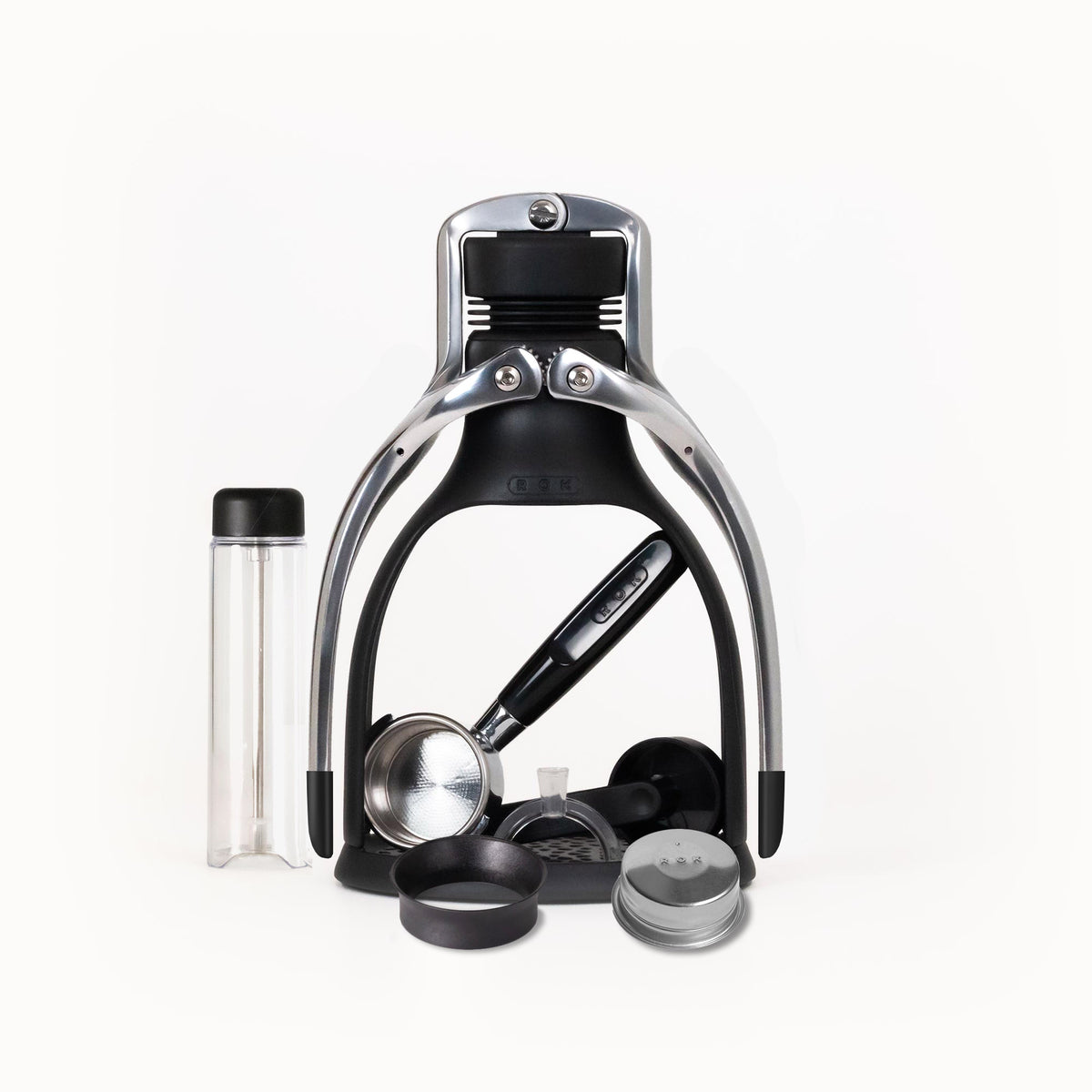
EspressoGC Black PLUS gives a non-electric lever two basket paths: the standard basket rewards deliberate grinding and preparation, while Smartshot restricts flow for a more forgiving start. The glass-composite chamber and dual arms keep the mechanism simple, with no pressure gauge or heater to organize the shot for you. Hot water, thermal preparation, a scale and cleanup all stay with the owner. The included manual milk frother is an accessory rather than a steam system. This package is attractive when quiet, deliberate espresso is the goal, and less useful when several effortless drinks are the expected morning routine. [source] [source] [source] [source] [source] [source]
The Product schema and scores apply only to the current EspressoGC Black PLUS package sold by ROK USA. They do not merge the original Presso, pre-GC ROK bodies, a machine fitted only with the GC conversion kit, commercial or pressure-gauge editions, Presso Smartshot, silver Classic PLUS, Explorer Edition bundles, a naked-portafilter bundle or seller-specific regional packages. ROK sells a conversion kit that can make an older body resemble the current GC brew chamber, but that does not prove identical age, wear, accessories or warranty.
The strongest reason to choose it: The current package offers two genuinely different coffee paths in a compact mechanical platform: the standard basket rewards espresso dialing, while Smartshot lowers the entry barrier. The main reason to pause: Without a heater or pressure gauge, the operator must create and judge thermal state, puck resistance, preinfusion, force, timing and yield on every shot.
03The first week
Set up the whole station, not only the machine
Place the 7 by 7 inch base on a stable dry counter with overhead and arm clearance. Add a capable kettle, scale and grinder if the standard basket is the goal. Identify the standard and Smartshot baskets before brewing because they need different expectations. ROK says the product is not dishwasher safe. Practice the fill, lock, lever and safe residual-water routine before optimizing a recipe. [source] [source]

04Rating deep dive
Espresso: control the variables the machine leaves to you
With the standard basket, grind, dose, distribution, tamp, water temperature, chamber preheat, fill level and lever force all affect the shot. The official page suggests a 25 to 30 second pull, but that is guidance rather than an automatic program. The Smartshot basket restricts flow and broadens acceptable grind, making it useful for entry or less capable grinders, though it does not make every coffee identical. The Black PLUS package provides no gauge, so use a scale, time and taste to keep adjustments interpretable. [source] [source] [source]
Espresso assessment
Espresso evidence translated into daily use
The EspressoGC Black PLUS score is an editorial judgment from documented design, independent demonstrations, owner context, and the dated market position. It is not a bench result from Coffeedant.
| Signal | What the evidence says | Buying consequence |
|---|---|---|
| Brew architecture | Two baskets create distinct standard and restricted-flow workflows. | The standard basket and direct dual-arm force can support serious espresso, while Smartshot adds a more forgiving entry path. |
| Control available | The owner creates preinfusion and pressure without a gauge. | Strong for a learner who enjoys adjusting heat and grind; weak for anyone expecting a machine to stabilize or report those variables. |
| Recipe consequence | Heat, grind, dose and yield remain external recipe variables. | Treat this as part of the EspressoGC Black PLUS buying decision, not a promise of identical results in every kitchen. |
Evidence note: Unknowns stay unknown. Variations in coffee, water, milk, setup, firmware, regional package, wear, and technique can change the experience described by these sources.
05Rating deep dive
Milk: speed only matters when texture stays controllable
A separate hand-pump frother is included, but EspressoGC has no steam boiler or wand. Milk must be heated separately, then pumped and poured around the espresso sequence. That can serve an occasional cappuccino, but it adds a second vessel and cannot provide the continuous wet-steam control of a boiler machine. [source]
Milk assessment
Milk evidence translated into daily use
The EspressoGC Black PLUS score is an editorial judgment from documented design, independent demonstrations, owner context, and the dated market position. It is not a bench result from Coffeedant.
| Signal | What the evidence says | Buying consequence |
|---|---|---|
| Steam or milk system | A hand-pump frother is included in the current PLUS package. | The included manual frother is useful but separate from the brewer and cannot steam. |
| Operator input | Milk needs separate heating and handling. | Adequate for occasional foam; cumbersome for repeat milk drinks or precise microfoam practice. |
| Queue consequence | There is no steam boiler, wand or simultaneous milk work. | Treat this as part of the EspressoGC Black PLUS buying decision, not a promise of identical results in every kitchen. |
Evidence note: Unknowns stay unknown. Variations in coffee, water, milk, setup, firmware, regional package, wear, and technique can change the experience described by these sources.
06Rating deep dive
Workflow: count every touch from cold start to a clean counter
A drink means heating water, preparing coffee, optionally warming brew parts, locking the portafilter, filling the chamber, raising and lowering both arms, watching time and yield, then clearing residual water and rinsing the basket. Simple mechanics do not mean few actions. Back-to-back drinks repeat the full heat, dose, pull and cleanup sequence. [source] [source]
Workflow assessment
Workflow evidence translated into daily use
The EspressoGC Black PLUS score is an editorial judgment from documented design, independent demonstrations, owner context, and the dated market position. It is not a bench result from Coffeedant.
| Signal | What the evidence says | Buying consequence |
|---|---|---|
| Cold-start routine | A kettle, grinder or coffee source and scale live beside the machine. | Mechanics are understandable, but every drink still contains hot-water, preheat, lever and rinse steps. |
| Drink sequence | Both arms provide direct feedback but no automatic stop. | Best for one deliberate drink; the friction becomes obvious in a household queue. |
| Cleanup load | Residual water and coffee parts need manual clearing after each pull. | Treat this as part of the EspressoGC Black PLUS buying decision, not a promise of identical results in every kitchen. |
Evidence note: Unknowns stay unknown. Variations in coffee, water, milk, setup, firmware, regional package, wear, and technique can change the experience described by these sources.
07Rating deep dive
Build and service: judge access, support, and failure response
ROK documents powder-coated aluminium, stainless steel, glass-composite and silicone in a 5.3 lb chassis. The official $35 conversion kit supplies a cylinder, plunger, O-ring and competition screen for older or current GC units, showing that core brew parts are designed to be replaceable. That parts path supports repairability, not a measured lifespan. [source] [source]
Let hot parts cool safely, remove grounds, rinse the basket and portafilter, wipe the chamber and frame, and dry parts before storage. Do not use a dishwasher. Inspect the silicone seal, screen, basket and locking points, and match replacement parts to the exact body and generation. ROK markets the machine as requiring no boiler descaling, but that does not eliminate normal rinsing, inspection or wear-part replacement.
Build assessment
Build evidence translated into daily use
The EspressoGC Black PLUS score is an editorial judgment from documented design, independent demonstrations, owner context, and the dated market position. It is not a bench result from Coffeedant.
| Signal | What the evidence says | Buying consequence |
|---|---|---|
| Core construction | Powder-coated aluminium and stainless steel carry the main structure. | Metal structure, replaceable GC brew parts and a long limited warranty form a convincing mechanical ownership case. |
| Access and care | Glass-composite chamber and silicone seal are replaceable components. | The architecture is serviceable, but wear exclusions and generation matching still matter. |
| Support boundary | The ten-year US term excludes wear, misuse and other listed conditions. | Treat this as part of the EspressoGC Black PLUS buying decision, not a promise of identical results in every kitchen. |
Evidence note: Unknowns stay unknown. Variations in coffee, water, milk, setup, firmware, regional package, wear, and technique can change the experience described by these sources.

08Rating deep dive
Features: separate daily help from brochure decoration
The useful features are mechanical and package-based: two baskets, dual arms, a dosing funnel, clip-on splitter and separate frother. The machine intentionally omits a heater, pump, gauge, timer, scale, reservoir, steam wand, presets and app. Buyers should value the included Smartshot path rather than compare the feature count with an electric semi-automatic. [source]
Features assessment
Features evidence translated into daily use
The EspressoGC Black PLUS score is an editorial judgment from documented design, independent demonstrations, owner context, and the dated market position. It is not a bench result from Coffeedant.
| Signal | What the evidence says | Buying consequence |
|---|---|---|
| Useful control | Standard and Smartshot baskets address different grinder and skill levels. | Two baskets, splitter, funnel and frother make the PLUS package more versatile than the bare mechanism. |
| Missing control | Clip-on splitter and funnel reduce small workflow gaps. | Useful package value, though buyers wanting heat, pressure or timing feedback need another platform. |
| Buyer relevance | No heater, gauge, timer, scale, presets or steam circuit is present. | Treat this as part of the EspressoGC Black PLUS buying decision, not a promise of identical results in every kitchen. |
Evidence note: Unknowns stay unknown. Variations in coffee, water, milk, setup, firmware, regional package, wear, and technique can change the experience described by these sources.
09Rating deep dive
Value: compare complete ownership on the same date
At US$259 direct, Black PLUS offers a metal lever, two extraction paths, frother and a long limited warranty for much less than premium manual levers. The complete station can still require a grinder, kettle, scale, better tamper and milk-heating vessel. Compare that total with Flair Classic, Cafelat Robot and an electric Bambino rather than treating $259 as the whole cost. [source] [source] [source]
Value assessment
Value evidence translated into daily use
The EspressoGC Black PLUS score is an editorial judgment from documented design, independent demonstrations, owner context, and the dated market position. It is not a bench result from Coffeedant.
| Signal | What the evidence says | Buying consequence |
|---|---|---|
| Checked price | $259 US direct price checked September 25, 2026. | The $259 package combines credible manual espresso hardware, two baskets and long warranty coverage at a modest machine price. |
| Total station | Kettle, scale, grinder and milk-heating gear may be additional. | Excellent when the manual routine is wanted and support gear already exists; less decisive after adding an entire station. |
| Long-term fit | Flair Classic costs less, while Robot and heated levers cost more. | Treat this as part of the EspressoGC Black PLUS buying decision, not a promise of identical results in every kitchen. |
Evidence note: Unknowns stay unknown. Variations in coffee, water, milk, setup, firmware, regional package, wear, and technique can change the experience described by these sources.
10Put the alternatives beside it
EspressoGC Black PLUS versus the closest practical choices
A useful comparison keeps architecture and buyer intent visible. A cheaper product may demand more technique, a faster product may expose fewer controls, and a traditional product may ask for more warmup and care. The rows below summarize the decision rather than pretending every specification carries equal weight.
| Machine | Price position | The quick decision |
|---|---|---|
| ROK EspressoGC Black PLUS | $259 current US direct | Choose for dual-arm feel, standard and Smartshot baskets, a frother and a long limited warranty at $259. |
| Flair Classic | $159 current US direct | Choose the cheaper metal-frame lever when a pressure gauge and detachable 40 mm head suit the routine. |
| Cafelat Robot Barista | Higher premium manual class | Pay more for an installed gauge, larger professional basket and a compact thermal path. |
| Breville Bambino Plus | Higher complete semi-automatic class | Choose electric heat and automatic steam when speed and milk matter more than direct lever pressure. |
DetailsOpen the technical and workflow comparison
| Machine | Dimensions | Heating | Coffee setup | Milk workflow | Best fit |
|---|---|---|---|---|---|
| ROK EspressoGC Black PLUS | 7 × 7 × 12.5 in; 5.3 lb | Separate kettle and manual thermal preparation | Dual arms; standard and Smartshot baskets; no gauge | Included separate hand frother | Affordable technique-led espresso |
| Flair Classic | 12.5 × 6.25 × 10 in; 5 lb | Separate kettle and thin cylinder | Gauge with flow-control and bottomless portafilters | Separate equipment required | Lowest-cost pressure feedback |
| Cafelat Robot Barista | About 24 cm diameter; 3 kg | Separate kettle; manual heat management | Gauge, dual arms and 57.5 mm basket | Separate equipment required | Premium straight espresso simplicity |
| Breville Bambino Plus | Compact powered appliance | Fast electric thermocoil | Pump-driven 54 mm portafilter | Automatic and manual steam | Fast mixed-drink households |
Compare the complete station, not only the press. Grinder, kettle, scale, heat routine, milk plan, pressure feedback, basket size and repeat-shot pace determine which manual machine is actually simpler.
11Owner evidence in proportion
What owner discussions add, and what they cannot prove
Owners and prospective buyers repeatedly discuss preheating, a fine-enough grind, crema, learning lever resistance, standard versus restricted baskets, portability, scale clearance and whether a Cafelat Robot or Flair offers easier thermal or pressure feedback.
These discussions are self-selected and span older ROK bodies, GC conversions, several baskets, grinders and regions. They reveal decision points and failure modes, but cannot establish typical taste, pressure, durability or defect rates for the current Black PLUS package.
12Choose by routine
Four routes from this decision
There is no universal upgrade path. Choose the card that fixes the most important daily mismatch, then read the full review before treating it as a recommendation for your counter, coffee, region, and budget.
Cheaper pressure feedback
Flair Classic
Spend less for a gauge, two portafilter paths and a detachable-head routine.
Read the Flair Classic reviewPremium direct lever
Cafelat Robot Barista
Pay more for a pressure gauge and larger professional basket in another compact dual-arm design.
Read the Cafelat Robot reviewHeated manual group
Flair 58 Plus 2
Move up for electric group preheat, 58 mm workflow and pressure feedback while keeping manual force.
Read the Flair 58 reviewFast milk workflow
Breville Bambino Plus
Choose pump pressure, rapid electric heat and automatic steam when convenience leads.
Read the Bambino Plus review13Questions before buying
EspressoGC Black PLUS FAQ
Is ROK EspressoGC Black PLUS the same as Presso Smartshot?
No. EspressoGC is the metal dual-arm platform. Presso Smartshot is a separate current product with a different body and warranty section.
What does GC mean here?
It identifies the glass-composite pressure-chamber generation. ROK sells a GC conversion kit for older bodies, so a used listing still needs an exact parts and condition check.
Does the Black PLUS include a pressure gauge?
No. The current US Black PLUS listing includes standard and Smartshot baskets, not a pressure gauge.
What is the difference between standard and Smartshot baskets?
The standard basket lets grind and puck preparation control resistance. Smartshot adds a restricted outlet intended to tolerate a broader grind range.
Does the ROK need preheating?
ROK emphasizes the insulating GC chamber, but independent reviewers and owners still find thermal preparation important for hotter targets and some coffees. Keep the routine consistent and judge by results.
Can it make two cups at once?
A clip-on double adapter can divide the outlet, but one coffee bed and one lever pull still produce the total beverage. It is not two independent shots.
Is the included frother a steam wand?
No. It is a separate manual pump frother. Heat the milk separately, then froth and pour it.
Does the ten-year warranty cover everything?
No. The US policy is limited to the original purchaser and excludes normal wear, misuse, improper care, unauthorized changes and other listed conditions. Keep proof of purchase and read the current policy.
See the machine in use
An independent video perspective

Whole Latte Love · Retailer perspective
ROK EspressoGC, GC Conversion Kit + Naked Extraction!
Published
Unique exact-model independent retailer demonstration of the GC chamber, conversion kit and bottomless extraction. It is not Coffeedant testing, current-package evidence or a controlled pressure and temperature test.
Watch on YouTube ↗Why I trust the verdict
What the evidence lets me say with confidence
I began with the exact model identity and official documentation, then separated factory claims from independent observation and self-selected owner reports. Conflicting regional or revision details were not averaged. Price was checked on September 25, 2026; stock, finishes, tax and warranty can change. Video supplies visual context, not Coffeedant testing. Community material informs questions, never failure rates. Missing measurements and long-term incidence data remain unknown.
Check the evidence
Sources and further reading
- ROK USA: EspressoGC Black PLUS
Official current identity, $259 price, package, materials, dimensions, weight, care guidance and product media checked September 25, 2026.
- ROK USA: warranties
Official ten-year limited term for EspressoGC and GrinderGC, including original-purchaser, wear, misuse and claim conditions.
- ROK USA direct listing
Live US stock, price and package context checked September 25, 2026; regional listings can differ.
- The Coffee Folk: ROK Espresso GC review
Independent written review updated February 5, 2026, used for preheat, workflow, gauge limitation and comparison context.
- Whole Latte Love: EspressoGC and conversion kit
Independent retailer video published January 15, 2019, showing the exact GC brew path, conversion parts and bottomless extraction.
- ROK USA: GC conversion kit
Official generation and replacement-part boundary for the GC cylinder, plunger, O-ring and competition screen.
- Coffeeness: best manual espresso machine
Independent manual-machine comparison and kettle workflow context, updated in 2026.
- r/espresso: ROK Espresso GC discussion
Self-selected owner and shopper context across different ROK packages and regions; not representative outcome data.
- r/Coffee: Cafelat Robot versus ROK discussion
Community comparison emphasizing workflow choice; comments are anecdotal and span different prices and experience levels.
- r/espresso: current ROK versus Robot owner comparison
Recent self-selected comparison discussing preheat, purge, gauge and daily workflow, not a controlled test.
- Crema: EspressoGC Explorer Edition
Current European bundle reference used to keep Explorer contents and pricing separate from the scored US Black PLUS package.
- ROK USA home and current range
Official current family context separating EspressoGC from Presso Smartshot and GrinderGC.
The buying decision
EspressoGC makes the manual trade clear and affordable
The current Black PLUS package is unusually coherent for $259. The standard basket leaves room to learn real espresso preparation, while Smartshot can keep the machine useful with a wider grind range. Replaceable GC parts and a long limited warranty support the simple mechanical concept.
The missing systems are equally important. A kettle provides heat, your hands provide pressure, and no gauge confirms it. Milk uses a separate frother, and every repeat drink restarts the manual sequence.
Choose EspressoGC when that physical process is the attraction. Choose Flair Classic for cheaper gauge-equipped learning, Cafelat Robot for a larger premium manual platform, Flair 58 for heated 58 mm workflow or Bambino Plus for electric speed and steam.
Search Amazon