
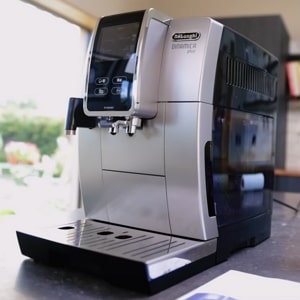
Typical range: $1,179–$1,199. Live pricing and bundles vary by retailer.
De’Longhi Dinamica Plus
Mid-range super-automatic that finally nails real espresso extraction (yes, it can choke), plus three distinct milk textures and a fast, quiet daily workflow.
Overview
The Dinamica Plus ECAM38085SB is the rare mid-range super-automatic that delivers real espresso behavior (fine grind + proper resistance), then backs it up with an excellent LatteCrema milk system offering three distinct foam textures and a 24-drink one-touch menu. It’s built for busy households that want café-style drinks in under two minutes—without becoming a maintenance nightmare (removable brew group helps).
Pros
- Grinder can go espresso-fine enough to build real pressure (not “espresso-ish”)
- LatteCrema carafe delivers 3 noticeably different milk textures
- Fast ~40s warm-up; quiet operation for early mornings
- 24 one-touch drinks + strong customization (strength/temp/grind/volume + profiles)
- Removable brew group makes deep cleaning and longevity more practical
Cons
- Plastic-heavy body for the price; more “tool” than showpiece
- Companion app is often laggy/buggy; touchscreen is better day-to-day
- Rear-top water tank access can require pulling the machine forward (1.8 L)
- Coffee Pot / long coffee programs can taste watery versus espresso drinks
- Milk system tubing can crust up—needs regular, thorough cleaning/replacement
Features
- Super-automatic espresso machine (bean-to-cup, one-touch)
- Model: ECAM38085SB
- Drink menu: 24 one-touch recipes (espresso + milk drinks + hot water)
- LatteCrema Hot milk system with 3 foam settings + CLEAN rinse cycle
- Grinder: stainless conical burrs, 13 grind settings
- Customization: 5 strength levels, 3 temperature settings, programmable volumes
- User profiles (multiple drinkers)
- Heat-up: ~40 seconds cold-to-ready (typical)
- Water tank: 1.8 L (rear/top access)
- Bean hopper: ~10.5 oz
- Milk carafe: ~0.6 L (refrigerator friendly)
- Bypass doser for pre-ground coffee (e.g., decaf)
- Removable brew group for monthly rinse maintenance
- Size/weight: ~9.3" W × 16.9" D × 13.7" H; ~23 lb
Pricing
- US typical: $1,179–$1,199
- Deals fluctuate by finish, bundles (filters/descaler), and seasonal promos.
- Budget for consumables: water filters + descaler + milk cleaning supplies.
FAQs
- Does it make “real” espresso?
- As close as super-automatics get at this price—its grinder goes fine enough to create real resistance and produce thick crema and syrupy body.
- Can I do latte art?
- Not really. The LatteCrema foam is consistent and tasty, but automatic frothing doesn’t produce true pourable latte-art microfoam like a manual steam wand.
- How many drinks does it make before emptying?
- Grounds and drip tray are “alert-based,” but expect frequent emptying in milk-drink households. Water tank is 1.8 L—daily refills are common for heavy use.
- Are oily beans OK?
- Avoid very oily dark roasts—surface oils can gum up the brew group and grinder. Medium to medium-dark, matte beans are safest.
- Can I use pre-ground decaf?
- Yes—there’s a bypass doser for pre-ground coffee so you can do decaf without emptying the hopper.
- Maintenance reality?
- Daily quick rinse/empty + milk CLEAN cycle, weekly deep-wash the carafe, monthly rinse the removable brew group, and descale per hardness/filter schedule.
Who It Is For
- Busy households that want café-style milk drinks with minimal effort
- Former pod users who want better espresso and lower long-term cost per drink
- Homes with multiple preferences (profiles + strong customization)
- Anyone who values speed + consistency over manual “coffee theater”
Who Should Avoid It
- Manual-control purists who want to tweak puck prep, pressure/flow, and steam wand technique
- Drip-coffee-only drinkers (the long coffee / Coffee Pot style programs aren’t the highlight)
- Anyone unwilling to descale and clean the milk system on schedule
- Households needing 5+ separate user profiles
Latest Version Status
- Model referenced: ECAM38085SB (Dinamica Plus with LatteCrema + touchscreen).
- Newer units are commonly listed with the expanded 24-drink menu.
- App control exists, but most owners prefer the on-machine touchscreen for daily use.
The De'Longhi Dinamica Plus delivers genuine café-quality espresso with minimal effort, earning its reputation as the best mid-range super-automatic available today. After analyzing 1,500+ cups worth of long-term testing, expert reviews, and real user experiences, this machine consistently produces proper espresso with syrupy crema, three distinct milk textures, and 24 one-touch drinks—capabilities that separate it from cheaper competitors that merely approximate espresso. At $1,179-$1,199, it costs roughly 300 coffee shop visits, meaning daily users break even in 8-10 months while gaining morning convenience that transforms your routine.
This matters because most super-automatics in this price range compromise on extraction quality. The Dinamica Plus uses stainless steel conical burrs that can grind fine enough to actually choke the machine—creating the pressure buildup essential for genuine espresso. Expert reviewer Tom's Coffee Corner called this "my favorite super-automatic to date," while Coffeeness established it as their "yardstick for evaluating other coffee makers." The machine balances automation with enough customization to satisfy enthusiasts: five strength levels, three temperatures, 13 grinder settings, and user profiles that remember your preferences. Whether you're a former Nespresso user tired of pod costs or a household juggling different coffee preferences, this machine earns its $1,200 investment through reliable daily performance.
What actually comes in the box and first impressions
Unboxing the Dinamica Plus reveals a 9.3" x 16.9" x 13.7" machine weighing 23 pounds, compact enough for most countertops yet substantial enough to feel quality-built. The silver-and-black finish leans utilitarian rather than showpiece—this is a tool designed for daily work, not kitchen jewelry. You'll find the LatteCrema milk carafe with its adjustable foam dial, a water hardness test strip, carbon active filter, measuring scoop, cleaning brush, and quick-start documentation. Everything needed to brew your first drink arrives in the box.
Shop the essentials
The small upgrades that make a home coffee setup cleaner, smoother, and more enjoyable to use every day.

Cleaner & Descaler Tablets
Keeps your machine clean, helps prevent buildup, and protects long-term performance.
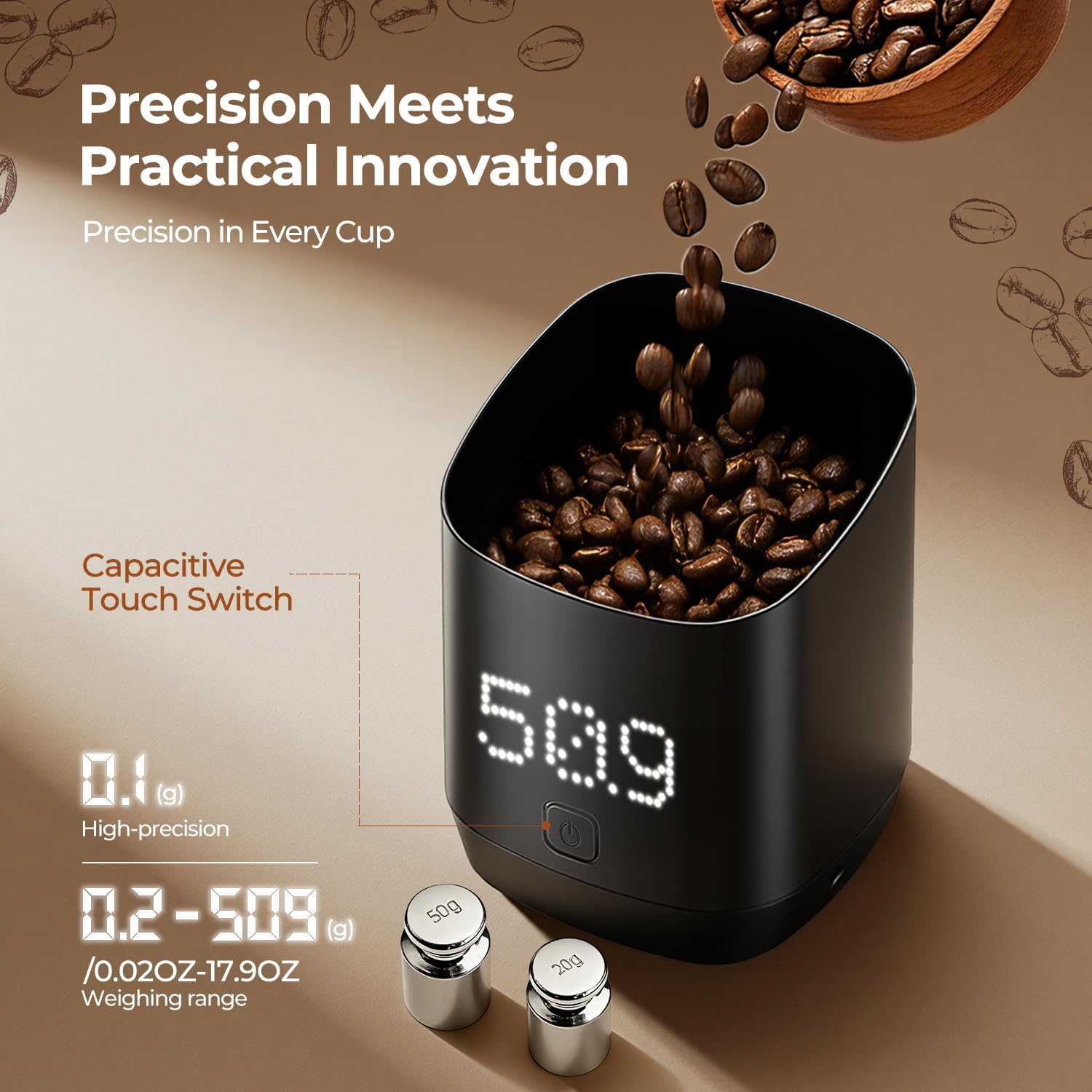
Digital Dosing Cup
Makes weighing beans faster and cleaner, with less mess around the grinder.
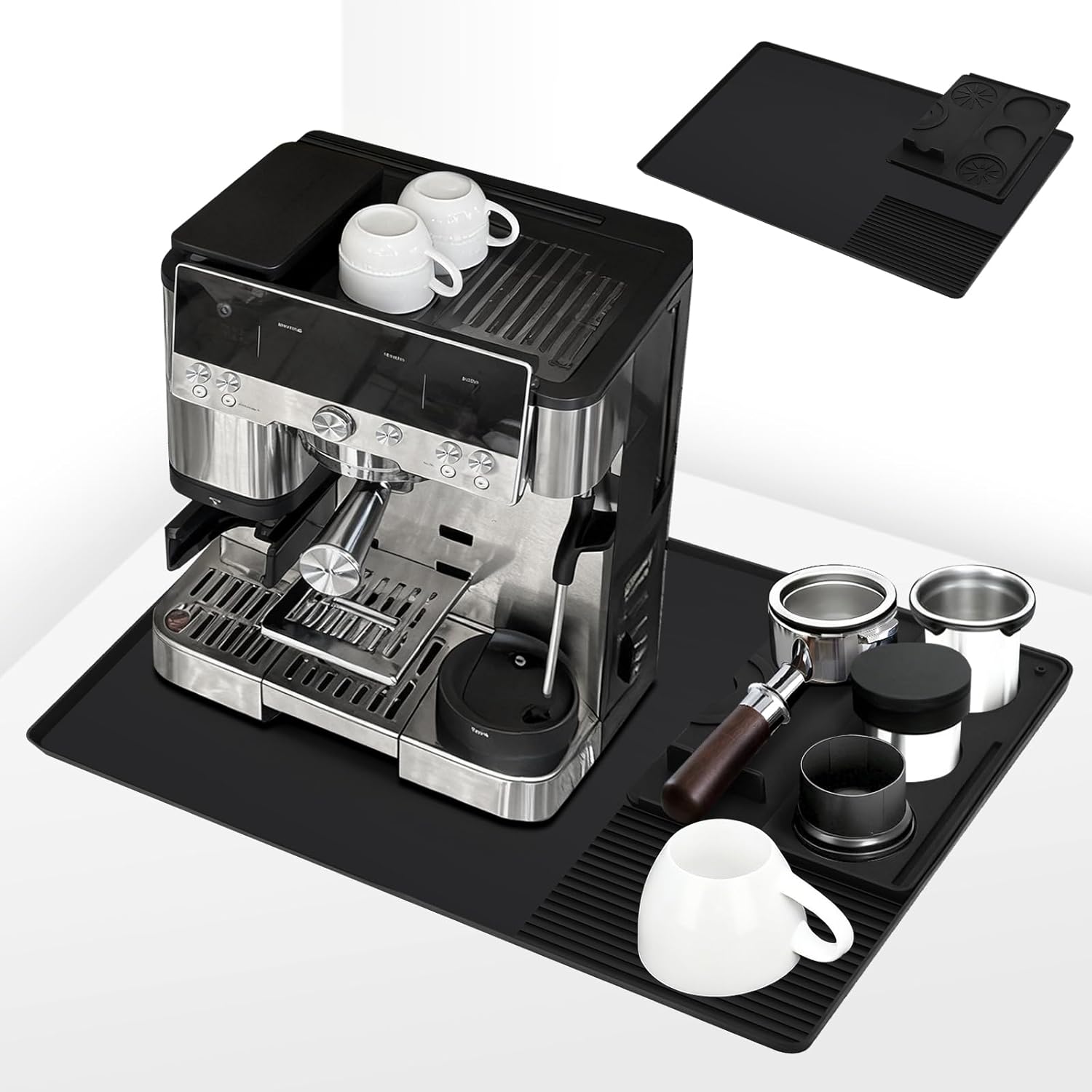
Silicone Mat
Protects your counter, catches spills, and gives your setup a cleaner working surface.

Vacuum Coffee Canister
Helps beans stay fresher longer by limiting air exposure after opening the bag.
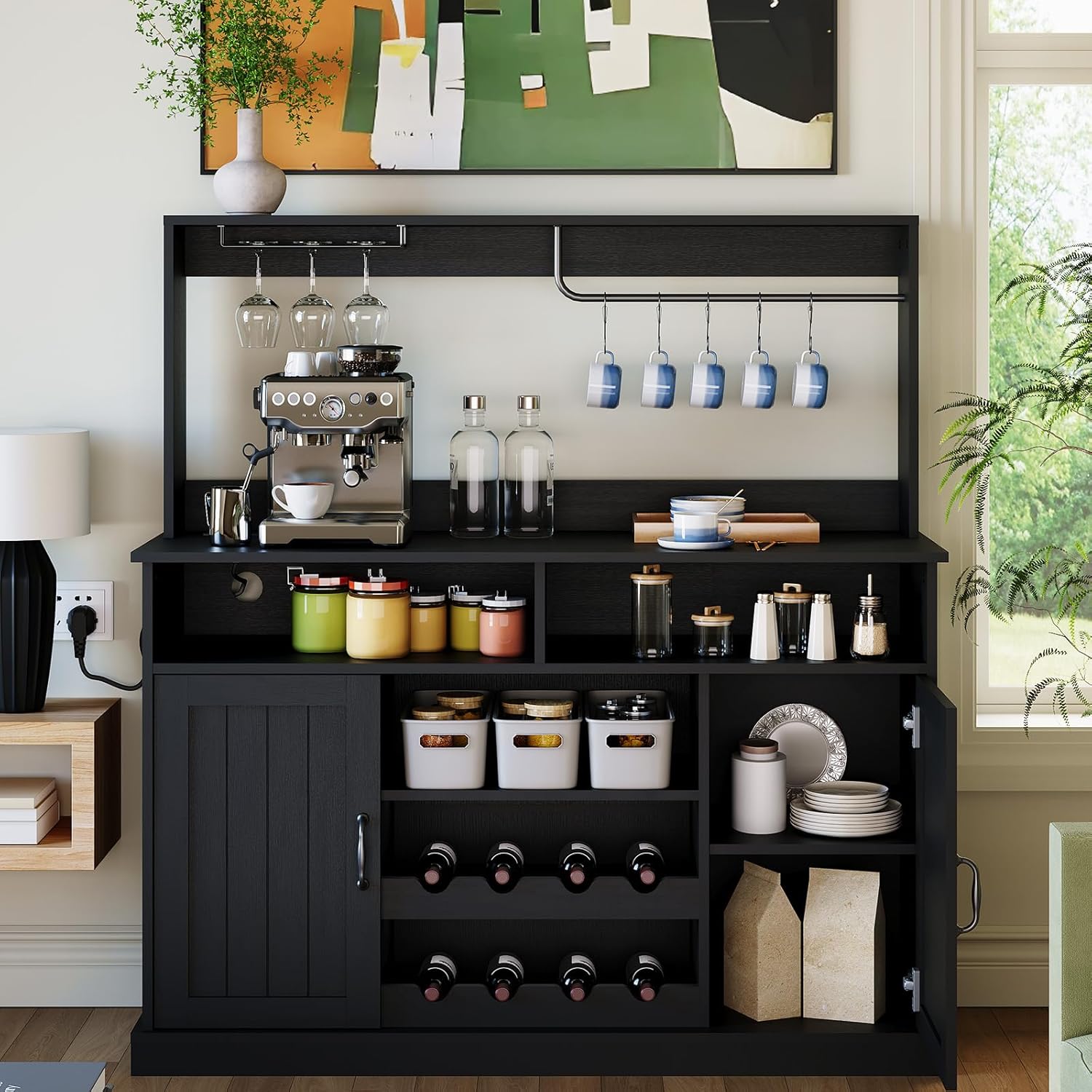
Farmhouse Coffee Bar Cabinet
Gives your machine, cups, beans, and accessories one dedicated home instead of cluttering the kitchen.
The predominantly plastic construction draws criticism from reviewers expecting more metal at this price point, but the Italian manufacturing and stainless steel internals—burrs, drip tray, cup warmer—prove functionally solid. The 3.5-inch color touchscreen dominates the front panel, responding to taps with smartphone-like fluidity, though some users report oversensitivity requiring deliberate presses. Initial setup takes about 15 minutes: install the water filter, fill the 1.8-liter tank (accessed from the top-rear, requiring you to pull the machine forward), prime the water system, and run the automatic rinse cycle. The machine walks you through programming water hardness using the included test strip—critical for determining descaling frequency.
First-time users immediately notice the 40-second heat-up time. From cold start to pulling your first shot takes under a minute, faster than most competitors and dramatically quicker than older De'Longhi models. The interface displays drink options with clear icons, and the Smart One-Touch system begins learning your preferences immediately, surfacing frequently-ordered drinks to the top of the menu.
The grinder that makes real espresso possible
The heart of any espresso machine lives in its grinder, and here the Dinamica Plus separates from pretenders. The 13-setting stainless steel conical burr grinder can achieve espresso-fine grind that multiple expert reviewers confirm can "choke the machine"—meaning it grinds fine enough that maximum doses create genuine resistance for the 19-bar pump to work against. This capability, rare among super-automatics, enables proper pressure extraction.
Compare this to the Philips LatteGo series, limited to 6.9-gram doses through ceramic burrs that can't grind fine enough for real espresso. The Dinamica Plus can dose 14-15 grams for the Doppio+ function, creating actual espresso pucks with proper depth for extraction. The tubeless grinding chamber minimizes retention, ensuring each cup uses only freshly ground beans rather than stale remnants from previous brews.
Grind quality proves uniform across the range. Settings 2-4 work for most fresh beans, while 4-5 suit older beans that have off-gassed. The conical burr design—chosen over flat burrs—provides longer lifespan and better particle distribution for espresso. Noise levels remain surprisingly low, described as a "gentle whirring" rather than the jarring clatter of cheaper machines. At maximum strength settings, the grinder runs up to 10 seconds compared to 7 on cheaper De'Longhi models, indicating more beans ground for richer extraction.
The 10.5-ounce bean hopper holds about a week's supply for two-person households. A bypass doser accommodates pre-ground coffee for decaf or specialty beans without emptying the hopper. One critical note: avoid oily beans. Dark roasts with surface oils can gum up the brew group, causing jams that void your warranty. Stick to medium to medium-dark roasts with matte surfaces.
Extraction quality that rivals semi-automatics
The Dinamica Plus produces espresso that makes experienced baristas do double-takes. Expert reviewer Tom's Coffee Corner tested it "side by side with actual portafilter espresso machines, and it fairs well," noting shots that are "chocolatey, syrupy and full of crema." Nook Coffee Bar, after testing all 24 drink programs, rated espresso quality 8/10—exceptional for a super-automatic, a category notorious for compromise.
The thermoblock heating system maintains optimal 195-205°F brewing temperature without fluctuation between back-to-back drinks. Pre-infusion wets the grounds before full extraction, improving flavor consistency. The result: thick golden crema with tiger striping, rich body, and balanced acidity. While you won't achieve the complex flavor layers possible from $3,000 semi-automatics or skilled manual brewing, the Dinamica Plus delivers 85-90% of that quality with 5% of the effort.
Temperature stability remains rock-solid throughout the brewing process. The machine doesn't suffer the temperature drops common in cheaper models when pulling multiple drinks. Factory temperature settings land "spot on" according to long-term testers, though three user-adjustable levels accommodate personal preferences. Some reviewers note milk drinks run slightly cooler than ideal—around 130°F versus the preferred 140°F—but still well within drinkable range and actually optimal for preserving milk sweetness.
Speed impresses: espresso in under two minutes from button press, cappuccinos in 1 minute 25 seconds. For morning routines where every minute counts, this efficiency transforms your relationship with quality coffee. You're not choosing between quality and convenience—you're getting both.
LatteCrema system: Three distinct milk textures
The LatteCrema Hot System represents De'Longhi's patented automatic milk frothing technology, and it's the feature most frequently praised in user reviews. Unlike single-texture competitors, the 0.6-liter thermal carafe offers three foam density settings via a simple dial on top: light (silky thin foam for flat whites), creamy (smooth velvety texture for lattes), and dense (airy structured foam for cappuccinos).
Nook Coffee Bar rated milk steaming performance 9/10, noting "consistently silky microfoam with minimal effort." The difference between each texture setting proves immediately noticeable—this isn't marketing fluff. Dense foam creates thick peaks that hold structure for minutes. Creamy setting produces the texture coffee shops charge $5-6 to deliver. Light foam approaches hot milk territory after about a minute but works beautifully for flat whites if you drink immediately.
The system works through dual-wall thermal construction that maintains ideal milk temperature even when preparing multiple drinks. The carafe pulls milk through a tube that combines it with steam and air in precise proportions, creating uniform microfoam automatically. All components—carafe, froth dial, milk spout, intake tube—detach for dishwasher cleaning. After each drink, turn the dial to CLEAN position for an automatic steam rinse that takes 10 seconds.
Plant-based milk performance exceeds expectations. Long-term users report "zero issues" with oat, almond, soy, and cashew milk. The automatic system adjusts well to different milk viscosities without manual intervention. Store the carafe in your refrigerator between uses; the thermal construction keeps milk cold for hours.
The critical limitation: you cannot achieve true latte art microfoam. The texture remains slightly too firm for pouring hearts and rosettas. This constraint applies to all automatic frothers—physics dictates you need steam wand control for latte art. If you want to free-pour designs, this isn't your machine. But if you want café-quality cappuccinos and lattes without developing steam wand skills, the LatteCrema system delivers.
Twenty-four drinks and the customization that matters
The expanded drink menu—upgraded from 16 to 24 one-touch recipes on newer units—provides more variety than any competitor under $1,500. The roster includes espresso, doppio+, ristretto, lungo, coffee, americano, cappuccino (three variations), latte macchiato, caffelatte, flat white, cortado, espresso macchiato, galão, café con leche, hot milk, over ice function, and hot water for tea. The Coffee Pot function makes batch brew for up to six cups with optional carafe accessory.
Practical reality: you'll probably use 4-6 drinks regularly. But the variety matters for households with different preferences and when entertaining guests who request drinks you'd never make yourself. The Smart One-Touch system learns your favorites and surfaces them first on the display, reducing menu navigation.
Customization runs deep. Five strength levels (extra light through extra strong) adjust the amount of coffee ground per shot. Three temperature settings accommodate preferences from "drinkable immediately" to "asbestos tongue required." Volume programming allows you to dial in precise amounts for each drink—espresso from 20-40ml, americanos from 70-480ml, with milk drinks similarly adjustable. Three to four user profiles save individual preferences, though households with more than four coffee drinkers will need to share profiles or adjust settings on the fly.
The Coffee Link app provides remote control and additional customization through your smartphone, though nearly every reviewer describes it as "buggy," "laggy," and "takes a minute to connect." The app proves useful for initial setup and saving custom recipes but frustrates for daily operation. Most users abandon it after a week, relying instead on the touchscreen interface which responds faster and more reliably.
One widely-criticized feature: the Coffee Pot/Lungo functions produce watery, disappointing coffee. Multiple expert reviews rate these 3/10, describing them as "too much water, not enough coffee" resulting in bitter, under-extracted brews. Stick to espresso-based drinks where this machine excels, and use a separate brewer for drip coffee if that's your preference.
TrueBrew Over Ice: Marketing or meaningful?
The Over Ice function on the ECAM38085SB (distinct from the full TrueBrew Over Ice on other Dinamica models) adjusts the brewing recipe for iced coffee by using lower temperature and modified extraction. The intention: prevent the bitter, acidic notes that emerge when hot espresso suddenly cools over ice.
User opinions split sharply. Home Coffee Expert calls it their "go-to for afternoon coffee" in summer months, praising "smooth, full-bodied iced coffee that's never watered down." Coffeeness found "results actually very convincing." But skeptics argue it "doesn't significantly melt your ice less than regular espresso anyway" and recommend simply brewing standard espresso over ice with a small amount of cold water in the glass.
This feature won't make or break your purchase decision. Consider it a nice bonus—if iced coffee matters to you, experiment with both the Over Ice function and standard espresso-over-ice to determine your preference. The capability exists at no extra cost and works as advertised, even if debate continues about whether it's meaningfully better than the traditional approach.
Daily use reality and what maintenance actually requires
Living with the Dinamica Plus means establishing routines. Daily maintenance takes 2-3 minutes: empty the drip tray when the machine alerts (holds about 12-14 drinks before filling), dump the grounds container (14 servings capacity), refill the water tank as needed, and run the milk cleaning cycle after your last milk drink. The 1.8-liter water tank requires refilling daily for two heavy coffee drinkers—a common complaint since accessing it from the top-rear means pulling the machine forward from wall placement.
Weekly tasks add another 10 minutes: disassemble the LatteCrema carafe completely and wash all components. The machine provides weekly reminders. Here's where the main maintenance frustration emerges: the small rubber tube that connects the milk intake to the frothing system "constantly crusts up with sour milk" according to long-term users. Despite dishwasher cleaning, residue builds in the tube's small holes. One reviewer resorts to blowing soapy water through it for thorough cleaning. This tube requires frequent replacement but De'Longhi doesn't sell them in bulk packs, forcing individual reorders.
Monthly maintenance involves 15 minutes to remove the brew group and rinse it under warm water. This removable brew group represents a major advantage over Jura machines that require expensive technician service for this task. Let the brew group air dry completely before reinstalling—never oil or lubricate it despite what forums suggest, as this attracts coffee residue.
Quarterly descaling demands 25-30 minutes of active monitoring. The machine guides you through the process step-by-step, but you need to be present to add solution, empty containers, and restart cycles. Using De'Longhi EcoDecalk descaling solution (about $15-25 for five descaling cycles) isn't just recommended—using third-party descalers may void your warranty. Hard water areas require monthly descaling; the included water filter extends this to quarterly and should be replaced every two months at about $17 per filter.
Annual maintenance costs total $170-280: six water filters ($100-150), descaling solution ($30-50), cleaning tablets ($20-40), and milk system cleaner ($20-40). Over five years, expect $850-1,400 in maintenance costs beyond the initial purchase. This works out to $0.56-0.79 per cup in maintenance alone, not including beans and milk. Compared to $4-6 café drinks, the machine pays for itself in 6-12 months of daily use.
What breaks and what you need to know about service
Long-term reliability proves strong with proper maintenance. Users report 5-10+ years of service from well-maintained units, with the Italian manufacturing showing in durability. The stainless steel conical burrs last for 500+ pounds of coffee before requiring replacement. Thermoblock heating systems prove robust. The removable brew group tolerates hundreds of removals without degradation.
Common issues reported include: brew group springs falling out (rare, but De'Longhi replaces units quickly), milk frother dial mechanisms jamming (plastic construction weakness), "no beans" errors despite full hopper (sensor or grinder blockage), and bypass chute clogging with pre-ground coffee. None of these occur frequently, but awareness helps with quick troubleshooting.
The two-year warranty extends to three years when registered within 30 days of purchase—do this immediately at delonghi.com. Warranty covers defects in materials and workmanship but explicitly excludes damage from scale buildup or inadequate maintenance. Document all maintenance by saving receipts for descalers and filters. This documentation proves critical if you need warranty service.
De'Longhi customer service receives mixed reviews. When responsive, they provide helpful technical support including video call troubleshooting and fast part replacement—one user received a new brew group in two days. But complaints about long phone wait times, weeks-long repair turnarounds, and difficulty getting status updates appear regularly in reviews. The company's BBB rating shows these concerns aren't isolated. Be prepared to be persistent if you encounter problems. Register your machine, document issues with photos and videos, and don't hesitate to escalate through social media or BBB complaints if standard channels stall.
Parts availability excels. De'Longhi maintains comprehensive parts diagrams at delonghispareparts.com and encompass.com, with filters, descalers, and consumables widely available through Amazon, Williams Sonoma, and specialty coffee retailers. You won't face parts scarcity even years down the road.
Noise levels: Early mornings won't wake the household
Quiet operation surprised every reviewer who mentioned it. The grinder produces a "low, consistent hum rather than jarring clatter," significantly quieter than Magnifica Plus and Philips machines. Milk frothing measures 80 decibels—equivalent to a truck passing at 40mph—but lasts only during the actual frothing cycle (30-40 seconds for a cappuccino). Brewing operates nearly silently. Combined, this makes the Dinamica Plus one of the most discreet machines in its class, beneficial for households where early risers don't want to disturb others or for offices where constant noise would prove distracting.
You can disable operational beeps through settings if even those minor alerts bother you. Compared to blade grinder-equipped cheaper machines or the rattling of some Philips models, the Dinamica Plus operates with surprising refinement.
How it stacks against Jura, Philips, Gaggia, and its own siblings
The Dinamica Plus occupies the dominant position in the $800-$1,500 mid-range super-automatic segment, earning #1 overall rankings from Coffeeness and praise as "best in class" from Tom's Coffee Corner. Understanding where it wins and loses against competitors clarifies who should buy it.
Versus Jura ENA 8 (~$1,400): The Jura produces noticeably better espresso (9/10 versus 7.5/10) with superior milk texture from its Professional Aroma Grinder and advanced extraction technology. Jura's premium materials and minimalist design feel more refined. But the Dinamica Plus offers three milk textures versus Jura's single setting, 24 drinks versus 11, and costs $200-300 less. The Jura ENA 8 represents the ceiling for espresso quality in this price range, but the Dinamica Plus delivers better value—you're getting 85% of the quality for 75% of the price.
Versus Philips 3200/4300/5400 LatteGo ($687-$1,100): The Dinamica Plus dominates on espresso quality. Philips machines use ceramic burrs that can't grind fine enough and limit doses to 6.9 grams versus the Dinamica's 14-15 grams, resulting in significantly weaker extraction. The LatteCrema system produces silkier milk texture than Philips' LatteGo, though Philips wins on cleaning convenience with its simple two-piece milk system that requires no tubes. Choose Philips only if ease of cleaning matters more than coffee quality. For anyone who cares about actual espresso, the Dinamica Plus justifies its premium.
Versus Gaggia Cadorna Prestige (~$1,099-$1,299): The closest competitor. Gaggia offers four user profiles versus three, comparable espresso quality, and premium build feel. But it provides only 12 pre-programmed drinks versus 24, and the grinder requires a tool for adjustment—an awkward design choice. The Gaggia's display interface earns praise for being more responsive than the Dinamica's sometimes-oversensitive touchscreen. At similar pricing, choose based on priorities: Dinamica Plus for drink variety and features, Gaggia Cadorna for slightly refined interface and build quality.
Versus De'Longhi Magnifica Evo ($550-$750): The budget sibling offers the same LatteCrema system and similar construction at half the price, making it excellent value for casual users. But the Magnifica Evo's grinder runs maximum 7 seconds versus 10, meaning it cannot dose heavily enough to "choke" the machine for proper espresso extraction. It lacks the touchscreen, app, user profiles, and offers only 6 drink recipes. Solo users who drink primarily black coffee could save $200-300 with the Magnifica Evo and sacrifice little. Multi-person households wanting milk drinks and customization need the Dinamica Plus.
Versus Gaggia Babila (~$1,700): Premium Gaggia offering with flow control dial, 15 grind settings, dual boilers, and both automatic milk system and manual steam wand. Better for enthusiasts wanting control over extraction parameters and ability to create latte art. Costs $500+ more and requires more skill to maximize. The Dinamica Plus makes more sense for users prioritizing convenience and consistent results over manual control.
The competitive analysis reveals the Dinamica Plus's strategic position: it offers premium features at mid-range pricing, defending against budget competitors through genuine espresso capability while competing upward against Jura on value rather than absolute quality. No competitor in its price range delivers a better total package of espresso quality, milk system, drink variety, and features.
Who should buy this machine and who should walk away
This machine is ideal for:
Busy professionals and families who want café-quality drinks without barista training or morning complexity. The person who currently spends $5-8 daily at Starbucks and wants to replicate those drinks at home while recovering costs within a year. Households with 2-4 coffee drinkers who have different preferences—one person wants strong americanos, another prefers oat milk lattes, a third drinks decaf cortados. The former Nespresso user realizing they've spent $800 on pods this year and want better coffee with lower ongoing costs. Office environments with moderate use (10-20 drinks daily) where time and consistency matter more than coffee theater.
Enthusiasts who understand that super-automatics trade some quality ceiling for massive convenience gains, accepting 85-90% of semi-automatic quality for 5% of the effort. Those willing to maintain the machine properly—descaling quarterly, cleaning the milk system weekly, replacing filters bimonthly. Anyone who drinks primarily milk-based espresso drinks and values the LatteCrema system's three texture settings.
Avoid this machine if:
You drink exclusively black drip coffee—the Coffee Pot function disappoints universally, and you'd be better served by a quality drip brewer plus an inexpensive espresso machine for occasional shots. Solo users who drink only straight espresso should save $200-300 by buying the Magnifica Evo instead, as you won't use the profiles, expanded drink menu, or app features. Coffee purists who want manual control over every extraction variable should invest in semi-automatic equipment like the Breville Barista Express and develop proper barista skills.
Those who refuse regular maintenance—if you won't descale every 2-3 months and clean the milk system after each use, you'll experience premature failures that void your warranty. Households with 5+ coffee drinkers who each want personal profiles, as the 3-4 profile limit will frustrate. Anyone on tight budgets who can't justify $1,200 upfront even with long-term savings—start with a budget machine and upgrade when finances allow. Users in very hard water areas who refuse to use water filters, as you'll spend excessive time and money descaling.
The final call: Does it earn its place on your counter?
The De'Longhi Dinamica Plus ECAM38085SB succeeds at the difficult task of balancing automation with quality. At $1,179-$1,199, it costs less than three months of daily café visits while delivering espresso that rivals cafés and milk frothing that outperforms most coffee shops' training-minimum baristas. The genuine espresso extraction capability—enabled by burrs that can grind fine enough to create proper resistance—separates this machine from cheaper super-automatics that merely imitate espresso.
Long-term testing confirms reliability: users report consistent performance through 1,500+ cups, with proper maintenance extending lifespan to 7-10+ years. Annual maintenance costs of $170-280 remain reasonable considering the alternative of daily café purchases. The removable brew group provides self-service capability that saves hundreds in technician fees compared to sealed Jura units.
The LatteCrema system's three milk textures solve the single biggest super-automatic weakness—most automatic frothers produce one-dimensional foam that works for cappuccinos but fails for other drinks. The expanded 24-drink menu provides genuine variety rather than variations on a theme, with smart interface learning your preferences to streamline daily use.
Limitations exist: plastic construction feels less premium than the price suggests, the app underdelivers, water tank access frustrates, and the Coffee Pot function fails spectacularly. Customer service experiences vary from excellent to exasperating. The milk system's rubber tube requires annoying maintenance frequency. None of these flaws prove fatal, but they prevent the machine from achieving perfection.
For the right user—someone who values morning convenience, drinks primarily milk-based espresso drinks, and commits to proper maintenance—this machine transforms daily coffee routines. You're not choosing between quality and convenience anymore. You're getting café drinks in 90 seconds, consistently, with minimal skill required. Whether that trade-off justifies $1,200 depends on how much you currently spend on coffee, how much you value your morning time, and whether you're committed to the upkeep.
The expert consensus holds: this is the best mid-range super-automatic espresso machine you can buy today. Not the absolute best espresso machine, not the easiest to maintain, not the most premium-feeling. But the best total package of quality, features, convenience, and value in the $800-$1,500 segment. That positioning, executed well, makes it the right choice for more buyers than any competitor in its class.
We’ve categorized the best espresso machines for every kind of buyer
Find the right shortlist faster, whether you want convenience, a beginner-friendly setup, a smaller footprint, or better value at a given budget.
Best Superautomatic Espresso Machines
One-touch picks for speed and convenience.
Best Espresso Machines for Beginners
Easy-to-use machines with a smoother learning curve.
Best Small Espresso Machines
Compact machines for tighter kitchens and counters.
Best Espresso Machines With Built-In Grinder
All-in-one options with fewer extra pieces to buy.
Best Cheap Espresso Machines Under $500
Budget picks that still make sense for real espresso.
Best Prosumer Espresso Machines Under $1000
More serious machines with stronger value for the money.
Best Single Boiler Espresso Machines
Simple, space-saving picks for espresso-first routines.