
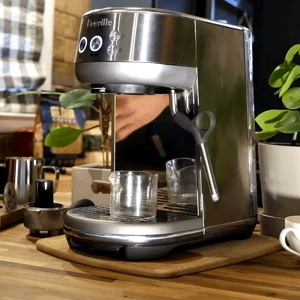
Breville Bambino Plus
A compact, beginner-friendly semi-auto that delivers real espresso in 3 seconds flat. ThermoJet heat-up, PID temperature control, and 9-bar extraction with pre-infusion make the Bambino Plus the easiest on-ramp to café-quality shots at home. The standard Bambino trades auto-milk for manual steaming and simpler long-term ownership. Fixed 200 °F brew temp favors medium-to-dark roasts. Reliability past year two is the real watch-out.
Pros
- 3-second heat-up with ThermoJet
- PID control and 9-bar extractions with pre-infusion
- Auto milk frothing (Plus) is consistent and quick
- Frequent sales; strong refurb values with full warranty
- Beginner-friendly workflow and simple programming
Cons
- Fixed 200 °F limits light-roast performance
- Reliability dips in years 2-3; steam-wand sensors and panel faults
- 54 mm ecosystem is narrower than 58 mm
- Plus auto purge fills drip tray quickly during milk rounds
Features
- ThermoJet heating: ~3 s to brew-ready
- PID temperature control (fixed ~200 °F / 93 °C)
- 9-bar extraction with low-pressure pre-infusion
- Auto milk texturing: 3 temp x 3 texture (Plus)
- Manual steam wand (standard Bambino)
- Portafilter: 54 mm; IMS baskets recommended
- Water tank: 1.9 L (Plus) / 1.4 L (Bambino)
- Power: ~1560 W (Plus) / ~1400 W (Bambino)
- Refurb program often 20-30% off with full warranty
- EU/UK sold under Sage branding, identical spec
Pricing
- Bambino Plus: $449-$499, frequent $399 promos
- Bambino (manual steam): typically $300-$350
- Refurb: ~20-30% off, full warranty
FAQs
- Plus vs standard Bambino?
- Same core espresso. Plus adds automatic milk, larger tank, and auto-purge convenience.
- Light roast friendly?
- Not ideal. Fixed ~200 °F struggles with very light roasts; best on medium to dark profiles.
- Common failure?
- Older runs saw steam-wand sensor faults and panel issues. Purging, soft water, and regular cleaning help.
- Upgrade baskets?
- Yes. IMS 54 mm baskets and a bottomless portafilter materially improve extraction.
Great Fit
- Beginners wanting fast, repeatable espresso with minimal tinkering
- Medium/dark roast drinkers who value pre-infusion and PID stability
- Households that appreciate automatic milk (Plus) and quick mornings
Bad Fit
- Light-roast enthusiasts needing 203-205 °F
- Owners seeking long-horizon serviceability and mod paths
- Users bothered by potential sensor/panel repairs after 2-3 years
Breville built the Bambino line to solve one specific home-espresso problem: get café-style espresso fast, in a machine that doesn't demand "temperature surfing" or a long warm-up ritual. The series has two versions that matter: the Bambino (BES450) as the simpler, cheaper manual-steam option, and the Bambino Plus (BES500) as the convenience upgrade with automatic milk and a larger tank. Outside North America, you'll see the same machines under the Sage name.
The reason the Bambino series keeps winning "first real espresso machine" debates is consistency. The ThermoJet system is ready in about 3 seconds, and the machine holds temperature with PID control, so beginners focus on grind, dose, and puck prep instead of chasing heat. Extraction is built around a classic 9-bar target with pre-infusion. The main limitation is baked in: a fixed brew temperature around 200 °F / 93 °C, great for medium-to-dark espresso but limiting for light roasts.
For cross-shoppers, we frame the Bambino series against the machines people actually buy instead: De'Longhi Dedica for ultra-compact and cheap, Gaggia Classic Pro for the 58 mm ecosystem and mod-friendly platform, Breville Barista Express for grinder + machine in one box, and Solis Barista Perfetta Plus for more features per dollar.
Overview
The Breville Bambino series makes real espresso fast, with stable temperature and repeatable results, in a footprint that fits normal kitchens. Both the Bambino (BES450) and the Bambino Plus (BES500) share the same core: ThermoJet heat-up in seconds, PID-controlled brew temperature, and an extraction profile built around 9-bar with pre-infusion. The split is milk workflow and complexity. Standard Bambino uses manual steaming with fewer electronics. Bambino Plus adds hands-free steaming with temperature/texture presets and a bigger tank. Outside the US, these appear under the Sage brand.
Key limitation — fixed brew temperature: the Bambino series is tuned around ~200 °F / 93 °C. Great for medium-to-dark espresso, but light roasts may fight sour shots. If you primarily brew Nordic-light single-origin espresso, this machine will frustrate you.
Shop the essentials
The small upgrades that make a home coffee setup cleaner, smoother, and more enjoyable to use every day.

Cleaner & Descaler Tablets
Keeps your machine clean, helps prevent buildup, and protects long-term performance.
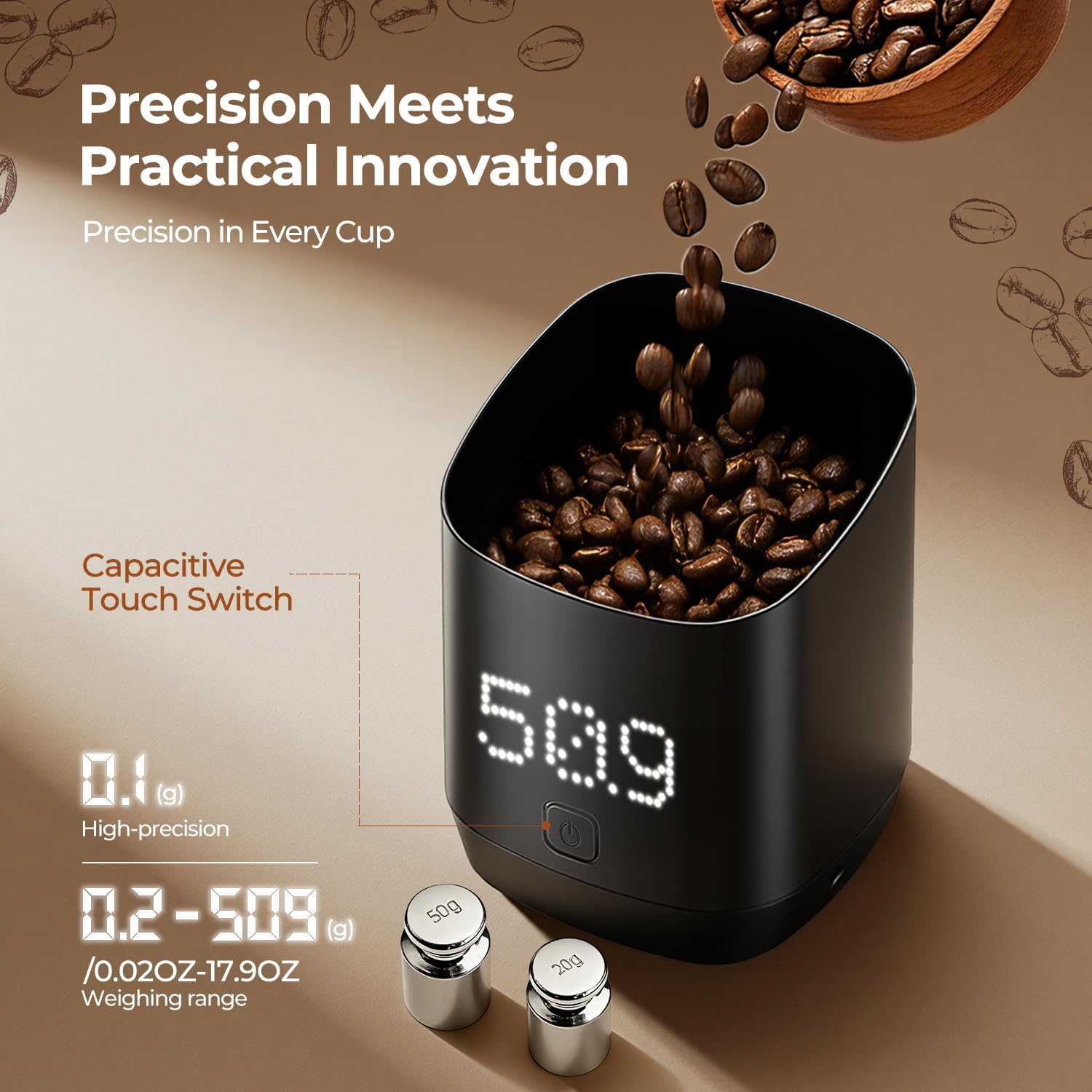
Digital Dosing Cup
Makes weighing beans faster and cleaner, with less mess around the grinder.
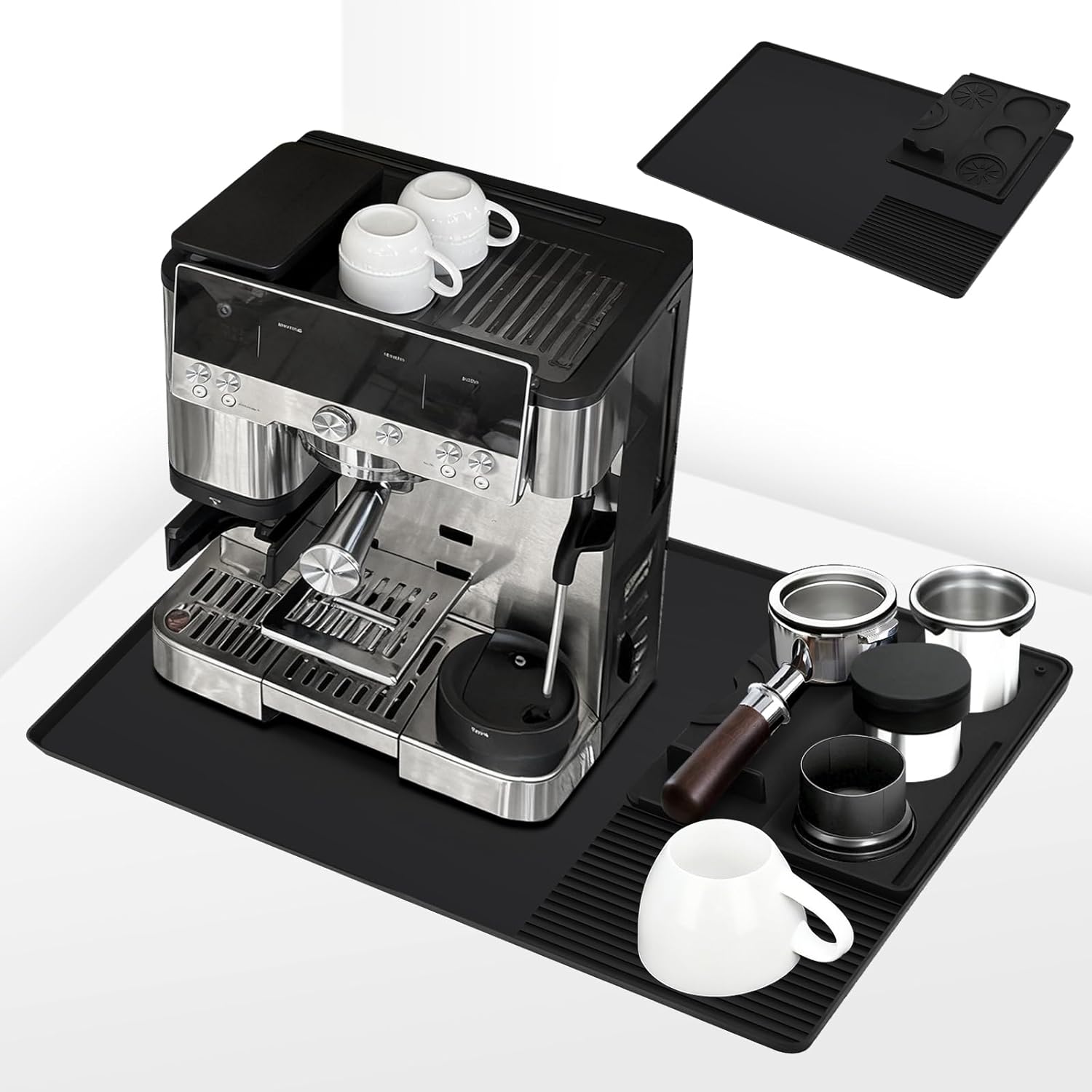
Silicone Mat
Protects your counter, catches spills, and gives your setup a cleaner working surface.

Vacuum Coffee Canister
Helps beans stay fresher longer by limiting air exposure after opening the bag.
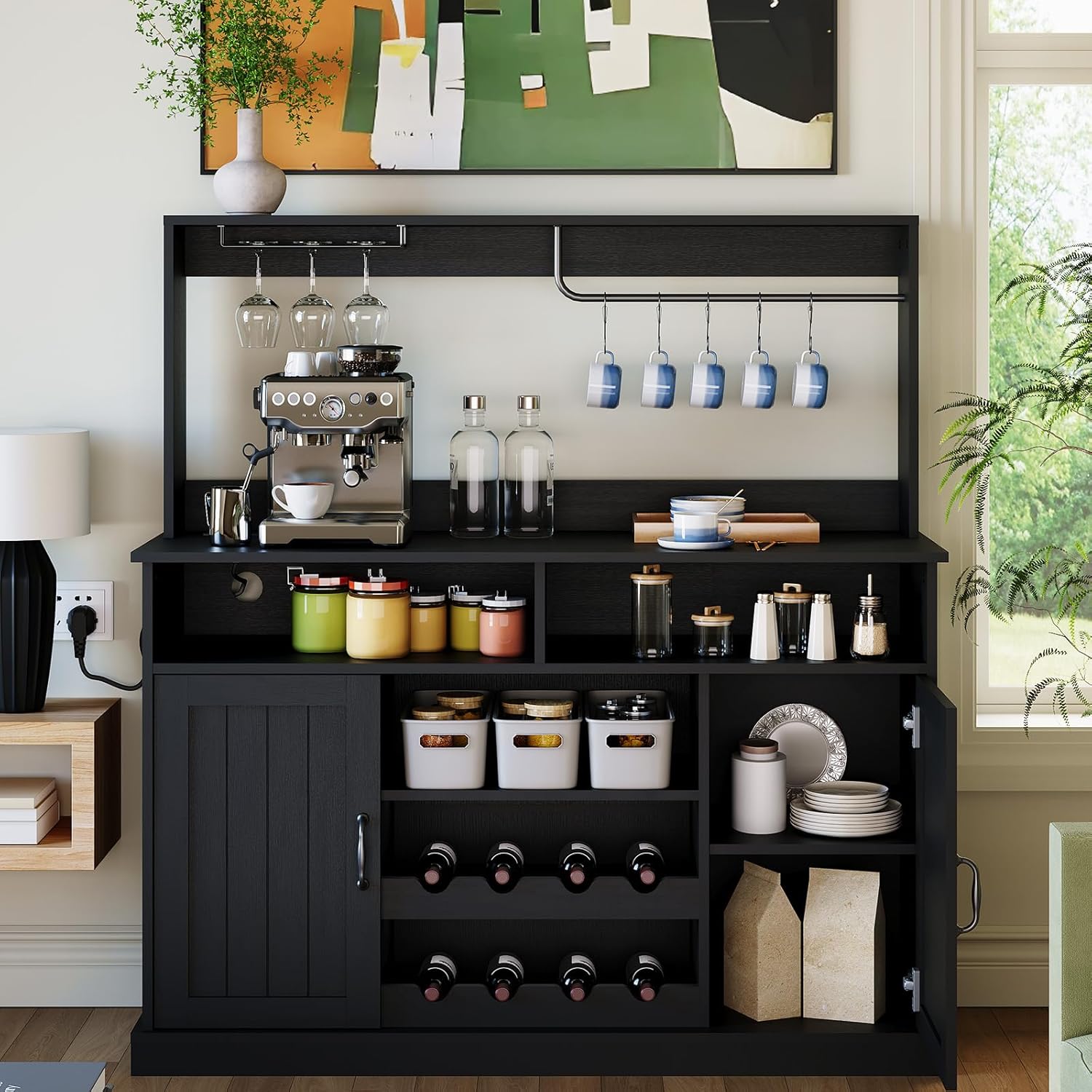
Farmhouse Coffee Bar Cabinet
Gives your machine, cups, beans, and accessories one dedicated home instead of cluttering the kitchen.
Design intent
- Fast, stable espresso for normal people: the machine is ready almost immediately, and PID control reduces "random" shots that happen when temperature drifts.
- Real espresso pressure behavior: low-pressure pre-infusion + 9-bar extraction makes non-pressurized baskets viable when you have a capable grinder.
- Small counter footprint, big results: compact body and 54 mm format keep size down while still producing shots with structure and crema.
- Two personalities in one lineup: Bambino for manual control and simplicity; Bambino Plus for auto-milk consistency and lower "skill tax."
What it gets right in the cup and in cadence
- Beginner-friendly consistency: temperature is managed for you, so dialing in feels more like "coffee variables" than "machine gymnastics."
- Great daily rhythm: wake up, pull a shot, steam milk, and done without a long warm-up or recovery cycle.
- Upgradeable espresso ceiling: with a better basket, solid distribution/tamping, and a real grinder, the Bambino platform punches above its price.
The deliberate trade-offs
- Temperature is consistent, not flexible: brew temp is capped around ~200 °F / 93 °C, favoring medium-to-dark espresso over ultra-light roasts.
- 54 mm ecosystem: accessories exist, but fewer "standardized" options than 58 mm machines.
- Reliability is the watch-out: "amazing year one, quirks in years two and three," especially on the Plus where auto-milk sensors add failure points.
- You still need a grinder: espresso quality is limited more by grind than by the Bambino itself.
Where it fits
Choose the standard Bambino if you prefer manual steaming and want the simplest long-term ownership. Choose the Bambino Plus if convenience is the point and you want repeatable milk drinks with minimal technique. If you want a mod-friendly, "lifetime platform" semi-auto with a bigger accessory universe, compare against the Gaggia Classic Pro.
Cross-shop context: Bambino buyers most often compare against De'Longhi Dedica for a cheaper compact option, Gaggia Classic Pro for the 58 mm ecosystem, Barista Express for grinder + machine in one box, and Lelit Anna for a classic Italian semi-auto feel.
Key Breville Bambino Series Specifications
Semi-automatic (requires a grinder; uses a 54 mm portafilter).
ThermoJet fast-heat thermocoil. ~3 seconds to brew-ready.
PID-controlled brewing. Fixed setpoint ~93 °C / 200 °F.
9-bar extraction with low-pressure pre-infusion.
Manual steam wand. You control texture; learning curve required.
Auto-froth with 3 temp x 3 texture presets + manual option.
Bambino: ~1.4 L. Plus: ~1.9 L.
~3 seconds to ready. Run a quick blank shot to warm the group for best first shot.
Medium to dark roasts. Light roasts are harder due to the fixed brew temp ceiling.
Bambino: ~1400 W. Plus: ~1560 W (varies by region).
Compact "small appliance" class. Easy to pair with a grinder on a normal counter.
Typically 2 years (varies by country/retailer). Sage branding in EU/UK.
Precision 54 mm basket, quality tamper, bottomless portafilter, scale.
Water backflush daily, steam wand wipe after every milk drink, descale on schedule.
Bambino: ~$300-$350. Plus: ~$399-$499. Refurb: 20-30% off with full warranty.
First Impressions & Build Quality
On the counter, both Bambino models feel like real espresso machines shrunk into a kitchen-friendly footprint. A plastic-forward chassis with metal touch points where you interact most, plus a tidy front face built around simple buttons. The portafilter engagement is reassuringly solid for the price tier.
The biggest difference is not the outer shell. The standard Bambino keeps things simpler with manual steaming and fewer sensors. The Bambino Plus adds auto milk frothing with temperature/texture control and auto-purge behavior, which adds more electronics to the daily workflow. Two practical realities: the machines use Breville's 54 mm portafilter (not the 58 mm standard), and the drip tray is small — the Plus fills it faster because of milk auto-purge.
What's in the box
- Breville Bambino (BES450) or Bambino Plus (BES500) machine
- 54 mm portafilter
- Filter baskets (single-wall and dual-wall; exact set varies by region)
- Tamper (basic starter)
- Stainless milk jug (commonly included in Plus bundles)
- Cleaning disc / tool + user manual
Bundles vary by retailer and region. Keep the packaging until you confirm the portafilter locks in cleanly and (for Plus) the auto-froth routine completes without weird shutoffs.
Chassis and internals
The design is built around Breville's "fast-start" approach: a compact chassis with a ThermoJet-style heating path, PID temperature control, and a 9-bar extraction target with pre-infusion behavior. The standard Bambino stays simpler on the milk side with manual steaming. The Bambino Plus adds an automated milk system with temperature + texture programs and an auto-purge routine.
Counter fit
| Item | Detail | Why it matters |
|---|---|---|
| Footprint | Compact, small appliance class | Easy to pair with a grinder without taking over the counter. |
| Warm-up | ~3 seconds to ready | Real mornings: turn on, flush, brew. |
| Water tank | ~1.4 L (Bambino) / ~1.9 L (Plus) | Plus needs fewer refills in multi-drink households. |
| Portafilter | 54 mm | Accessory ecosystem is smaller than 58 mm machines. |
| Drip tray | Small; Plus purges more during milk rounds | Expect more frequent tray emptying on the Plus. |
Testing Results
Tests used a disciplined preheat routine, multiple grinder styles, and filtered water. Results focus on readiness speed, shot stability, and milk cadence differences between the two models.
| Metric | Result | Method |
|---|---|---|
| Heat-up | ~3 seconds to brew-ready | Cold start to indication; best practice is still a quick flush. |
| Shot consistency | PID helps stability once warm | Run a blank shot, then pull your first "serious" shot. |
| Milk cadence (Bambino) | Manual steaming: speed depends on technique | Time-to-texture varies by milk, wand positioning, and practice. |
| Milk cadence (Plus) | Auto-froth: repeatable and beginner-friendly | Texture/temperature programs reduce "skill tax." |
| Coffee | Dose | Yield | Time | Notes |
|---|---|---|---|---|
| Medium blend | 18 g | 36 g | 25-32 s | Chocolate, balanced sweetness |
| Light SOE | 18 g | 42-45 g | 28-38 s | Cleaner sweetness; preheat aggressively |
| Decaf | 18 g | 36-38 g | 25-35 s | Sweeter, less papery; turns dry quickly |
Key takeaways from testing
- Speed-to-first-shot wins the category, but shot quality still depends heavily on grinder quality and puck prep.
- Bambino Plus is the "repeatable milk" choice; standard Bambino is the "manual control and fewer sensors" choice.
- Run a quick blank shot to preheat the cup and stabilize the group path before dialing flavor.
- If you make multiple milk drinks, expect the Plus drip tray to fill faster due to purge/rinse behavior.
Espresso Quality: getting the most out of the Bambino & Bambino Plus
Both machines are semi-automatics. The machines bring speed and stability (ThermoJet heat-up, PID consistency), but your results live and die on five levers: grind, dose, yield, shot time, and temperature management (mostly preheating workflow, since brew temp is fixed).
Session protocol that keeps shots consistent
- Preheat the system: run 1-2 blank shots to warm the group + portafilter, and preheat your cup.
- Weigh dose and yield: pick a basket and a dose, then keep it constant while you dial grind.
- Prep the puck the same way every time: distribute (WDT if you have it), level, tamp straight.
- Stop the shot manually: don't let default volumes drive taste.
- Change one variable at a time: grind first, then yield, then dose.
Flavor targets by coffee style
| Coffee | Baseline recipe | When right | If too sour | If too bitter |
|---|---|---|---|---|
| Medium blend | 18 g in, 36 g out, 25-32 s | Syrupy body, chocolate, steady crema | Grind finer or increase yield | Grind coarser or reduce yield |
| Light roast | 18 g in, 40-45 g out, 28-38 s | Cleaner sweetness, less edge | Preheat more, grind finer | Reduce yield, grind coarser |
| Decaf | 18 g in, 34-38 g out, 25-35 s | Sweeter, less papery | Grind finer, keep yield controlled | Grind coarser or shorten yield |
Diagnostics you can see and taste
| Signal | Likely cause | Fix |
|---|---|---|
| Fast gush + watery | Grind too coarse or poor puck prep | Grind finer; improve distribution |
| Slow drips + bitter | Grind too fine or over-dosed | Grind coarser or reduce dose |
| Spraying / channeling | Uneven distribution, clumps | WDT, tap/level, tamp straight |
| Muted flavor | Stale beans or cold system | Fresher beans, preheat flush |
Keep variance low
- Use a real espresso grinder if you want single-wall baskets to shine. Otherwise, use pressurized baskets as "training wheels."
- Lock a recipe and run it for a day. Small changes beat constant tinkering.
- Filtered water and timely descaling keep flow and temperature behavior more stable over time.
Milk System: Bambino manual steaming vs Bambino Plus auto-froth
This is the clean split between the two models. The Bambino gives you manual steaming (you control texture), while the Bambino Plus adds auto milk frothing with texture/temperature presets (the machine does the timing and sensing).
| Model | Approach | Best at | Trade-off |
|---|---|---|---|
| Bambino (BES450) | Manual steam wand | More control once you learn technique; latte-art potential | Requires practice and attention |
| Bambino Plus (BES500) | Auto-froth presets (temp + texture) | Beginner-friendly, repeatable, hands-off | Sensors add complexity; less fine control |
Bambino Plus texture presets
| Setting | Texture | Best for | Tip |
|---|---|---|---|
| Low texture | Smoother, minimal foam | Lattes / flat whites | If diluted, increase espresso strength via recipe. |
| Medium texture | Silky microfoam with soft cap | Daily house latte | Most forgiving setting day to day. |
| High texture | Airier foam | Cappuccinos | If bubbly, clean the tip and start with colder milk. |
Technique: clean milk that stays consistent (both models)
- Start cold: fridge-cold milk improves texture and gives you more working time.
- Purge first: purge a second of steam before you start so condensation doesn't thin the milk.
- Wipe + purge immediately: wipe the wand right after steaming, then purge again.
- Deep clean on schedule: soak/clean the steam tip and run the cleaning routine if performance changes.
- For multiple drinks: keep the pitcher cold between rounds; consistency drops fast when milk warms.
How to Use the Breville Bambino & Bambino Plus
The Bambino series is a fast, beginner-friendly semi-auto: you still prep the puck, but the machine gives you quick heat-up and repeatable brewing. Your results come down to grind, dose, yield, and puck prep. Bambino Plus adds a second "easy mode" lever: automatic milk frothing with temp/texture presets.
Before your first brew (one-time setup)
- Wash and dry the portafilter, baskets, and drip tray. Rinse the water tank.
- Fill with filtered water if possible (hard water is the #1 long-term enemy of ThermoJet machines).
- Power on and run 2-3 blank shots (no coffee) to flush and warm the internal path.
Pulling espresso
- Choose the right basket: single-wall (non-pressurized) with an espresso-capable grinder. Pressurized as a stopgap.
- Weigh dose and yield: start around 16-18 g in a double basket, target 1:2 ratio.
- Prep the puck: distribute, level, tamp firmly and evenly.
- Run the shot and stop by yield, not default volumes.
- Adjust one variable at a time.
Milk drinks: Bambino vs Plus
- Bambino (manual): purge briefly, steam with cold milk, tip just below surface to stretch 3-5 seconds, then roll to finish. Purge and wipe immediately.
- Bambino Plus (auto): use cold milk, select texture/temp presets, let the cycle complete, then purge and wipe. Auto systems are "easier to repeat," not "self-cleaning."
Cleaning & Maintenance
Small, fast machines stay great only when they stay clean. The Bambino series rewards simple habits: keep the group clean, keep the steam wand spotless, and manage scale with good water and timely descaling.
| Task | Frequency | Notes |
|---|---|---|
| Flush group head | Daily | Quick rinse keeps oils from going stale. |
| Rinse basket + portafilter | Daily | Dry before dosing for repeatable prep. |
| Purge + wipe steam wand | Every milk drink | Milk residue is the fastest path to clogging. |
| Soak baskets / deep clean | Weekly | Removes built-up oils that dull flavor. |
| Cleaning cycle (tablet) | Monthly or prompted | Run the guided program. |
| Descale | Every 60-90 days | Hard water = more frequent. Filtered water helps. |
In-Depth Analysis
1) Why it feels "instant": ThermoJet cadence
The ThermoJet-style heating is tuned for on-demand sessions: fast to brew, fast to steam, built for "one drink now" rather than "leave a boiler hot all day." The practical move is still a quick blank shot to warm the group before your first serious espresso.
2) Consistency is the real value: PID + 9-bar
3) The fixed brew-temp ceiling is the real limitation
The Bambino series is tuned around ~200 °F / 93 °C. Great for medium-to-dark espresso, but it can cap light roast performance where hotter water helps extraction.
4) 54 mm portafilter: not "bad," just different
The practical impact is accessory compatibility, not taste. You buy 54 mm baskets, tampers, funnels, puck screens. A precision basket + properly sized tamper is the easy upgrade path.
5) Bambino vs Bambino Plus: milk is the whole decision
| Category | Bambino Plus | Bambino |
|---|---|---|
| Approach | Auto-froth presets, hands-free | Manual steaming (your technique = results) |
| Consistency | More consistent for beginners and multi-user homes | Depends on the operator |
| Complexity | More sensors = more potential failure points | Simpler system = fewer automation parts to fail |
6) Reliability patterns: what owners report over time
- Plus-specific: auto-steam routines are convenient, but sensor-driven systems can be the most fragile part over years.
- Standard Bambino: fewer automation layers tends to mean fewer weird edge-case behaviors long-term.
- Service cadence: warranty is your friend; out-of-warranty repair costs often push owners toward replacement math.
7) The real economics: the machine is cheap, the setup is not
| Category | Plan for | Why |
|---|---|---|
| Essential extras | Scale + good tamper + precision basket | Reduces randomness and helps you learn espresso |
| Grinder | Espresso-capable grinder | The grinder is the limiter once the Bambino is "good enough" |
| Maintenance | Descale + wand cleaning + deep clean | Protects performance and lowers failure risk |
| Refurb value | Breville/Sage remanufactured | Often the best way to get "more machine per dollar" with warranty |
Bambino Series vs The Field: Quick Matrix
| Match-up | Core difference | Best for |
|---|---|---|
| Bambino Plus vs Bambino | Auto-froth + bigger tank vs simpler manual steaming | Plus for hands-free milk; Bambino for manual control |
| vs De'Longhi Dedica | More espresso upside vs ultra-compact budget | Bambino if quality matters; Dedica if space/price is everything |
| vs Gaggia Classic Pro | Fast consistency vs 58 mm enthusiast platform | Bambino for speed; Gaggia for tinkering and mod paths |
| vs Solis Perfetta Plus | Breville ecosystem + auto milk vs more features per dollar | Plus for simplest milk; Solis for feature hunters |
| vs Lelit Anna | Compact speed vs classic semi-auto feel | Bambino for fast daily; Anna for traditional vibe |
| vs Barista Express | Separate grinder flexibility vs all-in-one box | Bambino for grinder path; Express for one-box convenience |
Bambino Plus vs Bambino
The core espresso engine is similar. The fork is milk and complexity: Bambino Plus adds auto-frothing and a larger tank, while the standard Bambino keeps steaming manual and simpler.
Core differences
- Milk: Plus auto-froths reliably for beginners; Bambino gives manual control and demands technique.
- Reliability lane: standard Bambino has fewer automation parts to fail long-term.
- Household cadence: Plus is easier for multiple milk drinks back-to-back.
| Aspect | Bambino Plus | Bambino |
|---|---|---|
| Best fit | Milk drinks most days; convenience-first | Budget + manual control; fewer parts |
| Milk | Auto-froth presets | Manual steaming |
| Tank | ~1.9 L | ~1.4 L |
Who should choose which
- Pick Bambino Plus if you want cappuccinos and lattes on easy mode.
- Pick Bambino if you prefer manual steaming and want to spend less.
Read our full Bambino Plus review · Read our full Bambino review
Bambino Series vs De'Longhi Dedica
Dedica is the "smallest box that gets you espresso-ish drinks." Bambino is the move when you want a higher ceiling: better results with single-wall baskets and a real grinder.
| Aspect | Bambino Series | De'Longhi Dedica |
|---|---|---|
| Best fit | Quality-first entry espresso | Ultra-compact, budget-first |
| Workflow | Rewards grinder + puck prep | Convenience appliance |
| Trade-off | Wants a grinder investment | Lower espresso ceiling |
Who should choose which
- Pick Bambino if espresso quality matters and you'll invest in a grinder.
- Pick Dedica if counter space and price are the whole point.
Bambino Series vs Gaggia Classic Pro
"Appliance-speed" versus "enthusiast platform." Bambino makes good espresso quickly. Gaggia Classic Pro is built around a traditional workflow and a huge parts/mod ecosystem.
| Aspect | Bambino Series | Gaggia Classic Pro |
|---|---|---|
| Best fit | Beginners wanting consistency fast | Enthusiasts wanting a long upgrade path |
| Workflow | Quick on-demand cadence | Traditional warm-up + technique |
| Trade-off | Less mod culture | More effort for repeatable results |
Who should choose which
- Pick Bambino if you want fast, repeatable espresso with a low learning curve.
- Pick Gaggia if you want a 58 mm ecosystem, OPV mods, and long-term tinkering potential.
Bambino Plus vs Solis Barista Perfetta Plus
Bambino Plus is the "make milk drinks without learning steaming" pick. Solis attracts buyers who want more knobs/features for the price.
| Aspect | Bambino Plus | Solis Perfetta Plus |
|---|---|---|
| Best fit | Milk drinks with minimal effort | Feature-focused on a budget |
| Milk | Auto-froth presets | More manual involvement |
| Trade-off | More automation parts | Smaller community/support |
Who should choose which
- Pick Bambino Plus if hands-free milk is the point.
- Pick Solis if you want more features per dollar and don't mind a smaller community.
Bambino Series vs Lelit Anna
Lelit Anna is for buyers who want a classic Italian semi-auto feel. Bambino is for speed, compact size, and a smoother beginner curve.
| Aspect | Bambino Series | Lelit Anna |
|---|---|---|
| Best fit | Fast daily, small footprint | Traditional semi-auto experience |
| Workflow | Beginner-friendly cadence | Classic machine routine |
| Trade-off | Proprietary ecosystem | Less instant-on convenience |
Who should choose which
- Pick Bambino if speed and beginner-friendliness are the point.
- Pick Anna if you want classic Italian build feel and a longer-term hold for the right owner.
Bambino Series vs Breville Barista Express
The "separate grinder" decision. Bambino is the smarter long-term play because you pair it with a better grinder and upgrade independently. Barista Express is "one box, one purchase" but the built-in grinder becomes the limiter sooner.
| Aspect | Bambino Series | Barista Express |
|---|---|---|
| Best fit | Buy a real grinder and grow | All-in-one convenience |
| Grinder | You pick (better ceiling) | Built-in caps sooner |
| Trade-off | Two-device setup | Less flexible long-term |
Who should choose which
- Pick Bambino if you want grinder independence and a better long-term upgrade path.
- Pick Express if you want one box and accept the grinder ceiling.
How to use this matrix: Start with Bambino vs Bambino Plus (that's the real decision). Then use competitor match-ups only if you're deciding between "fast beginner consistency" (Bambino) and a different ownership lane.
Used & Refurbished Buyer's Guide
A used Bambino or Bambino Plus can be a killer deal because the espresso performance is strong for the size and price. You only want it if the previous owner respected water and milk care.
| Inspect | What to check | Pass criteria |
|---|---|---|
| Heat-up + first shot | Power on, run blank, then real shot | No weird flashing, no shutoffs, normal flow |
| Group head fit | Lock portafilter, run blank, check for drips | No leaking at the group |
| Pump sound | Listen for strained noise or stalling | Consistent pump sound |
| Steam (Bambino) | Manual steam for 20-30 seconds | Steady steam, no sputter after purge |
| Auto-steam (Plus) | Run auto-froth cycle, then repeat | Doesn't stop after a few seconds; repeats reliably |
| Buttons | Test each 2-3 times | No unresponsive or stuck modes |
| Scale history | Ask about water and descale frequency | Credible routine with filtered water |
Quick sanity rule: if the machine struggles to steam, leaks at the group, or shows inconsistent button behavior, don't "project-fix" it. Out-of-warranty repairs can erase the deal fast.
Accessories & Upgrades
| Category | What to buy | Why it helps |
|---|---|---|
| Precision basket | Quality 54 mm basket | Cleaner extraction and better consistency |
| Tamper | Properly sized 54 mm (often 53.3 mm) | Better edge coverage and repeatability |
| Scale | 0.1 g precision scale | Control dose and yield — the fastest consistency upgrade |
| WDT tool | 0.3-0.4 mm needles + dosing funnel | Prevents channeling in non-pressurized baskets |
| Bottomless PF | 54 mm bottomless portafilter | See channeling and fix puck prep faster |
| Water | Filtered/softened water + descaler | Scale is the long-term performance killer |
Known Issues & Troubleshooting
- Sour shots: go finer first, preheat with a blank shot. If using very light roasts, try a medium to see the machine at its best.
- Bitter / harsh shots: go slightly coarser, reduce yield, tighten puck prep.
- Shot runs fast + thin crema: grind too coarse or pressurized basket. Switch to non-pressurized + espresso grinder for real dialing.
- Inconsistent steam (Plus): purge, deep-clean the tip, descale in hard-water areas. If it persists, it's often a warranty/service moment.
- Weak steam / sputter (both models): purge first, then descale. Scale shows up in steam before espresso.
- Water around the group: confirm portafilter fully locked and gasket isn't torn or flattened.
- Buttons unresponsive / odd behavior: power-cycle, check the machine isn't stuck in a cleaning state. If persistent, service/return.
When to call service: persistent group leaks after gasket cleaning, recurring control failures, auto-steam that repeatedly stops after a few seconds (Plus), or pump sounds "dry" after confirming tank and descaling.
FAQ
Quick ownership answers.
Is the Bambino Plus worth the extra money?
For most milk-drink households, yes. The Plus buys you auto milk frothing and a smoother multi-user workflow. The standard Bambino is smarter if you want manual steaming or minimal complexity.
Do I need a real espresso grinder?
For single-wall baskets, yes. The pressurized basket works as training wheels with pre-ground, but the taste ceiling is lower.
Why do my shots taste sour?
Sour usually means under-extraction. Go finer first, then preheat with a blank shot. If using very light roasts, try a medium — the fixed ~200 °F limits light-roast performance.
Does the 54 mm portafilter hurt espresso quality?
Not inherently. 54 mm mainly affects accessory compatibility, not whether espresso can be good. A precision basket + proper tamper is the easy upgrade.
Which model is more reliable long-term?
Simpler machines age better. The standard Bambino's manual steam has fewer sensor layers. The Plus adds convenience with more components that can fail in years 2-3.
Is a refurbished Bambino worth buying?
Often yes, especially with solid warranty and easy returns. Refurb from Breville/Sage or major retailers is often the best value path into the series.
How often should I descale?
Depends on water hardness and usage. Descale on schedule and keep the wand clean every time. Filtered or conditioned water reduces both scale stress and weird behavior over time.
Final verdict: Breville Bambino Series
The call: the Bambino series is the best "get real espresso fast" play in its bracket. Small footprint, instant warm-up, surprisingly consistent shots. Choose Bambino Plus when hands-free milk is the point and multiple people will use it. Choose the standard Bambino when you want manual steaming and fewer automation layers to babysit over the years.
We’ve categorized the best espresso machines for every kind of buyer
Find the right shortlist faster, whether you want convenience, a beginner-friendly setup, a smaller footprint, or better value at a given budget.
Best Superautomatic Espresso Machines
One-touch picks for speed and convenience.
Best Espresso Machines for Beginners
Easy-to-use machines with a smoother learning curve.
Best Small Espresso Machines
Compact machines for tighter kitchens and counters.
Best Espresso Machines With Built-In Grinder
All-in-one options with fewer extra pieces to buy.
Best Cheap Espresso Machines Under $500
Budget picks that still make sense for real espresso.
Best Prosumer Espresso Machines Under $1000
More serious machines with stronger value for the money.
Best Single Boiler Espresso Machines
Simple, space-saving picks for espresso-first routines.