
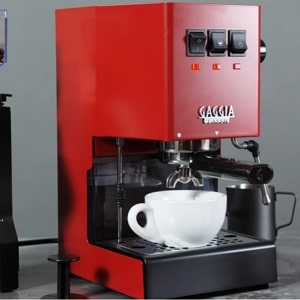
US retail $1,699 • UK £1,699. Specialty dealer warranties vary by region.
Gaggia Classic GT (2025)
Gaggia’s first prosumer dual-boiler: fast heat, precise dual PID, guided low-flow pre-infusion, external pressure adjust, and real steam power in a compact, steel chassis.
Overview
Classic name, new class. The GT is a dual-boiler with independent PID control, low-flow pre-infusion (with bloom), external OPV, volumetrics, and a serious steam boiler. Heat-up is fast for the category, workflow is clean, and control depth rivals pricier machines. Caveats: first-gen platform with limited long-term data, polarizing industrial look, and a small 120 ml brew boiler that isn’t built for party service.
Pros
- Dual PID boilers with 1 °C adjust and quick warm-up
- Low-flow pre-infusion + bloom presets and full manual control
- External OPV (6–12 bar) with real-time analog gauge feedback
- Powerful, consistent steam from 900 ml boiler; single-hole tip for art-grade microfoam
- Volumetric dosing, wake timer, eco mode, hot-water mode
Cons
- Launch-year model—limited long-term reliability data
- 120 ml brew boiler may constrain high-volume entertaining
- Industrial aesthetic won’t suit everyone
- Availability and warranties vary by specialty retailer
Features
- Dual boilers: 120 ml lead-free brass brew; 900 ml insulated stainless steam
- Dual PID with 1 °C / 1 °F increments on brew; four steam presets (248–275 °F)
- Low-flow pre-infusion (~3 g/s) with bloom; roast-based presets + manual mode
- External OPV adjustment (approx. 6–12 bar); factory brew pressure 9 bar
- 58 mm chrome-plated brass portafilter; commercial group; 3-way solenoid
- Volumetric shot programming via flow meter; integrated shot timer
- 2.4″ color TFT with capacitive controls + five backlit toggles
- Tank: 2.0 L removable reservoir; adjustable drip tray (74–115 mm clearance)
- Power: NA 120 V/1400 W • EU/UK 230 V/1300 W
- Size/weight: 16.7 H × 10.2 W × 16.4 D in; ~38.9 lb
- Hot-water mode lowers steam-boiler temp to prevent sputter for Americanos
- Wake-up timer and eco mode (steam boiler disable)
Pricing
- United States: $1,699 (typical)
- United Kingdom: £1,699
- Primary sales via specialty dealers and authorized Gaggia retailers
- Box includes 58 mm portafilter (double spout), 18 g & 11 g baskets, blind basket, wood-handle tamper
FAQs
- Plumb-in capable?
- Reservoir only on launch models.
- Warm-up time?
- ~5–6 minutes to brew capability; ~7–9 minutes to full steam.
- Can I change brew pressure?
- Yes—external OPV adjusts in seconds with a flathead screwdriver.
- Does pre-infusion run automatically?
- Yes—three presets by roast level, plus a manual mode up to ~30 s.
- Color options?
- Brushed stainless steel only at launch.
Who It Is For
- Upgrading Classic owners and enthusiasts wanting prosumer control without DIY mods
- Light-roast fans who benefit from temp agility and low-flow pre-infusion
- Milk-drink households (2–4/day) needing simultaneous brew/steam
Who Should Avoid It
- Traditionalists who want E61 styling or rotary/plumb-in builds
- High-volume entertainers regularly pulling 6+ back-to-back shots
- Buyers prioritizing the lowest price over pre-infusion and control depth
Variants & buying notes
- NA model: GACLASSICGT (120 V/60 Hz/1400 W) with roast-tuned PI profiles
- EU/UK model: EG3500 SIN046 (230 V/50 Hz/1300 W)
- Single finish: brushed stainless; metal badge with red “GT”
Gaggia built its reputation on accessible home espresso, and the Gaggia Classic GT is the brand’s first true step into prosumer territory: a compact dual-boiler machine designed for stable espresso and real milk cadence, with modern control features that make experimentation easy.
The GT’s “buying truth” is simple: it’s a dual boiler that makes pre-infusion and pressure tuning unusually approachable. You get low-flow pre-infusion with a bloom step, an externally adjustable OPV (no disassembly), and a brew-pressure gauge paired with a modern display—so dialing-in feels more predictable than many machines in this price lane. The reality check is equally straightforward: it’s a new platform with limited long-term ownership history, it’s electronics-forward, and water discipline still decides how smooth ownership feels.
For cross-shoppers, we typically frame the Classic GT against the machines people actually compare at checkout: Rancilio Silvia Pro X for an established compact dual-boiler lane, Lelit Elizabeth for compact dual-boiler value, Breville Dual Boiler for features-per-dollar, and Lelit Bianca if manual flow profiling is the point of the hobby.
Shop the essentials
The small upgrades that make a home coffee setup cleaner, smoother, and more enjoyable to use every day.

Cleaner & Descaler Tablets
Keeps your machine clean, helps prevent buildup, and protects long-term performance.
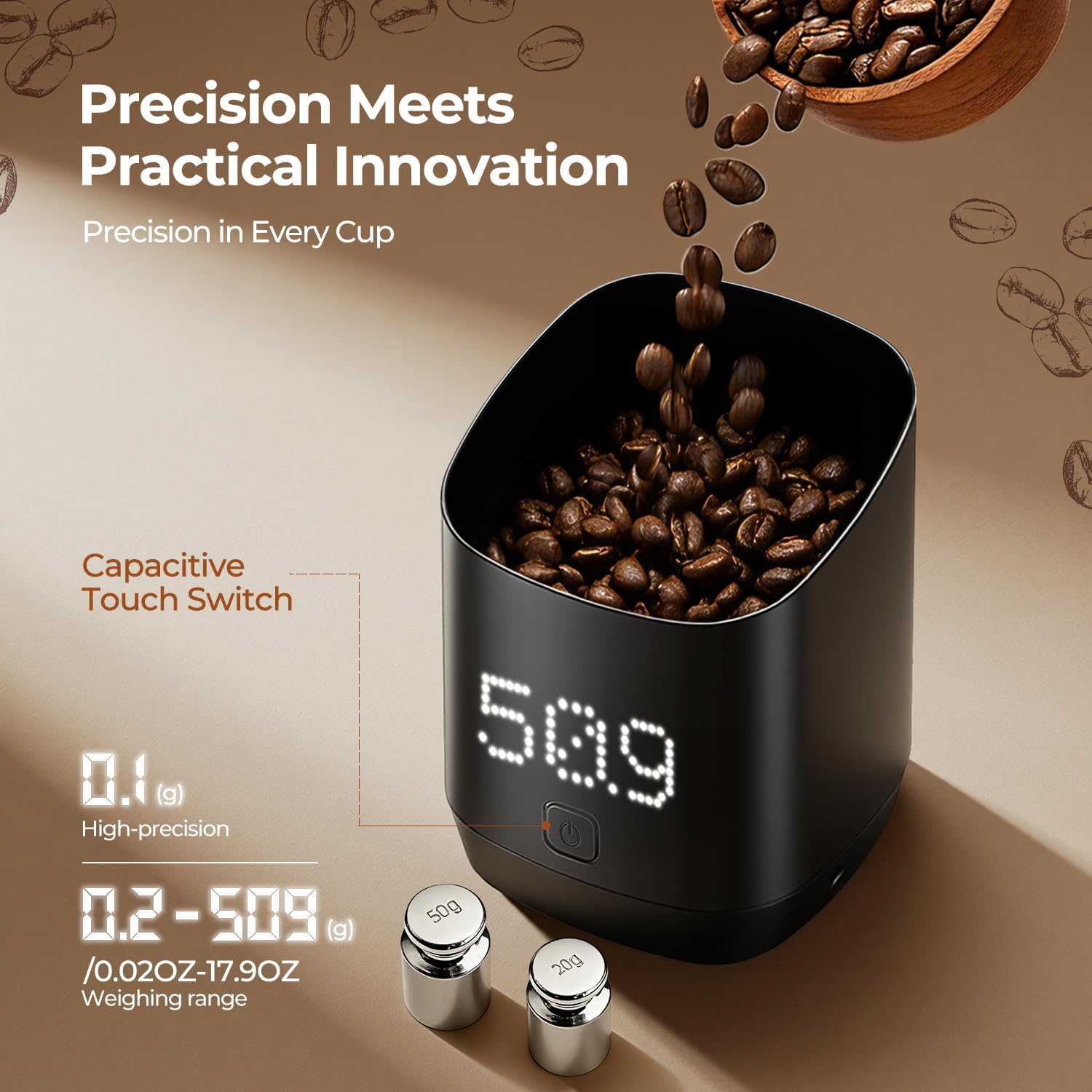
Digital Dosing Cup
Makes weighing beans faster and cleaner, with less mess around the grinder.
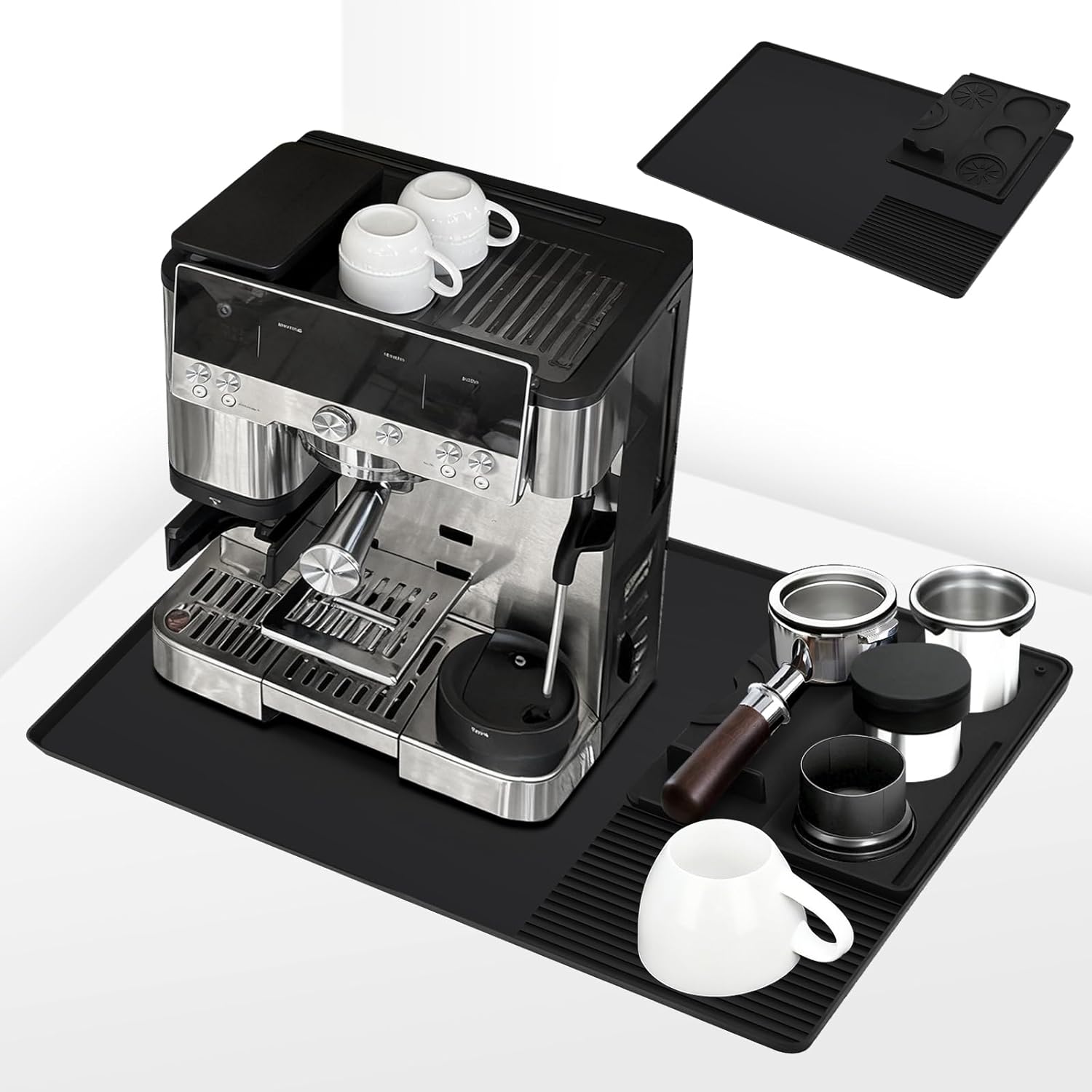
Silicone Mat
Protects your counter, catches spills, and gives your setup a cleaner working surface.

Vacuum Coffee Canister
Helps beans stay fresher longer by limiting air exposure after opening the bag.
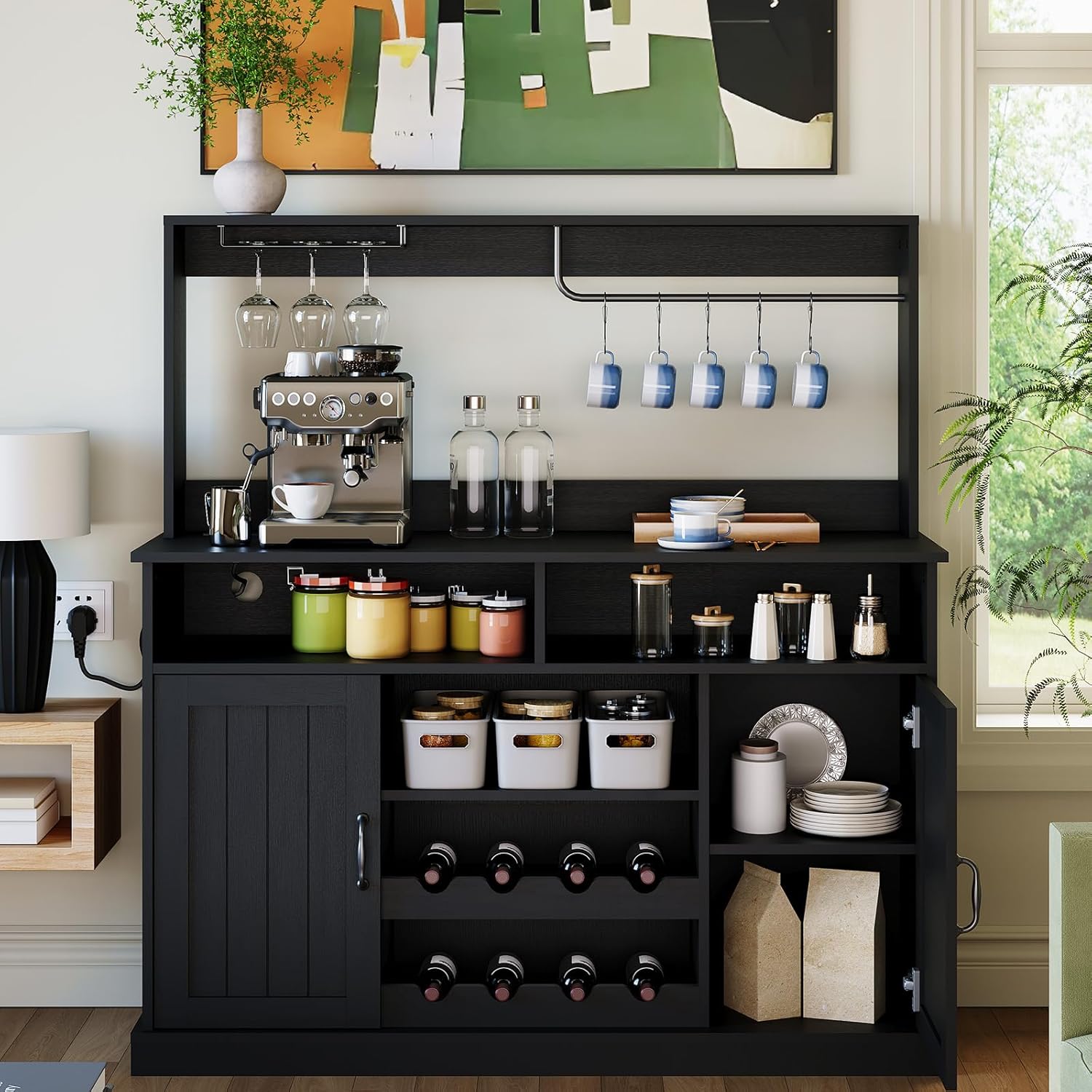
Farmhouse Coffee Bar Cabinet
Gives your machine, cups, beans, and accessories one dedicated home instead of cluttering the kitchen.
Overview
The Gaggia Classic GT is Gaggia’s first true prosumer dual-boiler machine (launched September 2025), and it’s not a “Classic Pro with two boilers.” It’s a purpose-built $1,699 platform meant to fight in the compact dual-boiler lane against machines like the Rancilio Silvia Pro X, Lelit Elizabeth, and newer value-focused dual boilers like the Profitec MOVE. The headline features are the ones enthusiasts normally mod for: dual PID control, a brew-pressure gauge, externally adjustable OPV (no disassembly), and a genuinely advanced low-flow pre-infusion with a bloom step.
In daily use, the GT is a “workflow-forward” prosumer box: quick warm-up for a dual boiler, straightforward temperature changes from the front panel, and a steam boiler big enough to feel like you can actually make milk drinks back-to-back without waiting. The UI is part of the pitch—a 2.4" color display plus physical toggles—so it feels more guided than most minimalist prosumer machines. The trade-off is that this is still a vibration-pump, reservoir-fed machine with a compact brew boiler, so the ownership style is “fast and practical,” not “E61 ritual and profiling theater.”
Design intent
- Prosumer stability without the ritual: dual boilers + dual PID for predictable brew temperature while you steam.
- Fast, accessible control: brew temp changes at the face of the machine; steam boiler presets keep milk cadence simple.
- Pressure experimentation made easy: externally adjustable OPV lets you move brew pressure without opening the chassis.
- Pre-infusion that actually matters: low-flow pre-wet + bloom step to soften early flow and help light/medium roasts behave.
- “Built-in mods” philosophy: features Classic Pro owners usually add aftermarket (PID, 9-bar logic, gauge, shot feedback) arrive factory-equipped.
What it gets right in the cup and in cadence
- Real temperature control: tighter stability than classic thermostat machines, with quick experimentation across roasts.
- Milk-drink workflow: steam capacity that supports “make a couple lattes” without the single-boiler wait cycle.
- Better first-shot confidence: pre-infusion + pressure feedback help you diagnose grind/puck prep faster.
- Americano friendliness: dedicated hot water behavior is built into the platform (less sputter-y than typical steam-boiler water dispensing).
The deliberate trade-offs
- It’s brand-new: launched in 2025, so long-term reliability “patterns” are still developing versus decade-old staples.
- Small brew boiler reality: the compact brew boiler is great for heat-up and footprint, but it’s not built for high-volume entertaining.
- No true profiling: pre-infusion is excellent, but it’s not a paddle/flow-control profiling platform like a Lelit Bianca.
- Vibration-pump character: louder and more “buzzy” than rotary-pump machines, especially during fill events.
- Industrial aesthetic: polarizing look—either you love the “tool” vibe or you’ll wish it looked more traditional.
Where it fits
The Classic GT is the right pick for home baristas who want a compact dual boiler with modern control (PID + pre-infusion + easy pressure adjustment), strong milk cadence, and a “factory-modded” value proposition—especially if you’re coming from a Gaggia Classic/Classic Pro and want a real leap. If you want the most proven, conventional dual-boiler ownership lane, the Silvia Pro X is the common cross-shop. If you want maximum programmability/value (especially outside the US), the Lelit Elizabeth is the frequent alternative. If features-per-dollar matters most and you’re okay with a more consumer-ish build lane, the Breville Dual Boiler remains the perennial comparison.
Cross-shop context on Coffeedant: Classic GT buyers most often compare against the Rancilio Silvia Pro X for “traditional prosumer” build feel, the Lelit Elizabeth for compact dual-boiler value, and the Breville Dual Boiler for features-per-dollar. If you don’t need dual boilers, simpler alternatives like the Profitec Go can be the smarter “espresso-first” buy when budget or footprint is the main constraint.
Gaggia Classic GT lineup: which version to buy
The Gaggia Classic GT is effectively a one-trim machine: it comes in brushed stainless (inox) only, and the brew engine does not change. What varies is region voltage, warranty coverage, and (sometimes) which retailer bundle you’re buying from. If you’re deciding between “Gaggia models” (not regions), the real fork is the entry single-boiler lane versus prosumer dual boiler: Classic/Classic Pro-style machines vs the Classic GT dual-boiler platform.
| Version | Lineup slot | Compared to reference | Typical price and note |
|---|---|---|---|
| Gaggia Classic GT (120V / North America) Reference | Safest US/CA default | Same stainless-only build, same dual-boiler core, same low-flow pre-infusion + bloom workflow, and the externally adjustable OPV. Buy this when you want straightforward 120V compatibility and the cleanest local warranty/support path. | US MSRP $1,699 • Often sold via specialty retailers (not mainstream big-box marketplaces) • Warranty commonly dealer-backed (e.g., 3-year parts & labor in NA) |
| Gaggia Classic GT (230V / UK) | UK voltage / UK warranty | Same machine and finish, but 230V electrical spec and UK/Europe dealer ecosystem. The buying decision here is often about warranty terms and total bundle value, not different espresso performance. | UK MSRP £1,699 • Warranty terms vary by dealer (commonly longer parts coverage in UK channels) • Cross-shop is tougher in the UK because value rivals can price lower |
| Gaggia Classic GT (230V / EU) | EU voltage / EU support | Same core hardware. Make sure you’re buying from an authorized dealer who can support parts, service, and warranty in your country. Importing can erase “deal” pricing fast if warranty becomes complicated. | EU pricing varies by country • Confirm plug type, dealer warranty, and return policy before you chase a cross-border discount |
| Import scenario (do this only if you’re sure) | High-friction | Don’t import a dual-boiler prosumer machine casually. If you must: confirm voltage, plug, service access, and whether the seller will honor warranty outside the region. | A voltage mismatch and warranty gaps cost more than any “savings” • Region-correct purchase is almost always the smarter move |
How to read this: choose the version that matches your region’s voltage and warranty support first. The Classic GT is not a “pick the best trim” machine—there’s one trim—so the smartest buy is the one with the least support friction.
Key Gaggia Classic GT Specifications
| Item | Detail |
|---|---|
| Machine | Gaggia Classic GT · Model page · Cross-shop: Rancilio Silvia Pro X · Lelit Elizabeth |
| Machine type | Semi-automatic dual boiler (dedicated brew boiler + dedicated steam boiler) |
| Boiler sizes | 120 ml brew boiler (lead-free brass, CW510) · 900 ml steam boiler (insulated stainless steel) |
| Temperature control | Dual PID (independent brew + steam control) · Brew temp adjusts in 1°C/1°F steps via front +/- buttons · Steam boiler offers preset temps + dedicated hot water mode |
| Pre-infusion | Low-flow pre-infusion (~3 g/s) with bloom step · Automatic roast-based presets + manual mode (up to ~30 s) |
| Pressure tools | Analog brew-pressure gauge + externally adjustable OPV (factory 9 bar; adjustable range commonly cited ~6–12 bar) |
| Pump | Dual Ulka vibration pumps (one per boiler) · 15 bar rated pump spec (brew pressure governed by OPV) |
| Portafilter size | 58 mm (standard accessory and basket ecosystem) |
| Steam performance | 900 ml steam boiler · Professional steam wand with single-hole tip · Strong “multiple milk drinks” cadence (no single-boiler waiting) |
| Warm-up expectations | Brew-ready in ~5–6 minutes · Full steam in ~7–9 minutes · Best first-shot quality after extra heat soak |
| Reservoir + clearance | Removable 2.0 L tank · Adjustable drip tray for about 74–115 mm cup/scale clearance |
| Footprint notes | About 16.7" H × 10.2" W × 16.4" D · About 38.9 lb (heavy, rigid, “tool” feel) |
| Maintenance rhythm | Water flush after shots · Detergent backflush weekly (solenoid-equipped group) · Descale based on water hardness (commonly run through the steam wand, not the group) |
| Coffeedant score | New platform (Sept 2025) · rating evolves as longer-term ownership data accumulates |
| Typical price | US MSRP $1,699 · UK MSRP £1,699 · Limited to specialty retailers / authorized dealers (not mainstream marketplaces) |
First Impressions & Build Quality
On the counter, the Classic GT reads like an industrial prosumer tool: a heavy steel frame, brushed stainless housing, and a control layout that mixes a 2.4" color TFT display with tactile toggles. The mass is the story—at nearly 39 lb, it feels closer to a “small commercial box” than a mod-friendly entry machine.
Ergonomically it’s a modern workflow machine: the front panel shows what you actually want while dialing in (time, temps, pre-infusion behavior), and the brew pressure gauge gives you immediate feedback when grind and puck prep are off. The adjustable tray is a practical win because it makes room for a scale without turning the setup into a balancing act.
What’s in the Box
- Gaggia Classic GT espresso machine
- 58 mm double-spout portafilter
- Traditional baskets: 18 g double and 11 g single
- Blind filter basket (for backflushing)
- 58 mm tamper (wood handle with stainless base)
- Ground coffee scoop
- Water tank and drip tray
- User documentation and warranty information
Bundles vary by retailer and region. If you want a bottomless portafilter, precision baskets (IMS/VST), or a better distribution workflow, plan those as add-ons.
Chassis and internals
The under-the-hood story is very “prosumer done right for the price”: dual boilers with independent PID control, a three-way solenoid so you can backflush, a real brew pressure gauge, and an externally adjustable OPV so pressure experimentation doesn’t require disassembly. It’s also electronics-heavy compared to old-school prosumer boxes (display, touch controls, volumetric programming), which is great for usability and the unknown for long-term field data.
Controls and touch points
The GT is unusually friendly for a dual boiler: brew temperature changes are quick and obvious, steam boiler control is preset-based, and pre-infusion is “real” (low-flow + bloom) rather than a vague pump pulse. It also includes practical ownership features like programmable wake-up, automatic shutoff, and an eco mode that can disable the steam boiler when you’re only pulling shots.
Counter fit
| Item | Detail | Why it matters |
|---|---|---|
| Width | ~10.2" | Narrow for a dual boiler; leaves room for a real grinder. |
| Height | ~16.7" | Measure cabinet clearance—taller than some compact prosumer boxes. |
| Depth | ~16.4" | Plan for rear clearance and comfortable cup/scale space. |
| Warm-up reality | Brew-ready fast; best after heat soak | First-shot quality improves when the group and portafilter are fully warmed. |
| Cup clearance | ~74–115 mm (tray adjustable) | Lets you fit a scale + cup; helps weight-based dialing and repeatability. |
| Noise profile | Dual vibration pumps | Expect vib-pump sound and occasional refill/fill events. |
| Accessory ecosystem | 58 mm standard | Easy baskets, tampers, puck screens, and bottomless portafilters. |
Testing Results
Tests used a disciplined warm-up and heat-soak routine, repeated shot sequences, and pre-infusion presets to map behavior across roast styles. Results below focus on warm-up cadence, temperature stability, steam timing, and copyable starting points.
| Metric | Result | Method |
|---|---|---|
| Warm-up to brew-ready | ~5–6 minutes | Brew boiler at setpoint; best first shot after portafilter/group heat soak. |
| Warm-up to full steam | ~7–9 minutes | Steam boiler at preset temp; purge before frothing. |
| Shot-to-shot temperature stability | Sub-1°C swing (PID-controlled) | Consecutive extractions after heat soak. |
| Pre-infusion behavior | Low-flow (~3 g/s) + bloom | Preset profiles for roast style + manual mode for custom timing. |
| 150 ml milk steam timing | ~20 seconds to ~60°C at highest steam setting | Brief purge, short stretch, then roll to finish. |
| Pressure adjustment friction | Very low | External OPV adjustment (no disassembly) encourages real experimentation. |
| Coffee | Dose | Yield | Time | Brew temp | Pre-infusion | Notes |
|---|---|---|---|---|---|---|
| Medium blend | 18 g | 38–42 g | 26–30 s | 92–94°C | Medium preset | Balanced sweetness; great baseline for learning the machine |
| Light SOE | 18 g | 45–50 g | 28–34 s | 95–96°C | Light preset (longer pre-wet) | Leans into GT’s strength: pre-infusion + stability for dense beans |
| Dark roast | 18 g | 36–40 g | 24–28 s | 90–92°C | Dark preset (shorter pre-wet) | Lower temp + tighter ratio to avoid ashiness and dryness |
| Decaf | 18 g | 38–44 g | 26–32 s | 92–94°C | Medium preset (or short manual) | Decaf often likes a slightly longer ratio and gentle pre-wet |
Key takeaways from testing
- It’s a control-forward dual boiler: PID stability + usable pre-infusion makes dialing-in feel more predictable than most compact prosumer boxes.
- External OPV is a real differentiator: it makes pressure experimentation practical instead of a “take the machine apart” project.
- Steam cadence is legit: enough power and capacity to do consecutive milk drinks without the single-boiler wait cycle.
- Heat-soak still matters: you can pull early, but the best first shot comes after the group and portafilter are truly warm.
- Water discipline is longevity: test hardness, descale on a rational schedule, and keep the group clean with weekly detergent backflush.
Espresso Quality: getting the best out of the Gaggia Classic GT
The Gaggia Classic GT is a prosumer dual-boiler semi-auto built for control and repeatability, not automation. With a good grinder and disciplined puck prep, it delivers clean, stable espresso thanks to dual PID control, a true independent steam boiler, a brew-pressure gauge, and a genuinely useful pre-infusion system (low-flow + bloom). Your “levers” are the ones that matter in real espresso: grind, dose, yield, time, brew temperature, plus pre-infusion profile and OPV pressure (externally adjustable).
Session protocol that keeps results consistent
- Heat soak, not just “ready”: lock in a dry portafilter and basket, let the brew boiler reach setpoint, then run a 3–5 second blank shot.
- Stabilize the first shot: GT can slightly overshoot on first heat-up—do one short flush, wait 1–2 minutes, then brew.
- Pick a baseline ratio: keep a target recipe steady (1:2 for medium/dark, 1:2.5-ish for lighter coffees) while you adjust grind.
- Choose a pre-infusion lane: start with the roast preset (Light/Medium/Dark), then move to manual only after you have a stable baseline.
- Change one variable at a time: adjust grind first, then yield, then temperature or pre-infusion. Touch OPV last.
- Use the gauge as feedback: stable pressure + bad taste usually means recipe; unstable pressure usually means puck prep or grind.
Flavor targets by coffee style
| Coffee | Baseline recipe (Classic GT) | What it tastes like when right | If too sour / thin | If too bitter / dry |
|---|---|---|---|---|
| Medium espresso blend |
Dose 18 g → Yield 36–40 g in 25–30 s Brew temp 92–94°C · Pre-infusion Medium preset Target pressure ~9 bar during main extraction |
Syrupy body, rounded chocolate, steady crema | Go finer or tighten yield (closer to 1:2); raise temp 1°C if needed | Go coarser or reduce yield slightly; drop temp 1°C if roast is darker |
| Light single-origin espresso |
Dose 18 g → Yield 45–50 g in 28–34 s Brew temp 95–96°C · Pre-infusion Light preset (longer/gentler wetting) Target pressure ~8–9 bar once flowing |
Bright but clean acidity, higher clarity, less astringency at longer ratios | Go finer, extend yield slightly (within taste), or increase temp 0.5–1°C | Go coarser, reduce yield, or shorten pre-infusion if the puck is over-wetting |
| Dark roast |
Dose 18 g → Yield 36–40 g in 24–28 s Brew temp 90–92°C · Pre-infusion Dark preset (shorter wetting) Target pressure ~9 bar (avoid choking) |
Heavy body, lower bite, less ashiness | Go finer or raise temp 0.5–1°C (only if roast isn’t very dark) | Go coarser, reduce yield, or drop temp 1°C; dark coffee turns dry fast when over-extracted |
| Decaf (Swiss-water style) |
Dose 18 g → Yield 38–44 g in 26–32 s Brew temp 92–94°C · Pre-infusion Medium preset (or short manual) Target pressure ~8–9 bar with smooth flow |
Caramel sweetness, controlled finish, less bite | Go finer and keep ratio reasonable; decaf often likes a slightly longer yield than classic blends | Go coarser or lower temp 0.5–1°C; avoid long pulls that amplify dryness |
Brew temperature, pre-infusion, and OPV: use them like tools
- Brew temperature: run 92–94°C for most blends; push 95–96°C for light roasts that taste tight or sharp; go 90–92°C for darker coffees.
- Pre-infusion: start with Light/Medium/Dark presets. Use manual mode when you want to tune wetting time (e.g., longer soak for dense light roasts, shorter for fragile dark roasts).
- Gauge literacy: low pressure + fast flow usually means too coarse / weak puck; high pressure + drips usually means too fine / overdosed.
- OPV discipline: treat OPV as the last lever. If you’re consistently over/under 9 bar *with correct grind and puck prep*, then adjust OPV in small steps and re-test.
- Volume discipline: fix taste with grind and ratio before you chase exotic settings. Recipe wins first.
Diagnostics you can see and taste
| Signal | Likely cause | Targeted fix |
|---|---|---|
| Fast shot, low gauge reading, thin body | Grind too coarse, under-dosed basket, or weak distribution | Go finer; verify dose; WDT and level tamp; keep pre-infusion moderate on medium roasts |
| Slow drips, high gauge reading, harsh dryness | Grind too fine, overdosed basket, or puck swelling/choking | Go coarser; reduce dose 0.5 g if needed; shorten yield; drop temp 0.5–1°C for darker coffees |
| Spritzing or sudden blonding early | Channeling from uneven puck prep or rim gaps | Improve distribution, tamp level, clean basket rim; use a calmer pre-infusion profile for light roasts |
| “Settings are right” but first shot is inconsistent | Not fully heat-soaked group and portafilter | Follow the heat soak protocol: short blank, brief wait, short blank, then brew |
| Gauge “stays high” after the shot | Normal behavior on a pressurized boiler path | Flush the group briefly after the shot; don’t treat this as a fault by itself |
Keep variance low
- Use a consistent puck routine (WDT, level tamp, dry basket). The GT rewards discipline.
- Log dose, yield, time, temp, and pre-infusion profile. Small changes add up fast.
- Keep water in a sane range (balanced hardness and alkalinity) to protect taste and reduce scale-driven drift.
Milk System: Classic GT steaming workflow, texture, and consistency
The Gaggia Classic GT has a true dual-boiler milk advantage: the 900 ml steam boiler keeps pressure steady while the brew boiler stays locked on temperature. In practice, that means a clean routine for multiple milk drinks in a row without waiting for recovery. The stock single-hole tip favors precise control and microfoam quality, so the main skill is controlling stretch time and building a stable roll.
Technique targets that make latte-art texture repeatable
- Purge briefly: clear condensation, then start immediately. Long purges waste pressure.
- Stretch early: add air in the first few seconds, then stop adding air before bubbles get big.
- Roll to finish: sink the tip slightly to build a stable whirlpool, then finish around 60–65°C.
- Wipe and purge: clean the wand right away and purge 1–2 seconds to keep the tip sharp.
Milk volume and real-world timing
| Milk volume | Target drink | Typical steam time | Tip |
|---|---|---|---|
| 150 ml (from ~5°C) | 5–6 oz cappuccino / flat white | ~20–25 s to ~60°C (high steam setting) | Single-hole tips reward calm stretch—don’t chase foam too long. |
| 200–250 ml | 8–10 oz latte | ~25–35 s | Stretch shorter than you think; let rolling do the texture work. |
| 350 ml | 12–14 oz latte | ~35–50 s | If foam gets too thick, shorten stretch and keep the roll tight. |
Texture targets by drink
| Drink | Milk volume | Target texture | Notes |
|---|---|---|---|
| Cappuccino | 150–220 ml | Glossy microfoam, slightly more lift | Stretch a bit longer than latte, then roll tight to avoid dry foam. |
| Latte | 200–350 ml | Paint-like microfoam, minimal bubbles | Short stretch, strong roll. Aim for “wet gloss,” not stiff foam. |
| Flat white | 160–220 ml | Low-foam, high gloss | Very short stretch, then roll. Finish closer to 60°C for sweetness. |
Keep milk performance sharp
- Do not let milk residue bake into the tip. Wipe and purge every time.
- If steam feels wetter than usual, raise steam boiler temp preset and keep purges short.
- If texture turns bubbly, the usual cause is stretching too long (or starting with warm milk), not weak steam.
Hardware Essentials
Boilers, heating, and water system
Classic GT uses a 120 ml lead-free brass brew boiler paired with a 900 ml insulated stainless steam boiler, each controlled by PID. That separation is the ownership win: the brew boiler stays stable while the steam boiler handles milk demand. Treat water as both an ingredient and a protection plan—scale management matters on any prosumer platform.
- Dual PID: set brew temp for roast level; choose a steam preset that matches your milk volume and workflow.
- Hot water mode: reduces steam boiler behavior for cleaner Americano water (less sputter than full-pressure draw).
- Water strategy: filtered water + known hardness beats reactive descaling.
Pumps, OPV, and brew-pressure gauge
The GT combines dual vibration pumps (one per boiler) with an externally adjustable OPV and an analog brew-pressure gauge. The gauge is a real workflow tool: it makes “too coarse vs too fine” obvious immediately, and OPV makes pressure experiments practical without disassembly.
- Best practice: diagnose with the gauge, confirm with taste, and adjust in small steps.
- OPV use: aim around 9 bar for classic espresso unless you have a reason to explore lower/higher.
- Noise note: vibration pumps are audible; tray/cup rattle can add perceived noise.
Group, solenoid, and 58 mm ecosystem
The GT is a standard 58 mm platform with a commercial-style group and a three-way solenoid. That means fast pressure release after shots and proper detergent backflushing as part of routine maintenance.
Steam hardware
The stock single-hole tip is a microfoam-friendly choice: it’s precise, forgiving once you control stretch time, and excellent for latte art when technique is consistent. Steam performance can be tuned via the GT’s steam temperature presets.
Accessories that actually improve results
- Espresso scale (0.1 g): fastest consistency upgrade.
- 58.5 mm flat tamper: helps edge seal and level tamping.
- WDT tool (0.3–0.4 mm): reduces channeling with modern grinders.
- Precision basket (18 g or 20 g): tighter geometry improves repeatability.
- Puck screen: keeps the shower area cleaner and helps flow consistency.
- Water plan: filter or remineralization routine that lands you in a scale-safe range.
- Optional: a GT-specific dispersion plate upgrade (if you want to chase distribution consistency without “modding” the machine).
Gaggia Classic GT vs The Field: Quick Matrix
| Match-up | Core difference | Best for | Jump to section | Model page |
|---|---|---|---|---|
| Classic GT vs Rancilio Silvia Pro X | GT’s low-flow pre-infusion + external OPV + TFT workflow vs Pro X’s bigger-brew-boiler stability and proven ownership lane | GT for control depth + fast tweaks; Pro X for established platform feel and heavier “classic prosumer” rhythm | Open | Silvia Pro X |
| Classic GT vs Lelit Elizabeth | GT’s guided low-flow + external pressure adjust vs Elizabeth’s compact dual-boiler value and efficient daily cadence | GT for pressure/pre-infusion play without DIY; Elizabeth for “buy it, dial it, live with it” value habits | Open | Lelit Elizabeth |
| Classic GT vs Breville Dual Boiler | Italian steel-tool vibe + external OPV vs maximum features-per-dollar and appliance-forward convenience | BDB for feature density and broad availability; GT for industrial build feel + tactile pressure workflow | Open | Breville Dual Boiler |
| Classic GT vs Profitec Pro 600 | Modern, fast-start dual-boiler UI vs E61 dual-boiler ritual and upgrade runway | Pro 600 for E61 ownership and long heat-soak workflows; GT for compact control depth and quicker routines | Open | Profitec Pro 600 |
| Classic GT vs Lelit Bianca | Repeatable low-flow pre-wet + external max-pressure adjust vs paddle flow control and real profiling | Bianca for experimentation and sculpting extractions; GT for guided control that stays simple day-to-day | Open | Lelit Bianca |
| Classic GT vs Ascaso Steel Duo PID | Dual boiler steam buffer + “café-grade” milk power vs ultra-fast dual-thermoblock efficiency | Steel Duo for speed-first and lower idle habits; GT for stronger milk cadence and pressure/pre-infusion depth | Open | Ascaso Steel Duo PID |
Gaggia Classic GT vs Rancilio Silvia Pro X
This is the closest “prosumer dual boiler under two grand” decision. Both can make excellent espresso with a real grinder. The difference is control style and platform maturity: the Classic GT leans into guided low-flow pre-infusion (with bloom), external OPV adjustment, and a modern TFT workflow. The Silvia Pro X counters with an established track record, a more traditional prosumer feel, and a brew/steam architecture that’s optimized for repeatability.
Core differences
- Pre-infusion: GT gives you low-flow + bloom logic and roast presets; Pro X is simpler and more “classic” in approach.
- Pressure workflow: GT’s external OPV is designed for quick experiments; Pro X leans on a more traditional prosumer ownership rhythm.
- Platform maturity: Pro X is a known quantity; GT is a first-gen platform with less long-term field history.
| Aspect | Gaggia Classic GT | Rancilio Silvia Pro X |
|---|---|---|
| Best fit | Enthusiasts who want low-flow pre-infusion control and fast pressure adjustment without DIY | Buyers who want an established compact dual boiler with a traditional prosumer service lane |
| Daily feel | Fast-start, toggle + TFT workflow, lots of “guided” control options | Simpler prosumer rhythm focused on stability and repeatability |
| Trade-off | New platform with less long-term reliability data | Less “guided” pre-infusion experimentation out of the box |
Who should choose which
- Pick Classic GT if low-flow pre-infusion + external OPV experimentation is a core reason you’re upgrading.
- Pick Silvia Pro X if you want a more established, straightforward dual-boiler ownership lane with a classic prosumer feel.
Gaggia Classic GT vs Lelit Elizabeth
This match-up is the “control depth” versus “value efficiency” fork. The Classic GT is trying to give you premium-ish tools—low-flow pre-infusion with bloom, external OPV, and a modern control layer— while the Lelit Elizabeth remains the compact dual-boiler benchmark for buyers who want strong performance with minimal fuss.
Core differences
- Control emphasis: GT is built around guided pre-infusion + pressure play; Elizabeth is built around fast, practical daily routines.
- Ownership vibe: GT reads more industrial/tool-like; Elizabeth reads more “compact value dual boiler.”
- Buying logic: choose GT for its unique control set; choose Elizabeth when value and efficiency matter most.
| Aspect | Gaggia Classic GT | Lelit Elizabeth |
|---|---|---|
| Best fit | Users who want pre-infusion/pressure tools and like experimenting with roast profiles | Value buyers who want compact dual-boiler performance with an efficient daily cadence |
| Daily feel | Lots of control depth, fast adjustments, industrial UI/controls | Simple, efficient routines that still deliver true dual-boiler capability |
| Trade-off | First-gen platform, control layer adds complexity | Less “special sauce” pre-infusion feel compared to GT’s low-flow/bloom approach |
Who should choose which
- Pick Classic GT if low-flow pre-infusion + external OPV are your main reasons to buy.
- Pick Lelit Elizabeth if you want the most “efficient” compact dual-boiler ownership for the money.
Gaggia Classic GT vs Breville Dual Boiler
This is a philosophy match-up. Breville Dual Boiler is the long-running “features-per-dollar” champion: it’s accessible, widely available, and feature-dense. Classic GT counters with a more industrial Italian build approach, an analog gauge workflow, and external pressure adjustment that encourages hands-on tuning—while still offering a modern control surface.
Core differences
- Value style: BDB wins on raw feature density and availability; GT wins on “prosumer tool” identity.
- Workflow: BDB feels appliance-forward; GT feels toggle/tool-forward with tactile feedback.
- Buying logic: pick BDB for the best deal-and-features combo; pick GT when build vibe + pressure/pre-infusion control are the point.
| Aspect | Gaggia Classic GT | Breville Dual Boiler |
|---|---|---|
| Best fit | Hands-on baristas who want industrial feel and quick pressure tweaks | Value-first buyers who want lots of features and easy purchase availability |
| Daily feel | Tool-like workflow with guided control depth | Feature-rich, convenience-forward, broadly supported in retail |
| Trade-off | Newer, less “field-proven” platform | Different long-term service expectations than traditional prosumer builds |
Who should choose which
- Pick Classic GT if you want Italian build feel and love external pressure/pre-infusion workflow.
- Pick Breville Dual Boiler if features-per-dollar and easy purchase/support access matter most.
Gaggia Classic GT vs Profitec Pro 600
This is the “modern compact prosumer” versus “E61 dual boiler” fork. Profitec Pro 600 appeals to buyers who want classic E61 ownership—more ritual, more mass, and a well-known upgrade ecosystem. Classic GT is about fast readiness, a modern control layer, and pressure/pre-infusion tools that are easy to adjust in daily life.
Core differences
- Group style: Pro 600 is E61; GT is a modern commercial-style group approach with a different ownership rhythm.
- Warm-up lifestyle: E61 platforms often reward longer heat soak; GT targets fast “ready-to-brew” behavior.
- Decision lens: buy Pro 600 for E61 ritual and long-term upgrade runway; buy GT for compact control depth without the E61 routine.
| Aspect | Gaggia Classic GT | Profitec Pro 600 |
|---|---|---|
| Best fit | Buyers who want fast starts and guided control depth in a compact chassis | E61 lovers who want traditional ritual and an upgrade-friendly platform |
| Daily feel | Quick adjustments, modern display/controls, pressure play without disassembly | E61 workflow with longer heat soak expectations |
| Trade-off | Newer platform, more electronics-driven experience | Larger footprint and more ritual-heavy routine |
Who should choose which
- Pick Classic GT if you want compact speed and easy pressure/pre-infusion experimentation.
- Pick Profitec Pro 600 if E61 ownership and upgrade runway are the point.
Gaggia Classic GT vs Lelit Bianca
This is “guided control” versus “true profiling.” Lelit Bianca is for people who want to sculpt flow and pressure with a paddle and treat espresso like a hobby craft session. Classic GT is for people who want better pre-infusion and easy pressure tuning without turning every shot into a profiling project.
Core differences
- Control style: Bianca offers manual flow control and real profiling; GT offers repeatable low-flow pre-wet plus max-pressure adjustment.
- Ritual vs routine: Bianca leans into ritual; GT leans into a faster, cleaner daily cadence.
- Decision lens: buy Bianca if experimentation is the point; buy GT if you want strong control that stays practical.
| Aspect | Gaggia Classic GT | Lelit Bianca |
|---|---|---|
| Best fit | Enthusiasts who want practical pre-infusion/pressure tools without full profiling | Profiling-focused baristas who want paddle control and experimentation runway |
| Daily feel | Guided control depth, fast tweaks, compact workflow | Hands-on, ritual-forward, profiling-first |
| Trade-off | No dynamic profiling during extraction | More ritual and typically a bigger footprint |
Who should choose which
- Pick Classic GT if you want a daily driver with serious pre-infusion and pressure tools.
- Pick Lelit Bianca if profiling is your main reason to upgrade.
Gaggia Classic GT vs Ascaso Steel Duo PID
This is the “speed-first modern platform” versus “boiler-buffer cadence” decision. Ascaso Steel Duo PID is loved for fast starts and efficient habits. Classic GT brings a true dual-boiler feel with a real steam boiler buffer, plus low-flow pre-infusion and external pressure adjustment that push it toward a more “prosumer tool” identity.
Core differences
- Heat-up and efficiency: Steel Duo is about speed and lower standby habits; GT is about boiler-buffer steadiness and strong milk cadence.
- Milk workflow: GT tends to feel more “mini café” for repeated milk drinks; Steel Duo is strong for quick sessions.
- Decision lens: buy Steel Duo for speed-first routines; buy GT if steaming and control depth are central to your week.
| Aspect | Gaggia Classic GT | Ascaso Steel Duo PID |
|---|---|---|
| Best fit | Milk drinkers who want strong steam cadence plus low-flow/pressure tools | Speed-first buyers who want rapid readiness and efficient on/off ownership |
| Daily feel | Tool-like dual-boiler rhythm with a deeper control layer | Very fast starts and modern efficiency habits |
| Trade-off | More complex control layer, first-gen platform | Different steam “feel” than a true steam boiler buffer |
Who should choose which
- Pick Classic GT if you want stronger milk cadence and more pre-infusion/pressure depth.
- Pick Ascaso Steel Duo PID if speed, efficiency, and quick daily starts are the main priorities.
How to use this matrix: If you want guided low-flow pre-infusion, fast pressure adjustment, and a tool-like dual-boiler workflow, Classic GT is the clean pick. If you want E61 ritual and upgrade runway, step to Pro 600 or Bianca. If you want maximum features-per-dollar, Breville Dual Boiler and Lelit Elizabeth are the first cross-shops.
In-Depth Analysis
The Gaggia Classic GT is Gaggia’s first true prosumer dual boiler: fast heat-up, serious milk capability, and unusually “easy to experiment” tools for this price tier. The headline differentiators are low-flow pre-infusion with a bloom step, an externally adjustable OPV (no disassembly), and a modern TFT interface paired with an analog brew-pressure gauge. The trade-offs are also real: it’s a brand-new platform with limited long-term field history, and its control layer is more electronics-heavy than old-school prosumer boxes.
1) Why it works for real home routines: fast dual boiler readiness + true milk cadence
The Classic GT is built to feel “ready when you are.” You get quick brew readiness and a steam boiler that supports repeated milk drinks without the brew temperature getting dragged around. If you make cappuccinos and lattes most days, the day-to-day win is simply that you stop waiting.
- What you feel: quick sessions, stable brewing while steaming, and “near unlimited” steam for normal home rounds.
- What it changes: fewer workflow pauses, easier back-to-back milk drinks, less temperature babysitting.
- What it is not: paddle-style profiling or dynamic pressure shaping during the main extraction.
2) The two tools that define the GT: low-flow pre-infusion + external OPV
The GT’s pre-infusion is not a token feature. It’s a low-flow wetting phase (about 3 g/s) with a bloom/soak behavior and roast-oriented presets, plus a manual mode that lets you hold pre-wet timing much longer than typical “soft infusion” implementations. Pair that with an externally adjustable OPV and you get a machine that encourages real experimentation without opening the chassis.
| Tool | What it solves | How to use it well |
|---|---|---|
| Low-flow pre-infusion + bloom | Calmer starts, better puck saturation, more forgiving light-roast starts | Use longer/softer profiles for light roasts; shorten for dark roasts to avoid over-wetting |
| External OPV (no disassembly) | Fast pressure experiments and easy correction when pressure is off | Adjust in small steps, validate with the gauge and taste, then lock in a repeatable recipe |
| Dual PID | Explicit temperature decisions by roast level | Higher for light roasts, mid for mediums, lower for dark roasts; keep notes |
| Analog brew gauge | Instant feedback when grind/prep is wrong | Watch pressure rise and stability; pair with shot time and taste |
3) Boiler sizing reality: excellent for normal home rounds, not a party cannon
The GT’s steam boiler is generous for home use, but the brew boiler is compact. That’s not automatically a problem—temperature control is strong and recovery can be quick—but it does shape expectations if you’re pulling many shots for guests.
- Best cadence: 2–4 drinks daily, especially milk drinks where the steam boiler does the heavy lifting.
- High-volume caveat: if you’re doing 6+ consecutive espressos, expect workflow discipline (and possibly brief pauses) to matter more.
4) The pressure gauge “quirk” that confuses people (and why it’s normal)
The brew gauge can hold the last extraction pressure after a shot. This is typically not a fault—on a pressurized system, the needle won’t drop until the group is relieved (a quick flush does it). In other words: treat it as an extraction tool, not a “pressure always returns to zero” instrument.
5) The Americano detail: hot water mode is a real quality-of-life feature
Many dual boilers spit and sputter when you draw hot water from a fully pressurized steam boiler. The GT’s hot water mode deliberately reduces steam boiler temperature for cleaner water delivery—small feature, big annoyance avoided if you drink Americanos.
6) Water strategy and descaling: protect the solenoid and keep taste stable
Treat water as both an ingredient and a protection plan. A sane hardness/alkalinity range keeps flavor pleasant and reduces scale-driven drift. If descaling is required, be careful with how you route solution on machines with a three-way solenoid valve.
- Hardness target: 40–80 ppm as CaCO3.
- Alkalinity target: 30–60 ppm as CaCO3.
- Descale routing: when in doubt, run descaler through the steam wand, then flush thoroughly.
7) The early-adopter truth: excellent first impressions, limited long-term data
The Classic GT is new enough that deep community troubleshooting lore and multi-year reliability patterns aren’t fully established yet. The upside is strong feature value and serious construction; the risk is that you’re buying into a first-generation platform with more electronics than classic prosumer machines. Warranty support and buying from an authorized dealer matter more here than “saving $80.”
8) Cross-shop logic: where it sits against the machines people actually compare
Classic GT wins when you want pre-infusion control, fast pressure adjustments, and a true milk cadence under $2k. If your priorities shift, the best answer shifts too.
| If you want... | Cross-shop | Why |
|---|---|---|
| Established compact dual-boiler lane | Rancilio Silvia Pro X | Proven ownership lane and classic prosumer “repeatability first” behavior |
| Compact dual-boiler value + efficiency | Lelit Elizabeth | Value benchmark with efficient routines and strong everyday performance |
| Maximum features per dollar | Breville Dual Boiler (BES920) | Feature-dense platform and friendly workflows, with different long-term service trade-offs |
| E61 ritual and upgrade runway | Profitec Pro 600 | Classic E61 feel, more ritual and warm-up lifestyle, upgrade ecosystem potential |
| Manual profiling as the point | Lelit Bianca | Paddle control for shaping flow and pressure—true profiling workflow |
| Very fast starts + efficiency habits | Ascaso Steel Duo PID | Speed-forward thermoblock behavior, great for quick sessions and low standby draw |
Editorial placement: keep OPV + pre-infusion explanation close to Espresso Quality, put hot water mode near Workflow/Drinks, and place descaling routing warnings near Maintenance so readers don’t accidentally create solenoid headaches.
Gaggia Classic GT - frequently asked questions
Fast answers to the questions people ask before they commit to the Classic GT.
Is the Gaggia Classic GT worth it?
Yes if you want a true prosumer dual boiler under $2k with low-flow pre-infusion, an external OPV for easy pressure tuning, and strong milk cadence. The main caveat is that it’s a first-generation platform with less long-term ownership history than established competitors.
How fast is warm-up in real use?
Brew readiness is quick for a dual boiler, but the best first shot still improves with a short heat-soak routine: leave the portafilter locked in, run a short blank shot after setpoint, wait a couple minutes, then brew.
What does “low-flow pre-infusion with bloom” actually do?
It gently wets the puck before full flow ramps up, then allows a short soak (bloom) to even saturation. In practice it can reduce early channeling and make light roasts easier to extract cleanly—assuming your grinder and puck prep are solid.
How do I adjust brew pressure (OPV) on the GT?
The GT’s OPV is externally accessible, so you can adjust maximum brew pressure without opening the machine. Make small changes, validate with the brew gauge plus shot behavior, and keep notes so you can return to your baseline quickly.
Why does the brew pressure gauge stay high after I finish a shot?
On a pressurized system the gauge can hold the last extraction pressure until the group is relieved. A quick flush drops the needle—this is typically normal behavior, not a broken gauge.
Is the steam strong enough for daily lattes and cappuccinos?
Yes. The steam boiler supports a real “home café” cadence for multiple milk drinks without waiting between brew and steam. Consistency still comes down to technique: brief purge, short stretch, then rolling integration to finish.
Can I run descaler through the group head?
Be cautious. On machines with a three-way solenoid, many owners route descaling solution through the steam wand instead of the group to reduce solenoid risk, then flush thoroughly. Always follow the manufacturer’s instructions for your region and revision.
Where can I buy it (and why isn’t it everywhere)?
Distribution is typically through specialty retailers and authorized dealers rather than big-box marketplaces. Because this is a new, electronics-forward prosumer platform, buying from an authorized seller with strong warranty support is part of the value.
Is it noisy?
It uses vibration pumps, so it will sound more “mechanical” than rotary-pump machines. The practical fix is basic: reduce cup/tray rattles and use a mat if your counter resonates.
Used & Refurbished Buyer’s Guide
Because the Gaggia Classic GT is a recent release, the used market is thinner than established prosumer models. That shifts the buying logic: prioritize warranty coverage, verify region voltage, and treat unknown water history as a real risk. If you can test the machine, focus on pressure behavior, pre-infusion functions, and any sign of scale or leaks.
| Inspect | What to check | Pass criteria |
|---|---|---|
| Startup + UI | Boot the display, toggle buttons, and settings navigation. | No glitchy behavior, missing segments, or repeated error states. |
| Heat-up behavior | Bring brew and steam to setpoints; verify steam reaches usable pressure without long stalls. | Stable approach to setpoint; no repeated overshoot alarms or cycling faults. |
| Pre-infusion modes | Test at least one preset and manual pre-infusion behavior. | Low-flow phase behaves predictably and transitions cleanly into brewing. |
| OPV adjustment access | Confirm the external OPV adjuster turns smoothly and affects pressure behavior. | Adjustments are possible without binding; pressure changes are observable and repeatable. |
| Brew pressure behavior | Pull a shot and observe gauge rise/stability; do a brief flush to confirm gauge relief behavior. | Pressure rises smoothly and holds during extraction; gauge relief on flush is normal. |
| Leaks (internals + fittings) | Inspect under the machine and around fittings for residue or scale trails. | No pooling, no crusty scale tracks, no dampness around joints. |
| Steam valve + wand | Steam for 20–30 seconds, then close the valve and check for continued dripping. | Stops cleanly (minor residual is OK). Persistent drip suggests valve wear. |
| Scale signals | Ask what water was used; inspect steam tip and reservoir area for chalky buildup. | Credible water routine, no obvious scale symptoms (weak steam, slow recovery, sputtering beyond normal). |
| Accessories | Confirm portafilter, baskets, blind filter, drip tray parts, and manuals. | Complete kit, or the price reflects missing parts. |
Refurb units should include fresh seals and a store-backed warranty. Confirm coverage on boilers, pumps, control board, and valves.
Accessories & Upgrades
The GT ships with many “mods” already built in (PID, gauge, 9-bar default behavior, pro wand), so the best upgrades are about extraction consistency, workflow measurement, and water discipline—not chasing basic missing features.
| Category | What to buy | Why it helps |
|---|---|---|
| Dial-in essentials | 0.1 g espresso scale | Locks in ratio and makes OPV/pre-infusion experiments actually comparable |
| Puck prep | WDT tool (0.3–0.4 mm) + quality 58 mm tamper (58.5 mm if your baskets fit) | Reduces channeling; improves consistency when you use longer pre-wet phases |
| Baskets | IMS/VST-style precision basket (18 g or 20 g) | Tighter geometry improves repeatability with good grinders |
| Cleanliness | Puck screen (optional) + group brush + backflush detergent | Keeps the shower area cleaner; reduces oil buildup that flattens flavor |
| GT-specific | Aftermarket dispersion plate designed for the GT (if you want more even distribution) | Can improve puck saturation uniformity and reduce edge bias on some coffees |
| Water strategy | Hardness test kit + filter or remineralization plan | Protects boilers, keeps steam recovery stable, and prevents “scale drift” in taste |
| Ownership spares | Group gasket (silicone preferred) + spare steam O-rings | Cheap parts that prevent nuisance leaks and keep workflow tight |
Related comparisons: Rancilio Silvia Pro X · Lelit Elizabeth · Breville Dual Boiler (BES920) · Lelit Bianca
Known Issues & Troubleshooting
- Gauge “sticks” after a shot: the needle may hold the last extraction pressure until you flush the group. This is typically normal pressurized-system behavior, not a broken gauge.
- Shots run fast and thin: grind finer and tighten puck prep first, then consider a longer low-flow pre-wet to calm early flow. Confirm with shot time and taste, not settings alone.
- Shots choke or taste harsh/dry: grind coarser and shorten pre-infusion. Over-wetting plus an overly fine grind can turn a shot astringent quickly.
- Touch/button response feels slightly delayed: minor UI lag can happen; if it becomes inconsistent (missed inputs), document it and use warranty support.
- Steam feels weak or recovery slows: scale is the first suspect. Verify water hardness and fix water habits before reaching for descaling.
- Hot water sputters for Americanos: use the GT’s hot water mode (if enabled) and avoid drawing water from a full-pressure steam condition.
- Back-to-back entertaining limits: if you’re pulling many shots in a row, keep workflow tight, avoid long idle gaps, and expect brief pauses to help stability.
Conclusion: Should You Buy the Gaggia Classic GT?
Who it’s for
- Upgraders who want prosumer dual-boiler workflow without DIY modding.
- Milk drinkers who benefit from true brew/steam separation and strong steam cadence.
- Experimenters who want low-flow pre-infusion + easy pressure adjustment without opening the machine.
- Buyers who like a modern interface and guided controls more than old-school minimalism.
Who should avoid it
- Risk-averse buyers who only want long-established platforms with years of community troubleshooting history.
- Profiling-first enthusiasts who want a paddle and dynamic flow control as the core experience.
- Silence seekers who want rotary-pump quiet.
- Anyone unwilling to commit to water discipline and routine cleaning.
The Gaggia Classic GT represents a watershed moment for the Italian manufacturer—this is their first prosumer dual-boiler espresso machine, released in September 2025. Despite sharing the "Classic" name with Gaggia's entry-level icon, the GT is an entirely different beast: a $1,699 prosumer machine designed to compete with the Rancilio Silvia Pro X, Lelit Elizabeth, and Profitec MOVE. With dual PID-controlled boilers, externally adjustable pressure, sophisticated pre-infusion, and Italian commercial-grade construction, the GT aims to deliver exceptional value in the crowded dual-boiler segment.
This machine matters because it bridges Gaggia's heritage of accessible espresso equipment with professional-grade features typically found in machines costing significantly more. The GT arrives factory-equipped with modifications that Classic Pro owners spend hundreds of dollars and hours installing: PID temperature control, 9-bar brewing pressure, a professional steam wand, and a brew pressure gauge. For coffee enthusiasts ready to move beyond entry-level machines but unwilling to compromise on build quality or spend $2,500+, the GT presents an intriguing proposition—if its unique feature set and industrial aesthetic align with your priorities.
Technical specifications reveal serious prosumer credentials
The Gaggia Classic GT features a dual-boiler configuration with independent PID control systems. The brew boiler holds 120ml (3.4 oz) of water in a lead-free brass (CW510) construction, externally heated and PID-regulated to within 1°C increments. The steam boiler is substantially larger at 900ml (30.4 oz), constructed from insulated stainless steel with internal heating. Both boilers employ Italian-made Ulka vibration pumps operating at 15 bar, with brewing pressure factory-set to 9 bar via an externally adjustable over-pressure valve (OPV) that can be modified from 6-12 bar without machine disassembly.
The machine measures 16.7 inches tall, 10.2 inches wide, and 16.4 inches deep, weighing 38.9 pounds—approximately twice the weight of the original Gaggia Classic. This substantial mass comes from one-piece steel frame construction with brushed stainless steel housing. Power consumption reaches 1,400W on North American 120V circuits or 1,300W on European 230V systems. The removable water reservoir holds 2 liters, while the adjustable drip tray offers 74-115mm cup clearance and accommodates a scale for weight-based dosing.
Temperature control represents a standout feature. The dual PIDs allow independent regulation: brew temperature adjusts in 1°C/1°F increments instantly via touchscreen +/- buttons without menu navigation, while the steam boiler offers four preset temperatures (248°F, 257°F, 266°F, and 275°F) plus a dedicated hot water mode that reduces temperature to prevent sputtering during Americano preparation. Heat-up time from cold start reaches approximately 5-6 minutes for brewing capability and 7-9 minutes for full steam pressure—remarkably fast for a dual-boiler machine.
The GT employs a professional 58mm chrome-plated brass portafilter with a commercial-style group head. A three-way solenoid valve enables backflushing and immediately releases pressure after extraction. The machine includes an analog brew pressure gauge connected directly to the boiler via copper capillary tube, providing real-time extraction feedback. A 2.4-inch color TFT display shows temperatures, shot timer, pre-infusion settings, and programmable parameters through capacitive touch buttons and five backlit toggle switches.
What's included and where to buy it
The GT ships with essential accessories: a professional 58mm stainless steel double-spout portafilter, 18g double-shot and 11g single-shot traditional filter baskets, a blind filter for backflushing, a wood-handle 58mm tamper with stainless steel base (made in Italy with Gaggia logo), and a ground coffee scoop. The machine features built-in functionality including volumetric shot programming via internal flow meter, programmable wake-up timer, automatic shutoff, eco mode to disable the steam boiler when unnecessary, and an articulated professional steam wand with single-hole tip.
Pricing and availability present an important consideration: The GT retails for $1,699 in the United States and £1,699 in the United Kingdom. Whole Latte Love offers it in North America with a 3-year parts and labor warranty, while Coffee-Direct UK provides a 5-year warranty (2 years full coverage plus 3 years parts-only). However, the machine is NOT available through mainstream retailers like Amazon, Williams-Sonoma, Seattle Coffee Gear, Sur La Table, or Crate & Barrel. Distribution remains limited to specialty coffee equipment retailers and authorized Gaggia dealers.
Model variations are minimal—the GT comes exclusively in brushed stainless steel with a metal Gaggia logo featuring red "GT" lettering. Regional variations exist primarily in electrical specifications: North American models (SKU: GACLASSICGT) operate at 120V/60Hz/1400W, while European/UK models (EG3500 SIN046) run at 230V/50Hz/1300W. The North American version received updated automatic pre-infusion profiles specifically optimized for light, medium, and dark roasts as of its September 2025 release.
Comparing the GT to Gaggia Classic Pro reveals completely different machines
A critical misconception must be addressed: the Gaggia Classic GT is NOT a dual-boiler version of the Classic Pro. As multiple reviewers emphasize, "This isn't simply a dual boiler Gaggia Classic... it's a premium 'prosumer' dual boiler espresso machine" positioned in an entirely different market segment. The Classic Pro costs $449—73% less expensive than the GT—and targets entry-level users learning espresso fundamentals.
The differences are comprehensive. Where the Classic Pro uses a single 100-130ml aluminum or brass boiler without temperature control, the GT employs dual PID-controlled boilers totaling over 1,000ml capacity. The Pro requires "temperature surfing" techniques and aftermarket PID modifications for stability; the GT maintains brew temperature within 1°C automatically. The Pro ships with 12-15 bar pump pressure requiring spring replacement or internal adjustment to reach optimal 9-bar brewing pressure; the GT comes factory-set at 9 bar with external adjustment accessible via flathead screwdriver in 5 seconds.
Pre-infusion capabilities differ dramatically. The Classic Pro offers no pre-infusion functionality whatsoever. The GT features low-flow pre-infusion at 3g/second with bloom step, three automatic presets calibrated for different roast levels, plus fully manual mode allowing up to 30 seconds of pre-wetting control. Steam power follows similar patterns: the Pro's small boiler requires 30 seconds transition time between brewing and steaming with limited capacity, while the GT heats 5oz of milk to 140°F in 20 seconds with near-unlimited steam availability.
Interface sophistication separates the machines. The Pro uses basic rocker switches with no display or feedback beyond illuminated buttons. The GT provides a 2.4-inch color TFT display with capacitive touch controls, showing real-time temperatures, shot timer, pre-infusion status, brew pressure gauge, and extensive programmable parameters including volumetric dosing and wake-up scheduling. Heat-up time for the Pro spans 5-15 minutes compared to the GT's 4-7 minutes despite having dual boilers.
How the GT stacks up against true prosumer competitors
The GT's real competition exists in the $1,350-$1,999 prosumer dual-boiler segment. The Rancilio Silvia Pro X ($1,350 UK / $1,990 US) represents the closest comparison, featuring a larger 300ml brass brew boiler (2.5x the GT's capacity) paired with a 1L steam boiler. The Silvia Pro X delivers more powerful steaming through its four-hole commercial tip and larger heating element, though the GT counters with superior pre-infusion control and its unique hot water mode that prevents sputtering during Americano preparation. The Silvia Pro X costs $291 more in the US but £349 less in the UK, demonstrating significant regional pricing variations.
The Lelit Elizabeth ($1,799 US / £1,200 UK) undercuts the GT by £500 in British markets while offering similar dual-boiler performance. The Elizabeth features a 300ml brass brew boiler, dual PID control, programmable pre-infusion with steam-powered low-pressure options, automatic backflushing, and the Lelit Quiet X pump for reduced noise. Reviewers note it as "the most programmable option in this range" with exceptional value proposition, particularly in the UK where pricing advantages are substantial.
The Breville/Sage Dual Boiler (£1,250 / $1,600) costs £450 less than the GT in the UK and delivers "one of the best machines on the market, performance-wise" according to community consensus. However, concerns about build quality persist—the Sage uses consumer-grade components rather than commercial construction, and reliability reviews remain mixed despite generally positive performance assessments when properly maintained.
Within the Profitec lineup, the Profitec MOVE matches the GT's £1,700 price point with a dual-boiler design using the same group and brew boiler as the Profitec GO. The Profitec Pro 500 with E61 group head costs slightly more at £1,600, though temperature stability reviews are mixed. The Profitec GO ($1,059) deserves mention as the best single-boiler prosumer option, featuring a massive 400ml brass boiler (4x larger than the Classic Pro) with PID, externally adjustable OPV, and pressure gauge at significantly lower cost than dual-boiler machines.
The GT's competitive positioning hinges on unique features: It's the only machine in this price range offering low-flow pre-infusion with bloom step, externally adjustable OPV requiring no disassembly, dedicated hot water mode, and dual independent pumps (one per boiler—rare in prosumer machines). However, its small 120ml brew boiler represents a potential limitation for high-volume use, and the industrial aesthetic polarizes potential buyers. Pricing competitiveness varies substantially by region, with better value propositions in North America than the UK.
Setup, first use, and temperature performance
Initial setup follows standard espresso machine procedures. Remove all packaging and wash removable components (portafilter, baskets, drip tray, water reservoir). Fill the tank to the MAX line and insert the decompression duct—easily forgotten but important for proper drainage. Prime the system by activating the pump with the brew switch while opening the steam wand until steady water flow appears. First-time users should flush the group head for several seconds to clear any manufacturing residue, noting that the brew boiler slightly overshoots temperature on initial heat-up.
Temperature stability proves exceptional. Testing by La Barista measured "minimal deviation value of under 1 degree" across multiple consecutive extractions. The dual PID system maintains set temperature within approximately 0.3°C—dramatically better than the 5-10°C swings typical of thermostat-controlled single-boiler machines. Temperature surfing becomes completely unnecessary, eliminating the technique required on standard Gaggia Classics. The brew boiler positions directly above the brass group head for optimal thermal coupling, while independent steam boiler control means pulling shots never impacts brewing temperature.
Adjusting brew temperature takes seconds via the +/- buttons flanking the LCD display, requiring no menu navigation. This accessibility encourages experimentation across roast levels: light roasts benefit from higher temperatures (95-96°C), medium roasts perform well at 92-94°C, and dark roasts extract optimally at 90-92°C. The steam boiler's four preset temperatures enable customization for different milk volumes and types, while the dedicated hot water mode—unique among competitors—reduces steam boiler temperature specifically for Americano preparation, preventing the sputtering that occurs when dispensing water from a full-pressure steam boiler.
Pre-infusion and pressure control capabilities
The GT offers sophisticated pre-infusion through low-flow delivery at approximately 3 grams per second, compared to the 7g/second rate during regular extraction. This gentle wetting phase includes active and passive pre-infusion with a bloom step—a feature typically found in machines costing $2,000+. Users can select from three automatic pre-infusion profiles optimized for light, medium, and dark roasts, or engage fully manual mode by holding the brew toggle for complete control over pre-infusion timing up to 30 seconds.
The display shows pre-infusion time separately from brewing time, providing clear feedback during the process. Combined with volumetric programming via the internal flow meter, users can create repeatable shot recipes that automatically execute preferred pre-infusion sequences. This level of control approaches what machines like the Lelit Bianca V3 offer through manual paddle profiling, though the GT lacks true dynamic pressure profiling during extraction.
Pressure adjustment via the externally accessible OPV represents a major advantage. Factory-set to 9 bar on North American models, the OPV adjusts across a 6-12 bar range (some sources indicate 3-15 bar capability) using only a flathead screwdriver—no machine disassembly required. The adjustment takes approximately 5 seconds compared to 30+ minutes of internal access work on competing machines. The brew pressure gauge connects directly to the boiler via copper capillary tube for accurate real-time readings, though it maintains pressure indication after extraction until the group is flushed (because the boiler remains full under pressure).
While the GT doesn't offer paddle-based dynamic pressure profiling like the Lelit Bianca or electronic pressure profiling systems, its combination of low-flow pre-infusion, externally adjustable maximum pressure, and volumetric programming provides substantial extraction control for exploring different brewing parameters. Experimentation with OPV settings, pre-infusion duration, and temperature proves straightforward compared to machines requiring disassembly for pressure modifications.
Steam performance and milk frothing capabilities deliver professional results
The GT's 900ml stainless steel steam boiler provides "near unlimited steam" capability according to Whole Latte Love's testing. The machine heats 5oz (150ml) of milk to 140°F (60°C) in 20 seconds at the highest temperature setting—professional-grade performance. The custom brass steam valve designed specifically for the GT features the Gaggia logo and delivers consistent, powerful steam through a professional single-hole ogive tip optimized for microfoam creation.
Four selectable steam temperatures (248°F, 257°F, 266°F, 275°F) enable customization for different milk volumes, types, and user preferences. The steam boiler reaches operating temperature approximately 7 minutes from cold start, with brew capability available earlier at 4-5 minutes. The dual-boiler architecture means zero waiting between brewing and steaming—a transformative workflow improvement over single-boiler machines requiring 30+ seconds of temperature management between operations.
Steam wand articulation provides wide range of motion for different pitcher sizes, though not full 360-degree rotation. The professional stainless steel construction includes an insulated grip section to prevent burns during extended steaming sessions. Purge functionality before and after steaming remains standard practice. The single-hole tip enables precise control for latte art, producing professional-quality microfoam when proper technique is applied.
For beginners, the powerful steam delivery actually aids learning—faster steaming means less time for errors to compound, and the forgiving power compensates somewhat for imperfect technique. More experienced users appreciate the unlimited capacity for multiple consecutive milk drinks and the ability to pull espresso shots simultaneously without impacting steam availability. The separate hot water dispenser (distinct from the steam wand) provides another unique convenience, particularly when the steam boiler operates in reduced-temperature hot water mode.
Water quality, descaling, and cleaning requirements
Water quality directly impacts machine longevity and performance. The GT's lead-free brass brew boiler and stainless steel steam boiler offer enhanced resistance to scale compared to aluminum construction, but regular descaling remains essential. BWT Bestsave S anti-scale filters receive specific recommendations from retailers, though any quality water filtration that maintains appropriate mineral content (avoiding completely distilled or reverse osmosis water) proves suitable.
Descaling frequency depends on water hardness: soft water areas may extend to 6-12 months between descaling, medium hardness suggests 3-6 months, and hard water requires 1-3 month intervals. Use water hardness test strips to establish your local baseline. Critical warning: Do NOT run descaling solution through the group head on machines with solenoid valves—this can cause scale buildup in the three-way solenoid requiring disassembly. Run descaling solution exclusively through the steam wand.
Recommended descaling products include Gaggia Decalcifier (official), Durgol Swiss Espresso Descaler, or DIY citric acid solution (2 tablespoons per quart of warm water). The process involves filling the reservoir with diluted descaler, heating the machine, and dispensing all solution through the steam wand in 2oz increments with 2-5 minute rest periods. Thorough flushing with fresh water completes the process—run the full tank through the steam wand, then dispense 2-4oz through the group head to clear any residual solution.
Daily maintenance takes minimal time. After each use, remove the portafilter and run water through the group for 3-5 seconds to flush residual coffee. Knock out grounds, rinse the portafilter and basket thoroughly. Immediately after steaming milk, purge the steam wand and wipe clean with a damp cloth. Empty and rinse the drip tray. These basic practices prevent buildup and ensure consistent performance.
Weekly backflushing using Cafiza or Puly Caff with the included blind basket maintains group cleanliness. Insert the blind basket with 1/2 teaspoon of cleaning powder, run the brew button for 10 seconds, wait 10 seconds, and repeat 5-6 times. Follow with several water-only cycles to rinse thoroughly. The GT's stainless steel shower screen tolerates backflushing without degradation. Monthly deep cleaning involves removing the shower screen (Phillips head screw) and shower holding plate (5mm Allen bolts) to soak in descaling solution while cleaning the group cavity with a stiff brush. Annual group gasket replacement ensures continued pressure seal integrity.
Common issues, troubleshooting, and long-term reliability
A critical caveat affects reliability assessment: The Gaggia Classic GT launched in September 2025, making it brand new at the time of this research. Virtually no long-term ownership data (6+ months) exists, and authentic user reviews remain extremely limited. Professional reviewers and early adopters provide positive initial impressions regarding build quality and performance, but long-term durability, common failure points, and reliability patterns cannot yet be established.
Early quality indicators prove encouraging. La Barista's testing concluded "The Gaggia Classic GT feels extremely stable and high-quality" after comprehensive evaluation. The machine weighs twice as much as the original Gaggia Classic, indicating substantial construction. Italian manufacturing at Gaggia's own factory (not outsourced to China, despite some speculation) suggests commercial-grade component quality. The use of lead-free brass brew boiler, stainless steel steam boiler, and commercial-grade group components aligns with professional equipment standards.
Potential concerns center on electronic complexity. The GT incorporates substantially more electronics than traditional espresso machines: dual PID controllers, color TFT display, capacitive touch buttons, volumetric flow meter, shot timer, and programmable memory functions. One Bulgarian forum user (electrical engineer) expressed concerns about electronic component longevity given high-temperature proximity, though this remains speculative without field data. The upside: Gaggia provides 3-year parts and labor warranty in North America and 5-year coverage (2 years full, 3 years parts) in the UK, suggesting manufacturer confidence.
Community discussions from Reddit's r/espresso and r/gaggiaclassic reveal minimal GT-specific content due to the machine's recent release. Most available discussion involves professional reviews and first impressions rather than troubleshooting or problem-solving threads. Home-Barista forum commentary remains limited but generally enthusiastic: "I'm really impressed by the capabilities of this machine at this price point. $1600 for an Italian dual boiler with powerful steam and guided preinfusion seems like a great deal."
Design quirks identified by early reviewers include pressure gauge behavior—the needle remains at last extraction pressure until group flushing because the boiler stays pressurized. This initially appears faulty but represents normal operation. Touch button response occasionally exhibits minimal delay according to La Barista testing, though navigation remains clear. The small 120ml brew boiler raises questions about capacity for back-to-back shots during high-volume entertaining, though temperature stability testing shows minimal impact during consecutive extractions.
Modifications, upgrades, and customization options
The GT's defining characteristic regarding modifications: It ships from the factory with most popular espresso machine mods already built-in. Features that Gaggia Classic Pro owners spend hundreds of dollars and hours installing—PID temperature control, 9-bar OPV adjustment, brew pressure gauge, professional steam wand, shot timer—come standard on the GT. This positions it as a complete prosumer platform requiring minimal modification compared to the extensive modding culture around entry-level machines.
Available GT-specific upgrades include the Shades of Coffee RainFlow GT Dispersion Plate ($85), designed specifically for the GT's 58mm x 14.5mm group dimensions to improve water distribution across the coffee puck for enhanced extraction consistency. The Shades CronoQube Automatic Shot Timer ($53) provides external timing more visible than the built-in LCD timer, useful for dialing in shots. Silicone shower screen gasket sets in 0.5mm and 1.0mm thicknesses (48mm ID) offer improved sealing and longevity compared to standard rubber gaskets.
Standard espresso accessories prove compatible: bottomless/naked portafilters ($40-100) enable extraction diagnosis, VST or IMS precision baskets ($30-50) with tighter hole tolerances improve shot consistency with quality grinders, and wooden handle portafilter upgrades provide aesthetic customization. Puck screens ($15-25) reduce channeling while keeping the group cleaner. These accessories enhance performance without modifying the machine itself.
What GT owners DON'T need: PID installation kits (has dual PIDs built-in), OPV adjustment springs or modification tools beyond a flathead screwdriver (externally adjustable in 5 seconds), pressure gauge addition (built-in analog gauge), steam wand upgrades (professional-grade wand standard), and basic shot timers (TFT display includes timing). The GT effectively eliminates the modification path that defines the Gaggia Classic Pro ownership experience.
Maintenance parts requiring periodic replacement include the group gasket (annually or when leaking; check GT specifications for exact size, likely 73mm x 57mm x 8mm, silicone preferred over rubber, $5-15), shower screen (every 1-2 years or when clogged, stainless steel, $10-20 for standard or $20-35 for IMS precision versions), steam wand o-rings (replace as needed when leaking, $2-5), and BWT or similar water filters (every 2-3 months, $15-25). The vibration pump may require replacement after 5-10 years ($60-100, professional installation recommended). Keeping spare group gaskets on hand proves essential since the machine cannot operate without a functional seal.
Grinder pairing recommendations across price points
Grinder quality becomes the limiting factor with the GT's dual-boiler precision. The machine's PID-controlled temperature stability, pre-infusion capabilities, and pressure management can only deliver exceptional results when paired with consistent, high-quality grinding. Budget allocation matters: with the GT consuming $1,700, remaining setup budget determines whether you achieve entry-level dual-boiler performance or café-quality results.
Budget tier ($150-$400) options provide entry points. The 1Zpresso J-Max ($200) hand grinder delivers exceptional value, featuring 48mm conical burrs with precise stepless adjustment that competes with $400-600 electric grinders. Labor-intensive but perfect for single-dosing enthusiasts. The DF54/MiiCoffee ($240-280) represents the standout electric value, offering 54mm flat burrs with plasma coil anti-static in a single-dose design—extraordinary specifications at this price that punch well above their cost bracket. The Baratza Encore ESP ($200) provides a modified Encore with Etzinger M2 conical burrs and 40 grind settings (1-20 for espresso micro-adjustments), backed by Baratza's legendary customer service and repairability.
Mid-range tier ($400-$800) contains the optimal pairing zone for most GT owners. The Eureka Mignon Specialità ($500-700) receives top recommendation as an Italian-to-Italian pairing, featuring 55mm flat hardened stainless steel burrs, silent operation below 60dB, stepless micrometric adjustment, and timer-based dosing. Made in Florence, this represents the quintessential GT companion. The Eureka Mignon Zero ($450-550) offers the same 55mm burrs in a single-dose zero-retention design ideal for users rotating between different beans.
The DF64 Gen 2 ($500-600) delivers 64mm flat SSP burrs with improved design addressing first-generation messiness issues, zero retention, plasma coil anti-static, and stepless adjustment. Exceptional for light roasts and direct portafilter dosing. The Baratza Sette 270 ($450-500) employs a unique suspended outer burr design with 40mm conical burrs across 270 grind settings, virtually zero retention, and fast grinding (~5 seconds). Louder than Eurekas but excellent for medium-dark roasts with outstanding customer support.
High-end tier ($800-$2,000+) maximizes the GT's potential. The Niche Zero ($700-800) cult favorite features 63mm conical burrs in a true zero-retention single-dose design with stepless adjustment and compact footprint—an elegant GT companion. The DF83 Gen 2/DF83V ($800-1,000) offers 83mm flat burrs with variable RPM control and plasma ionizer anti-static for ultra-low retention, producing café-level shots that transform GT capabilities. The Eureka Atom 75 ($1,200-1,500) with 75mm flat burrs brings commercial-grade consistency to home use.
The Mazzer Super Jolly deserves special mention: $800-1,200 new or $200-400 used, this commercial workhorse with 64mm flat burrs can last decades. Excellent used market availability makes it a value proposition for those with counter space for its larger footprint. Classic pairing with Gaggia machines, representing the traditional Italian espresso setup.
Recommended pairing philosophy: With a $1,700 GT investment, allocate $500-700 for grinding (Eureka Mignon range, DF64 Gen 2) for balanced setups, $700-1,000 for grinder-first approaches (Niche Zero, DF83V), or $250-400 for entry points while planning future upgrades (DF54, hand grinders). The GT's dual boilers and PID control eliminate machine-side variables, meaning grind quality becomes THE determinant of espresso quality. Burr selection matters: flat burrs deliver cleaner, more nuanced profiles with bright acidity ideal for light roasts and specialty coffee, while conical burrs produce heavier body and chocolatey profiles suited to traditional espresso and dark roasts.
User experiences, community feedback, and professional reviews
The critical limitation affecting user experience data: With September 2025 release timing, the GT lacks long-term ownership reviews (6+ months), extensive Reddit community discussion, or established troubleshooting knowledge bases. Most available information comes from professional reviewers and authorized dealers rather than independent users. This represents normal early-adoption reality but means prospective buyers accept some unknown reliability and support questions.
What professional reviewers love centers on value and features. Whole Latte Love declares it "best value dual boiler espresso machine" and notes "The Classic GT is a serious piece of equipment, vastly outperforming not only the original Gaggia Classic but also a wide range of prosumer espresso machines." Coffee Blog UK's Kev emphasizes it's "not simply a dual boiler Gaggia Classic... it's a premium 'prosumer' dual boiler espresso machine with a unique feature set" and concludes "worth the price IF its unique looks & feature set tick all your boxes."
Build quality impressions prove consistently positive. La Barista's testing found "The Gaggia Classic GT feels extremely stable and high-quality" with "remarkably thick" stainless steel housing and commercial-grade components. Italian manufacturing at Gaggia's factory addresses quality concerns. The dual-pump system (one per boiler) receives praise as a rare feature preventing fill-level interruptions during simultaneous brewing and steaming.
User interface draws particular appreciation. Reviewers note the TFT display is "highly reminiscent of Gaggia's super-automatics and quite intuitive to use compared to the typically much more claustrophobic interfaces found on most prosumers." Temperature adjustment without menu diving, externally accessible OPV requiring only 5 seconds to modify, and clear visual feedback through the analog pressure gauge all contribute to accessibility. La Barista noted "incredibly quick and easy" brew temperature adjustment and found navigation clear despite occasional minimal button delay.
Criticisms and concerns focus on competitive positioning and design choices. The £1,699 UK pricing represents £500 more than the Lelit Elizabeth and £450 more than the Sage Dual Boiler, creating value perception challenges. One Home-Barista user eliminated the GT noting "very expensive for what it offers," while others praised it as "great deal" at the $1,600 price point for Italian dual-boiler construction. The small 120ml brew boiler raises questions, with one professional noting concerns about "tiny boilers inside," though actual temperature stability testing showed minimal impact.
The industrial aesthetic proves divisive. Coffee Blog UK summarizes: "If you hate the way it looks and/or it's unusual feature set doesn't do much for you – then I'd say it's definitely not worth it for you. Why would you settle for a machine that doesn't tick all your boxes, when there's so much choice for premium dual boiler espresso machines around this price?" The bold design with metal logo and "GT" in red lettering, combined with toggle switches and visible hardware, appeals to some users while alienating others preferring traditional E61 aesthetics.
The pressure gauge behavior confused early users: the needle stays at pressure after extraction until group flushing because the boiler remains pressurized. Coffee Blog UK reviewer initially thought the gauge was faulty before understanding this represented normal operation rather than malfunction. Touch button responsiveness occasionally lags minimally according to testing, though not significantly enough to impact usability.
Early Home-Barista forum reception shows enthusiasm: "I just watched a bit of your review video and am really impressed by the capabilities of this machine at this price point. $1600 for an Italian dual boiler with powerful steam and a guided 'preinfusion'/soak seems like a great deal, especially one that is small enough for most kitchens." Community consensus emphasizes the GT targets upgrading Classic Pro owners who love the brand, users wanting profile control without manual paddles, and those making 2-4 drinks daily with emphasis on workflow efficiency.
What prospective buyers should know about community support: Reddit's r/espresso and r/gaggiaclassic contain minimal GT-specific discussion yet, limiting troubleshooting resources and modification guides. The r/gaggiaclassic community centers on the Classic/Classic Pro line, and GT content remains sparse. This will evolve over 6-12 months as ownership expands, but early adopters should prepare for limited peer support compared to established machines with years of community knowledge accumulation.
Dial-in recommendations and achieving optimal shot quality
Shot quality assessment places the GT firmly in professional-grade extraction territory when properly dialed in. The dual PID control enables extraction of nuanced flavors from specialty coffees across all roast levels, while low-flow pre-infusion brings out complex flavor profiles often muted on machines lacking this capability. Temperature stability proves crucial for balanced, consistent shots without the burnt or sour notes indicating temperature swings. At the $1,700 price point, the GT competes with machines costing significantly more in terms of extraction quality.
Standard dosing recommendations start with 16-18g in the double basket using a 1:2 to 1:2.5 ratio (36-45g output) targeting 25-30 second extraction times. The GT ships with 11g single and 18g double traditional baskets, though upgrading to VST or IMS precision baskets ($30-50) improves consistency with quality grinders. Perform the "nickel test" by placing a nickel on grounds after dosing—if the locked portafilter leaves an impression, reduce dose or use a shallower basket to prevent puck contact with the shower screen.
Dial-in process follows systematic adjustment: Start with 18g dose, grind fine for espresso, distribute evenly (WDT tool recommended), tamp with 15-20kg pressure, lock portafilter, pull shot. Target 25-30 seconds to 36-45g output. If extraction runs too fast (\u003c20 seconds), grind finer; if too slow (\u003e35 seconds), grind coarser. Keep dose and tamp pressure consistent while adjusting only grind size. The drip tray's adjustable height (74-115mm) accommodates scales for weight-based dosing during dialing in.
Temperature optimization varies by roast level: Light roasts extract optimally at higher temperatures (95-96°C) to fully develop complex acidity and fruit notes, medium roasts perform well at 92-94°C for balanced profiles, and dark roasts benefit from lower temperatures (90-92°C) to avoid over-extraction bitterness. The GT's instant temperature adjustment via +/- buttons encourages experimentation—tap to change in 1°C increments without menu navigation, flush briefly to stabilize at new temperature, and compare results.
Pre-infusion selection impacts extraction significantly. The light roast preset employs longer pre-infusion for better extraction of dense, harder beans. Medium roast preset balances pre-infusion duration for standard espresso profiles. Dark roast preset uses shorter pre-infusion to avoid over-extraction of more soluble, fragile cellular structure. Manual mode provides complete control over wetting and soak timing. Experimenting across profiles with the same coffee reveals how pre-infusion affects flavor—longer pre-infusion generally enhances sweetness and complexity while reducing astringency.
Warm-up and first shot preparation require attention. Allow minimum 5-10 minutes warm-up for optimal results, though brew capability arrives at 4-6 minutes and full steam power at 7 minutes. Leave the portafilter locked in during warm-up for thermal stability. Before pulling the first shot after power-on, flush the group for several seconds to clear superheated water from the initial temperature overshoot and stabilize extraction temperature. After this first flush, the machine maintains temperature automatically without surfing or management between shots.
The analog brew pressure gauge provides real-time feedback during extraction. Target 9-bar pressure during the main extraction phase, with lower pressure during pre-infusion. If pressure climbs above 9 bar, consider grinding slightly coarser or adjusting the OPV. If pressure struggles to reach 9 bar, grind finer or dose higher. The gauge remains at pressure after extraction until flushing—this is normal boiler behavior, not a malfunction.
Who should buy the Gaggia Classic GT and recommended setup configurations
The GT succeeds for specific user profiles. Ideal candidates include upgrading Classic Pro owners who love Gaggia's brand heritage and want prosumer performance with familiar ergonomics, enthusiasts valuing pre-infusion capabilities for light roast specialty coffee, home baristas making 2-4 milk drinks daily who benefit from simultaneous brew/steam capability, users wanting external OPV adjustment for pressure experimentation, and those who appreciate industrial aesthetics and intuitive interfaces over traditional E61 complexity.
The GT proves less suitable for users prioritizing traditional E61 group aesthetics, those seeking rotary pump refinement, buyers requiring plumb-in capability, high-volume entertainers making 6+ consecutive drinks (120ml brew boiler may limit capacity), and budget-conscious shoppers who could achieve similar performance with the Lelit Elizabeth for £500 less (UK) or Sage Dual Boiler for £450 less.
Recommended complete setup configurations balance machine and grinder investment:
Budget-conscious GT setup ($2,000 total): GT + DF54 ($240-280) or Baratza Encore ESP ($200) provides entry with significant upgrade potential through grinder replacement later. Adequate for learning espresso fundamentals while benefiting from dual-boiler convenience.
Balanced GT setup ($2,200-2,400 total): GT + Eureka Mignon Specialità ($500-700) or Gaggia MDF55 ($400-500) represents the most commonly recommended configuration. Italian-to-Italian pairing produces café-quality espresso with room for technique development. Aesthetic and functional harmony.
Enthusiast GT setup ($2,400-2,700 total): GT + Niche Zero ($700-800) or DF64 Gen 2 ($500-600) enables single-dose zero-retention workflow with near-professional results achievable immediately. Ideal for users rotating between multiple coffee varieties.
Premium GT setup ($2,800-3,200 total): GT + DF83V ($800-1,000) or Eureka Atom 75 ($1,200-1,500) maximizes the GT's dual-boiler capabilities with commercial-grade grinding. This configuration produces shots rivaling commercial café equipment when technique matches equipment quality.
Essential accessories for any configuration: 58mm calibrated tamper ($40-100), precision scale with 0.1g accuracy ($40-100), WDT tool for even distribution ($20-40), dosing funnel ($15-30), puck screen ($15-25), VST or IMS precision basket ($30-50), bottomless portafilter for extraction diagnosis ($40-100), multiple steaming pitchers in various sizes ($30-50 each), backflush disc, group head brush, and BWT water filters.
Colorways, model variations, and retail availability
Color options remain limited: The GT comes exclusively in brushed stainless steel (inox) finish with a metal Gaggia logo featuring "GT" lettering in red paint. No alternative colorways exist, contrasting with competitors like the Rancilio Silvia Pro X available in stainless steel, matte black, white, and pink. This singular aesthetic reflects the GT's industrial design philosophy—either it resonates with your style preferences or it doesn't, with no middle ground options.
Model variations center on regional electrical specifications rather than feature differences. North American models (SKU: GACLASSICGT) operate at 120V/60Hz/1400W with updated automatic pre-infusion profiles specifically optimized for North American release as of September 2025. European/UK/Australian models (EG3500 SIN046) run at 230V/50Hz/1300W with standard international specifications. All models feature identical dual-boiler systems, PID controls, pre-infusion capabilities, and build quality—voltage represents the primary distinction.
Retail codes include EG2109/05 for product searches on Gaggia.com, though availability varies substantially by region. North American distribution centers on Whole Latte Love as the primary authorized dealer ($1,699 with 3-year parts and labor warranty, free shipping over $75). Gaggia North America's website lists the machine but doesn't display pricing directly. UK distribution includes Coffee-Direct UK (£1,699 with 5-year warranty: 2 years full + 3 years parts, special offer: £100 off with code EG350010), Gaggia Direct UK (price on request), and Caffè Italia UK. European markets access through FREKKO (Netherlands) and various authorized dealers.
The GT's absence from mainstream retailers proves notable. Amazon does not carry the machine, nor do Williams-Sonoma, Sur La Table, Seattle Coffee Gear, or Crate & Barrel. Distribution remains exclusively through specialty coffee equipment retailers and authorized Gaggia dealers, suggesting a deliberate positioning strategy targeting serious home baristas rather than casual consumers. This limited distribution may impact hands-on evaluation opportunities before purchase, though specialty retailers typically offer better technical support and warranty service than mainstream outlets.
Recent updates and changes: The GT represents Gaggia's initial entry into prosumer dual-boiler territory with its September 2025 launch—no revisions or updates exist yet beyond the North American market receiving enhanced pre-infusion profiles. This is the first-generation GT with no known model history or prior versions. Future iterations may address early feedback regarding boiler size, interface responsiveness, or aesthetic variations, but current purchasers acquire the launch specification. The 3-5 year warranty coverage suggests Gaggia stands behind first-generation quality, though long-term reliability patterns remain unestablished.
The verdict: Gaggia's prosumer gamble pays off with caveats
The Gaggia Classic GT succeeds in its ambitious goal: delivering prosumer dual-boiler performance with commercial-grade Italian construction at a competitive $1,699 price point. Its standout features—low-flow pre-infusion with bloom step, externally adjustable OPV, dual independent PIDs, dedicated hot water mode, and intuitive interface—differentiate it meaningfully from competitors while the robust build quality justifies the Classic lineage association. Professional reviewers consistently praise its value proposition, particularly for North American buyers where pricing advantages prove strongest.
However, success comes with qualifications. The GT's September 2025 release means zero long-term reliability data exists, placing early adopters in uncharted territory regarding durability and support. The small 120ml brew boiler may limit high-volume entertaining capacity. The industrial aesthetic alienates traditional espresso machine enthusiasts expecting E61 group heritage. Regional pricing variations affect value perception—UK buyers face stiffer competition from the £500-cheaper Lelit Elizabeth, while US customers find more compelling relative value.
The GT performs best for enthusiasts seeking specific capabilities: extracting light roast specialty coffee benefits enormously from pre-infusion control and temperature stability; simultaneous espresso and milk steaming transforms workflow for latte-focused users; pressure experimentation through external OPV adjustment encourages exploration; and intuitive interface reduces the learning curve compared to traditional prosumer machines. When paired with quality grinding (Eureka Mignon Specialità or better), the GT produces café-level espresso rivaling machines costing significantly more.
Prospective buyers should honestly assess whether the GT's unique features justify its position in a crowded market. If you love the industrial aesthetic, value pre-infusion capabilities, make primarily milk drinks, drink Americanos (hot water mode), and want external pressure adjustment—the GT likely represents excellent value. If you prefer traditional styling, prioritize steam power over pre-infusion, rarely make milk drinks, or find better regional pricing on competitors like the Lelit Elizabeth or Sage Dual Boiler—alternatives may serve better.
The recommendation ultimately hinges on alignment: The GT doesn't compromise or try to please everyone. It presents a bold, distinctive vision of prosumer espresso equipment with specific strengths and clear limitations. For users whose priorities align with what the GT does exceptionally well, it represents genuine innovation and compelling value in the dual-boiler segment. For others, the crowded competitive landscape at this price point offers alternatives that may fit better. Wait 6-12 months if long-term reliability data matters more than early adoption, or commit now if the feature set solves specific problems your current equipment cannot address. Either way, Gaggia's first prosumer machine demonstrates serious ambition—whether that ambition translates to lasting market success depends on how well real-world ownership experiences match professional reviewers' initial enthusiasm.
We’ve categorized the best espresso machines for every kind of buyer
Find the right shortlist faster, whether you want convenience, a beginner-friendly setup, a smaller footprint, or better value at a given budget.
Best Superautomatic Espresso Machines
One-touch picks for speed and convenience.
Best Espresso Machines for Beginners
Easy-to-use machines with a smoother learning curve.
Best Small Espresso Machines
Compact machines for tighter kitchens and counters.
Best Espresso Machines With Built-In Grinder
All-in-one options with fewer extra pieces to buy.
Best Cheap Espresso Machines Under $500
Budget picks that still make sense for real espresso.
Best Prosumer Espresso Machines Under $1000
More serious machines with stronger value for the money.
Best Single Boiler Espresso Machines
Simple, space-saving picks for espresso-first routines.