
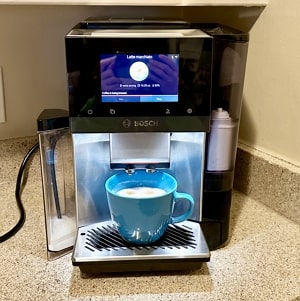
Sale $1,199 (reg. $1,599) • 800 Series lineup $1,199–$2,299 • 120 V North America.
Bosch 800 Series (TPU60309)
A gorgeous, ultra-friendly smart interface with 36 drinks—but only 6 grind steps and lukewarm beverages hold espresso quality back. The only defensible buy is the TPU60309 at ~$1,199; skip pricier TQU models unless the milk container convenience is everything to you.
Overview
Bosch’s 800 Series is a coffee appliance first: dazzling 5″ touchscreen, app control, true two-cup brewing, and hand-holding maintenance. As an espresso machine, it disappoints—only 6 grind settings and cooler drink temps mean you’re chasing “good enough,” not greatness.
Pros
- Best-in-class 5″ touchscreen + Home Connect
- 36 international drinks; favorites storage
- True Double Cup (grinds twice) for simultaneous servings
- Quiet ceramic grinder; apartment-friendly
- Guided Calc’n’Clean makes upkeep easy
Cons
- Only 6 grind steps—can’t truly dial-in or ‘choke’ a shot
- In-cup temps ~110–120°F; hot-drink lovers will be unhappy
- Plastic-heavy build for $1.2–$2.3k
- No foam density control; limited manual influence
- App can be flaky; travel mug clearance limited
Features & Specs
- 5″ capacitive touchscreen • Home Connect Wi-Fi app
- 36 CoffeeWorld drinks • 10–30 favorites • Double Cup (true dual)
- CeramDrive ceramic grinder • 6 grind settings • 320 g hopper
- 81 oz / 2.4 L water tank • removable brew unit • guided cleaning
- 19-bar pump • thermoblock • 3 temp settings (~190/200/210 °F)
- In-cup drink temps typically ~110–120 °F (preheat cups recommended)
- Dimensions 15″H × 12.19″W × 18.38″D • ~22 lb • 1600 W • 120 V
- Milk systems: TPU60309 hose; TQU60307/60703 integrated carafe + AutoMilk Clean
Pricing & Lineup
- TPU60309 (Piano Black) – hose to carton, no AutoMilk Clean • best value at ~$1,199 (sale)
- TQU60307 (Silver) – integrated 23.7 oz milk container + AutoMilk Clean • ~$1,999–$2,199
- TQU60703 (Stainless) – adds cup warmer + lighting • ~$2,299
- Alternatives: DeLonghi Dinamica Plus (cheaper, 13 steps), Jura E8 (slightly more, far better espresso)
FAQs
- Is it ‘real’ espresso?
- Not in the enthusiast sense—the 6-step grinder can’t reach true espresso fineness on many beans.
- Why is my coffee lukewarm?
- Thermoblock + internal plumbing = ~110–120 °F in cup. Preheat cups; you can’t raise it much further.
- Which model should I buy?
- TPU60309 on sale. TQU models add convenience, not better coffee.
- Light roast friendly?
- No. You’ll likely under-extract. Medium/dark blends fare better.
- Pods?
- No. Whole beans or single-dose via bypass with pre-ground.
Who It’s For / Not For
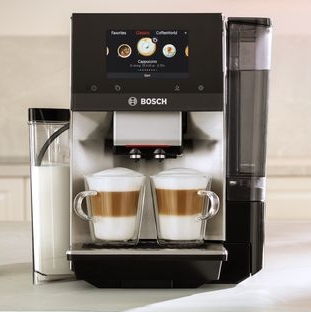
Current listed price $989.
Bosch 500 Series VeroCafe (TPU40109)
Overview
Time-saving, family-friendly super-auto with genuine two-drink brewing and a plant-milk-loving external hose. Coffee quality needs tweaks out of the box and the 6-step grinder limits light roasts, but the Bosch earns its keep in busy homes that care more about fast back-to-back milk drinks than café-style dialing.
Pros
- True double-cup: two lattes or cappuccinos simultaneously
- Plant-milk friendly Milk Express Plus with easy cleaning
- Compact 9.5″ width with full front-access service
- Simple TFT touchscreen with 9 drinks and low menu friction
- Bosch brand consistency plus 2-year warranty
Cons
- Still pricey versus DeLonghi Magnifica Evo
- Only 6 grind settings, so light roasts are hard to nail
- Factory defaults under-extract and need tweaking
- No app, user profiles, or deep customization
- Grinder is noticeably loud and the glossy finish shows fingerprints
Features & Specs
- 9 one-touch drinks and true double-cup brewing
- CeramDrive ceramic grinder, 6 grind steps, 270 g hopper
- External Milk Express Plus hose with auto purge
- 64 oz / 1.9 L removable water tank with front access
- 15-bar vibration pump and thermoblock heating
- Brew temperature adjustment via service menu
- TFT color touchscreen with strength and volume programming
- Spout height 2.5″–5.5″
- Dimensions: 14.75″H × 9.5″W × 16.625″D
- Power: 1600 W • 120 V • about 15.2 lb
- Warranty: 2 years parts and labor or 7,000 cups
Pricing & Lineup
- Bosch 500 (TPU40109) – 9 drinks, double-cup, 6 grind steps, external hose, current link price $989
- Bosch 300 (TPU30109) – 4 drinks, 5 grind steps, smaller tank, no double-cup
- Bosch 800 (TPU60309) – 35+ drinks, cold brew, app support, bigger tank, integrated carafe
- DeLonghi Magnifica Evo – stronger value play with wider grind adjustment
FAQs
- Beginner-friendly?
- Yes to operate, but you’ll still need to tweak grind, strength, and temperature for the best cup.
- Pods or capsules?
- No. Whole beans or pre-ground coffee via bypass only.
- Descale how often?
- Depends on water hardness. Roughly every 2 months in hard water or every 3–4 months in softer water.
- Is double-cup real?
- Yes. It grinds fresh for both and prepares two drinks in one cycle.
- Noise level?
- The grinder is noticeable, especially compared with some rivals, though brewing is calmer than grinding.
Who It’s For / Not For
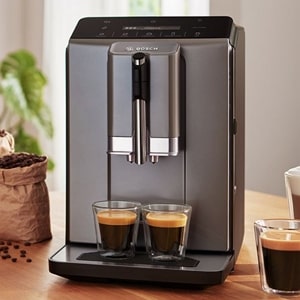
Typical retail sits around $799–$899. This model only makes sense when heavily discounted (often under $600).
Bosch 300 Series VeroCafe
Convenience-first bean-to-cup with an in-cup frother and simple touch UI—undercut by lukewarm espresso (reported ~127°F) and very limited grind control for the price.
Overview
The TIU20307 nails “press button, get drink” convenience in a small footprint—especially for milk beverages—yet the core output is held back by critically low serving temperature and minimal adjustability. If coffee quality matters, it’s hard to justify at full price. If simplicity matters most (office use) and you catch a deep discount, it can be a workable appliance.
Pros
- Foolproof one-touch workflow for multiple users
- Milk Express in-cup frother is quick and low-fuss
- Quiet ceramic grinder and simple LCD touch panel
- Front-access components and automatic rinse cycles
- Compact footprint for small kitchens and breakrooms
Cons
- Reported ~127°F espresso/coffee: lukewarm and under-extracted
- Very limited grind adjustment and tuning controls
- Weak/watery results even at maximum strength (common reports)
- Premium pricing vs stronger value rivals
- Early reliability complaints on milk frother connection
Features
- Bean-to-cup super-automatic (grind/dose/tamp/brew at button press)
- Milk Express in-cup frother (no external milk carafe)
- Drinks: espresso, coffee, cappuccino, latte macchiato, hot milk/froth
- Ceramic flat burr grinder (quiet, oil-resistant)
- Thermoblock heating; 15-bar vibration pump
- LCD touch panel with illuminated sensors
- Removable brew unit behind front service door
- Water tank ~45 oz (1.3 L); bean hopper ~8.8 oz (250 g)
Pricing
- Typical retail: $799–$899 (US/CA varies by seller and promos)
- “Worth considering” zone: under ~$600 (deep-discount promos)
- Best use-case at any price: office / shared kitchen that values simplicity over quality
FAQs
- Why does the coffee taste weak or lukewarm?
- Independent reviews report very low in-cup temperature (around 127°F), which under-extracts coffee and flattens flavor. Preheating cups helps a little, but it’s largely a hardware limitation.
- Can I dial in grind and brew settings?
- Adjustability is minimal. Reports often cite only 1–3 grinder settings and limited user control over extraction variables.
- Can I use pre-ground coffee or decaf?
- This model is typically described as whole-bean only (no true bypass doser). If you need pre-ground/decaf flexibility, choose a different super-auto.
- Is it good for milk drinks?
- Milk drinks can be the best fit because hot milk and foam help mask the weak espresso base—assuming the frother connection stays reliable.
Who It Is For
- Offices and shared kitchens needing foolproof, no-training operation
- Beginners who mostly drink milk-based beverages and want zero-effort workflow
- Space-constrained counters that need a compact super-automatic footprint
Who Should Avoid It
- Straight espresso drinkers (temperature is the dealbreaker)
- Anyone who wants real control (grind range, temperature, recipes)
- Value-focused buyers comparing against Magnifica-class alternatives
Model Status
- Model: TIU20307 (Bosch 300 Series VeroCafe)
- Positioning: entry-level feature set with mid-range pricing (brand premium)
- If you want “Bosch but better”: the 800 Series addresses many limitations at a much higher cost.
Bosch is not a heritage espresso name in the Italian sense, but it has been an engineering-led consumer brand for a very long time. Robert Bosch founded the company in Stuttgart in 1886, and Bosch’s home-appliance business now operates through BSH, which was founded in 1967 and has been wholly owned by the Bosch Group since January 2015.
In coffee, Bosch’s story is really a story about automation. According to BSH’s own historical overview, Bosch-branded portafilter machines arrived in 1994, the brand’s first fully automatic coffee machines followed in 1999, and Bosch portion systems such as Tassimo appeared in 2004. That timeline matters because it shows Bosch’s priorities clearly: the company has not tried to build its identity around barista ritual or old-world machine culture. Instead, it has steadily pushed coffee toward convenience, consistency, and easier daily use.
That same philosophy still defines Bosch’s espresso-machine efforts today. Its current range is built around fully automatic and built-in coffee machines, with Bosch highlighting one-touch drink preparation, ceramic grinders, removable brew units, and guided cleaning programs such as Calc’n Clean. So when you look at a Bosch espresso machine, you are usually not looking at a purist’s platform first. You are looking at a practical appliance from a brand that has spent decades trying to make espresso more accessible, less fussy, and more repeatable for everyday households.
We’ve categorized the best espresso machines for every kind of buyer
Find the right shortlist faster, whether you want convenience, a beginner-friendly setup, a smaller footprint, or better value at a given budget.
Best Superautomatic Espresso Machines
One-touch picks for speed and convenience.
Best Espresso Machines for Beginners
Easy-to-use machines with a smoother learning curve.
Best Small Espresso Machines
Compact machines for tighter kitchens and counters.
Best Espresso Machines With Built-In Grinder
All-in-one options with fewer extra pieces to buy.
Best Cheap Espresso Machines Under $500
Budget picks that still make sense for real espresso.
Best Prosumer Espresso Machines Under $1000
More serious machines with stronger value for the money.
Best Single Boiler Espresso Machines
Simple, space-saving picks for espresso-first routines.