
De’Longhi grew from a Treviso metal workshop into a global appliances group that now shapes both home and professional espresso. The company’s portfolio spans manual portafilter machines, fully automatic “bean-to-cup” systems, and capsule partnerships with Nespresso and Dolce Gusto. It also controls high-end commercial capability through Eversys and a major stake in La Marzocco, which keeps the group close to the cafés that set quality benchmarks. For home buyers, De’Longhi’s most important lines today are Dedica and La Specialista on the manual side, and Magnifica, Dinamica, Rivelia, Eletta, and PrimaDonna on the fully automatic side. For milk, the brand’s LatteCrema system is the headline technology; for beans, Bean Adapt personalizes grind and brew parameters on select models.
De’Longhi at a glance
- Founded: 1902, Treviso, Italy. Publicly listed as De’Longhi S.p.A.
- Coffee debut: 1993 pump espresso machine; 2003 “Magnifica” super-automatic.
- Key partnerships: Nespresso distribution and Lattissima production since mid-2000s; Dolce Gusto distribution/manufacture in select markets.
- Professional coffee: Full ownership of Eversys; business combination with La Marzocco gives the group control of a new professional coffee hub.
- Current leadership note: Fabio de’ Longhi serves as CEO and Chairman (CEO role effective September 2022).
History: from heaters to espresso leadership
Early years and diversification
De’Longhi began in 1902 and historically produced heaters and air conditioners before broadening into small domestic appliances. The shift toward coffee accelerated in the 1990s. The first in-house pump espresso machine arrived in 1993, and a decade later the Magnifica became De’Longhi’s first super-automatic. That product defined a path the company still follows: scaled consumer machines with iterative improvements to grinders, temperature control, and milk handling.
Strategic acquisitions and partnerships
- Kenwood (2001): Purchasing the British kitchen-machine maker expanded De’Longhi’s manufacturing footprint and food-prep portfolio.
- (2001 via Kenwood): The Italian small-appliance brand joined the group and remains an entry-level design-driven label inside De’Longhi.
- Nespresso agreement (2004): A “historic agreement” established distribution for capsule machines and led to the Lattissima line in 2007, produced in De’Longhi factories.
- Dolce Gusto distribution/manufacture: De’Longhi is one of the two main hardware producers for Nestlé’s Dolce Gusto system in various markets.
- Braun small-appliance rights (2012): De’Longhi acquired perpetual rights from Procter & Gamble to make and sell Braun-branded small appliances, augmenting its non-coffee portfolio.
- Capital Brands (2020): The NutriBullet and Magic Bullet blender company became part of De’Longhi to strengthen North American distribution and wellness-oriented appliances.
- Eversys (2017–2021): From a 40% stake to full control in 2021, Eversys brings high-volume, super-automatic commercial espresso engineering into the group.
- La Marzocco and the professional coffee hub (2023–2024): De’Longhi structured a combination of Eversys with La Marzocco, acquiring roughly 41% of La Marzocco and creating a group-controlled professional center. Financial reporting in 2024 highlighted the impact of consolidating that stake.
The companies and brands De’Longhi owns or controls today
De’Longhi is both a single brand and the centerpiece of a larger De’Longhi Group. Here is the current brand map that matters for coffee:
De’Longhi (core brand)
The flagship brand for home coffee and comfort appliances, and the name consumers associate with Magnifica, Dinamica, Rivelia, Eletta, PrimaDonna, Dedica, and La Specialista.
Kenwood
A leader in kitchen machines and food processors. While not a coffee brand, Kenwood’s engineering and global sourcing bolster group manufacturing, distribution, and after-sales infrastructure.
Braun (small-appliance license)
De’Longhi holds the perpetual rights to produce and sell Braun small domestic appliances. This does not include ownership of the Braun trademark, which remains with P&G.
An Italian heritage label focused on colorful, accessible appliances from breakfast to cleaning. It participates in entry-level coffee and espresso categories under group oversight.
Deals of the Week
Capital Brands (NutriBullet and Magic Bullet)
Acquired in 2020 to deepen North American retail coverage and extend into blender-centric wellness. Useful to know when you see De’Longhi leveraging U.S. channels.
Eversys
A Swiss builder of commercial super-automatics, fully controlled by De’Longhi since 2021. Eversys machines are commonplace in high-volume café, hotel, and office contexts where consistency and telemetry matter.
La Marzocco (significant minority in a combined hub)
De’Longhi acquired about 41.2% of La Marzocco as part of a business combination with Eversys that created a world-class operator spanning automatic and semi-automatic professional machines. De’Longhi Group controls roughly 61.4% of the new professional hub structure.
Why this matters to buyers: De’Longhi now sits across the espresso stack, from a €300 starter machine to the multi-group commercial gear your favorite café might run. The engineering and milk-system lessons travel in both directions.
Notable product lines in De’Longhi’s coffee portfolio
Manual and “assisted manual” (portafilter)
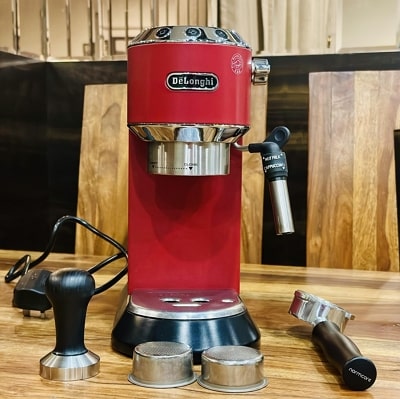
- Dedica (EC685 and variants): Ultra-slim thermoblock single-boiler format. Entry-level ergonomics, compact footprint, basic panarello-style steam wand, and fast heat-up. The newer Dedica Duo expands usability including chilled extraction options in some regions.
- Stilosa: Budget manual line in select markets, often bundled with pressurized baskets and an entry steam wand.
- La Specialista family (Arte, Prestigio, Maestro, Opera, and Arte Evo): De’Longhi’s assisted-manual concept. Highlights include Sensor Grinding Technology, Smart Tamping Station, and Active Temperature Control. Maestro adds higher-end milk control and dual-heating approaches; Arte Evo brings Cold Extraction Technology to broaden drink profiles. These innovations reduce workflow friction without eliminating the feel of a real portafilter.
Fully automatic “bean-to-cup”
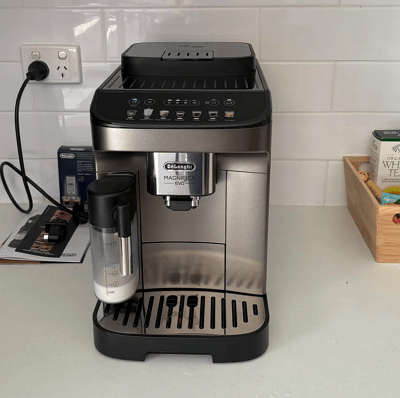
- Magnifica / Magnifica Start / Magnifica Evo: The workhorse entry tier into De’Longhi’s automatics. Conical burr grinders with multi-step adjustment and one-touch espresso, lungo, and common milk drinks. Evo variants often bundle LatteCrema.
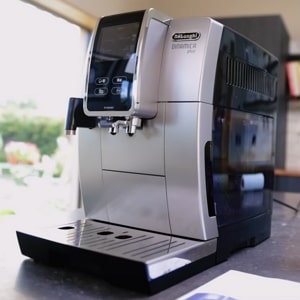
- Dinamica / Dinamica Plus: Adds expanded drink menus, hotter water management, and typically a better user interface with app connectivity on Plus models. Many SKUs integrate LatteCrema.
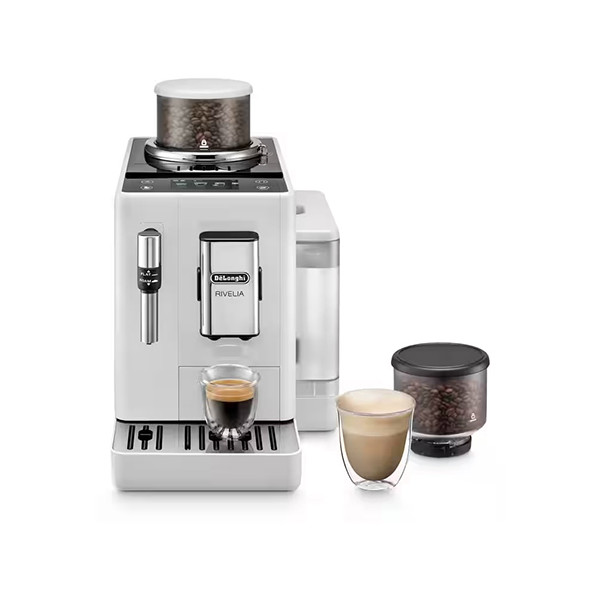
- Rivelia: The modern compact flagship for convenience-focused homes. Touch UI, multiple user profiles, and a dual-hopper concept to swap between beans without purging. Often paired with Bean Adapt logic.
- Eletta / Eletta Explore: More milk options including cold-foam readiness where LatteCrema Hot & Cool is available, and broader drink menus with iced profiles.
- PrimaDonna (e.g., PrimaDonna Soul): Top-tier home models with Bean Adapt Technology that tunes grind and shot parameters to your beans, plus rich LatteCrema implementation and app control.
Capsule systems (partnership hardware)
- Nespresso Lattissima / Gran Lattissima and other Original-line models: Designed and produced by De’Longhi for Nespresso’s Original capsules in many regions, bringing one-touch milk drinks to capsules.
- Dolce Gusto portfolio: Nescafé’s Dolce Gusto machines are produced by De’Longhi or Krups depending on the model and market. You will often see De’Longhi-branded hardware like the Piccolo XS or Genio S in retail channels.
Technology and innovations that define De’Longhi machines
LatteCrema milk system
De’Longhi’s automatic milk frothing standard. It is built to produce dense, stable foam at suitable temperatures and is available as LatteCrema Hot and LatteCrema Cool. The Cool carafe extends one-touch drinks to cold foam for iced beverages. In practical use, this means repeatable cappuccino foam without a manual steam-wand skill curve, and credible cold foam suitable for modern iced menus.
Bean Adapt Technology
On higher-end automatics like PrimaDonna Soul and Rivelia, Bean Adapt adjusts grind and extraction settings to your beans’ roast and solubility profile. It reduces the trial-and-error needed to dial in new coffee.
Assisted manual workflow (La Specialista)
Sensor Grinding Technology measures and regulates dose; Smart Tamping Station eliminates a major variable by applying consistent pressure inside the group; Active Temperature Control stabilizes brew water to protect flavor and crema. For beginners, these steps shorten the time to a good shot; for tinkerers, they are constraints you can still work around with basket swaps and grind changes.
Professional integration
With Eversys under full control and a major stake in La Marzocco within a combined structure, De’Longhi has engineering visibility across both automatic and semi-automatic commercial platforms. The financial reporting around the 2024 consolidation makes clear the strategic weight of this professional hub. For home buyers, the trickle-down shows up in milk algorithms, thermal management, and service practices.
How De’Longhi segments the espresso market
De’Longhi plays across three user archetypes:
- Capsule convenience for users who want speed and zero mess.
- Fully automatic for households that drink milk drinks daily and value one-touch output.
- Manual/assisted manual for people who want café-style texture control and espresso-first flavor.
That segmentation is not just marketing. It maps directly to brew temperature control, pump behavior, grinder quality, milk system design, and cleaning cadence. The brand’s catalog overlaps in price and features, so the differences matter.
Current selection of De’Longhi espresso machines by type
Below is a practical map of what you can buy today, organized by brew type. Model availability varies by region, but these represent the active lines you will encounter.
Manual and assisted-manual (portafilter, 51–58 mm baskets depending on line)
Dedica series (EC685; EC885/EC890 in some markets)
- Format: Narrow single-boiler thermoblock with pressurized baskets, pannarello-style wand.
- Why it exists: A compact first step into real espresso without the footprint.
- Strengths: Heat-up speed and size.
- Watch-outs: Temperature swings and lower steam power than prosumer gear.
- Who should buy: Apartment kitchens and occasional milk drinkers.
La Specialista series (Arte, Arte Evo, Prestigio, Maestro, Opera)
- Format: Integrated grinder, assisted tamping, controlled temperature; higher-tier models add dual-heating and more program logic.
- Why it exists: Give manual results with fewer error points.
- Strengths: Consistent puck prep and faster learning curve; Maestro-level milk and temperature control are fringe benefits.
- Watch-outs: Fixed grinder architecture and proprietary accessories limit long-term mod paths compared to classic E61 or 58-mm ecosystems.
- Who should buy: Busy homes that still want a real portafilter and better milk than a super-automatic.
Fully automatic “bean-to-cup” (integrated grinder and milk)
Magnifica / Magnifica Start / Magnifica Evo
- Format: Entry bean-to-cup with buttons or simple displays; programmable strength and volume; optional LatteCrema carafe.
- Why it exists: Value play for one-touch espresso and cappuccino.
- Strengths: Parts availability, service familiarity, and cost of ownership.
- Watch-outs: Narrow grind range, limited temp control granularity.
- Who should buy: Daily cappuccino drinkers prioritizing convenience.
Dinamica / Dinamica Plus
- Format: Expanded recipes, finer controls, app connectivity on Plus models; LatteCrema variants common.
- Why it exists: Middle band of the line with better UIs and milk behavior.
- Strengths: Broad drink list and friendly cleaning prompts.
- Watch-outs: Milk temperature and foam texture top out below café wand standards.
- Who should buy: Families with varied orders.
Rivelia
- Format: Compact premium with a 3.5-inch touch interface, user profiles, and dual hoppers to swap beans quickly. Often integrates Bean Adapt and LatteCrema.
- Why it exists: Make frequent bean changes painless and keep the kitchen footprint small.
- Strengths: UX, bean-swap, and drink customization.
- Watch-outs: Not a substitute for a top-tier manual shot if you chase dense ristretto texture.
- Who should buy: Households splitting dark and light roasts or caffeinated and decaf.
Eletta / Eletta Explore
- Format: One-touch hot and cold recipes, typically with LatteCrema Hot & Cool.
- Why it exists: Iced latte and cold-foam drinkers who want automatic milk outdoors of summer.
- Strengths: Cold foam on demand; travel-mug friendly programs in Explore.
- Watch-outs: Carafe cleaning discipline is non-negotiable.
- Who should buy: Year-round iced coffee households.
PrimaDonna (PrimaDonna Soul highlighted)
- Format: Flagship home automatic with Bean Adapt and the fullest recipe set.
- Why it exists: Showcase extraction optimization across many beans with app control.
- Strengths: In-machine tuning by bean with touchscreen guidance and rich LatteCrema routines.
- Watch-outs: Price and complexity; requires a few weeks of ownership to appreciate.
- Who should buy: Heavy daily use and variety, willing to pay for consistency.
Capsule machines (partnership hardware)
Nespresso Original Lattissima family
- Format: Original capsules with integrated milk carafe and one-touch milk drinks.
- Why it exists: Café-style milk drinks with capsule simplicity.
- Strengths: Lowest mess path to a cappuccino.
- Watch-outs: Capsule cost and capsule-only flavor ceiling.
- Who should buy: Offices and time-pressed households.
Dolce Gusto machines
- Format: Pressure-based capsule system with De’Longhi and Krups models in market.
- Why it exists: Budget pod espresso and long drinks in a compact format.
- Strengths: Low entry price and broad retail coverage.
- Watch-outs: Two-capsule milk drinks and narrower espresso definition.
- Who should buy: Giftable starter machines and dorms.
Design, build, and service philosophy
Industrial design and materials
De’Longhi has standardized on compact thermoblock designs for entry products and more robust thermal architectures as price rises. Plastics are common in housings and milk pathways, with stainless accents as you move up the lines. Compared to prosumer machines from specialty brands, De’Longhi trades raw metal mass for quick heat-up and cost control. That is a valid choice for convenience-first buyers.
Grinder and hydraulics choices
Fully automatics use conical burr sets with multi-step adjustment. Expect a conservative range tailored to medium roasts. On La Specialista, the integrated grinder and assisted tamping aim for repeatability rather than extreme flexibility. If you want 18-gram updoses and ultra-fine light-roast ristretti, look at manual prosumer gear; if you want a dependable 1:2 with reasonable crema every morning, De’Longhi delivers.
Milk systems and cleaning
LatteCrema produces repeatable foam without the wand technique learning curve. The cost is cleaning discipline: carafes need daily rinses and regular deep cleans to prevent milk stone and biofilm. Cold-foam carafes add one extra part to manage, but the workflow pays off if iced milk drinks are routine.
Where De’Longhi sits against its peers
- Versus Breville/Sage: Breville dominates the enthusiast manual tier with 54–58 mm baskets and powerful wands. De’Longhi’s La Specialista counters with assisted workflows that are friendlier to first-time users.
- Versus Philips/Saeco and Jura: On fully automatics, De’Longhi competes head-to-head with Philips for value and with Jura for premium UX. De’Longhi’s LatteCrema and Bean Adapt are strong value propositions; Jura still wins on shot dryness and overall polish at the very high end, while De’Longhi undercuts on price.
- Versus Gaggia: Gaggia remains a modder’s favorite for classic single-boiler manual machines. De’Longhi Dedica is easier to fit in small kitchens and simpler to live with, but has a smaller performance envelope.
Buying guidance by user type
If you make 2–4 milk drinks every morning
Choose a Magnifica Evo/Start or Dinamica Plus with LatteCrema. You want one-touch reliability; Bean Adapt is optional here.
If you want café-like control without café-like effort
La Specialista Maestro or Arte Evo gets you closer to a real bar workflow, with safety rails on grind, tamp, and temperature.
If you rotate beans or share the machine with multiple users
Rivelia. The dual-hopper approach is the simplest way to run decaf and regular or light and medium day to day.
If iced and cold-foam drinks are your thing
Eletta Explore or any LatteCrema Cool carafe model. You will use the cold-foam button all year.
If you want top-tier automatic extraction with the most guidance
PrimaDonna Soul. Bean Adapt and the larger screen shorten the tuning curve.
Manufacturing, distribution, and market presence
De’Longhi leverages a global network built up through Kenwood, Braun small-appliance rights, and later Capital Brands. This shows in spare-parts availability and retail coverage. The group routinely highlights leadership in home espresso by unit share, and recent financials called out growth aided by the La Marzocco consolidation. For capsule systems, official Nespresso communications and independent reporting make clear that De’Longhi is one of the key machine partners alongside Breville and others. For Dolce Gusto, De’Longhi is a primary hardware producer next to Krups.
The café connection: Eversys and La Marzocco
With Eversys integrated and the La Marzocco stake formalized inside a combined professional hub, De’Longhi now straddles automatic and traditional commercial categories. Law-firm, media, and corporate governance documents describe the transaction and the ownership split. Operationally, the value for De’Longhi’s home buyers is indirect but real: milk algorithms, thermal stability strategies, and telemetry learnings often trickle down into consumer machines over time.
Frequently asked questions
Does De’Longhi make Nespresso machines?
De’Longhi is a core Nespresso partner. The company signed a distribution agreement in 2004, and De’Longhi produces the Lattissima line in its factories for Nespresso’s Original capsules in many markets. Other partners like Breville and KitchenAid also distribute Nespresso machines, depending on the region.
Are Dolce Gusto machines made by De’Longhi or Krups?
Both, depending on the model and market. The Dolce Gusto system is a Nestlé platform with hardware produced by De’Longhi and Krups.
Who is De’Longhi’s CEO?
As of late 2022, Fabio de’ Longhi took on the CEO role and continues to serve as Chairman. Corporate documents and press releases reflect this management change.
What is LatteCrema and is it different from a steam wand?
LatteCrema is a sealed automatic carafe that doses, textures, and dispenses milk foam at target temperatures, including a Cool variant for cold foam on certain machines. A traditional wand allows more texture nuance and art but requires skill.
What is Bean Adapt?
A software-driven routine that adjusts grind and extraction parameters to beans’ roast and solubility. Available on top lines like PrimaDonna Soul and Rivelia.
The state of De’Longhi in 2025
From an industry perspective, De’Longhi has secured an end-to-end position in espresso:
- Consumer reach: Big-box shelves, online channels, and strong after-sales support.
- Technology stack: LatteCrema milk, Bean Adapt, and assisted manual workflows.
- Professional credibility: Eversys leadership in automatics and a major stake in La Marzocco’s traditional craft give the group technical gravity.
- Financial signal: 2024 reporting noted a revenue and EBITDA lift associated with the La Marzocco consolidation, confirming the strategic logic of the professional hub.
For buyers, the practical takeaway is simple. If you want capsule convenience with real milk drinks, De’Longhi is a safe bet. If you want one-touch bean-to-cup with cold foam, there is likely a LatteCrema model at your price. If you want your hands on a portafilter without the steepest learning curve, La Specialista is built for you. And if you want commercial engineering in your kitchen, the PrimaDonna family shows where the group is headed.
Current product families: quick reference
Manual / assisted manual
- Dedica (EC685, EC885/EC890): Slim manual thermoblock.
- La Specialista (Arte/Arte Evo, Prestigio, Maestro, Opera): Assisted manual with integrated grinder, tamping, and temp control.
Fully automatic (bean-to-cup)
- Magnifica (Start, Evo variants).
- Dinamica / Dinamica Plus.
- Rivelia.
- Eletta / Eletta Explore.
- PrimaDonna Soul (and regional PrimaDonna variants).
Capsule
Closing perspective
De’Longhi’s superpower is not any single machine. It is the company’s ability to industrialize reliable, user-friendly espresso at scale, while borrowing just enough from the professional side to keep flavors convincing and workflows clean. That is why you see Magnifica and Dinamica units in kitchens that do not have time for a hand grinder, and why La Specialista machines show up on counters where the barista wants to tamp but not troubleshoot. And it is why the group has bought its way into professional coffee: because the line between café and home keeps moving.
If you want this overview converted into a buyer’s guide with price bands for US/UK/EU and live model examples, I can produce that immediately.
We’ve categorized the best espresso machines for every kind of buyer
Find the right shortlist faster, whether you want convenience, a beginner-friendly setup, a smaller footprint, or better value at a given budget.
Best Superautomatic Espresso Machines
One-touch picks for speed and convenience.
Best Espresso Machines for Beginners
Easy-to-use machines with a smoother learning curve.
Best Small Espresso Machines
Compact machines for tighter kitchens and counters.
Best Espresso Machines With Built-In Grinder
All-in-one options with fewer extra pieces to buy.
Best Cheap Espresso Machines Under $500
Budget picks that still make sense for real espresso.
Best Prosumer Espresso Machines Under $1000
More serious machines with stronger value for the money.
Best Single Boiler Espresso Machines
Simple, space-saving picks for espresso-first routines.