

Late-2025 snapshots: $2,399–$3,599 (US) • ~€1,999 (EU) • CA$2,719–CA$3,399 (CA) • A$3,823–A$4,250 (AU)
Bezzera Mitica Top PID
A quiet, plumbable E61 heat-exchanger that steams hard from a 2-liter copper boiler, with a PID that tightens the steam band (and your flush routine) for repeatable home or small-office service.
Overview
Mitica Top PID is Bezzera’s flagship HX for home/small-office duty: E61 lever group + mechanical preinfusion, 2.0 L copper heat-exchanger boiler, rotary pump, dual manometers, and a switchable water path (4 L tank now, plumb + drain later). The PID tightens the boiler band so your flush routine stays consistent.
Pros
- Rotary pump calm + tank or plumbed operation
- 2.0 L copper HX boiler: strong, dry steam and fast recovery
- PID tightens day-to-day behavior without “menu bloat”
- Joystick valves and solid ergonomics for fast milk service
- Serviceable E61 platform with broad parts/dealer support
Cons
- HX discipline remains: brief cooling flush after long idle
- No built-in shot timer (use scale/timer)
- Many units ship with non-insulated wands (towel habit required)
- Copper boiler may not satisfy “stainless-only” shoppers
Features
- Architecture: E61 lever + mechanical preinfusion, HX boiler, rotary pump
- Boiler: 2.0 L copper heat-exchanger
- PID: boiler temperature control (displayed “coffee temperature” 80–100 °C)
- Gauges: dual manometers (boiler + pump pressure)
- Reservoir: 4.0 L tank with low-water protection
- Plumb support: G 3/8″ feed + dedicated drain (10 mm) when hard-lined
- Power: ~1250–1450 W (220–240V) • ~1350 W (110–120V)
- Wands/valves: multidirectional steam + hot water wands with joystick valves
- Size & weight: 320 W × 450 D × 400 H mm • ~27 kg (Top PID)
- E61 ecosystem: 58 mm portafilters, accepts flow-control kits (optional)
Pricing
- United States: ~$2,399–$3,599 (dealer + promos)
- European Union: ~€1,999 snapshot (VAT/retailer dependent)
- Canada: ~CA$2,719–CA$3,399
- Australia: ~A$3,823–A$4,250
FAQs
- Does the PID set brew temperature?
- No—on this HX design it governs boiler temperature (steam band), which tightens the HX idle window. Brew temp is managed by heat-soak + a short cooling flush routine.
- Is it plumbable?
- Yes. Run the 4 L tank now, then plumb later via G 3/8″ line-in and add a drain (10 mm) to make purges/backflush water hands-off.
- How strong is the steam?
- It’s a highlight: 2.0 L copper HX boiler delivers dry, forceful steam with fast recovery for typical 12 oz pitchers and back-to-back milk drinks.
- Do I need a flush every shot?
- After long idle, yes—flush until the sputter becomes a smooth stream. During back-to-back shots, you often skip it because the HX hasn’t overheated.
- Can I add flow control later?
- Yes. It’s an E61 platform and accepts common flow-control kits. It’s optional (not stock).
Who It Is For
- Milk-forward households that want strong steam and easy back-to-back drinks
- Buyers who want rotary quiet and a real path to plumb-in + drain
- People who like E61 lever feel and a predictable routine (not touchscreen dashboards)
- Home or small-office setups that value durability and serviceability
Who Should Avoid It
- Anyone who refuses HX cooling-flush routines (consider a dual boiler)
- Shoppers who demand a built-in shot timer on the machine
- “Stainless-only” buyers who won’t accept a copper boiler
- Users who want pressure/flow profiling out of the box (no stock flow control)
Model Notes
- Top PID: rotary pump + PID boiler control + plumb/drain-ready hardware stack.
- Wand insulation: many current units are not “no-burn” (purges are efficient; wipe-down needs care).
- Water: copper + brass means water quality is non-negotiable (tank softening or line filtration + regulator).
Takeaway
Mitica Top PID is Bezzera’s flagship single-boiler heat-exchanger for home and small office duty. It marries a copper 2 liter HX boiler with a rotary pump, a PID that governs the boiler temperature, and a switchable water path so you can run a 4 liter tank today and plumb it later. The chassis is all stainless, the group is a classic E61 with thermosyphon heating, and the face is clean: dual gauges, lever control, and a compact PID display. Dimensions are 320 by 450 by 400 millimeters and net weight is about 27 kilograms in the Top PID configuration. The package is simple to live with and built to be serviced. In plain English: this is a quiet, plumbable HX that steams hard, repeats shots when you follow a short flush routine, and fits real counters.
Build and design
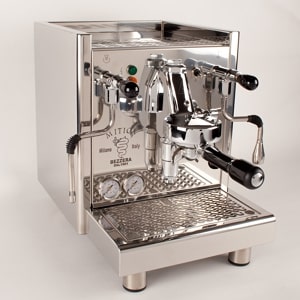
Mitica’s casework is classic Bezzera. Heavy gauge stainless forms a rigid box with clean seams and a cup frame that does not rattle. The E61 lever group sits centered between large boiler and pump gauges. The PID window is small and out of the way, which keeps the front panel calm. Under the skin you get Bezzera’s HX boiler built in copper at 2 liters, wrapped with sensible wattage so the machine steams with authority without popping breakers in older kitchens. The rotary pump sits on the lower deck and feeds a switchable water path: 4 liter tank by default, or flip to a fixed water connection when you are ready to hardline the bar. It is a hardware stack built around durability and a predictable routine rather than a spec sheet full of widgets.
The E61 here is the familiar, mass-heavy unit heated by a thermosyphon loop from the HX. That loop keeps the group hot and ready for fast service once the machine is heat-soaked. As with any E61 HX, the water resting in the heat exchanger climbs above brew temperature during idle, which is the reason you adopt a small cooling-flush before sensitive shots. The lever actuation gives you that signature mechanical pre-infusion as the pump ramps. It is a tactile, reliable control stack that rewards clean puck prep with calm pours under a bottomless.
Two practical details separate the Top PID from cheaper E61 boxes. First, the rotary pump. It is quieter than a vibe pump and gives a steadier pressure trace, especially when you brew and steam at the same time. Second, the plumbing path. Mitica Top PID is built for the long game; it can run from the big tank for months, then accept a line and drain when you finish the coffee corner. The official brochure even lists the specific connections: G 3/8 inch feed and a 10 mm drain. Those are the details that cut friction as you turn a kitchen hobby into a daily practice.
Workflow
Warm-up and readiness
From cold, the boiler reaches pressure fast. What decides your first shot is group soak. Give the E61 and the portafilter real time to equalize. Lock a portafilter in during warm-up so the brass and steel come up together. The goal is boring consistency, not a race to the first espresso. Once the group is saturated, you are in the machine’s sweet spot where the cooling-flush length is short and repeatable.
PID, pressure, and what the numbers actually control
This PID is not a dedicated brew-boiler controller. It supervises the steam boiler temperature, which narrows the steam-pressure band and establishes the HX idle state that the group inherits. Bezzera exposes the control as a “coffee temperature” between 80 and 100 °C on the tiny display. Treat that number as a temperament dial. Pick a setpoint that fits your roast and milk workload, then leave it there for weeks while you do the real work at the grinder. The PID’s job is to keep the band tight so your flush map does not drift.
Cooling-flush discipline
Every HX parks overheated water in the exchanger when it idles. The fix is simple. After a pause, raise the lever and flush until the sputter turns into a smooth stream, then lock and pull. For a medium espresso blend this is brief. For dense light roasts add a beat. When you are pulling back-to-back shots, you often skip the flush because the HX has not climbed. Watch the boiler gauge to judge where you are in the pressure cycle. If it is at the top of the range, lengthen the flush a second. If it just refilled after steaming and sits low, brew straight in. The PID tightens this cycle, which is why the routine becomes second nature.
Tank or line, same cadence
As a tank machine the Mitica Top PID is painless. Four liters buys real headroom and the machine has proper low-water protection. When you plumb in, the rotary pump earns its keep. It is quiet under flow and delivers steady pressure while the steam circuit does its thing. You can add a drain to the deep tray to remove purge management from your brain. Several dealers spell this out and the official sheet lists both feed and drain connections for the Top PID. This is the right kind of future-proofing.
Ergonomics that keep you moving
Bezzera fits quick joystick valves for steam and water. The wands articulate cleanly. Most current stock is not “no-burn,” which means purges are efficient and wipe-downs need a little care. The gauges are large and readable across a kitchen. The lever is firm without drama. Once you teach the household the dose, yield, and time you want, the machine disappears behind routine.
Espresso performance
Stability you can count on
An HX shot lives or dies on starting state and puck prep. Mitica Top PID gives you the tools to make stability the default. The 2 liter copper boiler provides mass and steam reserve. The PID narrows the boiler swing. The rotary pump’s pressure ramp is gentle. The E61 carriage gives you mechanical pre-infusion and a thermal bank that is hard to upset once it is saturated. With a small flush map for your roast, the machine repeats. Dealer documentation and the brand’s brochure line up with what you taste: strong steam, steady extraction, and a routine that holds up when you pull a few drinks in a row.
Starting recipes that work
For a house medium blend, start at 18 grams in a standard 58 mm double. Distribute honestly and tamp level. After a long idle, do the short flush until the flow smooths, then lock and pull 36 grams out in 27 to 31 seconds from pump on. Keep dose and yield fixed while you move grind to land in time. For lighter roasts, extend the flush slightly, tighten grind, and run 1:2.2 in the low thirties. For darker roasts, minimize the flush and pull closer to 1:1.9 while watching the finish. The lever’s pre-infusion will help calm the start if your distribution is clean.
What the cup looks like when you are on target
E61 profile is a known quantity. You get mid-range sweetness, round body, and a clean finish when you cut the tail at the right moment. Medium blends pour syrupy and hold their shape in milk. With careful flush timing and a touch tighter grind, light roasts can be clear and sweet without astringency. You are not chasing lab-grade clarity or pressure-profiling experiments. You are building predictable, drinkable espresso across blends. That is the point of this platform.
Milk steaming
Steam is where Mitica flexes. A 2 liter HX boiler at sensible wattage delivers dry, forceful steam with quick recovery for 12 ounce pitchers. The joystick valves are fast, the wand articulation gives you proper angles, and the rotary pump keeps the kitchen soundtrack calm while you steam and brew in parallel. Bezzera’s literature and dealer specs are all aligned on boiler size, power range, and the HX architecture. In practice your routine is simple. Purge a quick burst to clear condensation, stretch for six to eight seconds, then roll to temperature. Two 12 ounce pitchers back-to-back are routine. If you host often, bump the PID a step and give the group time to follow; steam authority rises and recovery tightens.
Tip choice matters. If you are learning, run a two-hole tip until you can hit the first eight seconds of air on autopilot. When your hands are consistent, switch to a higher-flow tip to raise throughput. Because the wands are not insulated on many units, the steam line purges fast and wipes clean, but you need your towel habit to be automatic. That is service reality, not a drawback.
Maintenance and reliability
Daily loop
Purge and wipe the steam wand after every pitcher. Backflush with water at the end of the session. Detergent backflush weekly if you pull daily. Knock the shower screen and baskets into a soak on schedule. Replace the group gasket before it turns to stone. Mitica’s parts are mainstream and its layout is sensible: pressurestats, safety thermostats, probes, rotary pump, and valves are all common service items with good dealer coverage. This is not an orphaned machine. It is a serviceable E61 HX built by a manufacturer that publishes brochures, parts lists, and wiring diagrams. (Bezzera)
Water decides your service story
Mitica will run tanked or plumbed, which means water quality is your decision. For the tank, use filtered water with hardness and alkalinity in an espresso-safe band, or a proven remineralized recipe that plays well with copper and brass. On a line, protect the machine with a cartridge that softens and stabilizes alkalinity within spec. Dealers are blunt about limescale and warranty limits, and Bezzera’s own materials call out the plumbing pathways because they expect owners to make this machine permanent. Set water up on day one. Your element, probes, and vacuum breaker will thank you.
Access and parts
Bezzera is not a boutique brand with one importer and a shrug. In North America, Europe, and Australia you will find dealers listing Mitica with parts support and published specs. The Top PID variant uses a copper HX boiler and a rotary pump that many shops stock. The PID, gauges, and valves are off-the-shelf service components. All the boring stuff is what keeps a machine like this running for a decade.
Programming and controls
Here is what you actually adjust and why it matters.
- PID temperature. The Top PID shows a “coffee temperature” and lets you set 80–100 °C. Internally, it governs the boiler’s steam temperature. Lower values reduce steam power and nudge the HX idle state cooler for dark roasts. Midrange values cover everyday blends and routine milk. A step higher helps when you are hosting or working light roasts. Any change takes a couple of shots to fully propagate through the group, so judge after the second or third pull.
- E61 lever. The lever starts and stops the shot. The group’s mechanical pre-infusion calms the initial flow and rewards honest distribution.
- Brew-pressure baseline. Rotary pump pressure is set with an expansion valve. Set a sane nine-bar baseline with a blind basket and a gauge, then leave it alone. Your bottomless portafilter will tell you when the problem is prep, not pressure.
- Tank or line switch. The Top PID is switchable. Use the 4 liter tank or connect the G 3/8 inch feed. Add the 10 mm drain when you plumb in so purges and backflush water leave the tray automatically.
- Joystick valves. Quick, positive open and close for steam and hot water. They speed up milk rounds and reduce wrist strain over time.
Bench workflow: from unboxing to a calm service
1) Placement and water
Give the steam wand room to move and make sure you can pull the portafilter straight. If you plan to stay tanked, rinse the 4 liter reservoir and seat it fully. If you plan to plumb in, install a softening cartridge within spec for copper and brass, connect a G 3/8 inch feed, and route a 10 mm drain. Confirm everything is leak-free before power. Bezzera’s brochure lists these connections so you can measure once and avoid surprises.
2) Warm-up
Lock an empty portafilter in the group. Power on. Allow the group and baskets to heat-soak fully. Purge the steam wand briefly as the boiler approaches pressure to eject condensation. You are not chasing a quoted minute count; you are aiming for the first shot to taste like the third.
3) PID baseline
Set the PID to a sensible middle value. Pull three shots at a fixed dose and yield while you move grind to hit time. Start at 18 g in, 36 g out, 27 to 31 seconds from pump on. Write the numbers down. You are training your grinder and your hands, not the machine.
4) Light-roast path
From that baseline, raise the PID one small step, extend the initial flush a beat after a long idle, tighten the grind, and run 1:2.2 in the low thirties. If astringency creeps in, cut the finish earlier and revisit grind.
5) Milk cadence
Pull your shot, purge a quick burst on the steam wand, stretch for six to eight seconds, roll to temperature, wipe, purge. For a guests-heavy session with larger pitchers, raise the PID a notch beforehand and give the group two shots to catch up. The 2 liter boiler has the mass and the rotary pump has the calm to keep pace.
6) Cleaning loop
Water backflush at session end. Detergent backflush weekly if you pull daily. Soak the screen and baskets on schedule. Empty and rinse the tank rather than topping up forever. If you are plumbed, change cartridges on time and confirm zero hardness after the filter. That is how you keep HX behavior predictable and steam dry.
Competitive comparisons
ECM Technika V Profi PID
Technika is the closest rotary-pump HX peer. It uses an insulated stainless boiler of about 2.1 liters, carries a PID for boiler temperature and a shot timer in newer revisions, and can run tank or plumbed. Shot feel is similar once both machines are in their set bands. ECM’s casework is immaculate and the boiler material is a difference if you want stainless on principle. If your priorities are rotary quiet, a PID-tamed HX, and a plumb path, both fit. Choose by local aftersales support, wand ergonomics, and whether you prefer ECM’s PID and timer interface.
Profitec Pro 500 PID
Pro 500 PID is a stainless-boiler HX with a vibration pump and a visible boiler PID. It is tank-only and usually costs less. It pulls similar shots once warm and steams well. If you will never plumb in and can live with pump buzz, Pro 500 PID is a clean value play. If rotary calm and a direct-line path matter, Mitica Top PID earns its premium.
Rocket Mozzafiato Cronometro R
Rocket’s Mozzafiato R is another rotary-pump HX with PID boiler control, a front shot timer, a 1.8 liter insulated copper boiler, and switchable tank-to-line plumbing. It is extremely similar on paper and in practice. Rocket favors a front-mounted timer and a different design language. Bezzera leans on joystick valves and the brand’s long parts footprint. Shot quality is a wash. Choose the interface and aftersales you prefer.
Bezzera Magica and Mitica S
Magica S and Mitica S are the vibe-pump siblings. They keep the 2 liter copper HX and E61 group, delete the rotary pump, and run tank-only. They save money and carry the same E61 routine, just with more pump noise and no plumbing. If your budget or location rules out a rotary pump, Magica S or Mitica S stay attractive.
Bezzera Duo MN
Duo MN is Bezzera’s dual-boiler line with independent PID control for brew and steam. It kills the cooling-flush habit for straight shots and opens up lighter-roast work with degree-level precision. It adds cost and complexity. If you drink mostly straight espresso and want numbers to map to flavor changes directly, Duo MN is the upgrade path. If milk drinks and simple cadence rule your mornings, Mitica Top PID remains the calmer tool.
Real-world numbers and notes
- Boiler and power. 2.0 L copper HX boiler; 1250–1450 W on 220–240 V and 1350 W on 110–120 V elements are listed across Bezzera documentation and dealer specs.
- Pump and water. Rotary pump, tank-or-line plumbing with G 3/8 inch feed and 10 mm drain connections on the Top PID.
- Reservoir. 4.0 L internal tank with low-water protection.
- Dimensions and weight. 320 × 450 × 400 mm; 27 kg net for the Top PID. Plan a little extra depth for a straight portafilter pull.
- Wands and valves. Joystick valves, multi-directional wands; many units ship without wand insulation which speeds purges but requires a tidy towel habit.
- Optional flow control. E61 group can accept an aftermarket flow-control kit if you want to experiment with pressure/flow. Some US dealers bundle it. This is optional, not stock.
- Late-2025 pricing snapshots. US 2,399 to 3,599 USD, EU around 1,999 EUR, AU 3,823 to 4,250 AUD, CA 2,719 to 3,399 CAD depending on seller and promos.
Strengths
- Rotary pump with a plumb-in path. Quiet pressure and the option to hardline the machine when your bar grows.
- Copper HX boiler with real steam. A 2 liter boiler at sensible wattage produces dry, forceful steam and fast recovery in a home setting.
- PID that tightens the band. Better day-to-day repeatability without turning the face into a menu maze.
- Joystick valves and straightforward ergonomics. Faster milk rounds and less wrist strain.
- Serviceable platform and global parts support. Mainstream components, published documentation, and active dealers.
Trade-offs
- HX discipline remains. You still perform a short cooling-flush after long idle for sensitive shots. The PID narrows the swing; it does not remove it.
- No built-in shot timer. You will use a scale with timer or an external timer to track time and ratio.
- Wands commonly not insulated. Purges are efficient, cleanup is quick, but you need a confident towel habit.
- Copper vs stainless. If you want a stainless boiler on principle, look to ECM’s rotary HX; Mitica stays with copper which performs beautifully but is not stainless.
Scores
- Build quality: 9.0
- Temperature stability: 8.7
- Shot consistency: 8.8
- Steaming power: 9.2
- Workflow and ergonomics: 9.0
- Maintenance and serviceability: 8.9
- Value: 8.8
Total: 8.9
Verdict
Mitica Top PID is what happens when a manufacturer with a century of machine building sticks to mechanics that work. There is no app and no graph. You get a copper 2 liter HX boiler, a rotary pump, a PID that keeps the steam band tight, an E61 group that rewards discipline, and a water path that starts on a tank and ends on a polished coffee corner with a line and a drain. The result is espresso that stays in the pocket and milk rounds that feel easy. The casework is stainless and sturdy, the controls are tactile, and the parts stack is common across regions, which makes ownership low drama.
If your taste and workflow demand independent brew temperature or pressure-profiling out of the box, a dual boiler like Bezzera Duo MN or a paddle machine is the better fit. If you want the E61 lever rhythm with rotary quiet, a real HX steam reserve, and a PID that tightens behavior without turning the front into a dashboard, Mitica Top PID deserves a permanent spot on the counter. It is a calm, honest tool that will outlast a few grinders and roast phases, which is exactly what a prosumer machine should be.
TL;DR
Rotary-pump E61 heat-exchanger with a 2 liter copper boiler, a 4 liter tank, and a PID that narrows the steam band and stabilizes HX behavior. It runs from the tank or a G 3/8 inch line and includes a 10 mm drain path when plumbed. Dimensions are 320 by 450 by 400 mm and net weight is about 27 kg. There is no built-in shot timer. Typical late-2025 pricing sits around 2,399 to 3,599 USD in the US, roughly 1,999 EUR in the EU, around 3,823 to 4,250 AUD in Australia, and 2,719 to 3,399 CAD in Canada. It is quiet, steams hard, and repeats shots once you map a short cooling-flush after idle.
Pros
- Rotary pump calm with tank or plumbed operation
- 2 liter copper HX boiler with strong, dry steam and quick recovery
- PID control that tightens day-to-day behavior without adding complexity
- Joystick valves and solid ergonomics for fast milk service
- Serviceable design with published documentation and active dealer support
Cons
- Requires a brief cooling-flush after long idle, like any HX
- No built-in shot timer; you will use a scale with timer
- Wands commonly not insulated; effective but demands a tidy towel habit
- Copper boiler will not satisfy shoppers who insist on stainless everywhere
Who it is for
- Home baristas who want E61 lever feel with rotary quiet and a clear path to plumbing
- Milk-forward households that value strong steam and back-to-back capacity
- Buyers who prefer a straightforward control stack where the PID tightens behavior without taking over the bar
- People who will actually use the flexibility of tank today and line tomorrow, not just talk about it
Glanceable specs
- Group. E61 lever with mechanical pre-infusion; 58 mm portafilters
- Boiler. 2.0 L copper heat-exchanger; 1250–1450 W on 220–240 V, 1350 W on 110–120 V
- Pump. Rotary, adjustable expansion valve for brew-pressure baseline
- PID. “Coffee temperature” display 80–100 °C that governs boiler temperature and steam band
- Gauges. Boiler and pump pressure, large dials
- Water. 4.0 L tank or direct line; feed G 3/8 inch and 10 mm drain when plumbed
- Wands and valves. Multi-directional steam and hot-water wands with joystick valves; many units not insulated
- Size and mass. 320 × 450 × 400 mm; 27 kg net (Top PID)
- Typical price, late 2025. US 2,399–3,599 USD; EU about 1,999 EUR; AU roughly 3,823–4,250 AUD; CA 2,719–3,399 CAD.