
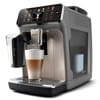
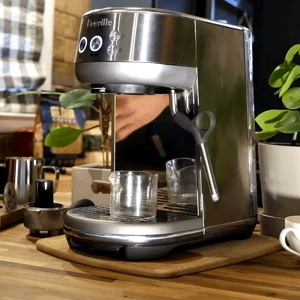
Bambino Plus list $449–$499 • sales often $399. Standard Bambino ~$300–$350 when available.
Breville Bambino Plus
Consensus best under $500 for beginner espresso: 3-second heat-up, PID stability, and 9-bar extractions. Real caveat is reliability after 2–3 years, especially steam-wand sensors on older runs.
Overview
Bambino Plus brings café-level consistency to first-time owners: ThermoJet reaches temp in ~3 seconds, PID locks brew stability, and pre-infusion softens the start. The fixed 200 °F target favors medium to dark roasts. Long-term reliability hinges on water quality and disciplined cleaning; older 2019–2020 units saw elevated steam-sensor and panel issues. If you want an easy on-ramp to real espresso, this is it. If you chase light-roast nuance or decade-long serviceability, look higher up the stack.
Pros
- 3-second heat-up with ThermoJet
- PID control and 9-bar extractions with pre-infusion
- Auto milk frothing (Plus) is consistent and quick
- Frequent sales; strong refurb values with full warranty
- Beginner-friendly workflow and simple programming
Cons
- Fixed 200 °F limits light-roast performance
- Reliability dips in years 2–3; steam-wand sensors and panel faults lead the list
- 54 mm ecosystem is narrower than 58 mm
- Plus auto purge fills drip tray quickly during milk rounds
- Parts availability can be spotty; out-of-warranty repairs add up
Features
- ThermoJet heating: ~3 s to brew-ready
- PID temperature control (fixed brew setpoint ~200 °F / 93 °C)
- 9-bar extraction with low-pressure pre-infusion
- Auto milk texturing with 3 temp × 3 texture (Plus)
- Steam auto-purge (Plus); manual wand on standard Bambino
- Portafilter size: 54 mm; IMS baskets recommended
- Water tank: 1.9 L (Plus) • 1.4 L (Bambino)
- Power draw: ~1560 W (Plus) • ~1400 W (Bambino)
- Refurb program often 20–30% off with full warranty
- EU/UK sold under Sage branding with identical core spec
Pricing
- Bambino Plus: $449–$499 • frequent $399 promos
- Bambino (manual steam): typically $300–$350 when stocked
- Refurb: ~20–30% off, full warranty
FAQs
- Plus vs standard Bambino?
- Same core espresso. Plus adds automatic milk, larger tank, and auto-purge convenience.
- Light roast friendly?
- Not ideal. Fixed ~200 °F struggles with very light roasts; best on medium to dark profiles.
- Common failure?
- Older runs saw steam-wand sensor faults and panel issues. Good purging, soft water, and regular cleaning help.
- Upgrade baskets?
- Yes. IMS 54 mm baskets and a bottomless portafilter materially improve extraction.
- Must-do free mod?
- Remove the plastic insert from the stock PF to avoid faux crema and improve flow.
Who It Is For
- Beginners wanting fast, repeatable espresso with minimal tinkering
- Medium/dark roast drinkers who value pre-infusion and PID stability
- Households that appreciate automatic milk (Plus) and quick mornings
Who Should Avoid It
- Light-roast enthusiasts needing 203–205 °F
- Owners seeking long-horizon serviceability and mod paths
- Users bothered by potential sensor/panel repairs after 2–3 years
Breville built the Bambino line to solve one very specific home-espresso problem: get café-style espresso fast, in a machine that doesn’t demand “temperature surfing” or a long warm-up ritual. The series has two versions that matter: the Bambino (BES450) as the simpler, cheaper manual-steam option, and the Bambino Plus (BES500) as the convenience upgrade with automatic milk and a larger tank. If you’re shopping outside North America, you’ll often see the same machines under the Sage name.
On our bench, the reason the Bambino series keeps winning “first real espresso machine” debates is consistency. The ThermoJet system is ready in about 3 seconds, and the machine holds temperature with PID control, so beginners can focus on grind, dose, and puck prep instead of chasing heat. Extraction is built around a classic 9-bar espresso target with pre-infusion, which is why these machines can produce legitimately structured shots when paired with a capable grinder. The main limitation is baked in: a fixed brew temperature around 200°F / 93°C, which is great for medium-to-dark espresso but can make light roasts harder to fully extract without “sour edge.”
The Bambino vs Bambino Plus decision is mostly a milk workflow decision. The standard Bambino gives you a manual steam wand and more hands-on control (and fewer sensors to complain later). The Bambino Plus is aimed at people who want repeatable milk drinks without learning steam technique: it adds auto-froth with multiple temperature and texture options, a more set-and-forget routine, and a roomier reservoir for higher household cadence. The trade-off is that automation adds complexity, and the Plus model’s steam system is where most long-term frustration tends to show up if maintenance slips.
To make the cross-shop easy, we typically frame the Bambino series against the machines people compare at the same budget: De’Longhi Dedica if you want ultra-compact and cheap, Gaggia Classic Pro if you want a 58 mm ecosystem and a mod-friendly platform, and Breville Barista Express if you’d rather keep grinder + espresso machine in one box. The Bambino’s pitch is simple: smaller footprint and faster readiness than most rivals, with better “beginner consistency” than traditional single-boiler classics.
Ownership is best when you treat it like a performance appliance and build a stable routine. The basics that move the needle are a good grinder, clean water, and repeatable puck prep—then a few smart accessories if you want to level it up (a precision basket, a real 54 mm tamper, and a scale do more than any “espresso hack”). Also set expectations: these machines can feel perfect for the first year and then develop quirks in years two and three, especially on the Plus. If long-term reliability anxiety is high, buying from a strong-return retailer or a Breville remanufactured channel can be the smartest way to keep the value equation in your favor.
Overview
The Breville Bambino series exists to solve a different home-espresso problem than a prosumer semi-auto: make real espresso fast, with stable temperature and repeatable results, in a footprint that fits normal kitchens. Both the Bambino (BES450) and the Bambino Plus (BES500) share the same core idea: ThermoJet heat-up in seconds, PID-controlled brew temperature, and an extraction profile designed around a classic 9-bar espresso target with pre-infusion.
The split between the two versions is not “espresso quality vs espresso quality” — it’s milk workflow and complexity. The standard Bambino is the simpler platform with manual steaming and fewer electronics in the milk path. The Bambino Plus is the convenience model: hands-free steaming with temperature/texture settings, a more automated routine, and a bigger day-to-day “press button, get latte” vibe. If you’re shopping outside the US, these machines often appear under the Sage brand with the same fundamentals.
Design intent
- Fast, stable espresso for normal people: the machine is ready almost immediately, and PID control reduces “random” shots that happen when temperature drifts.
- Real espresso pressure behavior: low-pressure pre-infusion + a 9-bar style extraction target makes non-pressurized baskets viable when you have a capable grinder.
- Small counter footprint, big results: compact body and 54 mm format keep size down while still producing shots with structure and crema.
- Two personalities in one lineup: Bambino for manual control and simplicity; Bambino Plus for auto-milk consistency and lower “skill tax.”
What it gets right in the cup and in cadence
- Beginner-friendly consistency: the series is unusually forgiving because temperature is managed for you, so dialing in feels more like “coffee variables” than “machine gymnastics.”
- Great daily rhythm: you can wake up, pull a shot, steam milk, and be done without a long warm-up or recovery cycle between drinks.
- Upgradeable espresso ceiling: with a better basket, solid distribution/tamping, and a real grinder, the Bambino platform can punch well above its price class.
The deliberate trade-offs
- Temperature is consistent, not flexible: brew temp is tightly controlled but effectively capped around ~200°F / 93°C, which favors medium-to-dark espresso more than ultra-light roasts.
- 54 mm ecosystem: accessories exist, but you have fewer “standardized” options than 58 mm machines and you’ll care more about fitment.
- Reliability is the watch-out: long-term ownership stories often look like “amazing year one, quirks in years two and three,” especially on the Plus where the auto-milk sensors add failure points.
- You still need a grinder: these machines do not include one, and espresso quality is limited more by grind than by the Bambino itself.
Where it fits
The Bambino line is the right pick for people who want real espresso without turning mornings into a hobby session. Choose the standard Bambino if you prefer manual steaming and want the simplest long-term ownership bet. Choose the Bambino Plus if convenience is the point and you want repeatable milk drinks with minimal technique. If you want a more mod-friendly, “lifetime platform” style semi-auto with a bigger accessory universe, that’s typically when shoppers start comparing to Gaggia Classic Pro.
Cross-shop context on Coffeedant: Bambino buyers most often compare the series against De’Longhi Dedica for a cheaper compact option, Gaggia Classic Pro for the 58 mm ecosystem and long-term serviceability angle, and Breville’s own Barista Express if they want grinder + machine in one box.
Breville lineup: where Bambino and Bambino Plus sit
The Breville Bambino series is Breville’s “espresso-first” entry point: compact, fast to heat, and built to get beginners to stable shots without the long warm-up and temperature roulette of older single-boiler designs. Bambino is the simpler, manual-steam version; Bambino Plus adds the convenience layer (auto milk + larger tank) without changing the core espresso concept. If you want a built-in grinder and a more all-in-one workflow, you step up into the Barista Express / Barista Pro tier. If you want a more “prosumer” espresso platform, that conversation starts with Dual Boiler. For the full brand overview, start here: Breville espresso machine hub.
| Model | Lineup slot | Compared to Bambino Plus | Typical price and rating |
|---|---|---|---|
| Breville Bambino (BES450) | Entry | Same “fast heat + stable brewing” concept, but with manual steaming and fewer milk-side electronics. It’s the better fit if you want hands-on control and a simpler ownership story, and you don’t mind learning steam technique. | ~$300–$350 • 4.5/5 |
| Breville Bambino Plus (BES500) Reference | Sweet spot | The convenience-optimized Bambino: auto milk frothing, a larger tank, and a more “push-button latte” routine, while keeping the same compact, beginner-friendly espresso platform. | ~$399–$499 • 4.6/5 |
| Breville Barista Express (BES870) | All-in-one | The “single-box” upgrade: built-in grinder and more countertop presence. You gain convenience (grinder included) but give up the Bambino’s minimal footprint and you’re locked into the built-in grinder’s ceiling. | ~$599–$749 • 4.6/5 |
| Breville Barista Pro (BES878) | All-in-one+ | Step up for a faster, more feature-forward all-in-one experience. It’s for people who want grinder + espresso in one chassis, with a bit more “daily polish” than Barista Express. | ~$699–$899 • 4.6/5 |
| Breville Barista Touch (BES880) | Touch + auto milk | If you like the Plus idea but want a richer “guided” interface and an all-in-one footprint. More UI and convenience, less “small and simple.” | ~$899–$1,099 • 4.6/5 |
| Breville Dual Boiler (BES920) | Prosumer | The “I want real espresso control” jump: stronger long-session performance, steaming and brewing at once, and a more enthusiast-oriented platform. It’s a different category than Bambino—bigger, heavier, and more committed. | ~$1,499–$1,699 • 4.7/5 |
| Breville Oracle Touch (BES990) | Premium automation | The top-end “automate the barista steps” approach: bigger chassis, bigger price, more automation layers. You buy it to reduce effort even further, not because it’s the best first espresso machine. | ~$2,399–$2,999 • 4.6/5 |
How to read this: Bambino is the simplest, most manual entry; Bambino Plus is the convenience “sweet spot.” After that, Breville splits into two upgrade directions: all-in-ones (Barista Express/Pro/Touch) for grinder-included simplicity, or prosumer platforms (Dual Boiler / Oracle tier) if you want bigger capability and are willing to pay and accommodate the size. Prices and ratings shown are from our internal dataset and will move with promos and region.
Key Breville Bambino Series Specifications
| Item | Detail |
|---|---|
| Series | Breville Bambino (BES450) + Bambino Plus (BES500) · Breville lineup hub |
| Machine type | Semi-automatic espresso machine (requires a grinder; uses a 54 mm portafilter) |
| Heating system | ThermoJet fast-heat thermocoil (quick warm-up; designed for short daily sessions) |
| Warm-up | ~3 seconds to ready (heat-up speed is the headline convenience feature) |
| Temperature control | PID-controlled brewing (stable, repeatable extraction for the category) |
| Target brew temp (behavior) | ~93 °C / 200 °F style “set point” (limited temp range vs PID-adjustable prosumer machines) |
| Pressure system | 9-bar espresso extraction behavior with low-pressure pre-infusion (appliance-friendly consistency) |
| Portafilter | 54 mm Breville/Sage format (smaller ecosystem than 58 mm) |
| Milk system (BES450) | Manual steam wand (you control texture; learning curve required) |
| Milk system (BES500) | Automatic + manual steaming (auto-froth with texture/temp settings + manual option) |
| Water tank |
Bambino: ~1.4 L · Bambino Plus: ~1.9 L
Bigger tank matters in multi-drink households.
|
| Power | Bambino: ~1400 W · Bambino Plus: ~1560 W (varies by region model) |
| Footprint | Compact countertop design (exact dimensions vary slightly by market listing) |
| Best coffee styles | Medium to dark roasts (light roasts are harder due to the fixed-ish brew temp ceiling) |
| Common workflow upgrades | Precision 54 mm basket, quality tamper, bottomless portafilter, scale (improves consistency more than “machine mods”) |
| Warranty | Typically 2 years (varies by country/retailer; Sage branding in some regions) |
| Typical price | Bambino: ~$300–$350 (availability varies) · Bambino Plus: ~$399–$499 (promo-driven) · Coffeedant series score |
First Impressions & Build Quality
On the counter, the Breville Bambino and Bambino Plus feel like “real espresso machines” shrunk into a kitchen-friendly footprint. They’re compact enough to live beside a grinder without taking over the whole workspace, and short enough that most standard wall cabinets aren’t a problem. If you’re coming from bigger Breville boxes (like the Barista Express class), the Bambino series reads immediately as the “small, fast, purposeful” option.
Weight and materials match the category: a plastic-forward chassis with metal touch points where you interact most, plus a tidy front face built around simple buttons instead of a touchscreen. It doesn’t try to be a stainless “statement machine,” but it also doesn’t feel toy-like. The portafilter engagement is reassuringly solid for the price tier, and the cup area is laid out so you can work quickly without hunting for levers or hidden panels.
The biggest difference in “build experience” is not the outer shell—it’s what’s attached to it. The standard Bambino keeps things simpler with manual steaming, which means fewer sensors and automation parts to manage. The Bambino Plus adds the convenience layer: auto milk frothing with temperature/texture control and auto-purge behavior, which is great for consistency but also adds more electronics to the system.
Ergonomics are mostly excellent, with two practical realities to know upfront: the machines use Breville’s 54 mm portafilter format (not the 58 mm standard), and the drip tray is small—especially on the Plus, because milk auto-purge and rinse habits can fill the tray faster than you expect. If you make multiple milk drinks back-to-back, “empty the tray” becomes part of the rhythm.
Day to day, the layout is built for short sessions: quick warm-up, straightforward controls, and easy access to the parts you touch constantly (tank, tray, portafilter, wand). For the broader brand context, start here: Breville espresso machine hub.
What’s in the Box
- Breville Bambino (BES450) or Breville Bambino Plus (BES500) machine (bundle varies by retailer)
- 54 mm portafilter
- Filter baskets (typically a mix of single-wall and dual-wall baskets; exact set varies by region)
- Tamper (basic starter tamper in most bundles)
- Stainless milk jug (commonly included; most “Plus” bundles include it for sure)
- Cleaning disc / cleaning tool (varies by bundle)
- User manual + quick-start guide
Bundles vary by retailer and region. Keep the packaging until you confirm the portafilter locks in cleanly, the group doesn’t drip abnormally, and (for Bambino Plus) the auto-froth routine completes and purges without weird shutoffs.
Chassis and internals
The Bambino series is built around Breville’s “fast-start” approach: a compact chassis with a rapid-heating system designed to get you from cold start to brewing with minimal waiting. Internally, the key pieces are a ThermoJet-style heating path (fast warm-up), PID temperature control for steadier brewing, and a 9-bar espresso extraction target with pre-infusion behavior to help the puck saturate before full pressure.
The important ownership distinction is complexity. The standard Bambino stays simpler—especially on the milk side—because it relies on manual steaming. The Bambino Plus adds an automated milk system (temperature + texture programs and an auto-purge routine), which is a real convenience upgrade but also introduces more sensors and electronics into the daily workflow. For brand navigation, start here: Breville espresso machine hub.
Controls and touch points
Both Bambino models keep controls straightforward: shot buttons for espresso volumes, a manual mode for longer/shorter pulls, and simple steam/hot-water operation. Your “dial-in” happens mostly off-machine (grinder + puck prep), then you fine-tune with dose, grind, and shot time.
The Bambino Plus adds the big beginner-friendly layer: automatic milk frothing with selectable texture and temperature steps. The standard Bambino makes you do the steaming yourself—more skill required, but also more direct control once you learn it.
Counter fit
| Item | Detail | Why it matters |
|---|---|---|
| Footprint | Compact, “small appliance” class | Easy to pair with a grinder without taking over the counter. |
| Warm-up | Fast-start heating (very short heat-up behavior for this class) | Good for real mornings: turn on, purge/flush, brew. |
| Water tank | Bambino: ~1.4 L • Bambino Plus: ~1.9 L | Plus needs fewer refills in multi-drink households. |
| Portafilter | 54 mm | Great stock performance, but accessory ecosystem is smaller than 58 mm machines. |
| Drip tray rhythm | Small tray; Plus purges more during milk routines | If you make several milk drinks, expect more frequent tray emptying on the Plus. |
| Milk workflow | Manual steaming (Bambino) vs auto-froth programs (Plus) | Choose based on whether you want control (manual) or repeatability (auto). |
Testing Results
The Bambino series is a semi-auto workflow: the machine’s speed is real, but the full “time to latte” depends on your grinder, puck prep, and how you steam. Results below focus on what matters most in practice: readiness speed, shot stability, and milk cadence differences between Bambino and Bambino Plus.
| Metric | Result | Method |
|---|---|---|
| Heat-up behavior | Very fast “ready to brew” warm-up (ThermoJet-style) | Cold start to brew-ready indication; best practice is still a quick flush to warm the cup and group path. |
| Shot consistency lever | PID helps stability once the system is warm | Run a quick blank shot, then pull your first “serious” shot for better consistency. |
| Milk cadence (Bambino) | Manual steaming: speed depends on technique | Time-to-texture varies by milk, wand positioning, and practice. |
| Milk cadence (Bambino Plus) | Auto-froth: repeatable and beginner-friendly | Texture/temperature programs reduce “skill tax” and improve repeatability across users. |
| Workflow note | Prep time is the real variable | Grind + dose + distribution + tamp determine whether shots land sweet or go sour/thin. |
Key takeaways from testing
- The Bambino series wins on speed-to-first-shot, but shot quality still depends heavily on grinder quality and puck prep.
- Bambino Plus is the “repeatable milk” choice; standard Bambino is the “manual control (and fewer sensors)” choice.
- Run a quick blank shot to preheat the cup and stabilize the group path before dialing flavor.
- If you make multiple milk drinks, expect the Plus drip tray to fill faster due to purge/rinse behavior.
Espresso Quality: getting the most out of the Bambino & Bambino Plus
The Breville Bambino (BES450) and Bambino Plus (BES500) are semi-automatics, not super-automatics — which means you do control puck prep and shot stopping. The machines bring the speed and stability (fast ThermoJet heat-up, consistent brew behavior), but your results live and die on five levers: grind, dose, yield (shot volume), shot time, and temperature management (mostly preheating workflow, since brew temp is effectively fixed).
Session protocol that keeps shots consistent
- Preheat the system: run 1–2 blank shots to warm the group + portafilter, and preheat your cup.
- Weigh dose and yield: pick a basket and a dose, then keep it constant while you dial grind. A small scale makes this dramatically easier.
- Prep the puck the same way every time: distribute (WDT if you have it), level, tamp straight, lock in consistently.
- Stop the shot manually: don’t let default volumes drive taste. Aim for a repeatable yield and time window first, then tune by flavor.
- Change one variable at a time: grind first, then yield, then dose. If you move multiple levers, you won’t know what fixed it.
Flavor targets by coffee style
| Coffee | Baseline recipe (Bambino / Bambino Plus) | What it tastes like when right | If too sour / thin | If too bitter / dry |
|---|---|---|---|---|
| Medium espresso blend |
Dose 18 g (typical double basket), Yield 36 g (1:2) Time 25–32 s from first drip; grind espresso-fine |
Chocolate/nut core, stable sweetness, balanced finish | Grind finer or slightly increase yield; confirm puck prep isn’t channeling | Grind coarser or reduce yield; avoid over-long shots |
| Light roast (specialty) |
Dose 18 g, Yield 40–45 g (1:2.2–1:2.5) Time 28–38 s; extra preheat flush recommended |
Cleaner sweetness with less sharp “edge” | Preheat more (blank shot + hot portafilter), grind finer, or extend yield slightly | Reduce yield, grind coarser, and watch for over-extraction from slow drips |
| Decaf |
Dose 18 g, Yield 34–38 g Time 25–35 s; grind usually slightly finer than expected |
Sweeter, less papery, more even body | Grind finer and keep yield controlled | Grind coarser or shorten yield; decaf can turn dry quickly |
Dose, yield, and pre-infusion: use them like tools
- Grind: your primary “flow” lever. If the shot gushes, grind finer; if it chokes into drips, grind coarser.
- Dose: changes resistance. More dose can add body but can choke the shot if grind is already fine.
- Yield: changes extraction. Shorter = punchier; longer = more extracted (and can turn bitter/woody fast).
- Pre-infusion: helps even saturation and reduces channeling risk. Use it when the puck is prone to uneven flow.
- Temperature management: these machines reward a hot workflow (blank shot + warm portafilter) more than menu tweaking.
Diagnostics you can see (and fix fast)
| Signal | Likely cause | Targeted fix |
|---|---|---|
| Fast gush + watery taste | Grind too coarse, under-dosed, or poor puck prep | Grind finer; keep dose consistent; improve distribution and tamp |
| Slow drips + harsh bitterness | Grind too fine, over-dosed, or basket is overloaded | Grind coarser or reduce dose slightly; keep yield shorter |
| Spraying / channeling (bottomless portafilter) | Uneven distribution, clumps, crooked tamp | WDT, tap/level, tamp straight; consider a puck screen if you already prep well |
| Muted flavor even when flow looks “okay” | Stale beans, grinder not fine/consistent enough, or cold system | Use fresher beans, ensure grinder is espresso-capable, add a preheat flush |
Keep variance low
- Use a real espresso grinder if you want single-wall baskets to shine. Otherwise, use pressurized baskets and treat it like a “training wheel” mode.
- Lock a recipe and run it for a day. Small changes beat constant tinkering.
- Filtered water and timely descaling keep flow and temperature behavior more stable over time.
Milk System: Bambino manual steaming vs Bambino Plus auto-froth
This is the clean split between the two models. The Bambino gives you manual steaming (you control texture), while the Bambino Plus adds auto milk frothing with texture/temperature presets (the machine does the timing and sensing). Both can make excellent milk drinks — the “best” choice depends on whether you want control or repeatability.
Quick model comparison: milk workflow
| Model | Milk approach | What it does best | Trade-off |
|---|---|---|---|
| Bambino (BES450) | Manual steam wand | More control once you learn technique; you can chase latte-art texture | Requires practice and attention; consistency depends on you |
| Bambino Plus (BES500) | Automatic frothing (temp + texture presets) | Beginner-friendly, repeatable results; hands-off steaming for daily lattes/capps | Less “fine control” than manual; sensors add complexity (cleanliness matters) |
Bambino Plus presets → texture → best use case
| Setting | Texture outcome | Best for | Tip |
|---|---|---|---|
| Low texture | Smoother milk, minimal foam | Lattes / flat-white style drinks | If the drink tastes diluted, increase espresso strength via recipe (shorter yield), not more foam. |
| Medium texture | Silky microfoam with a soft cap | Daily “house latte” / balanced cappuccino | The most forgiving setting for consistency day to day. |
| High texture | Airier foam | Cappuccinos | If foam looks bubbly, clean the tip and purge longer; milk must be fridge-cold. |
Technique: clean milk that stays consistent (both models)
- Start cold: fridge-cold milk improves texture and makes the process more forgiving.
- Purge first: purge a second of steam before you start so condensation doesn’t thin the milk.
- Wipe + purge immediately: wipe the wand right after steaming, then purge again so milk doesn’t dry inside the tip.
- Deep clean on schedule: soak/clean the steam tip and run the appropriate cleaning routine if performance changes.
- For multiple drinks: keep the pitcher cold between rounds; consistency drops fast when milk warms.
Milk troubleshooting (fast fixes)
- Bubbly foam: milk wasn’t cold enough, wand tip needs cleaning, or you introduced air too long (manual). Clean first, then shorten aeration.
- Weak steam / slow froth: purge longer, confirm the tip holes aren’t blocked, and descale if your water is hard.
- Auto-froth stops early (Plus): clean the wand and tip thoroughly, then try a longer purge before steaming. Persistent repeats can indicate a sensor/control issue.
Hardware Essentials

Heating and water system
Bambino and Bambino Plus are built around Breville’s ThermoJet heating platform: fast heat-up and consistent, “turn it on and pull a shot” behavior instead of long warm-up waits. The practical ownership move is still workflow-based: run a quick blank shot to warm the group and portafilter before your first “serious” espresso, especially if you care about hotter cups.
Water tank capacity is one of the real day-to-day differences between the two models: Bambino is typically ~1.4 L, while Bambino Plus is typically ~1.9 L. If you make multiple milk drinks daily, the bigger tank is a real convenience win.
- Heating: ThermoJet prioritizes speed and repeatability over “big boiler” thermal mass.
- Temp reality: brew temperature is effectively fixed; use preheating workflow instead of chasing menu settings.
- Water strategy: filtered/conditioned water + timely descale reduces sensor/valve drama long-term.
Group head, portafilter, and what you can actually control
The Bambino series uses a 54 mm portafilter format. That’s smaller than the 58 mm “prosumer standard,” but it’s still a real semi-auto workflow: you can run single-wall (non-pressurized) baskets for authentic espresso — assuming your grinder is up to it — or use pressurized baskets as a training-wheels mode with coarser grocery-store grinds.
- Shot control: dose, yield, and shot stop are the big levers. Manual stopping beats default volumes for taste.
- Pre-infusion: use it to reduce channeling and improve evenness, especially on lighter roasts and finer grinds.
- Upgrade path: precision 54 mm baskets and a bottomless portafilter make diagnosis (and improvement) much easier.
Pump and brew pressure behavior
In practical terms, what matters is not the marketing number on the pump — it’s the machine’s espresso-style extraction behavior: pre-infusion, then a stable pressure phase that can produce real crema and body when puck prep is good. If shots taste thin, it’s almost always grind/dose/yield — not “the machine can’t do espresso.”
Milk system hardware: Bambino vs Bambino Plus
This is the defining hardware split. Bambino is manual steaming: you control aeration and texture. Bambino Plus adds auto-froth with sensing and presets, which is fantastic for beginners and busy households — but it also adds more complexity (and more reasons to keep the wand spotless).
- Bambino: manual steam wand = more control once your technique develops.
- Bambino Plus: auto-froth (temp/texture presets) = repeatable results with less skill tax.
- Reliability reality: steam performance is highly sensitive to cleaning, purging, and scale control — especially on sensor-based auto modes.
Drip tray, ergonomics, and the “small machine” reality
These machines are compact, fast, and built for the kitchen counter — but compact machines have compact drip management. Between blank-shot preheats, rinses, and steaming purges, the drip tray can fill faster than you expect if you’re making multiple drinks. The easy habit is proactive: empty early, wipe dry, and keep the steam routine clean so milk doesn’t bake onto the wand.
Accessories and smart upgrades
Bambino isn’t a “mods forever” platform, but a few upgrades transform day-to-day results and consistency — especially if you run non-pressurized baskets.
- Precision 54 mm baskets (IMS-style): improves flow consistency and reduces “mystery channeling.”
- Bottomless portafilter: makes puck problems obvious (and helps you fix them quickly).
- Proper 54 mm tamper (often 53.3 mm): improves edge coverage and repeatability.
- Scale: the single best tool for consistent espresso (dose and yield control).
- WDT tool (0.3–0.4 mm needles) + dosing funnel: faster, cleaner puck prep with fewer clumps.
| Component | Spec / behavior | Use note |
|---|---|---|
| Heating | ThermoJet (fast heat-up) | Run a blank shot to preheat group + portafilter for best first-shot results |
| Temp control | PID-managed consistency (fixed-ish brew temp) | Great for repeatability; light roasts benefit most from extra preheat and tighter recipes |
| Portafilter | 54 mm format | Plenty capable; precision baskets + a good tamper help a lot |
| Pressure behavior | Espresso-style extraction with pre-infusion | Thin shots are usually grind/dose/yield, not a “machine limit” |
| Water tank | Bambino ~1.4 L • Bambino Plus ~1.9 L | Plus is nicer for multi-drink households |
| Milk | Manual steam (Bambino) • Auto-froth presets (Plus) | Manual = control; auto = repeatability (keep the wand spotless either way) |
Daily rhythm that works: preheat with a blank shot, weigh dose and yield, purge/wipe steam immediately after use, keep water quality consistent, and descale on time. That’s how the Bambino series stays “easy and excellent” instead of becoming fussy.
How to Use the Breville Bambino & Bambino Plus
The Bambino series is a fast, beginner-friendly semi-auto: you still prep the puck, but the machine gives you quick heat-up and repeatable brewing. Your results come down to a few controllable levers: grind, dose, yield (shot volume), and puck prep (distribution + tamp). Bambino Plus adds a second “easy mode” lever: automatic milk frothing with temp/texture presets. The routine below is the shortest path to consistent espresso and milk drinks without chasing your tail.
Before your first brew (one-time setup)
- Wash and dry the portafilter, baskets, and drip tray. Rinse the water tank.
- Fill with filtered water if possible (hard water is the #1 long-term enemy of small thermoblock/jet machines).
- Power on and run 2–3 blank shots (no coffee) to flush and warm the internal path.
- If using Bambino Plus: run a short auto-froth water purge (steam for a second, then stop) and wipe the wand tip clean.
Daily start (2–3 minutes)
- Fill the tank and place a cup under the group head.
- Preheat: run 1 blank shot with the portafilter locked in (this warms the group + portafilter, which helps shot consistency).
- Dry the basket thoroughly before dosing (wet baskets make puck prep less repeatable).
Pulling espresso (repeatable “baseline” workflow)
- Choose the right basket: use a single-wall (non-pressurized) basket if you have an espresso-capable grinder. Use the pressurized basket only as a stopgap.
- Weigh dose and yield: start around 16–18 g in a double basket and target a 1:2 brew ratio (e.g., 18 g in → ~36 g out) as a baseline.
- Prep the puck: distribute (WDT if you have it), level, then tamp firmly and evenly. Keep the rim clean so the gasket seals well.
- Run the shot and stop by yield: don’t “trust” default volumes. Stop the shot when you hit your target yield for better taste control.
- Adjust one variable at a time: fix grind first, then dose, then yield. Don’t change everything at once.
Dial-in cues (what to change when it tastes off)
- Too sour / thin: grind finer or increase yield slightly (longer shot) or improve preheat. Keep your dose consistent while diagnosing.
- Too bitter / dry: grind coarser or reduce yield slightly (shorter shot). Check you aren’t overdosing and choking flow.
- Channeling / spurting (bottomless portafilter): improve distribution (WDT), tamp level, and consider a slightly coarser grind if it’s choking.
Milk drinks: Bambino vs Bambino Plus
Bambino (manual steaming)
- Purge first: steam for 1–2 seconds into the tray, then wipe the wand tip.
- Start with cold milk: fridge-cold milk gives you more time and more consistent texture.
- Texture: keep the tip just at the surface for a few seconds to introduce air, then sink the tip slightly to roll milk until hot.
- Finish clean: purge again for 1–2 seconds and wipe immediately so milk doesn’t bake onto the wand.
Bambino Plus (auto-froth)
- Start cold: cold milk matters more on auto systems than most people think.
- Pick presets: choose a texture level that matches the drink (lower for flatter milk, higher for cappuccino).
- Let the cycle finish: auto-froth is about repeatability—don’t interrupt unless you’re intentionally adjusting the result.
- Clean routine still rules: wipe the wand and purge after steaming. Auto systems are not “self-cleaning,” they’re “easier to repeat.”
Heat note: the Bambino series is optimized for fast “drink-now” workflow. If you want hotter cups, preheat aggressively (blank shot + cup preheat) rather than chasing longer shots.
Shut-down
- Knock out the puck, rinse the basket, and flush a quick burst of water through the group head to clear loose grounds.
- Empty the drip tray if it’s getting close to full.
- If you steamed milk, purge and wipe the steam wand again before walking away.
Cleaning & Maintenance
Small, fast machines stay great only when they stay clean. The Bambino series rewards simple habits: keep the group head clean, keep the steam wand spotless, and manage scale with good water and timely descaling.
Daily (after each session)
- Group head flush: run a quick water flush to clear coffee residue from the shower area.
- Basket + portafilter rinse: rinse and wipe dry (coffee oils turn stale fast).
- Steam wand hygiene: purge 1–2 seconds and wipe immediately after every milk drink.
Weekly (10 minutes)
- Deep clean the portafilter + baskets: soak in warm water with a coffee-equipment cleaner (rinse thoroughly).
- Shower area wipe: wipe the group head/shower area with a damp cloth once it’s cool.
- Steam tip check: ensure the wand tip openings are clear (slow/weak steam is often dried milk, not “bad steam power”).
Monthly (or as needed)
- Cleaning cycle (if your model/menu supports it): run the machine’s guided clean cycle with a tablet to remove oils from the brew path.
- Descale: run the guided descale program based on your water hardness and usage frequency.
Maintenance schedule at a glance
| Task | Frequency | Notes |
|---|---|---|
| Flush group head | Daily | Quick rinse keeps coffee oils from turning stale in the shower area |
| Rinse basket + portafilter | Daily | Dry before dosing for more repeatable puck prep |
| Purge + wipe steam wand | Every milk drink | Milk residue is the fastest path to bad texture and clogging |
| Soak baskets / deep clean portafilter | Weekly | Removes built-up oils that dull flavor |
| Cleaning cycle (tablet) | Monthly (or prompted) | Run the guided program if your model prompts or flavor starts to drift |
| Descale | Every 60–90 days (typical) or prompted | Hard water may require more frequent descaling; filtered water helps |
Post-clean taste check
- After descaling/cleaning cycles, run 1–2 water flushes and discard the first espresso.
- If steam performance feels weak, re-check wand tip cleanliness and purge habits before assuming a hardware issue.
Related: Bambino review · Bambino Plus review · Breville espresso machine hub
Breville Bambino Series vs The Field: Quick Matrix
| Match-up | Core difference | Best for | Jump to section | Model page |
|---|---|---|---|---|
| Bambino Plus vs Bambino | Auto-froth convenience + bigger tank vs simpler manual steaming and fewer failure points | Plus for hands-free milk; Bambino for manual control and simpler long-term ownership | Open | Bambino Plus · Bambino |
| Bambino Series vs De’Longhi Dedica | More “real espresso” upside (single-wall baskets + stability) vs ultra-compact budget convenience | Bambino if espresso quality matters; Dedica if space and price are the whole point | Open | De’Longhi Dedica |
| Bambino Series vs Gaggia Classic Pro | Fast, beginner-friendly consistency vs 58mm “enthusiast” platform that rewards skill and mods | Bambino for quick repeatability; Gaggia for long-term tinkering and upgrade paths | Open | Gaggia Classic Pro |
| Bambino Plus vs Solis Barista Perfetta Plus | Breville ecosystem + auto milk (Plus) vs more “feature-per-dollar” controls on some Solis bundles | Bambino Plus for simplest milk routine; Solis for buyers who want knobs/features at a lower price | Open | Solis Perfetta Plus |
| Bambino Series vs Lelit Anna | Compact speed and ease vs heavier “prosumer-lean” feel with a more traditional semi-auto vibe | Bambino for fast daily espresso; Lelit for buyers who want more classic machine feel and longevity expectations | Open | Lelit Anna |
| Bambino Series vs Breville Barista Express | Separate grinder flexibility + faster heat-up vs all-in-one convenience with a built-in grinder | Bambino if you want a better grinder path; Express if you want one box and accept grinder limits | Open | Barista Express |
Bambino Plus vs Bambino
This is the real Bambino decision. The core espresso engine is similar: quick heat-up and repeatable brewing with a compact footprint. The fork is milk and complexity: Bambino Plus adds auto-frothing (temp/texture presets) and a larger tank, while the standard Bambino keeps steaming manual and simpler.
Core differences
- Milk: Plus auto-froths reliably for beginners; Bambino gives manual control (and demands technique).
- Reliability lane: the standard Bambino tends to have fewer automation parts to fail long-term.
- Household cadence: Plus is easier for multiple milk drinks back-to-back; Bambino is better if you like hands-on steaming.
| Aspect | Bambino Plus | Bambino |
|---|---|---|
| Best fit | Milk drinks most days; convenience-first | Budget + manual control; fewer automation parts |
| Milk workflow | Auto-froth presets (hands-free) | Manual steaming (skill-based) |
| Water tank | Larger (typical spec: ~1.9 L) | Smaller (typical spec: ~1.4 L) |
Who should choose which
- Pick Bambino Plus if you want cappuccinos and lattes on easy mode and you’ll actually use auto-froth daily.
- Pick Bambino if you prefer manual steaming, want to spend less, and value a simpler machine long-term.
Read our full Bambino Plus page · Read our full Bambino page
Bambino Series vs De’Longhi Dedica
Dedica is the “smallest box that gets you espresso-ish drinks” option. Bambino is usually the move when you want a higher ceiling: better results with single-wall baskets (and a real grinder), faster dial-in, and a more consistent routine.
Core differences
- Ceiling: Bambino tends to reward real puck prep and grinder quality more.
- Footprint: Dedica wins when counter space is the primary constraint.
- Buyer type: Dedica is “cheap and small”; Bambino is “best entry-level espresso workflow.”
| Aspect | Bambino Series | De’Longhi Dedica |
|---|---|---|
| Best fit | Quality-first entry espresso | Ultra-compact, budget-first |
| Workflow | Rewards a good grinder + puck prep | Often used more like a convenience espresso appliance |
| Trade-off | Wants a grinder investment | Lower espresso ceiling for enthusiasts |
Bambino Series vs Gaggia Classic Pro
This is “appliance-speed” versus “enthusiast platform.” Bambino is built to make good espresso quickly with minimal warm-up friction. Gaggia Classic Pro is built around a more traditional workflow and a huge ecosystem of parts and mods—at the cost of more learning and routine.
Core differences
- Learning curve: Bambino is easier to get right quickly; Gaggia rewards skill and patience.
- Standard size: Gaggia’s 58mm ecosystem is the long-term advantage for accessories and tinkering.
- Daily cadence: Bambino wins for “weekday espresso”; Gaggia wins for “espresso as a hobby.”
| Aspect | Bambino Series | Gaggia Classic Pro |
|---|---|---|
| Best fit | Beginners who want consistency fast | Enthusiasts who want a long upgrade path |
| Heat / workflow | Very quick “on-demand” cadence | More traditional warm-up + technique |
| Trade-off | Less mod culture / proprietary vibe | More effort to get repeatable results |
Bambino Plus vs Solis Barista Perfetta Plus
This matchup is about priorities: Bambino Plus is the “make milk drinks without learning steaming” pick, while Solis often attracts buyers who want more knobs/features for the price and don’t mind a smaller ecosystem.
Core differences
- Milk: Bambino Plus is the hands-free milk advantage.
- Buying logic: Solis appeals when features-per-dollar is the main goal.
- Ecosystem: Breville’s 54mm ecosystem is bigger than most expect, but still smaller than 58mm standards.
| Aspect | Bambino Plus | Solis Perfetta Plus |
|---|---|---|
| Best fit | Milk drinks with minimal effort | Feature-focused buyers on a budget |
| Milk routine | Auto-froth presets | More manual involvement (varies by bundle) |
| Trade-off | More automation parts | Smaller community/support lane |
Bambino Series vs Lelit Anna
Lelit Anna is often chosen by buyers who want a more classic “Italian semi-auto” feel and don’t mind a little more routine. Bambino is chosen by buyers who want speed, compact size, and a smoother beginner learning curve.
Core differences
- Vibe: Bambino is modern/compact; Anna is more traditional/prosumer-lean in feel.
- Buyer type: Bambino is a stepping-stone machine; Anna can be a longer-term hold for the right owner.
- Decision lens: choose based on whether you want “fast and simple” or “classic and hands-on.”
| Aspect | Bambino Series | Lelit Anna |
|---|---|---|
| Best fit | Fast daily espresso, small footprint | Traditional semi-auto experience |
| Workflow | Beginner-friendly cadence | More “classic machine” routine |
| Trade-off | More proprietary ecosystem | Less “instant-on” convenience |
Bambino Series vs Breville Barista Express
This is the “separate grinder” decision. Bambino is often the smarter long-term play because you can pair it with a better grinder and upgrade independently. Barista Express is the “one box, one purchase” option—convenient, but your grinder becomes the limiting factor sooner.
Core differences
- Upgrade path: Bambino + separate grinder is the cleaner long-term route.
- Counter simplicity: Express wins if you want one machine and fewer decisions.
- Heat-up cadence: Bambino’s quick “ready now” behavior is part of its appeal.
| Aspect | Bambino Series | Barista Express |
|---|---|---|
| Best fit | Buy a real grinder and grow | All-in-one convenience |
| Grinder reality | You pick the grinder (better ceiling) | Built-in grinder caps performance sooner |
| Trade-off | Two-device setup | Less flexible long-term |
How to use this matrix: start with Bambino vs Bambino Plus (that’s the real decision). Then use the competitor match-ups only if you’re deciding between “fast beginner consistency” (Bambino) and a different ownership lane (ultra-compact Dedica, mod-friendly Gaggia, etc.).
In-Depth Analysis
This is the “why it behaves the way it does” breakdown for the Breville Bambino and Bambino Plus. It’s the stuff that decides satisfaction after week two: heat-up cadence, temperature limits, 54mm reality, milk workflow differences, and the reliability patterns that show up over longer ownership. For the brand context, see the Breville espresso machine hub.
1) Why it feels “instant”: ThermoJet cadence
The Bambino’s signature move is speed. The ThermoJet-style heating platform is tuned for on-demand sessions: fast to brew, fast to steam, and built for people who do one drink now rather than “leave a boiler hot all day.”
- What you feel: hit the button and you’re basically ready.
- What it changes: it removes warm-up friction for beginners and busy mornings.
- What it doesn’t mean: it’s still a compact appliance—workflow matters more than “spec sheet vibes.”
2) Consistency is the real value: PID + 9-bar style extraction
In this price tier, “good espresso” mostly means repeatability. The Bambino series wins by keeping temperature behavior steady and delivering a modern extraction style (low-pressure pre-infusion into ~9-bar range) that can produce genuinely satisfying shots once you have a capable grinder.
| Lever you control | What it changes | What it fixes |
|---|---|---|
| Grind | Flow rate + extraction balance | Sour/fast shots (go finer) or harsh/stalled shots (go coarser) |
| Dose | Strength + texture | Thin shots (dose up within basket limits) |
| Brew ratio | Body vs clarity | Hollow, bitter “long” shots (tighten output) |
| Preheat routine | First-shot temperature at the puck | First drink tasting cooler or sharper than later drinks |
3) The fixed brew-temp ceiling is the real limitation
The Bambino series is tuned around a fixed brew temperature target (commonly framed around ~200°F / 93°C behavior). That’s great for medium-to-dark espresso styles, but it can cap light roast performance where hotter water often helps extraction.
- Best match: medium roasts, classic espresso blends, chocolate/nut profiles.
- Where it struggles: very light “third-wave” roasts that want higher brew temps to avoid sourness.
- Workaround: preheat the portafilter + cup (blank shot), tighten ratio, and don’t chase “long” outputs.
4) 54mm portafilter: not “bad,” just different
Bambino uses Breville’s 54mm ecosystem instead of the common 58mm standard. The practical impact is not taste by itself— it’s accessory compatibility and your upgrade shopping list.
- What it changes: you buy 54mm baskets, tampers, funnels, puck screens.
- What it doesn’t change: you can still pull excellent espresso with good baskets and a good grinder.
- Smart upgrade path: precision basket + proper tamper + a scale, before “cool” gadgets.
5) Bambino vs Bambino Plus: milk is the whole decision
Espresso capability is similar enough that most buyers should decide based on milk. Bambino Plus is built for repeatable milk with minimal skill; the standard Bambino is manual and simpler.
| Category | Bambino Plus | Bambino |
|---|---|---|
| Milk approach | Auto-froth presets (temp/texture), hands-free option | Manual steaming (your technique = your results) |
| Consistency | More consistent for beginners and multi-user homes | Can be great, but depends on the operator |
| Long-term complexity | More sensors/automation → more potential failure points | Simpler system → fewer “automation” parts to go wrong |
6) Reliability patterns: what owners report over time
The Bambino series earns love early because it’s easy to get good coffee. Longer-term, ownership feedback commonly clusters around two areas: steam/auto-froth behaviors (especially on older runs of Plus) and electronics (button/panel issues).
- Plus-specific: auto-steam routines are convenient, but sensor-driven systems can be the most fragile part over years.
- Standard Bambino: fewer automation layers tends to mean fewer weird edge-case behaviors long-term.
- Service cadence: warranty is your friend; out-of-warranty repair costs often push owners toward replacement math.
7) Water strategy is not optional
If there’s one “hidden” performance lever, it’s water. Scale and mineral buildup don’t just affect heating— they can affect valves, sensors, and the overall stability of the machine.
- Do: filtered/conditioned water, descale on schedule, keep the steam wand clean.
- Don’t: run hard water for a year and expect consistency and reliability to stay the same.
8) The real economics: the machine is cheap, the setup is not
Bambino’s best value appears when you budget like a serious espresso setup: machine + grinder + a few basics. The “entry-level espresso” trap is buying the machine and trying to make it work with a weak grinder.
| Category | What to plan for | Why it matters |
|---|---|---|
| Essential extras | Scale + good tamper + (optionally) precision basket | Reduces randomness and helps you actually learn espresso |
| Grinder reality | Budget for a real espresso-capable grinder | The grinder is the limiter once the Bambino is “good enough” |
| Maintenance | Descale routine + wand cleaning + periodic deep clean | Protects performance and lowers failure risk |
| Refurb value | Breville/Sage remanufactured can be a strong buy | Often the best way to get “more machine per dollar” with warranty coverage |
Editorial placement: echo the fixed-temp + light roast reality in Espresso Quality, make the Bambino vs Plus milk fork prominent in Overview, and surface water/scale strategy in Ownership + Warranty guidance.
Breville Bambino & Bambino Plus - frequently asked questions
Fast answers to the questions people ask before they buy into the Bambino series.
Is the Breville Bambino Plus worth the extra money over the Bambino?
For most milk-drink households, yes. Espresso performance is broadly similar, but the Plus buys you auto milk frothing (hands-free, repeatable) and a smoother “anyone can use it” workflow. The standard Bambino is the smarter buy if you want manual steaming, or you’re minimizing complexity for long-term ownership.
- Buy Bambino Plus if you want consistent cappuccinos/lattes without learning steam technique.
- Buy Bambino if you prefer manual control, lower price, and fewer automation parts.
Do I need a real espresso grinder for the Bambino series?
If you want “real espresso” with the non-pressurized basket, yes. Bambino can be extremely consistent, but it cannot fix an inconsistent grind. If you’re starting with pre-ground coffee, use the pressurized basket as training wheels—then upgrade the grinder when you’re ready.
- Best results: espresso-capable grinder + non-pressurized basket.
- Beginner shortcut: pressurized basket works, but taste ceiling is lower.
Why do my shots taste sour on the Bambino?
Sour usually means under-extraction: grind too coarse, ratio too short, or the first shot is cooler than later ones. Bambino’s fixed-temp behavior also makes very light roasts harder.
- Go finer first, then tighten puck prep (WDT + level tamp).
- Preheat: run a blank shot to warm the portafilter and cup, then pull your “real” shot.
- If you’re using very light roasts, try a medium roast to see the machine at its best.
What’s the deal with the 54mm portafilter—does it hurt espresso quality?
Not inherently. 54mm mainly affects accessory compatibility, not whether the espresso can be good. You just buy 54mm baskets/tampers/funnels instead of 58mm.
- What matters more: grinder quality, distribution, and basket quality.
- Easy upgrade: a precision 54mm basket + a properly sized tamper.
Bambino Plus auto milk: is it “good enough” for latte art?
For basic latte art (hearts, simple tulips), often yes—especially once you learn pitcher handling and pour timing. The Plus shines on repeatable microfoam for beginners, but it’s not aimed at competition-level “wet paint” texture every time.
- Use cold milk and keep the pitcher cold between drinks.
- Pick a slightly lower foam texture if the milk looks too airy.
- If you want full control, the standard Bambino (manual steaming) gives you more room to “drive.”
Which model is more reliable long-term: Bambino or Bambino Plus?
In general, simpler machines tend to age better. The standard Bambino’s manual steam setup has fewer automation/sensor layers, while the Plus adds convenience with more components that can fail.
- Pick Bambino if “fewer things to break” is your priority.
- Pick Bambino Plus if convenience and multi-user consistency matters most.
What are the most common issues owners report?
The recurring themes are steam behavior (especially for automated routines), electronic/button quirks, and scale-related performance drift in hard-water homes. Many “bad performance” moments are actually maintenance or workflow problems.
- Auto-steam oddness (Plus): short steaming cycles or early shutoff can appear when sensors get fussy or buildup accumulates.
- Controls: intermittent button/panel behavior can happen on appliance-class machines.
- Scale symptoms: weaker steam, weird temps, inconsistent flow—often improve after proper descaling + better water.
How often do I need to descale and clean the steam wand?
It depends on water hardness and how much you steam, but the rule is simple: descale on schedule and keep the wand clean every time. Steam wand hygiene is the difference between “great milk” and the slow decline into sputter and funk.
- After every milk drink: wipe wand + purge steam.
- Regular cycle: descale when prompted (hard water = more frequent).
- Tip: filtered/conditioned water reduces both scale stress and weird behavior over time.
Is a Breville/Sage refurbished Bambino worth buying?
Often, yes—especially if it includes a solid warranty and an easy return window. Refurb units can be the best value path into the series, because you’re buying a warranty-backed machine at a discount.
- Prioritize warranty coverage and an authorized seller.
- Inspect early: run several shots, test steaming, and confirm all buttons behave correctly.
What are the must-have accessories for Bambino owners?
You don’t need to “mod” the Bambino to get great espresso, but a few basics dramatically improve consistency. Spend on control and repeatability first.
- Scale (timed shots + brew ratio control).
- Proper 54mm tamper (fit matters).
- Precision basket (optional, but a real upgrade if your grinder is good).
- WDT tool (especially helpful with non-pressurized baskets).
Used & Refurbished Buyer’s Guide
A used Breville Bambino or Bambino Plus can be a killer deal—because the espresso performance is strong for the size and price— but you only want it if the previous owner respected water and milk care. These machines are compact, fast, and electronics-heavy, so a “looks clean” listing can still hide scale, sensor weirdness, and steam issues.
| Inspect | What to check | Pass criteria |
|---|---|---|
| Heat-up + first shot | Power on, run a blank shot, then pull a real shot. | Stable behavior: no weird flashing states, no sudden shutoffs, water flows normally. |
| Group head + portafilter fit | Lock in the portafilter firmly, run a blank shot, check for drips around the gasket. | No leaking at the group; portafilter locks in confidently (not “loose” or crooked). |
| Pump sound + flow | Run 2–3 cycles (blank + shot). Listen for strained pump noise or stalling. | Consistent pump sound; no long “dry” buzzing; flow doesn’t randomly cut out. |
| Steam system (Bambino) | Manual steam for 20–30 seconds; confirm steady steam and no sputter after purge. | Steam stays consistent; wand purges cleanly; no “weak steam” after a short run. |
| Auto-steam + sensors (Bambino Plus) | Run an auto-froth cycle, then a second one immediately after purging. | Doesn’t stop after a few seconds; repeats reliably; no constant “workaround required” behavior. |
| Buttons + control logic | Test single/double shot buttons and (Plus) milk settings. Try each 2–3 times. | No unresponsive buttons, no incorrect triggering, no stuck modes. |
| Scale history | Ask: water hardness, filter use, and descale frequency. | Credible routine (filtered/softened water + regular descaling). Vague answers in hard-water areas = risk. |
| Accessories + baskets | Confirm baskets, tamper, milk jug (Plus), and cleaning disc/tooling if included. | Non-pressurized basket present if you want real espresso; missing parts should reduce price. |
Refurb units from Breville/Sage or major retailers are often the sweet spot if they include a real warranty and easy returns. Confirm coverage on the pump, thermocoil/ThermoJet heating path, and (Plus) the steam automation system.
Accessories & Upgrades
Bambino machines don’t need mods—they need repeatability tools. Your biggest upgrades are basket quality, puck prep, and a workflow that makes good shots easy to repeat.
| Category | What to buy | Why it helps |
|---|---|---|
| Precision basket | Quality 54 mm basket (precision style) | Cleaner extraction and better consistency—especially if you’re chasing sweeter, less “muddy” shots. |
| Tamper that fits | Properly sized 54 mm tamper (flat base) | Reduces channeling. Fit matters more than fancy branding. |
| Scale | 0.1 g precision scale (timer optional) | Lets you actually control dose and yield (the fastest path to consistent espresso). |
| Distribution | WDT tool (fine needles), dosing funnel (optional) | Helps prevent channeling in non-pressurized baskets and makes dialing less frustrating. |
| Bottomless portafilter (optional) | 54 mm bottomless portafilter | Diagnostic tool: you can see channeling and fix puck prep faster. |
| Puck screen (optional) | 53–54 mm screen | Keeps the shower area cleaner and can improve evenness on some setups. |
| Water strategy | Filtered/softened water routine; descaler on hand | Scale is the long-term performance killer: weak steam, temp drift, and “why is this acting weird?” moments. |
| Cleaning | Group-head cleaning tablets + steam wand brush/cloth routine | Keeps flavor clean and prevents milk residue from becoming a reliability problem (especially on the Plus). |
Known Issues & Troubleshooting
- Sour shots (under-extraction): go finer first, then confirm your dose/yield. Preheat the portafilter with a blank shot before your first “real” shot.
- Bitter / harsh shots (over-extraction or channeling): go slightly coarser, reduce yield, and tighten puck prep (WDT + level tamp). Don’t “fix” bitterness by over-dosing the basket.
- Shot runs fast + thin crema: grind is too coarse or basket is pressurized. Switch to a non-pressurized basket + espresso grinder for real dialing.
- Inconsistent steam (Plus): if auto-steam stops early or acts “fussy,” purge the wand, deep-clean the wand tip, and stay aggressive about descaling in hard-water areas. If it persists, it’s often a warranty/service moment.
- Weak steam / sputter (both models): purge first, then descale if steam power has gradually declined. Scale shows up in steam performance before it shows up in espresso taste.
- Water around the group: confirm the portafilter is fully locked in and the group gasket isn’t torn or flattened. Persistent leaks after cleaning = service.
- Buttons unresponsive / odd behavior: power-cycle, check the machine isn’t stuck in a cleaning state, and avoid plugging into unstable outlets. If it keeps happening, don’t chase it—service/return window is your friend.
Conclusion: Should You Buy the Breville Bambino or Bambino Plus?
Who it’s for
- People who want real espresso at home without a big, slow “prosumer” machine.
- Beginners who value fast heat-up and repeatability over endless tinkering.
- Bambino Plus: milk-drink households that want consistent cappuccinos/lattes without learning steam technique.
- Bambino (standard): buyers who prefer manual steaming and want simpler long-term ownership.
Who should avoid it
- Light-roast purists chasing higher brew temps and maximum clarity.
- Anyone who refuses routine water management (hard water will punish this platform).
- People who want buy-it-for-life repairability and a big parts ecosystem.
- Those unwilling to invest in an espresso-capable grinder (the machine can’t outrun a bad grind).