
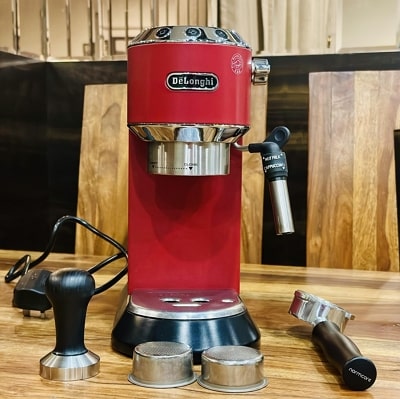
$248.85 on Amazon
Pricing varies by region and finish. Check Amazon for current bundles and colorways.
This selector updates the rating, pros/cons, score breakdown, and Amazon offer.
De’Longhi Dedica
Overview
The Dedica family spans the slim Style/Deluxe models through Arte and Duo, and up into the Maestro line. Pick your model above to see the matching rating, pros/cons, score breakdown, and Amazon offer.
Pros
Cons
Quick Specs
Design & Daily-Use Features
- Slim-footprint lineup with removable tank and easy-dump drip tray
- Volumetric programming on many models
- Selectable brew temperature levels (model-dependent)
- Assisted steaming approach; some variants are tuned for latte-art texture
- ESE pod compatibility on many variants
- Thermoblock system for fast readiness (blank shot recommended to heat group)
Espresso Quality & Temperature
Pressurized stock: easy crema and approachable flavor with broad grind tolerance; nuance is muted.
Unpressurized upgrade: add a proper 51 mm basket or bottomless portafilter and a capable grinder to improve sweetness, structure, and clarity.
Deals of the Week
Stability: warm the group/portafilter with a blank shot; keep your routine consistent for repeatability.
Milk Steaming Performance
Assisted wands make foam simpler; removing sleeves or using latte-art tips can help push texture finer on the right variants. Power suits small pitchers; larger volumes will tax recovery.
Tip: Pull espresso first, then steam. Finish with a short water burst through the group to settle temps back to brew mode.
Dial-In Guide
With stock pressurized baskets
- Use fresh coffee; grind slightly coarser than true espresso if your grinder struggles.
- Level tamp; the basket supplies backpressure.
- Program your shot volume to match your cup and taste.
With unpressurized baskets
- Invest in an espresso-capable grinder; dose and yield by weight if you can.
- Target a balanced 1:2-ish ratio and adjust by taste.
- Keep warm-up consistent (blank shot, hot cup, warm portafilter).
Comparisons (Same Footprint Class)
- Breville Bambino / Plus: often stronger steam and faster routine. Dedica wins on width and broad accessory ecosystem.
- Gaggia Classic Pro: bigger, more traditional 58 mm path and stronger steam, but less compact-first.
- Other 51 mm machines: Dedica usually wins on value and parts/accessory availability.
Maintenance Notes
- Daily: purge wand, wipe tip, rinse portafilter, empty drip tray.
- Weekly: clean baskets/screens; keep the shower area tidy.
- Periodic: descale per your water hardness and usage.
Who It’s For / Who Should Skip It
Buying & Setup Advice
- Budget for a grinder and, if you want the next step, a 51 mm non-pressurized basket/bottomless portafilter.
- Keep warm-up and dosing consistent before you judge taste.
- For milk drinks, learn one repeatable steam routine before chasing latte art.
De’Longhi built the Dedica EC685 for real kitchens: it’s slim, fast-heating, and forgiving. It’s a compact, thermoblock-style semi-automatic that prioritizes quick espresso drinks over endless tuning, with a small-format 51 mm portafilter ecosystem and beginner-friendly baskets that make it easier to get crema-forward results (even with pre-ground coffee).
On our bench, Dedica is best understood as a workflow machine. You’ll get the best results by keeping shots short and consistent, preheating your cup/portafilter, and treating milk drinks as the “easy win” lane. The ceiling is mostly set by inputs: if you want café-style espresso structure, you’ll need an espresso-capable grinder and (optionally) a non-pressurized basket—otherwise the machine is optimized for “good, fast, repeatable.”
Steam is designed for everyday convenience, not prosumer power. You can absolutely make satisfying cappuccinos and lattes, but consistent, silky microfoam depends on technique: purge the wand, start with cold milk, and keep milk volumes modest.
Buying lens: Dedica makes sense when space and simplicity are the priority. If your goal is maximum espresso ceiling per dollar (or you already know you want a full 58 mm ecosystem), cross-shop a higher-headroom platform and budget for the grinder from day one. For the full brand overview, start here: De’Longhi espresso machine hub.
Overview
The De’Longhi Dedica family is built around one idea: make espresso drinks in tiny kitchens without turning warm-up into a ritual. Across the lineup, you’re looking at fast thermoblock heat, compact footprints, and controls that aim for “weekday repeatable” more than “lab instrument precise.” On Coffeedant, we treat Dedica / Style / Deluxe (EC680 / EC685 / EC785) as the baseline, then explain how Arte (EC885), Duo (EC890), Maestro (EC900) and Maestro Plus (EC950) change the ownership experience.
The core “buying truth” is still basket + grinder. Many Dedica variants ship with pressurized baskets (and often an ESE pod basket), which makes drinkable espresso with a wide range of grinds. If you pair the machine with an espresso-capable grinder and move to a 51 mm non-pressurized basket (or a compatible bottomless portafilter), the cup can jump in sweetness, texture, and definition. That upgrade path is mostly aftermarket, not the factory default.
Design intent
- Small-counter champion: the classic Dedica / Arte / Duo models are built to stay slim and live permanently on tight counters. Maestro models are still “compact for the feature set,” but they’re not the same ultra-slim chassis.
- Fast readiness: thermoblock heating favors quick warm-up and convenience over boiler-style thermal mass.
- Repeatability over tinkering: the lineup leans on stored volumes/presets and straightforward controls so you can run the same routine daily.
- Milk ladder (by model): Dedica/Style/Deluxe typically go assisted foam; Arte and Maestro models aim for more manual microfoam control; Maestro Plus adds automatic milk help for people who want consistency with fewer reps.
- Hot + iced convenience (where relevant): Duo exists for people who split time between hot espresso drinks and café-style iced routines.
- 51 mm ecosystem: accessories are common, but fit can vary by ear/lug geometry and basket shape, so “51 mm” is a starting point, not a guarantee.
What it gets right in the cup and in cadence
- Fast daily rhythm: quick warm-up + clear controls keep mornings simple, especially if you don’t want a 20-minute preheat routine.
- Good repeatability: once you settle on a dose and a yield, Dedica machines can hit the same output with less fuss than most entry-level setups.
- Milk drinks are achievable: small pitchers, clean technique, and the “right wand for your model” is the formula. Some variants make latte-art texture more realistic, others prioritize “easy foam.”
- Small-space ergonomics: these machines are designed to work with limited clearance and limited counter depth.
- Upgrade runway: the Dedica family has a big aftermarket: baskets, bottomless portafilters, tampers, dosing funnels, puck screens.
The deliberate trade-offs
- Pressurized-basket ceiling: convenience baskets make early success easier, but they cap clarity and nuance once you start using fresher coffee.
- Thermoblock limitations: quick warm-up is the win; thermal inertia is the loss. Back-to-back service can expose drift if you rush steps.
- Steam is rarely “prosumer”: even the better-wand variants won’t feel like a big boiler machine when you’re doing multiple large milks in a row.
- Not the 58 mm world: 51 mm is workable, but it’s less universal for baskets/tampers than the standard prosumer ecosystem.
- More help can hide technique: the more automation you add (especially for milk), the faster the routine gets, but the less feedback you get while learning.
Where it fits
Treat the Dedica family as a size-first espresso platform with a big upgrade path. If you want the simplest, most compact entry point, start with the classic Dedica/Style/Deluxe. If milk texture matters most, Arte is the more milk-forward pick in the slim lineup. If you live in iced drinks, Duo is the “hot + cold” Dedica. If you want a more guided, step-up experience within De’Longhi’s manual world, Maestro and Maestro Plus are the higher-tier options, with Plus leaning into convenience for milk drinks.
Cross-shop context on Coffeedant: Dedica-family buyers commonly compare against compact thermoblock rivals for speed and steam performance, and against entry prosumer single-boilers when they want a more traditional 58 mm workflow and stronger milk cadence. If your priority is maximum cup quality, plan your grinder and basket choices early. That’s where the Dedica ceiling is decided.
This selector updates Specs, Build, What’s in the Box, Counter fit, and Testing notes. It will sync with your main Dedica product-box selector (if that element exists on the page).
Key De’Longhi Dedica Specifications Dedica
Specs below reflect the selected model. Regional bundles can change what’s included in the box.
| Item | Detail |
|---|---|
| Machine | De’Longhi Dedica |
| Model codes | EC680 / EC685 / EC785 |
| Machine type | Compact single-group manual pump espresso machine (thermoblock) |
| Heating system | Thermoblock |
| Pump pressure | 15 bar (rated) |
| Brew temperature control | Adjustable brewing temperature (Low / Medium / High) via settings menu |
| Programmable dosing | Yes (programmable cup volumes) |
| Baskets included | Pressurized single + pressurized double + ESE pod basket (bundle dependent) |
| Portafilter ecosystem | 51 mm ecosystem (classic Dedica fit) |
| Steam system | Assisted frother (Cappuccino system) for easy foam |
| Water tank | 1.1 L removable |
| Dimensions | 149 × 330 × 305 mm (W × D × H) |
| Weight | ~4.2 kg |
| Max cup height | Up to ~120 mm (tray removed for taller mugs) |
| Auto-off | 9 min / 30 min / 3 hours (settings menu) |
| Compatible coffee | Ground coffee + ESE pods (where basket included) |
| Warranty | Varies by region/retailer |
First Impressions & Build Quality Dedica
What’s in the Box Dedica
Chassis and internals Dedica
Controls and touch points Dedica
Counter fit Dedica
| Item | Detail | Why it matters |
|---|---|---|
| Dimensions | 149 × 330 × 305 mm | Slim footprint is the reason Dedica exists. |
| Weight | ~4.2 kg | Heavier is usually easier to lock-in without the machine sliding. |
| Water tank | 1.1 L removable | Enough for a few drinks, but expect drip tray maintenance on compact machines. |
| Max cup height | ~120 mm | Tray removal is the “tall mug” hack on slim Dedicas. |
| Portafilter ecosystem | 51 mm (classic Dedica fit) | Big aftermarket, but confirm ear/lug fit when you buy bottomless parts. |
| Power | ~1300 W | Thermoblock favors speed. Use a blank shot preheat for consistency. |
Testing Results Dedica
These are practical ownership expectations and workflow notes for the selected model.
| Metric | Result | Method / what to do |
|---|
Key takeaways Dedica
This element updates the espresso and milk playbook for the selected machine.
It will also sync with #cd-model-select and #cd-model-select-sticky if those exist on the page.
Dedica family performance map Dedica
Use this map to pick the right “lane” fast: basket strategy (forgiving vs pro) and milk approach (assisted vs manual vs automatic).
| Model | Espresso lane out of the box | Milk lane | What it’s best at | Biggest “gotcha” |
|---|---|---|---|---|
| Dedica EC680/EC685/EC785 |
Convenience-first via pressurized baskets. Upgrades unlock more clarity. | Assisted foam (easy cappuccino foam; sleeve-off improves texture with practice). | Small counter + fast routine + easy “good enough” espresso drinks. | Long yields go thin fast. Shorten yield before you chase more dose. |
| Dedica Arte EC885 |
Same Dedica-class brew core, often with a more modern basket kit. | Manual wand (My LatteArt) for better microfoam potential. | Milk texture practice in a slim footprint. | Still compact steam power. Small pitchers are the sweet spot. |
| Dedica Duo EC890 |
Recipe-led espresso with a Cold Brew option built in. | Manual wand (My LatteArt) with a more guided UI overall. | Hot + iced households that want the machine to guide the routine. | If you never use Cold Brew, you are paying for UI and presets. |
| Dedica Maestro EC900 |
Two-lane basket set (forgiving + brew-like-a-pro). More headroom without immediate aftermarket parts. | Manual pro-style wand for smoother milk when technique is steady. | Step-up Dedica experience with a more serious espresso path. | Portafilter/parts compatibility can differ from classic slim Dedicas. Confirm before buying upgrades. |
| Dedica Maestro Plus EC950 |
Maestro espresso lane + more temp management. | Automatic milk (Auto LatteArt) with texture and temperature targets. | Milk-drink homes that want repeatability with fewer reps. | Automation does not replace grinder quality. It just makes milk easier. |
Espresso Quality: getting the best out of the De’Longhi Dedica family Dedica
Session protocol that keeps results consistent
Flavor targets by coffee style
| Coffee | Baseline recipe (selected model) | What it tastes like when right | If too sour / thin | If too bitter / dry |
|---|
Dose, grind, yield, temperature: use them like tools
Diagnostics you can see and taste
| Signal | Likely cause | Targeted fix |
|---|
Keep variance low
Milk System: workflow, texture, and consistency Dedica
Milk controls and outcomes by model
| Wand / mode | Texture outcome | Best for | Notes |
|---|
Milk volume and real-world timing
| Drink size | Milk volume | Target drink | Typical steam time* | Tip |
|---|
*Timing varies with milk temperature, pitcher shape, and your wand style. Compact thermoblocks prefer smaller volumes.
Technique: clean milk that stays consistent
Texture targets by drink
| Drink | Best mode on selected model | Mouthfeel | Notes |
|---|
Keep milk performance sharp
Hardware Essentials Dedica
Heating and water system
Portafilter, baskets, and what changes with upgrades
Steam wand hardware
Quick facts for scanners
| Component | What you have (selected model) | Use note |
|---|
How to Use the De’Longhi Dedica family Dedica
Before your first brew (one-time setup)
Daily start (2 minutes)
Pulling espresso (your basket lane)
Steaming milk
Shut-down
Cleaning & Maintenance Dedica
Daily
Weekly
Periodic
De’Longhi Dedica EC685 vs The Field: Quick Matrix
| Match-up | Core difference | Best for | Jump to section | Model page |
|---|---|---|---|---|
| Dedica EC685 vs Breville Bambino | Narrow, budget-friendly thermoblock + pressurized-basket ease vs stronger out-of-box espresso workflow and steaming | Dedica for tiny counters/value; Bambino for better “start here” espresso + steam without mods | Open | Breville Bambino |
| Dedica EC685 vs Breville Bambino Plus | Manual steam + slim footprint vs auto milk convenience (Plus) and a more “hands-off” milk workflow | Dedica for compact/manual learning; Bambino Plus for milk-drink households that want automation | Open | Bambino Plus |
| Dedica EC685 vs Gaggia Classic Pro | Compact appliance-style thermoblock vs traditional 58 mm single-boiler platform with stronger “real espresso” headroom | Dedica for speed/space/ease; Classic Pro for enthusiasts who want classic espresso technique + upgrades | Open | Gaggia Classic Pro |
| Dedica EC685 vs Smeg ECF01 | Value + support ecosystem vs design-first aesthetics in the same 51 mm footprint lane | Dedica if you want the most machine for the money; Smeg if kitchen design is the priority | Open | Smeg ECF01 |
| Dedica EC685 vs De’Longhi Stilosa (EC260) | More features (programmable volumes, 3 temps) vs cheaper “basic” De’Longhi entry machine | Dedica for daily use convenience; Stilosa if you’re strictly optimizing for lowest buy-in cost | Open | De’Longhi Stilosa |
| Dedica EC685 vs Flair Neo Flex | Electric pump convenience vs manual lever control and maximum counter-space efficiency | Dedica for fast repeatable shots; Flair if you want manual control and don’t mind the ritual | Open | Flair Neo Flex |
De’Longhi Dedica EC685 vs Breville Bambino
This matchup is “tiny footprint + budget value” versus “best starter espresso workflow.” The Dedica wins on width and simplicity (and it’s very easy to live with), while the Bambino tends to win if you care about out-of-box espresso potential and milk steaming.
Core differences
- Counter fit: Dedica is notably narrower and easier to place in tight kitchens.
- Out-of-box ceiling: Bambino is often the easier “good espresso sooner” platform, especially if you move beyond pressurized baskets.
- Upgrade path: Dedica can level up with a non-pressurized 51 mm basket + real grinder, but it starts life in pressurized mode.
| Aspect | Dedica EC685 | Breville Bambino |
|---|---|---|
| Best fit | Small counters, value buyers, simple daily use | “Starter done right” espresso + better steam workflow |
| Strength | Very slim footprint; programmable volumes; 3 temp levels | Usually stronger espresso workflow + steaming for the price tier |
| Trade-off | Pressurized-first stock setup; modest steam power | Not as narrow; often costs more |
Who should choose which
- Pick Dedica if footprint and price are your top constraints and you’re happy to grow with technique.
- Pick Bambino if you want the most “good espresso fast” experience in this starter category.
De’Longhi Dedica EC685 vs Breville Bambino Plus
If you make milk drinks daily and want less technique, Bambino Plus is about convenience. The Dedica is the slimmer, cheaper machine that rewards hands-on control and simple routines.
Core differences
- Milk workflow: Bambino Plus leans toward automation; Dedica leans toward simple manual steaming.
- Value vs convenience: Dedica is the “do more with less” option; Plus is “pay to reduce friction.”
- Learning curve: Dedica teaches technique; Plus reduces the need for it.
| Aspect | Dedica EC685 | Bambino Plus |
|---|---|---|
| Best fit | Compact kitchens; hands-on milk learning | Milk-drink households that want convenience |
| Strength | Very narrow footprint; fast warm-up; simple controls | Convenience-focused milk routine; easier daily latte workflow |
| Trade-off | Modest steam power; Panarello is “training wheels” unless sleeve removed | Higher cost; larger footprint |
Who should choose which
- Pick Dedica if you want a compact machine and you’re okay learning milk technique.
- Pick Bambino Plus if you want milk convenience to be the point of purchase.
De’Longhi Dedica EC685 vs Gaggia Classic Pro
This is “compact appliance espresso” versus “traditional espresso machine.” The Classic Pro costs more and takes more space, but it’s a clearer route to classic espresso technique and stronger long-term tinkering. The Dedica is the slimmer, faster-warm-up machine that fits kitchens the Gaggia often can’t.
Core differences
- Platform: Dedica is a compact thermoblock; Classic Pro is a traditional single-boiler, 58 mm machine.
- Headroom: Classic Pro typically offers more “true espresso” tuning potential.
- Ownership style: Dedica is speed and simplicity; Gaggia is technique and upgrade culture.
| Aspect | Dedica EC685 | Gaggia Classic Pro |
|---|---|---|
| Best fit | Small-space, quick sessions, casual milk drinks | Enthusiasts who want classic espresso technique |
| Strength | Very compact; programmable volumes; easy daily routine | 58 mm ecosystem; clearer “traditional espresso” path |
| Trade-off | Pressurized-first stock setup; modest steam power | More space, more cost, more time/technique |
Who should choose which
- Pick Dedica if your kitchen and routine demand compact + fast.
- Pick Classic Pro if you want a more traditional espresso learning path and upgrade headroom.
De’Longhi Dedica EC685 vs Smeg ECF01
These two often live in the same kitchen-constrained, 51 mm ecosystem lane, but the buying reason differs: Dedica is a value/features play with a huge accessory ecosystem; Smeg is primarily a design appliance.
Core differences
- Value: Dedica typically offers more functionality per dollar.
- Aesthetics: Smeg is bought for look and brand vibe.
- Ownership: both benefit from good coffee + smart technique; Dedica has the broader “parts/accessories” ecosystem.
| Aspect | Dedica EC685 | Smeg ECF01 |
|---|---|---|
| Best fit | Value buyers and small-space espresso fans | Design-first kitchens |
| Strength | Slim footprint + programmable volumes + 3 temp levels | Aesthetic appeal and “statement” appliance identity |
| Trade-off | Not a prosumer platform; steam is modest | Often a premium paid for design rather than performance |
Who should choose which
- Pick Dedica if you’re optimizing for function and value.
- Pick Smeg if you’re optimizing for look and countertop aesthetics.
De’Longhi Dedica EC685 vs De’Longhi Stilosa (EC260)
If you’re staying in the De’Longhi ecosystem, this is the “spend a bit more to enjoy daily use” upgrade. The Dedica adds quality-of-life features (programmable volumes, 3 temperature levels, slimmer build), while Stilosa is the cheaper “basic espresso appliance” entry point.
Core differences
- Daily convenience: Dedica’s programming + temp settings make repeat shots easier.
- Budget: Stilosa exists to get you in at the lowest price.
- Buying logic: if you’ll use it often, Dedica is usually the smarter “live with it” pick.
| Aspect | Dedica EC685 | De’Longhi Stilosa |
|---|---|---|
| Best fit | Daily users who want repeatability and better ergonomics | Lowest-cost entry buyers |
| Strength | Programmable volumes + 3 brew temps + very slim footprint | Cheaper on-ramp to espresso drinks |
| Trade-off | Still entry-focused; best results require technique (and grinder upgrades for non-pressurized) | Fewer quality-of-life features; more “basic” experience |
Who should choose which
- Pick Dedica if you want the better daily ownership experience in De’Longhi’s entry lane.
- Pick Stilosa if your main requirement is “spend as little as possible.”
De’Longhi Dedica EC685 vs Flair Neo Flex
This is a “workflow preference” decision. The Dedica is fast and appliance-simple. The Flair Neo Flex is manual and compact, trading speed for hands-on control and portability.
Core differences
- Convenience: Dedica is push-button brewing with a steam wand.
- Manual control: Flair is lever-driven and can reward technique, but it’s a ritual.
- Milk: Dedica steams; Flair requires a separate milk frother if you want lattes/cappuccinos.
| Aspect | Dedica EC685 | Flair Neo Flex |
|---|---|---|
| Best fit | Fast daily espresso + simple milk drinks | Manual espresso hobbyists and ultra-small setups |
| Strength | Repeatable routine; steams milk; quick warm-up | Very small footprint; technique-forward control |
| Trade-off | Entry-machine limits; needs upgrades for best espresso clarity | No built-in steaming; slower and more hands-on |
Who should choose which
- Pick Dedica if you want speed, convenience, and integrated milk steaming.
- Pick Flair if you want manual control and don’t mind adding a separate milk solution.
How to use this matrix: If your priority is the smallest footprint and a simple daily routine, the Dedica is the value play. If your priority is “more traditional espresso headroom,” you’ll usually end up in the Gaggia/Breville lane (or beyond).
In-Depth Analysis
This block explains why the De’Longhi Dedica EC685 is such a common “first real espresso machine,” and why it can also frustrate people who expect café-style shots without upgrading anything. The headline is simple: Dedica wins on slim footprint, fast thermoblock warm-up, and easy pressurized-basket success, but its ceiling is set by the entry workflow: a 51 mm portafilter ecosystem, stock pressurized baskets, and a steam setup that’s great for quick cappuccinos but not a “power steam” prosumer experience. For the full brand overview, start here: De’Longhi espresso machine hub.
1) Why it’s so popular: tiny, fast, and forgiving
Dedica exists for real kitchens: limited counter space, limited patience, and a desire for espresso drinks that feel more “made” than drip coffee. It’s notably narrow (the “fits anywhere” vibe), warms up quickly thanks to thermoblock heating, and the pressurized baskets are designed to give you a crema-topped result even with pre-ground coffee or a basic grinder.
- What you feel: quick start, simple buttons, and repeatable morning drinks.
- What it changes: makes espresso drinks accessible without a full barista setup.
- What it doesn’t do: deliver café-level shot structure if the input coffee/grind is not on point.
2) The real trade-off: “pressurized success” vs “true dial-in headroom”
Stock Dedica is optimized for pressurized baskets. That’s why it works with supermarket espresso grinds and why beginners get “results fast.” The downside is the espresso tastes more like “strong espresso-style coffee” than syrupy café shots—until you move into a non-pressurized (single-wall) basket and pair it with a real espresso-capable grinder.
| Constraint | What it causes | How to work around it |
|---|---|---|
| Pressurized baskets (stock) | Easy crema + forgiving flow, but less clarity and less “café syrup” texture | Use fresh beans/pre-ground, keep doses consistent, and don’t chase ultra-long shots |
| Small basket ecosystem (51 mm) | Less space for dose and puck dynamics vs 58 mm prosumer platforms | Focus on repeatability: consistent puck prep + shorter ratios; upgrade basket/grinder if you want more |
| Thermoblock temperature behavior | Fast heat-up, but more sensitivity to workflow (cold portafilter/cup = cooler shots) | Preheat cup + portafilter with a brief hot-water run; pull a “warm-up” flush before the first shot |
| Entry steam lane | Great for quick foam; harder to get consistent microfoam without technique | Use cold milk, purge the wand, and consider a simpler steaming routine (smaller pitcher, smaller milk volume) |
3) Heat and consistency: why “preheat” matters more than settings
Dedica typically offers multiple temperature levels and programmable shot buttons, but temperature consistency still depends heavily on workflow. Small machines lose heat fast: a cold portafilter and cold cup can make shots taste thin, sour, or simply “not hot enough.”
- Preheat the cup: quick hot-water rinse → huge quality-of-life improvement.
- Warm the group/portafilter: run a short hot-water/blank cycle with the portafilter locked in.
- Pull tighter shots: long “lungo” pulls are the fastest route to hollow flavor on entry baskets.
4) Milk drinks: Dedica’s safest lane
If you drink cappuccinos, lattes, and iced milk drinks, Dedica’s strengths show up fast. The espresso doesn’t have to be perfect to make satisfying milk drinks, and the machine’s steaming approach is designed for everyday usability. The key is technique: purge the wand, start with cold milk, and don’t expect café microfoam instantly.
- Best-case: quick cappuccinos with reliable foam and low fuss.
- Common frustration: inconsistent texture when you rush steaming or don’t purge/clean the wand.
- Fix: smaller milk volumes and a short, repeatable routine beat “try harder” every morning.
5) Counter fit + ergonomics: why it’s a “small kitchen hero”
Dedica’s core identity is physical: it’s unusually narrow for a pump espresso machine and is easy to leave on the counter. It’s also more “appliance” than “tank,” so treat it like an appliance: keep water clean, descale on schedule, and don’t ignore leaks or gasket wear.
- Footprint (typical): ~5.9" W (very slim) with standard depth/height for the category.
- Clearance: removing the drip tray often helps fit taller cups.
- Usability: programmable single/double buttons make repeat shots easy.
6) Maintenance economics: small machine, big water truth
On machines like Dedica, water quality and descaling schedule matter more than “tuning.” If your water is hard and you postpone descale, performance and taste drift (and eventually reliability does too). Annual consumables costs vary widely, but the “right” spend is usually basic: descaler, a brush, and a clean routine.
| Cost / expectation | What to plan for | Why it matters |
|---|---|---|
| Descaling | As prompted / on a schedule (more often in hard-water homes) | Scale changes heat, flow, and can lead to pump/valve issues over time |
| Group gasket wear | Eventually replace if you see drips at the portafilter or poor sealing | A worn gasket causes leaks and inconsistent extraction |
| Milk wand hygiene | Wipe + purge immediately after steaming | Prevents clogs and keeps foam consistent |
| Best “upgrade” | Better grinder (if you go non-pressurized) | Grind quality is the main lever that changes espresso character |
7) The buying truth: what Dedica is (and what it isn’t)
Dedica EC685 is a compact, forgiving espresso appliance that makes espresso drinks achievable in real kitchens. It is not a plug-and-play café shot machine unless you also bring café-grade inputs (fresh beans + capable grinder + basket choice). If you accept that, it’s one of the best “small counter” buys in the category.
Editorial placement: put the “pressurized vs non-pressurized” truth near the top, include a short preheat workflow tip, and tie upgrades to grinder/basket before you talk about accessories.
De’Longhi Dedica EC685 - frequently asked questions
Fast answers to the questions people ask before they commit to a Dedica.
Is the Dedica EC685 a good first espresso machine?
Yes—especially if you need a small footprint and want quick, repeatable espresso drinks without turning it into a hobby. Stock Dedica is designed for pressurized baskets, so it’s forgiving with pre-ground coffee and basic grinders. If you want café-style espresso, plan to add an espresso-capable grinder and a non-pressurized basket later.
What’s the biggest limitation of the Dedica?
The main limitation is “espresso ceiling.” The stock setup is optimized for pressurized baskets and convenience, not for precision dialing like a more traditional espresso platform. You can absolutely make enjoyable drinks, but the jump to noticeably better espresso usually requires fresh beans, a better grinder, and a single-wall (non-pressurized) basket.
Do I need a grinder to use the Dedica?
You can start with pre-ground coffee (that’s part of the appeal), but a grinder is the best upgrade if you care about espresso quality. Pressurized baskets hide some grind problems; non-pressurized baskets require a real espresso-capable grind to avoid fast, weak shots.
Why does my espresso taste sour/thin or bitter/dry?
On Dedica, this is usually a combination of coffee freshness, shot volume, and temperature workflow. Sour/thin often means the shot is too cold or too fast; bitter/dry often means you’re over-pulling or using very dark coffee with too much contact time. Try: preheat cup + portafilter, keep shots tighter (don’t stretch into long lungos), and use fresher beans.
Can the Dedica make good milk drinks?
Yes—milk drinks are Dedica’s safest lane. Start with cold milk, purge the wand before and after steaming, and keep milk volumes modest. You can get smooth, café-style texture with practice, but don’t expect “prosumer steam power” from a slim entry machine.
Will a 58 mm tamper/portafilter fit?
No. Dedica uses a 51 mm ecosystem. If you’re buying accessories, match the size (tamper, baskets, portafilter parts) to 51 mm. If you want to live in a 58 mm world long-term, you’ll typically be happier on a 58 mm machine platform.
How often do I need to descale?
As often as your water demands. Hard water means more frequent descaling. If flow slows down, temperature feels inconsistent, or the machine prompts for descale, do it promptly. Descale is the difference between “works for years” and “mystery performance drift.”
Used & Refurbished Buyer’s Guide
A used De’Longhi Dedica EC685 can be a great deal, but entry machines hide condition in two places: scale (water circuit) and seals (group gasket + steam/hot-water paths). The good news: you can test most of the risk quickly with a few simple checks.
| Inspect | What to check | Pass criteria |
|---|---|---|
| Power-up | Turn it on, let it heat, run a hot-water cycle. | Heats normally, no error lights, water dispenses smoothly. |
| Pump + flow | Pull a shot (with coffee if possible). Listen for abnormal rattling and watch flow. | Consistent pump sound; not a weak dribble every time; no stalling. |
| Group head leaks | Run a shot and look for water leaking around the portafilter rim. | Dry rim during extraction (minor drips can indicate gasket wear). |
| Steam function | Switch to steam, purge, then steam water for a few seconds. | Steam engages without long delays; wand isn’t clogged; no weird sputter after purge. |
| Wand hygiene | Inspect the steam tip and wand for baked-on milk residue. | No sour smell; tip holes aren’t blocked; wand wipes clean easily. |
| Water tank + seals | Remove/reseat the tank, check for cracks and leaks at the valve area. | Tank seats cleanly; no wet base; no hairline cracks. |
| Buttons + programming | Test single/double buttons and re-program volume once. | Buttons respond immediately; volumes can be set and repeat consistently. |
| Scale evidence | Ask about water used + descale frequency; inspect for heavy mineral buildup. | Credible descale history; no heavy chalky residue; flow/steam not weak. |
| Accessories | Confirm portafilter, baskets, scoop/tamper, and any included filters are present. | Core parts included; missing baskets/portafilter should lower the price meaningfully. |
Refurb units often carry a shorter store-backed warranty than new (commonly 6–12 months). Confirm coverage on the pump/thermoblock and electronics—those are the expensive failures.
Accessories & Upgrades
Dedica is an upgrade-friendly platform—but the best upgrades follow a strict order: coffee freshness → grinder → basket choice → then workflow tools. Accessories without better grind quality won’t magically create café shots.
| Category | What to buy | Why it helps |
|---|---|---|
| Grinder (biggest upgrade) | Espresso-capable burr grinder (stepless or fine-stepped) | Transforms shot texture and consistency if you move beyond pressurized baskets |
| Basket path | 51 mm non-pressurized basket (single-wall), matched to your portafilter | Unlocks “real espresso” dialing—requires a capable grinder |
| Puck prep | 51 mm tamper + simple WDT tool | Reduces channeling and improves repeatability on non-pressurized baskets |
| Consistency tool | Small precision scale | Lets you control dose and beverage yield instead of guessing by button time |
| Milk workflow | Small milk pitcher (12–16 oz) + thermometer (optional) | Smaller volumes steam more predictably on entry steam power |
| Cleaning | Descaler + group brush + microfiber cloth | Keeps flow stable, prevents residue buildup, extends machine life |
| Water strategy | Filtered water routine (and hardness awareness) | Reduces scale load and keeps taste steadier |
Related: De’Longhi Dedica EC685 review
Known Issues & Troubleshooting
- Shot runs fast and tastes thin: common with stale coffee or too-coarse grinds. Use fresher coffee, reduce shot volume, and preheat portafilter/cup. If using a non-pressurized basket, grind finer (and expect to need a better grinder).
- Shot tastes sour: often “too cold” or under-extracted. Preheat aggressively, use the hotter temperature setting if available, and avoid long pauses between preheat and brewing.
- Shot tastes bitter/dry: often over-pulled or very dark coffee at too long a volume. Shorten the shot, reduce brew time/volume, and consider a slightly cooler temp setting for very dark roasts.
- Portafilter leaks at the rim: likely a worn/dirty group gasket or improper lock-in. Clean the gasket area; if it persists, replace the gasket.
- Steam is weak or sputters: purge first, descale if scale is suspected, and ensure the tip holes aren’t clogged. Small machines also struggle with large milk volumes—steam smaller pitchers for better results.
- Milk texture is too bubbly: purge + wipe the wand, keep milk very cold, and don’t “inject air” for too long. Consistent routine beats random adjustments.
- Flow slows over time: descale on schedule. Scale is the silent killer of thermoblock machines.
Conclusion: Should You Buy the De’Longhi Dedica EC685?
Who it’s for
- Small kitchens that need a genuinely slim espresso machine.
- Beginners who want forgiving results with pressurized baskets and/or pre-ground coffee.
- Milk-drink households that want quick cappuccinos and lattes without a complex workflow.
- People who like “upgrade optional”: you can start simple and level up later with a grinder + basket.
- Anyone who values fast warm-up and a straightforward daily routine.
Who should avoid it
- Espresso purists expecting café-level shots with no upgrades or technique.
- Buyers who want a 58 mm ecosystem and maximum accessory compatibility.
- Heavy back-to-back milk drinkers who need stronger, more consistent steam power.
- People who dislike workflow steps (preheat, dosing consistency) but still want “great espresso.”
- Anyone who plans to buy a grinder anyway and would rather start on a higher-ceiling platform.
We’ve categorized the best espresso machines for every kind of buyer
Find the right shortlist faster, whether you want convenience, a beginner-friendly setup, a smaller footprint, or better value at a given budget.
Best Superautomatic Espresso Machines
One-touch picks for speed and convenience.
Best Espresso Machines for Beginners
Easy-to-use machines with a smoother learning curve.
Best Small Espresso Machines
Compact machines for tighter kitchens and counters.
Best Espresso Machines With Built-In Grinder
All-in-one options with fewer extra pieces to buy.
Best Cheap Espresso Machines Under $500
Budget picks that still make sense for real espresso.
Best Prosumer Espresso Machines Under $1000
More serious machines with stronger value for the money.
Best Single Boiler Espresso Machines
Simple, space-saving picks for espresso-first routines.