
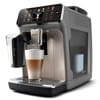

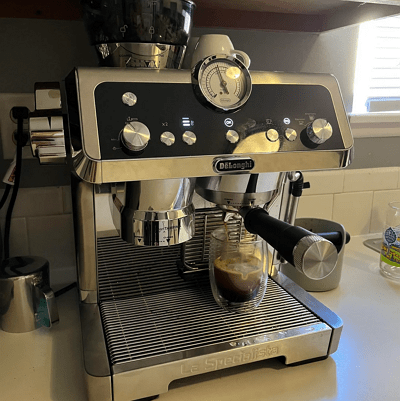
De’Longhi La Specialista Prestigio
Model – EC9355M
Assisted tamping, dual heaters and dynamic pre-infusion that make consistency feel automatic.
De’Longhi La Specialista Prestigio — scores and quick fit
Score breakdown
Overall score: 8.4 / 10Description in plain terms
Prestigio is an assisted manual platform that removes three early mistakes: dosing, tamping and brew temperature choice. It adds dynamic pre-infusion and a true dual-heating layout so you can brew and steam in stride. The 8-step grinder is the main limit for very light roasts. For most homes it delivers steadier espresso and reliable milk texture with a simple routine.
Who it is for
- New and intermediate home baristas who want fewer variables to manage
- Milk-drink households that need quick, consistent steam
- Buyers who want one box with a grinder, hot-water delivery and clear controls
Who should avoid it
- Light-roast purists who need half-step grinder micro-adjustment
- Tinkerers who want a 58 mm ecosystem and heavy modding
- Users who want a screen full of recipes and automation
Main features
- Dual heating: dedicated brew thermoblock plus a separate steam heater
- Dynamic pre-infusion and three brew-temperature selections
- Integrated conical grinder with 8 macro steps and sensor-assisted dosing
- Smart Tamping Station lever for consistent, clean tamping
- 51 mm portafilter with single-wall baskets
- 2.0 L tank, 1450 W, rated 19 bar pump
Pros
- Dual heating gives fast brew-to-steam transitions
- Smart Tamping Station improves puck consistency and keeps counters clean
- Dynamic pre-infusion and three temperatures add real taste control
- Integrated grinder with sensor-based dosing
- Simple panel and dedicated hot-water path
Cons
- Only 8 grinder steps; dose nudges often needed for light roasts
- 51 mm format is narrower for upgrades than 58 mm
- Thermoblock brew path lacks the thermal mass of prosumer groups
La Specialista Prestigio is De’Longhi’s “assisted manual” sweet spot. It blends a real conical burr grinder, a lever-driven tamping station, dynamic pre-infusion, three brew-temperature settings, and a true dual-heating layout that lets you brew and steam in stride.
It is not a café machine and it does not need to be. What it does is remove three of the most error-prone moves for new baristas: dosing, tamping, and temperature guesswork. The result is steadier extractions, fewer sink shots, and milk texture that improves week over week.
Official documentation confirms the 2 liter tank, 1450 W power, 8 grind steps, 3 temperature profiles, and the dual brew-and-steam heaters that power the workflow.
At a glance
- Architecture. Brew thermoblock with its own sensor and a separate steam heater, controlled by solenoids for coffee, hot water, and steam. This is a dual-heating system, not a single block that flips jobs.
- Controls. Espresso, Coffee, and Americano or Long Black by region, plus a “MY” program button for custom volumes. Three temperature selections and a pressure gauge on the face.
- Grinder. Integrated conical burrs with 8 macro steps and De’Longhi’s Sensor Grinding tech that keeps dose consistent as you change the amount.
- Tamping. Smart Tamping Station. You dock the loaded portafilter and pull a lever. The machine delivers a consistent tamp without mess.
- Pre-infusion. Dynamic pre-infusion that adapts wetting time to grind and dose density for a calmer start to the shot.
- Water, size, power. 2.0 L tank, 380 × 370 × 445 mm with hopper, rated 1450 W, 19 bar pump spec. Weight is typically listed at about 13.5 kg.
- Portafilter. 51 mm with single-wall baskets. Aftermarket 51 mm bottomless options exist for the entire La Specialista line.
- Typical price checks, late 2025. US listings vary from roughly 750 to 900 dollars depending on seller and stock. UK historical deal trackers show £430 to £700 swings, with most reputable retailers sitting between £500 and £650 when in stock. Canada often lands just under 1,100 CAD. Expect seasonal promos.
Glanceable specs
- Dual heating: dedicated brew thermoblock plus a separate steam heater
- Dynamic pre-infusion and Active Temperature Control with three brew settings
- Built-in grinder with 8 steps and bean-level sensors
- Smart Tamping Station lever
- 51 mm portafilter with single-wall baskets
- 2.0 L water tank, 1450 W, 19 bar pump, 380 × 370 × 445 mm, about 13.5 kg
Build and design
Chassis and footprint
Prestigio fits on real counters. The case is stainless with black accents, the hopper is low enough to clear standard cabinets, and the controls are physical dials and buttons instead of a screen maze. The gauge gives at-a-glance feedback, and the cup area has two levels so you can park a demitasse low or slip a taller mug under the hot-water spout. De’Longhi’s spec pages and multiple retailer listings align on the 380 mm width, 370 mm depth, and 445 mm height with hopper attached, plus a 2 liter tank and 1450 W input. The pump is rated at 19 bar, which is standard for this class.
Under the hood
The service manual is unusually transparent. It shows separate heating elements for brew and steam, each with its own probe and safety fuse. Coffee flow is handled by a dedicated solenoid that opens to the thermoblock during extraction, while a different valve manages the hot-water spout. A third solenoid directs steam to the wand and dumps pressure to an expansion chamber when you close up. That layout is why you can move from shots to milk with minimal waiting and why recovery feels quick for a consumer chassis.
Smart tamping done sensibly
The tamp station is not a gimmick. You lock the portafilter into the grinding throat, pull the side lever, and the puck lands flat and consistent. It keeps counters clean and pressures your technique to be repeatable. If you want to chase a distribution tool later, the system still plays nicely with 51 mm accessories.
Fit and finish
Controls have clear detents, the bean lid seals correctly, and the drip tray is generous. The only common complaint I see is that the plastic grind slider looks light compared to metal dials, though performance holds up in practice. If you want pure metal tactility, you are shopping in a different price band.
Workflow
Warm-up and prep
Thermoblocks reach temp quickly, but you still need to heat-soak the metal mass that touches coffee. Lock the portafilter during warm-up, purge a one-second rinse before your first shot, and you are good. Dual heating means you can steam without long flip-flop delays. The manual describes separate coffee and steam sequences, then shows how the machine purges and resets without user gymnastics.
Grinding and dosing
Sensor Grinding tech keeps the dose stable across grind changes. You still set the macro step on the hopper and the dose amount on the front dial. Eight steps is a short ladder, so make dose your fine adjuster at first. For a medium roast, start around the middle grind setting with the dose dial pointing up, then trim dose rather than bouncing a full step. De’Longhi’s product page confirms the 8-step range and dosing-sensor logic.
Smart Tamping Station rhythm
Grind straight into the basket through the chute. Tap gently to settle if you need it, then pull the lever once for a firm, even press. The tamping light and the “tamp now” icon help new users stick to a sequence. This lever keeps your angle honest and your bench cleaner than an open funnel. The user manual describes the dock-and-press sequence and the cleaning routine for the tamp throat.
Temperature selection
Three brew-temperature settings change how forgiving the machine feels across roasts. As a starting point, leave it in the middle for house blends, go hot for dense light roasts, and drop to cool for dark roasts that taste sharp when you push them. The service material lists test temperatures of about 84, 86, and 88 Celsius measured at the spouts after warmup sequences, which maps to sensible cup temps for a small thermoblock.
Dynamic pre-infusion
Pre-infusion is automatic and time-variable. The system wets the puck based on density and grind, which softens the first seconds, reduces channeling from tiny distribution misses, and steadies pressure ramps. It is not a modder’s pre-infusion menu. It is a practical safety net tied to the way most owners will use the machine. De’Longhi’s tech notes describe this behavior clearly.
Everyday recipes
Start with 17 to 18 g in the double basket, 34 to 36 g out, and 27 to 32 seconds from pump on. If you run fast at the finest step, add one gram of dose before you consider materials that are not included. If you run slow at a coarser step, pull the dose down a gram and retest. Use the “MY” button to store your output for a primary bean. The manual shows a straightforward path to programming espresso, coffee, and Americano volumes, with Long Black replacing Americano on Australian stock.
Espresso performance
Consistency over raw power
A small thermoblock cannot mimic a saturated group, but that is not the brief here. The combination of assisted dosing, lever tamping, and dynamic pre-infusion gives you more good extractions per bag. Shots settle into a syrupy line with fewer early spurts once you respect distribution, and crema holds well on medium roasts. The pressure gauge is a training wheel. Treat it as feedback, not a target, and judge with the scale and stream.
Light-roast reality
Light roasts demand fine control. Eight grinder steps means you sometimes straddle perfect. The fixes are small dose moves, careful tamp, and the hot temperature profile. If light Nordic roasts are your daily drink, you will prefer a separate grinder with finer micro-adjustment. If you buy more medium roasts than not, the built-in grinder and tamp station do reliable work. De’Longhi’s literature confirms the step count and temperature selections you are working with.
Americano vs Long Black
The service manual exposes a small regional quirk. Outside Australia you will see Americano as a coffee-then-water sequence. Australian units show Long Black as water-then-coffee. It is a small difference that matters to taste and crema. If you like Long Black but your panel only shows Americano, you can replicate the sequence manually.
Milk steaming
Power and control
The steam circuit has its own heater pack. That is why steam comes up quickly after coffee and why recovery feels snappy for this size. With a 12 ounce pitcher, you stretch for a few seconds, then ride the roll to temperature. The service documentation lists a 1,070 W steam assembly split across two elements, plus a steam solenoid that dumps residual pressure cleanly at close. It reads like a scaled-down commercial logic and behaves that way on the bar.
Texture
The “My Latte Art” wand is manual. It will teach you. Purge, find the paper-tearing hiss for the first five to seven seconds, then drop the tip under the surface and watch the whirlpool form. Glossy microfoam is attainable with practice, and the included pitcher is the right size for the wand’s output. De’Longhi’s product page calls out the wand as a latte art tool rather than an auto-frother. That is the right call for learning and control.
Americano and tea service
Hot water delivery has its own button and its own solenoid path. That keeps the workflow simple when you need an Americano or preheat water for pourover. The manual’s flow charts make the path clear.
Maintenance and reliability
Daily loop
Purge and wipe the wand after each drink. Rinse baskets and knock pucks promptly. Keep the chute and the tamp throat clean, especially with oily dark roasts. De’Longhi’s support pages organize short videos on menu settings, grinder cleaning, and basic hygiene, which is rare at this price.
Descale cadence
Program your local water hardness so the descale reminder triggers on a realistic schedule. The service manual provides a clear table showing how hardness and your mix of coffee, hot water, and steam accelerate the counter. If you steam a lot, you will reach a descale sooner than pure espresso users. Use an aluminum-safe descaler and follow the guided cycle.
Parts and accessories
Because the line uses 51 mm, you can buy bottomless portafilters, precision baskets, and tampers sized for La Specialista without guessing. Third-party options are common. If you later step up to a prosumer 58 mm machine, you will need new tools, but for this platform the 51 mm ecosystem is fine.
What fails and what does not
The brew and steam heaters are protected by thermal fuses, sensors, and firmware. Solenoids are standard parts. Keep scale out and kills drop. The grind slider’s plastic feel is often discussed, but performance holds. If you treat the machine like an appliance instead of a modding canvas, it will repay you with stability.
Programming and controls
Temperature
Tap the temperature button to cycle low, medium, and high profiles. The service test spec shows an incremental rise of roughly two degrees Celsius per step at the spouts once the path is heat-soaked. Use that knowledge to land sweetness without chasing timing alone.
Brew volumes
You can program espresso, coffee, and Americano volumes, and you can store a personal favorite on the “MY” button. The manual’s table shows default targets and adjustable ranges for espresso and the water component in Americanos or Long Blacks. If you pour a specific recipe every morning, commit it and move on.
Grinder and dose
Eight macro steps with a front-panel dose dial are simple enough for a household and structured enough for repeatability. If you hit a coffee that wants a half-step, nudge dose by a gram before you consider swapping baskets. De’Longhi’s official spec lists the grind settings and confirms the sensor-assisted dosing logic.
Competitive comparisons
Breville/Sage Barista Express Impress
Express Impress automates dosing and tamping with a spring-loaded arm and gives more grind steps than Prestigio. It is fast for beginners and tidy for small kitchens. Prestigio answers with dynamic pre-infusion, a manual latte art wand that feels closer to café behavior, and a dual-heating layout that keeps the line moving. If you want more handholding at grind and tamp, go Impress. If you want a steadier pre-infusion and a manual wand that teaches real control, stay here.
Breville/Sage Barista Pro
Barista Pro heats fast and has finer grinder adjustment. Its screen UI is clear, and shot timing is right on the face. Prestigio’s tamp station and dynamic pre-infusion make up ground on consistency, and its steam heater keeps milk service calm. If light roasts are your life, Pro’s grinder range helps. If you value assisted tamping and a quiet, repeatable routine, Prestigio is a simpler place to live.
De’Longhi La Specialista Arte
Specialista Arte is the minimal sibling. One brew heater, manual wand, three temperatures, and a tidy barista kit. It costs less and teaches fundamentals. Prestigio upgrades you to the tamp station, dynamic pre-infusion, and a separate steam heater. If your mornings are milk-forward, the dual-heating advantage is obvious after day one.
De’Longhi La Specialista Maestro
Specialista Maestro layers on more automation and recipes. It keeps dynamic pre-infusion and expands the experience with higher-end trim and programs. If you want more drinks on buttons, Maestro is the flagship. If you want an assisted manual that focuses on core espresso and milk with fewer distractions, Prestigio is the right balance.
Real-world numbers and notes
- 2.0 L tank, 380 × 370 × 445 mm, 1450 W, 19 bar rated pump, about 13.5 kg.
- Dual heaters: brew thermoblock with 1300 W element and separate steam assembly at 1070 W (2 × 535 W).
- Three brew-temperature settings with verified test targets near 84, 86, and 88 Celsius at the spouts after warmup cycles.
- Dynamic pre-infusion adapts wetting to puck density; Smart Tamping Station provides lever-assisted tamp.
- 8 grind steps with bean-level sensing to stabilize dosing.
- Region note: Americano on most markets; Long Black sequence on Australian units.
Strengths
- Dual heating that behaves like two jobs at once. Brew and steam without the long pause that plagues single-block designs.
- Smart Tamping Station. Cleaner bench, steadier pucks, and less beginner variability.
- Dynamic pre-infusion and three brew temperatures. Real levers for taste without a complex menu.
- Integrated grinder with sensors. Predictable dosing and a short path from beans to puck.
- Honest ergonomics. Simple panel, dedicated hot-water path, and a manual wand that teaches microfoam.
Trade-offs
- Eight grinder steps. You will sometimes want a half-click, especially on light roasts.
- 51 mm format. Fully supported, but not as open as 58 mm for baskets and accessories.
- Thermoblock brew path. Fast and stable enough for its class, but not the thermal mass of a prosumer E61 or saturated group.
Scores
- Build quality: 8.4
- Temperature stability: 8.0
- Shot consistency: 8.2
- Steaming power: 8.4
- Workflow and ergonomics: 9.0
- Maintenance and serviceability: 8.3
- Value: 8.4
Overall: 8.4
Verdict
Prestigio sits in the lane a lot of people actually need. It respects craft but trims the busywork. You grind with a short, sensible ladder. You tamp with a lever that keeps your angle honest and your counter clean. You pick a temperature profile that suits the roast. The machine handles wetting logic and moves from shot to steam without drama because the heaters split the workload. The result is a simple routine that yields more consistent espresso and steady milk texture for small households.
If you plan to live on light roasts and want micro-adjustment to the half-click, a separate grinder with finer steps will make you happier. If you want a screen full of drinks, Maestro or a super-automatic lives down that aisle. For the majority who want a hands-on espresso machine that removes the first three booby traps and still lets you learn, Prestigio earns its space and pulls its weight. On price, keep an eye on seasonal promos. Historic ranges show real swings by market and month, which makes this platform an even better deal when you time it.
TL;DR
De’Longhi La Specialista Prestigio is an assisted manual espresso machine with dual heating, dynamic pre-infusion, three brew-temperature settings, an 8-step integrated grinder with sensors, and a lever-driven tamp station. It uses a 51 mm portafilter and a 2 liter tank in a 380 × 370 × 445 mm chassis at 1450 W. It is built for clean, repeatable workflow and steady milk service. The main limitation is the grinder’s coarse step ladder for very light roasts. Shop around, because prices swing hard by region and season.
Pros
- Dual heating with quick brew-to-steam transitions
- Smart Tamping Station for consistent pucks and cleaner counters
- Dynamic pre-infusion plus three temperature settings for taste control
- Integrated grinder with sensor-based dosing
- Simple interface and dedicated hot-water delivery
Cons
- Only 8 grinder steps
- 51 mm ecosystem is narrower than 58 mm for upgrades
- Thermoblock brew path lacks the heft of prosumer groups
Who it is for
- New and intermediate home baristas who want fewer variables to manage while they learn
- Milk-drink lovers who value fast, consistent steam and a manual wand
- Households that want one box with a grinder and clear controls rather than a dozen apps and modes
- Buyers who care about repeatability more than modding or tinkering
De’Longhi La Specialista Prestigio — FAQ
Is it truly dual heating or one block doing two jobs?
Prestigio has a dedicated brew thermoblock and a separate steam heater with their own sensors and controls. That is why you can move from shots to milk with minimal waiting.
Does Smart Tamping replace technique?
It removes angle and pressure variability so pucks are flat and repeatable. You still need sensible distribution and to keep the tamp throat clean.
How do I set grind and dose on day one?
Start mid-range on the 8-step grinder with the dose dial at center. Aim for 17–18 g in, 34–36 g out in 27–32 seconds. If you are between steps, nudge dose by 1 g before changing a full step.
Can it handle light roasts well?
Yes with the hot temperature profile, careful tamp and small dose moves. If you live on very light roasts and want half-step control, use a separate grinder with finer micro-adjustment.
Is pre-infusion adjustable?
Pre-infusion is dynamic and automatic. The machine adapts wetting to puck density and grind. There is no user menu for timing.
How strong is the steam for latte art?
The steam circuit has its own heater so recovery is quick. With a 12 oz pitcher, stretch for a few seconds then ride the roll. Glossy microfoam is attainable with practice.
Americano vs Long Black on this machine?
Most regions show Americano which is coffee then water. Australian units show Long Black which is water then coffee. If you prefer Long Black and your panel shows Americano, run hot water first then pull the shot.
What portafilter size and accessories fit?
It uses a 51 mm portafilter with single-wall baskets. 51 mm bottomless portafilters and precision baskets for La Specialista are widely available.
How should I pick the brew-temperature setting?
Use the middle setting for most medium roasts, high for dense light roasts and low for dark roasts that taste sharp at higher temps.
What is the maintenance and descale cadence?
Program local water hardness so reminders are realistic. Purge and wipe the wand after use, rinse baskets, and keep the grind chute and tamp throat clean. Use an aluminum-safe descaler and follow the guided cycle when prompted.