

US: typically $899–$1,049 • EU/UK: often €700–€900 (stock & promos vary).
ECM Casa V
A compact stainless single boiler that heats fast, lets you set brew pressure via an easy-access OPV, and delivers classic shots—no screens, just solid mechanics.
Overview
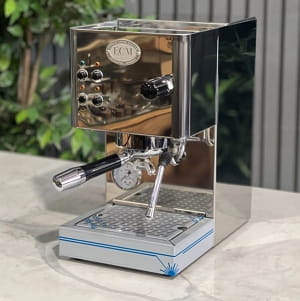
Casa V keeps it classic: 0.4 L insulated brass boiler, ring brew group, front pump gauge, and an adjustable OPV reachable under the cup tray. Brew-ready in ~5–7 min, steam in ~1 min. No PID, no timer, and the wand doubles as hot water—perfect if you prefer a mechanical, repeatable routine over menus.
Pros
- Compact stainless chassis with insulated brass boiler
- Front gauge + easy-access OPV for DIY brew-pressure set
- Quick warm-up; steam ready about a minute after switch
- 58 mm ecosystem for baskets and tools
- Big 2.8 L tank in a narrow case
Cons
- No PID or shot timer (thermostat surfing needed)
- Shared wand for steam & hot water—no separate spout
- Single boiler pace for multiple milk drinks
- Some listings show 0.3 L boiler; most are 0.4 L
Features & Specs
- Type: Single boiler, dual use
- Boiler: ~0.4 L brass, insulated (some listings show 0.3 L)
- Group: Ring group • 58 mm portafilter
- Pump: Vibration • front pump-pressure gauge
- Pressure control: Adjustable OPV under cup tray
- Tank: ~2.8 L removable (top-fill)
- Wand: Multidirectional; also dispenses hot water
- Power: ~1200 W (region dependent)
- Heat-up: Brew-ready ~5–7 min • Steam ~1 min
- Size/Weight: 210 W × 370 D × 380 H mm • ~14 kg
Workflow & Dial-In
- Warm-up: Park the portafilter in the group; run a short blank flush before the first shot.
- Surfing: No PID—pull at a consistent point in the thermostat cycle after a brief rinse.
- OPV set: Use a blind basket and the front gauge; cap start-of-shot around 9–10 bar, then leave it.
- Brew-to-steam: Brew first, switch to steam, purge, texture; then cool back to brew with a short flush.
- Starting recipe: 18 g in → 36 g out in 25–30 s; adjust grind before anything else.
Steaming & Hot Water
Expect calm, dry steam suitable for a 150–200 ml pitcher. Purge after the steam light, add air for a few seconds, then roll to finish. Open the same wand valve in brew mode for hot water (Americanos/rinses).
Maintenance & Water
- Daily: Water backflush at session end; wipe & purge wand every use.
- Weekly: Detergent backflush (3-way valve equipped).
- Scale: Use soft/filtered water; descale on a schedule matched to your water.
Comparisons
- Profitec GO: Adds PID + shot timer; better if you want numeric control.
- Bezzera Hobby: Punchy single boiler; Casa V offers larger 0.4 L boiler and very tidy footprint.
- Rancilio Silvia V6: Heavier, longer warm-up; Casa V heats faster and has easy-access OPV.
- Gaggia Classic Pro: Budget workhorse/mod platform; Casa V is more refined stock.
- Ascaso Steel UNO PID: Thermoblock + PID; faster to temperature, different feel/maintenance.
Pricing & Availability (Nov 2025)
- United States: often under $1,000; some listings ~$1,049.
- EU/UK: broadly €700–€900 (region & promos vary).
- Note: sold in both 110 V and 230 V—confirm voltage/plug.
FAQs
- PID?
- No. Casa V is thermostat-controlled; surf for consistency.
- Shot timer?
- No—use a scale/timer or smartphone.
- OPV access?
- Yes—under the cup tray; set with a blind basket + front gauge.
- Hot water?
- Via the steam wand in brew mode (shared wand).
Takeaway
The ECM Casa V is a compact, stainless single boiler that does the fundamentals well. You get a ring brew group, a 0.4 liter brass boiler with insulation, a front pump-pressure gauge, and easy access to the expansion valve so you can set brew pressure yourself. Warm-up is quick for a boiler machine. Steam is ready in about a minute. There is no PID, no shot timer, and no separate hot-water tap, though the wand doubles for hot water. If you want a simple, durable machine that fits small kitchens and you like hands-on control rather than menus, the Casa V is worth a serious look. The core configuration and quick warm-up claims are documented by ECM and leading retailers.
At-a-Glance Specs
- Type: Single boiler, dual use
- Boiler: Approx. 0.4 liter brass, insulated
- Group: Ring brew group, 58 mm portafilter
- Pump: Vibration pump with front pump-pressure gauge
- Pressure control: Adjustable expansion valve under the cup tray
- Water tank: Approx. 2.8 liters, removable
- Wand: Multi-directional steam wand that also dispenses hot water
- Power: About 1200 W depending on market
- Heat-up: Brew-ready in around 5 to 7 minutes, steam in about 1 minute
- Size and weight: 210 W x 370 D x 380 H mm, about 14 kg
These details are pulled from ECM’s product overview and multiple retailer spec sheets. Note a minority of listings quote a 0.3 liter boiler; ECM’s own materials and most retailers state 0.4 liter.
Price and Availability
- United States: commonly positioned under 1000 dollars at major shops. Examples include Whole Latte Love marketing it as best-in-class under 1000 dollars, while some stores list at 1049 dollars when in stock. Expect periodic promos and bundles.
- United Kingdom and EU: widely available through specialty retailers, often between 700 and 900 euros or near 895 euros in Scandinavia when in stock. Retail pricing varies with currency and sales cycles.
If you are buying outside the EU or US, confirm voltage and plug type. The Casa V is sold in both 110 V and 230 V versions.
Build
Materials and layout
This is ECM’s smallest machine and it looks and feels like the rest of the line. The case is polished stainless steel. The brew circuit centers on a compact brass boiler with insulation and a ring brew group that warms quickly. A front manometer shows pump pressure during extraction. The wand is on a ball joint and handles both steam and hot water. The water tank slides out from the top and holds roughly 2.8 liters. These hardware choices are consistent across the official overview and several detailed spec pages.
The footprint is small: 210 mm wide, 370 mm deep, 380 mm tall. Mass around 14 kg keeps the machine planted when you lock in a 58 mm portafilter. If you are working under cabinets, the top-fill reservoir is convenient, and the cup area is still usable for preheating.
Controls and interface
The Casa V keeps the interface simple. Power, brew, and steam are controlled by dedicated buttons and indicator lights. The rotary knob on the right manages steam and hot water through the same wand. This layout is as straightforward as it sounds and is documented in the user manuals from ECM’s resellers and support partners.
Pressure gauge and expansion valve
The front gauge reads pump pressure. The over-pressure valve is reachable without opening the chassis, tucked under the cup tray. That means you can set a sensible brew-pressure ceiling against a blind basket and never touch it again. Several retailers call out this adjustability and show its location.
Workflow
Warm-up
A ring group and a small insulated brass boiler are a fast combination for a boiler-based machine. ECM and retailers quote roughly five to seven minutes to brew-ready. Give the portafilter time to heat by parking it in the group, then run a brief blank flush before your first shot. Steam is ready in about a minute when you switch to steam. The warm-up and steam timing claims appear consistently across spec pages and manuals.
Temperature management without PID
Casa V does not have PID control. ECM’s home-line matrix confirms no PID on this model. You will use a simple cadence to land your brew temperature in a repeatable zone. The routine is uncomplicated. After warm-up, run a short rinse to settle the group and to wake the thermostat. Pull the shot as the machine cycles, then keep your time between shots steady. This is standard practice on non-PID single boilers.
Brew-to-steam sequencing
You brew first, then switch to steam. Wait for the steam-ready light, purge the wand, and texture your milk. After steaming, drop back to brew by dispensing a short burst of hot water and running a small cooling flush so the boiler returns to brew temperatures faster. ECM’s manuals and retailer guides describe the steam sequence and the boiler behavior in plain steps.
Hot water
There is no separate hot-water tap. The wand is shared. Opening the valve in brew mode dispenses hot water from the boiler. Several support pages walk through using the wand for hot water and for filling and rinsing procedures.
Espresso Performance
Puck prep and baskets
Casa V ships with a 58 mm portafilter and standard single and double baskets. The 58 mm ecosystem makes it easy to upgrade to a precision basket and a proper tamper. The ring group locks in cleanly and gives you honest mechanical feedback. Once heat-soaked, the group keeps up with back-to-back shots if your cadence is steady. Retailers list the 58 mm format and the included accessories.
Pressure and flow
Set the expansion valve once. A blind basket and the front gauge make this easy. Target around nine to ten bar on the gauge at the start of the pump cycle. Once you are in that window, leave the valve alone. Time and yield will tell you what the puck is doing. ECM’s product matrix and retailer pages confirm the OPV access and the presence of the pump gauge.
Temperature behavior
Without a PID you are riding the thermostat cycle. That is not a problem if you use a consistent routine. A short pre-shot rinse stabilizes the dispersion path. Pulling at a consistent point in the cycle keeps shots in the same zone. On medium roasts, start around a traditional 18 g in with 36 g out in 25 to 30 seconds and adjust grind before you change anything else. On medium-light roasts, a slightly longer ratio and a gentle first second on the pump can calm flow and preserve sweetness. ECM and retailers emphasize quick warm-up and a small insulated boiler, which is the combination that makes a simple cadence work.
In the cup
With clean puck prep and the OPV set sensibly, Casa V produces classic, syrupy extractions on medium roasts and reveals citrus and florals on medium-light espresso roasts. The ring group keeps heat in the metal and the brass boiler’s thermal mass smooths out small variations during the shot. You will not have a number on a screen, but you will have a consistent process that produces repeatable shots once dialed. The gauge helps you see if puck resistance is in a healthy band. The official and retailer descriptions align with this behavior.
Milk Steaming
Power and pace
For a 0.4 liter boiler, Casa V has respectable steam. Retailers quote about a minute from brew to stable steam. The wand is articulated and easy to position. Expect to texture a 150 to 200 ml pitcher to latte temperatures at a calm pace with a dry, controllable flow. If you plan two milk drinks back-to-back, give the boiler a moment to recover or you will feel a drop-off. These timings and capabilities are echoed across multiple vendor pages.
Technique tips
Purge the wand after the steam light comes ready. Aerate with the tip near the surface for a few seconds, then sink slightly and roll. Cut steam at your finish temperature and immediately wipe and purge the wand. Switch back to brew mode and run a short cooling flush to pull the boiler down to brew temperatures. ECM’s documentation and retailer how-tos mirror this sequence.
Maintenance and Water
Daily and weekly care
Backflush with water after sessions. Wipe and purge the wand every time you steam. Empty the tray before it rides high. Do a detergent backflush weekly with a blind basket because the Casa V has a three-way valve. ECM-labeled manuals hosted by retailers cover the cleaning routine and the steam sequence in detail.
Descaling and water quality
Small brass boilers scale if you feed them hard water. Keep hardness in a friendly range and descale on a schedule that matches your water. Manuals and support pages describe first fill, safe boiler rinses, and signs of scale in the steam path and group. Using the wand for hot water during a maintenance day is a simple way to pull fresh water through the boiler.
Service and parts
The Casa V has been in the line for years. Parts such as boiler assemblies, gaskets, and valves are easy to source from ECM partners and specialist parts houses. Several vendors and parts catalogs list Casa V components, including the 1200 W element and the direct-mounted brew group. That ecosystem matters if you plan to keep the machine long term.
Real-World Workflow Tips
- Park the portafilter in the group during warm-up. Heat in the metal is free stability.
- Anchor a simple surf. Use a short blank flush before each shot to settle the group and to cue the heater, then pull with a consistent cadence. This is the right move on any non-PID single boiler.
- Set brew pressure once. Use a blind basket and the front gauge to lock in a sensible ceiling near nine to ten bar. The expansion valve is reachable from the top.
- Treat steaming like a sprint. Brew first, steam one pitcher, then cool back to brew with a short flush. Expect roughly a minute to steam readiness.
- Use the wand for hot water when you need to top an Americano or rinse. There is no separate spout, so keep a cup ready and open the valve gently in brew mode.
Competitive Set
Profitec GO
Compact single boiler with PID, a built-in shot timer, front gauge, and an adjustable OPV. Boiler is 0.3 liter brass. Heat-up is quick and you can set brew and steam temperatures to the degree. GO is the better pick if you want numeric temperature control and timer-driven dialing without learning a surf routine.
Bezzera Hobby
Single boiler with a nickel-plated brass boiler around 0.25 liter, a commercial 58 mm group, strong steam for its size, and simple switches. No PID in typical trims. Hobby warms fast and feels robust. Casa V counters with a larger 0.4 liter boiler and a very tidy footprint.
Rancilio Silvia V6
Brass single boiler with a ring group and no PID in base trim. Warm-up is longer and the case is heavier. Silvia has a deep community and excellent longevity. Casa V heats faster and includes an easy-access OPV, which simplifies pressure setup.
Gaggia Classic Pro
Lower-priced boiler single with a 58 mm group and a large mod ecosystem. Stock temperature control is basic and steam is milder out of the box. If budget rules and you plan to tinker, Gaggia is still relevant. Casa V is more refined stock and has better steam readiness.
Ascaso Steel UNO PID
Thermoblock with PID, programmable preinfusion, and external OPV. Warms very quickly and provides digital control. It feels different at the group than a brass boiler machine and has a distinct maintenance profile. Choose it if you want speed and setpoints over the boiler feel.
Where Casa V fits
Casa V is for people who want a compact, stainless boiler machine with real metal where it counts, fast heat-up, and hands-on control. It is not a menu-driven experience. It is a mechanical one. That is the appeal.
Scores
- Build and materials: 8.4/10
Polished stainless case, insulated brass boiler, ring group, and a front gauge in a compact chassis. The machine feels solid on the bench and the parts ecosystem is healthy. - Workflow and usability: 8.0/10
Fast warm-up for a boiler single, straightforward switches, top-fill tank, and a shared wand that keeps the footprint small. Lack of PID means you rely on cadence rather than numbers. - Espresso consistency: 7.9/10
Once you set brew pressure and stick to a routine, the Casa V is steady. The gauge is helpful. A precision basket is a smart early upgrade. The limitation is the thermostat control, not the hydraulics. - Milk steaming: 7.6/10
Respectable power for a 0.4 liter boiler and fast readiness. Perfect for one drink at a time. Recovery is reasonable but it is still a single-boiler rhythm. - Maintenance and serviceability: 8.2/10
Simple internals, clear manuals, and common parts. The wand doubles for hot water, which keeps the layout clean but requires a little care during rinses. - Value: 8.0/10
Often under 1000 dollars in the US and priced competitively in the EU for a stainless boiler single with a gauge and adjustable OPV. If you want built-in PID or a timer, the Profitec GO shifts the value equation.
Final Verdict
The ECM Casa V is a compact, metal-first machine that keeps the experience focused. It warms up quickly. It gives you a 58 mm path, a brass boiler with insulation, a front gauge, and a real expansion valve you can reach. It asks for a simple routine rather than a setpoint. Do that and you will get honest espresso and tidy microfoam in a footprint that fits real kitchens.
It is not the choice for people who want a screen, a timer, or degree-by-degree tweaking on day one. Those buyers should look at a PID single boiler like the Profitec GO or at a heat exchanger if milk drinks dominate. If you like learning a rhythm and you want a durable machine that behaves like a tool, Casa V earns its spot. The features behind this verdict are verified by ECM’s own materials and by reputable retailers with current listings.
TL;DR
Small stainless single boiler with a 0.4 liter brass boiler, ring group, front pump gauge, and an adjustable expansion valve under the cup tray. It heats fast, steams a single drink well, and returns to brew without fuss if you run a short cooling flush. No PID and no shot timer. If you like hands-on control in a small footprint, this is a strong pick.
Pros
- Compact stainless chassis with brass boiler and insulation
- Front pump-pressure gauge and easy-access expansion valve
- Quick warm-up and fast steam readiness for a boiler single
- 58 mm ecosystem for baskets and tools
- Large 2.8 liter reservoir in a narrow case
Cons
- No PID or shot timer
- Shared wand for steam and hot water rather than a separate tap
- Single-boiler sequencing slows multi-drink milk service
- Some listings quote 0.3 liter boiler capacity, which can confuse buyers scanning specs
Who It Is For
Home baristas who want a traditional single-boiler experience in a small, well-built package. If you make one to three drinks per session, prefer metal and mechanical feedback to screens, and appreciate the ability to set brew pressure yourself, the Casa V fits the brief. If you prefer numeric temperature targets or you serve several milk drinks in a row, consider a PID single boiler or step up to a heat exchanger.
Variant and buying notes
- Capacity discrepancy: most sources and ECM’s regional pages list a 0.4 liter brass boiler. A few retailer pages show 0.3 liter. Treat 0.4 liter as the baseline.
- No PID: ECM’s product matrix confirms Casa V ships without PID control. Classika PID is ECM’s single-boiler option with PID.
- Dimensions: published at 210 x 370 x 380 mm. Always check your retailer’s listing since some include portafilter depth in their numbers.
- Heat-up claims: brew-ready in about 5 to 7 minutes, steam in about 1 minute. This aligns across several retailers and support pages.