
Typical street price: $1,549–$1,659 (US) • ~€1,299 (EU) • ~£1,179 (UK). Voltage and bundles vary.
ECM Puristika
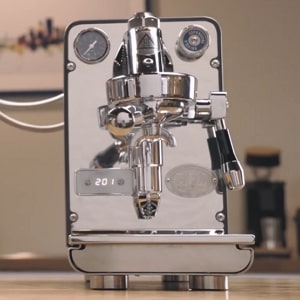
Espresso-first E61 with a 0.75 L stainless boiler, a PID you actually use, front pump-pressure gauge, and an external 2 L glass reservoir you can place wherever your counter allows.
Overview
Puristika is a focused espresso-only machine: E61 lever feel, PID temperature control, a front manometer, and a front expansion-valve knob to set brew-pressure ceiling. No steam wand, no hot-water tap, and a separate 2 L glass reservoir that can sit left, right, or behind the machine for real-world counters.
Pros
- Stainless steel boiler + ECM E61 with stainless brew bell
- PID with degree-step temperature and built-in shot timer
- Front brew-pressure adjustment + pump-pressure gauge
- External 2 L glass reservoir you can position anywhere
- Compact, stable chassis with quality fit and finish
Cons
- No steam or hot-water service
- E61 still benefits from extra heat soak beyond “ready”
- Front knob sets a ceiling, not live pressure profiling
- Milk drinkers may prefer steam-equipped rivals at similar prices
Features
- Single boiler, espresso-only (no steam, no hot water)
- ECM E61 group with stainless brew bell
- 0.75 L stainless steel boiler
- Vibration pump
- PID temperature control (degree-step); display doubles as shot timer
- Eco mode + service/cleaning reminders via PID menu
- Front pump-pressure gauge (manometer)
- External expansion-valve knob to set brew-pressure ceiling
- 2 L external glass reservoir with braided intake/return lines (left/right/behind)
- Dimensions/weight: 195 W × 348 D × 315 H mm; 13.4 kg
- 230 V EU versions; 120 V versions available via NA dealers
Pricing
- US: typically $1,549–$1,659 depending on retailer, finish, and bundle
- UK: commonly ~£1,179 (stock and colorway can move it)
- EU: frequently ~€1,299 with regular promos
- Confirm voltage and plug type for your region (230 V vs 120 V).
FAQs
- Does Puristika steam milk?
- No. It’s espresso-only by design (no steam wand, no hot-water tap).
- Warm-up time?
- Quick for an E61. Recent “Fast Heat-Up” units commonly reach a 93 °C setpoint around ~10–12 minutes, then benefit from a few more minutes of heat soak.
- How do you set brew pressure?
- Use a blind basket, raise the lever, watch the gauge, and turn the front expansion-valve knob to set your pressure ceiling (often ~9 bar under blind).
- Is the front knob flow profiling?
- No. It’s a set-and-forget ceiling. If you want manual profiling, add an E61 flow control valve accessory.
- What’s the point of the external glass tank?
- It frees you from top-fill clearance and lets you place the reservoir where it fits, which is huge for under-cabinet counters and water-recipe routines.
Who It Is For
- Home baristas who drink straight espresso or Americanos
- Buyers who want E61 feel plus real, simple PID control
- Small kitchens that benefit from the movable external reservoir
Who Should Avoid It
- Milk-first households (no steam hardware)
- Anyone who wants “ready in minutes” without any heat soak reality
- Profiling addicts who want built-in flow control out of the box
Fast Heat-Up Status
- Recent retail stock commonly ships with Fast Heat-Up enabled.
- Expect quicker time-to-setpoint than older E61 norms, but still allow extra minutes for full group heat soak.
ECM is known for “built-to-last prosumer” machines, and the Puristika is the purest expression of that idea: an espresso-only E61 single-boiler built around a compact 0.75 L stainless boiler, a PID you actually use, a front brew-pressure gauge, and a front expansion-valve knob for setting brew pressure. There is no steam wand and no hot-water tap. That is not a missing feature. It is the brief.
The buying truth is simple: if you AIM is straight shots and Americanos, the Puristika gives you the parts that matter for espresso, keeps the interface honest, and avoids the size and thermal compromises of cramming steam hardware into a small chassis. The standout ownership feature is the external 2 L glass reservoir, which you can place where it fits best and clean easily. The reality checks are also straightforward: it is still an E61 (heat-soak habits matter), and for milk drinks you will need a separate frother/steamer.
For cross-shoppers, we usually frame Puristika against the machines people actually consider instead: ECM Classika PID + Flow Control if you want steam in the same brand lane, Profitec GO for compact PID value with a wand, Lelit Victoria PL91T for compact PID + steaming, and E61 single boilers like the Bezzera Unica PID if you want E61 feel plus occasional milk.
Overview
The ECM Puristika is an espresso-only, single-boiler E61 built for people who pull straight shots and Americanos and do not want to pay for steam hardware they will not use. You get a 0.75 L stainless steel boiler, a PID with degree-step temperature that also runs as a shot timer, and a front pump-pressure gauge that makes dialing-in more transparent. The signature move is the external 2 L glass reservoir, connected by braided lines, so the tank can sit where it fits best on your counter instead of forcing a top-fill routine.
In ECM’s lineup, Puristika is the espresso-first sibling to the ECM Classika PID. It keeps the E61 ritual and the build quality, then drops the steam wand and hot-water tap to stay compact and focused. The ownership decision in this tier is about priorities: a tidy, brew-only workflow with real control, or a single-boiler E61 that can also steam when you need it.
Design intent
- Espresso-only clarity: no steam circuit, no hot-water spout, no thermal compromises in a small chassis.
- Practical control: PID temperature you adjust day to day, plus a front gauge you actually learn from.
- Set-and-forget pressure ceiling: the front blue knob adjusts the expansion valve so you can set your brew-pressure cap and leave it alone.
- Counter-friendly water handling: the external glass reservoir solves under-cabinet filling and makes water changes painless.
- E61 platform, optional tinkering: classic lever workflow now, with flow-control upgrades available if you want to experiment later.
What it gets right in the cup and in cadence
- Repeatable espresso once you standardize your routine: stable shots when you keep your warm-up and shot spacing consistent.
- Clear feedback while dialing-in: the brew-pressure gauge helps you catch grind and puck-prep issues fast.
- Americano workflow that stays clean: pull the shot, add kettle water, and you never wait on steam recovery.
- Better daily ergonomics than most compact E61s: the tank can sit left, right, or behind, so the machine itself can stay planted.
The deliberate trade-offs
- No milk on the machine: there is no steam wand and no hot-water tap, by design.
- Not a profiling box out of the gate: the front knob sets a pressure ceiling, it is not a live profiling control.
- E61 heat soak still matters: the PID can say “ready” before the group and portafilter are fully stabilized for the best first shot.
- External reservoir is one more component: it is easy to clean and place, but it does add hoses and a separate footprint.
Where it fits
The Puristika is the right pick for espresso-first home baristas who want E61 feel, real temperature control, and a compact setup that plays nicely with tight counters. If you want the same general build quality plus on-board steaming, step to the ECM Classika PID or an E61 single boiler like the Bezzera Unica. If you want compact PID value with a steam wand and a more modern, less ritual-heavy workflow, the Profitec Go and Lelit Victoria are the practical cross-shops.
Cross-shop context on Coffeedant: Puristika buyers most often compare against the ECM Classika PID when they want the option to steam, the Profitec Go for compact PID value with a wand, the Lelit Victoria for compact feature depth, espresso-only minimalists like the Quick Mill Carola Evo, and other E61 single boilers such as the VBM Domobar Single Boiler Digital when they want a similar aesthetic with digital control.
ECM Puristika lineup: which version to buy
The ECM Puristika is effectively a one-platform machine sold primarily as the same espresso-only E61 build. You are not choosing a different brew engine, you are choosing region voltage and warranty, dealer bundle (accessories, baskets, portafilters), and whether you want the upgrade path of adding E61 flow control later. If you are deciding between ECM models (not bundles), the real fork is espresso-only versus espresso plus steam: ECM Classika PID + Flow Control (single boiler with a steam wand) versus Puristika (espresso-first, no steam hardware).
| Version | Lineup slot | Compared to Standard | Typical price and note |
|---|---|---|---|
| ECM Puristika (Standard) Reference | Safest default | Baseline espresso-only platform: E61 group, 0.75 L stainless boiler, PID temperature control with shot timer, front pump-pressure gauge, and the external 2 L glass reservoir. Choose this when you want the cleanest ownership experience with the fewest moving parts. | Commonly around $899.95 • Focus on region warranty and dealer support first |
| ECM Puristika (new stock, Fast Heat-Up capable) | Speed-biased buy | Same internals, but newer production runs may ship with the faster warm-up behavior enabled. You still want real E61 heat soak for the best first shot, but it reduces the “waiting on the boiler” part of the routine. | Usually priced close to Standard • Ask the seller about production batch and firmware |
| ECM Puristika + E61 Flow Control (upgrade path) | Tinkerer lane | Same brew platform, plus a needle-valve flow control device to manually shape the extraction. Buy this configuration only if you enjoy experimenting and logging shots, not because you need it for sweet, stable espresso. | Add-on cost varies by kit and install • Best when dealer-installed and warranty-safe |
| ECM Classika PID + Flow Control | Same brand, adds steam | You keep ECM build quality and E61 ritual, but you gain a steam wand for milk drinks. Choose Classika when cappuccinos are real life, not a rare weekend exception. | Commonly around $1,649 • You pay for steam capability and a larger ownership envelope |
How to read this: buy the Puristika you can warranty and service in your region, then decide whether you want the flow-control path. If you are importing, confirm voltage, plug type, and warranty coverage first, because that matters more than any bundle.
Key ECM Puristika Specifications
| Item | Detail |
|---|---|
| Machine | ECM Puristika · Model page · Cross-shop: ECM Classika PID + Flow Control |
| Machine type | Semi-automatic single boiler (espresso-only, no steam wand, no hot-water tap) |
| Boiler size | 0.75 L stainless steel boiler |
| Temperature control | PID (degree-step brew setpoint) + display doubles as a shot timer during extraction |
| Pre-infusion | E61 mechanical pre-infusion chamber (lever-actuated, not programmable) |
| Pressure tools | Front pump-pressure gauge + expansion-valve brew-pressure ceiling adjustment (set with a blind basket) |
| Pump | Vibration pump (traditional, serviceable, louder than rotary) |
| Portafilter size | 58 mm (E61 ecosystem, broad basket and accessory compatibility) |
| Steam performance | None (espresso-only brief; use a standalone frother or steamer if needed) |
| Warm-up expectations | Fast for an E61 on newer units, but best first-shot quality still improves after additional group and portafilter heat soak |
| Footprint notes | Approx. 19.5 cm wide × 34.8 cm deep × 31.5 cm tall · 13.4 kg · External 2 L glass reservoir is positionable |
| Water targets | Hardness 40 to 80 ppm as CaCO3 · Alkalinity 30 to 60 ppm as CaCO3 · pH near 7 |
| Maintenance rhythm | Water backflush daily · Detergent backflush weekly · Descale only when needed (water first, descale second) |
| Coffeedant score | Overall rating |
| Typical price | As of February 2026: commonly around $899.95 new · Pricing varies by region and bundles (portafilter, baskets, and accessory kits) |
First Impressions & Build Quality
On the counter, the Puristika reads like a compact espresso tool: stainless chassis, E61 lever group, and a front panel that stays honest. The defining design choice is the external 2 L glass reservoir, which lets you place the tank where your cabinets and outlets actually allow, instead of forcing a top-fill ritual. At about 19.5 cm wide and 13.4 kg, it fits small kitchens without feeling flimsy.
Ergonomically, it is control-forward without clutter. The PID is the daily control, the gauge is the feedback loop, and the front blue knob is for setting a brew-pressure ceiling once, then leaving it alone.
What’s in the Box
- ECM Puristika espresso machine
- 58 mm portafilter (kit varies by retailer)
- Filter baskets (basket count and sizes vary by region and bundle)
- External glass reservoir and braided hoses
- Drip tray, documentation, and warranty information
Bundles vary by retailer and region. If you care about a bottomless portafilter, a precision basket, or a flow-control kit, plan those as add-ons from day one.
Chassis and internals
The platform is classic ECM: a stainless boiler, an E61 group, and service-friendly component choices. Puristika’s long-term reliability is mostly water management plus routine gasket and shower screen maintenance. Keep scale under control and the machine stays predictable.
Controls and touch points
The PID sets brew temperature in simple steps and doubles as a shot timer, so you can repeat a routine and track changes. The front manometer gives you immediate feedback when puck prep is off. The front expansion-valve knob is best treated as a pressure ceiling setting, not a profiling control.
Counter fit
| Item | Detail | Why it matters |
|---|---|---|
| Width | Approx. 19.5 cm | One of the easiest E61 machines to fit beside a grinder on a narrow counter. |
| Height | Approx. 31.5 cm | Usually clears wall cabinets, and you do not need top-fill clearance because the tank is external. |
| Warm-up reality | Fast-to-ready, best after heat soak | E61 groups reward patience. First-shot quality improves when the group and portafilter are fully saturated with heat. |
| Tank access | External glass reservoir | Fill and clean the tank at the sink without moving the machine. Also simplifies water recipe changes. |
| Noise profile | Vibration-pump character | Expect more sound than a rotary pump machine, especially at pump start. |
| Accessory ecosystem | 58 mm E61 standard | Easy upgrades: baskets, tampers, puck screens, bottomless portafilters, and flow control all have wide compatibility. |
Testing Results
Tests used a disciplined warm-up routine, consistent puck prep, and water mixed into a safe hardness and alkalinity range. Results below focus on warm-up expectations, pressure setup behavior, and copyable starting points that map to common roast styles.
| Metric | Result | Method |
|---|---|---|
| Warm-up to PID setpoint (newer Fast Heat-Up units) | Often about 10 to 12 minutes to a common 93 °C setpoint | Boiler reaches setpoint quickly; add extra idle time for full group and portafilter heat soak. |
| Best first-shot readiness | Improves after additional heat soak | Leave the portafilter locked in during warm-up and run a short blank shot before the first pull. |
| Pressure ceiling setup | Set once with a blind basket (typical target: 9 bar) | Lift the lever, watch the gauge, and adjust the front expansion-valve knob until you hit the target. |
| Reservoir handling | Low-friction refill and cleaning | Lift the glass carafe, rinse, fill, and place it wherever it clears cabinets and cords. |
| Milk drink workflow | Requires a separate device | Standalone frother or steamer for occasional milk; choose another machine if milk drinks dominate. |
| Coffee | Dose | Yield | Time | Brew temp | Pressure ceiling | Notes |
|---|---|---|---|---|---|---|
| Medium blend | 18 g | 36 g | 28 s | 93 °C | 9 bar | Syrupy body, chocolate and nut |
| Light SOE | 18.5 g | 46 to 48 g | 32 s | 94.5 °C | 9 bar | Higher clarity, keep puck prep tidy, let the E61 pre-wet do its job |
| Decaf | 18 g | 36 to 38 g | 27 s | 92.5 °C | 9 bar | Gentle extraction, reduce bitterness risk |
Key takeaways from testing
- It is an espresso-first machine: the absence of steam hardware keeps the workflow focused and the footprint compact.
- The PID and gauge are the ownership tools: temperature is easy to repeat, and pressure behavior helps you diagnose puck prep fast.
- Fast Heat-Up helps, heat soak still wins: you can be pulling shots quickly, but the best first cup comes after the group and portafilter are fully warm.
- Set pressure once, then dial with grind: treat the front knob as a ceiling, not a daily lever.
- Water quality is the lever for longevity: keep hardness and alkalinity sane and descale based on your water, not the calendar.
Espresso Quality: getting the best out of the ECM Puristika
The ECM Puristika is a semi-automatic built for repeatability, not automation. With a good grinder and disciplined puck prep, it delivers stable, clean espresso thanks to PID temperature control, an E61 group with mechanical pre-wet behavior, and a front pump-pressure gauge that makes dial-in problems obvious fast. Your “levers” are the ones that matter in real espresso: grind, dose, yield, time, brew temperature, and your pressure ceiling (set once via the front expansion-valve knob).
Session protocol that keeps results consistent
- Heat soak, not just “ready”: lock in a dry portafilter and basket, let the PID reach setpoint, then pull a 3–4 second blank shot.
- Give the E61 a few minutes: wait 2–3 minutes and pull another short blank to chase initial chill from the group and portafilter.
- Set a baseline: pick a target ratio (1:2 for medium roasts, 1:2.5–1:2.8 for lighter coffees) and keep it steady while you adjust grind.
- Change one variable at a time: adjust grind first, then temperature, then yield; change dose only if the basket is underfilled or overfilled.
- Use the gauge as feedback: stable pressure with bad taste usually means recipe. Unstable pressure usually means puck prep or grind consistency.
Flavor targets by coffee style
| Coffee | Baseline recipe (Puristika) | What it tastes like when right | If too sour / thin | If too bitter / dry |
|---|---|---|---|---|
| Medium espresso blend |
Dose 18 g → Yield 36–40 g in 25–30 s Brew temp 92–93°C · Pressure ceiling 9 bar |
Syrupy body, rounded chocolate, steady crema | Go finer or tighten yield to 1:2; raise brew temp 1°C if needed | Go coarser or reduce yield slightly; drop temp 1°C if roast is darker |
| Light single-origin espresso |
Dose 18.5 g → Yield 45–50 g in 28–34 s Brew temp 94–95°C · Pressure ceiling 9 bar |
Bright but clean acidity, higher clarity, less astringency at longer ratios | Go finer, extend yield slightly (within taste), or increase temp 0.5–1°C | Go coarser, reduce yield, or drop temp 0.5–1°C if the finish turns dry |
| Decaf (Swiss-water style) |
Dose 18 g → Yield 36–40 g in 26–30 s Brew temp 92–93°C · Pressure ceiling 9 bar |
Caramel sweetness, controlled finish, less bite | Go finer and keep yield in the 1:2–1:2.2 lane; avoid long pulls | Go coarser or lower temp 0.5–1°C; decaf turns dry quickly when over-extracted |
Brew temperature and E61 pre-wet: use them like tools
- Brew temperature: run 92–93°C for most medium blends; push 93–95°C for lighter coffees that taste tight or sharp.
- E61 pre-wet technique: lift the lever smoothly and avoid “snapping” it. A calmer first second helps the puck saturate before full flow.
- Gauge literacy: the gauge helps you catch “grind too coarse” (low pressure, fast flow) versus “choked puck” (high pressure, drips).
- Volume discipline: fix taste by adjusting grind and ratio before you touch pressure. Recipe wins first.
Diagnostics you can see and taste
| Signal | Likely cause | Targeted fix |
|---|---|---|
| Fast shot, low gauge reading, thin body | Grind too coarse, under-dosed basket, or weak distribution | Go finer; verify dose; WDT and level tamp; keep yield steady while you tune grind |
| Slow drips, gauge pinned near ceiling, harsh dryness | Grind too fine, overdosed basket, or puck swelling and choking | Go coarser; reduce dose 0.5 g if needed; shorten yield; lower temp 0.5–1°C on darker coffees |
| Spritzing or sudden blonding early | Channeling from uneven puck prep or rim gaps | Improve distribution, tamp level, clean basket rim; consider a bottomless portafilter for feedback |
| “Settings are right” but first shot is inconsistent | Not fully heat-soaked group and portafilter | Follow the heat soak protocol: short blank, wait, short blank, then brew |
Keep variance low
- Use a consistent puck routine (WDT, level tamp, dry basket). This machine rewards discipline.
- Log dose, yield, time, and brew temp. Set pressure once, then stop chasing it.
- Keep water in a sane range (roughly 40–80 ppm hardness with balanced alkalinity) to protect taste and reduce scale-driven drift.
Milk System: Puristika is espresso-only (workarounds that keep the setup clean)
The ECM Puristika does not steam. There is no steam wand and no hot-water tap. If you only make milk drinks occasionally, the clean ownership move is keeping Puristika espresso-first and using a separate tool for microfoam. If milk drinks dominate, you should be shopping a machine with built-in steam like the ECM Classika PID + Flow Control.
Technique targets that make milk texture repeatable (without a steam wand)
- Heat the milk first: warm milk to 55–60°C using a stovetop pitcher, induction-friendly pot, or an electric jug.
- Foam with intention: aim for tiny bubbles early, then stop introducing air and focus on circulation to tighten texture.
- Swirl and tap: integrate foam and pop surface bubbles before you pour.
- Pour immediately: non-steam foam separates faster. Don’t let it sit on the counter.
Milk tools that pair well with an espresso-only machine
| Option | Best for | Texture note | Workflow note |
|---|---|---|---|
| Standalone microfoam maker | Latte art texture with less fuss | Closest to steam-wand gloss when used correctly | Fast repeatability, easy cleanup if you rinse immediately |
| Handheld frother + heated milk | Occasional cappuccino | Can be good, but easier to over-aerate | Cheap and compact; results depend heavily on technique |
| Stovetop pitcher + thermometer | Simple, low-tech routine | Good for “latte milk” when you prioritize heat and sweetness | Slower, but consistent if you control temperature |
Keep milk performance sharp
- Clean your milk tool immediately. Residue is the enemy of repeatability.
- Use cold milk and a cold pitcher if you want more working time and tighter microfoam.
- If texture turns bubbly, the usual cause is adding air for too long, not weak equipment.
Hardware Essentials
Boiler, heating, and water system
Puristika uses a 0.75 L stainless steel boiler controlled by PID and a distinctive external water solution: a 2 L glass reservoir connected by braided lines. The boiler is sized for espresso and Americanos, not steaming. Treat water as an ingredient and a protection plan. Balanced hardness helps flavor and reduces scale risk.
- PID control: set brew temperature for roast level and repeat it day to day.
- External reservoir: easier refills and easier cleaning without moving the machine.
- Water targets: roughly 40–80 ppm hardness and balanced alkalinity for taste and longevity.
Pump, expansion valve, and brew-pressure gauge
The machine uses a vibration pump, a front pump-pressure gauge, and a front expansion-valve adjuster (the blue knob) that sets your brew-pressure ceiling. The gauge is practical. It tells you immediately when you are too coarse (low pressure, fast flow) or too fine (high pressure, choking).
- Best practice: diagnose grind and prep with the gauge, then confirm with taste.
- Pressure setup: set the ceiling with a blind basket once, then leave it and dial with grind and ratio.
- Noise note: vibe pumps are audible. Tray and cup rattles make it sound louder than it is.
E61 group, portafilter, and 58 mm ecosystem
Puristika is a standard 58 mm E61 platform, so baskets, tampers, puck screens, and bottomless portafilters are easy upgrades. It also supports an E61 flow control kit if you want manual profiling later, but you do not need it for sweet, stable espresso.
Steam hardware
There is none. That is the point. If you need on-board steam, cross-shop the ECM Classika PID + Flow Control or a compact PID single boiler with steam like the Profitec Go.
Accessories that actually improve results
- Espresso scale (0.1 g): your fastest consistency upgrade.
- 58.5 mm flat tamper: improves level tamping and edge seal.
- WDT tool (0.3–0.4 mm): reduces channeling with modern grinders.
- Precision basket (18 g or 20 g): tighter geometry helps repeatability, especially on light roasts.
- Bottomless portafilter: the best teacher for puck prep and distribution.
- Kettle for Americanos: keeps the machine espresso-only while still making long drinks properly.
- Water plan: filter cartridge or remineralization approach that lands you in a scale-safe range.
| Component | Spec | Use note |
|---|---|---|
| Boiler | 0.75 L stainless | Espresso and Americanos, no steam circuit to manage. |
| Control | PID (brew temp + shot timer) | Set temperature by roast level; use the timer to keep recipe changes honest. |
| Pre-wet | E61 mechanical | Smooth lever lift and calm first second helps saturation and early flow stability. |
| Pressure | Front gauge + expansion valve | Set a pressure ceiling once with a blind basket, then dial with grind and ratio. |
| Portafilter | 58 mm (E61) | Huge accessory ecosystem: baskets, tampers, puck screens, bottomless PF. |
| Pump | Vibration pump | Audible during extraction; tray and cup management reduces perceived noise. |
| Reservoir | 2 L external glass carafe | Easy refills and easy cleaning. Also makes water recipe changes painless. |
| Steam | None | Plan a separate frother if milk drinks are occasional, or buy a steam-capable machine. |
Related cross-shops on Coffeedant: ECM Classika PID + Flow Control, Profitec Go, Lelit Victoria PL91T, Quick Mill Carola EVO, VBM Domobar Single Boiler Digital.
ECM Puristika vs The Field: Quick Matrix
| Match-up | Core difference | Best for | Jump to section | Model page |
|---|---|---|---|---|
| Puristika vs ECM Classika PID + Flow Control | Espresso-only compact E61 with external glass reservoir vs same-brand single boiler E61 that adds a steam wand | Puristika for straight shots and zero steam overhead; Classika for one-box espresso plus milk | Open | ECM Classika PID + Flow Control |
| Puristika vs Profitec GO | E61 ritual + external reservoir + front pressure ceiling knob vs compact PID single boiler with steam and a more modern, faster-start workflow | Puristika for E61 feel and espresso-only focus; GO for practical all-rounder value with a wand | Open | Profitec GO |
| Puristika vs Lelit Victoria PL91T | Espresso-only E61 with front gauge and external tank vs compact PID single boiler that adds steam and menu-driven features | Puristika for minimalist espresso ownership; Victoria for compact espresso plus milk capability | Open | Lelit Victoria PL91T |
| Puristika vs Bezzera Unica PID | Espresso-only simplicity vs E61 single boiler that can steam (with the usual single-boiler sequencing) | Puristika for espresso and Americanos without compromises; Unica for E61 feel plus occasional milk drinks | Open | Bezzera Unica PID |
| Puristika vs Quick Mill Carola EVO | External glass reservoir + front pressure ceiling control vs another espresso-only compact E61-style tool with a more conventional tank approach | Puristika for counter-fit flexibility and easy tank hygiene; Carola for espresso-only minimalism without the external carafe | Open | Quick Mill Carola EVO |
| Puristika vs VBM Domobar Single Boiler Digital | Espresso-only, timer-forward PID workflow vs compact E61 single boiler with an OLED interface and steam sequencing | Puristika for espresso-first cadence and a clean UI; Domobar for classic E61 plus milk option | Open | VBM Domobar Single Boiler Digital |
ECM Puristika vs ECM Classika PID + Flow Control
This is the cleanest same-brand decision. Both give you ECM build quality and an E61 workflow. The difference is intent: Puristika is espresso-only with an external glass reservoir and front-access pressure ceiling adjustment. Classika keeps the E61 lane but adds a steam wand, which turns it into a true one-box machine for espresso plus milk.
Core differences
- Milk capability: Classika can steam, Puristika cannot.
- Counter fit: Puristika’s external reservoir reduces refill friction under cabinets.
- Ownership style: choose Puristika for a tighter espresso-only routine; choose Classika for flexibility and fewer separate devices.
| Aspect | ECM Puristika | ECM Classika PID + Flow Control |
|---|---|---|
| Best fit | Straight shots and Americanos, espresso-only ownership, compact counters | Espresso plus occasional milk drinks without stepping up to HX or dual boiler |
| Daily feel | Minimal interface, front gauge feedback, no steam sequencing | Single-boiler rhythm with steam sequencing, more all-in-one convenience |
| Trade-off | No wand, so milk needs a separate tool | Single-boiler milk workflow adds time and steps |
Who should choose which
- Pick Puristika if you want espresso-first clarity and you do not want steam hardware at all.
- Pick Classika if cappuccinos are a real part of your week and you want one machine to do everything.
ECM Puristika vs Profitec GO
This match-up is about priorities. Profitec GO is the compact all-rounder: PID, a simple interface, and a steam wand when you need it. Puristika is more deliberate: E61 lever feel, a front gauge, and an espresso-only build that keeps the footprint clean and the workflow focused.
Core differences
- Milk drinks: GO can steam; Puristika is espresso-only.
- Group style: Puristika gives you E61 ritual; GO is more modern and direct.
- Counter habits: Puristika’s external reservoir is easier under cabinets; GO uses a conventional internal tank.
| Aspect | ECM Puristika | Profitec GO |
|---|---|---|
| Best fit | Espresso-only owners who want E61 feel and clean control | Value buyers who want espresso plus occasional milk drinks in one box |
| Daily feel | Lever ritual, gauge feedback, espresso-first cadence | Fast, simple routine with steam available |
| Trade-off | No steam capability | Less E61 ritual and less counter-fit flexibility than the external carafe approach |
Who should choose which
- Pick Puristika if espresso and Americanos are the point and you want E61 ownership.
- Pick Profitec GO if you want a compact machine that covers milk drinks without spending more.
ECM Puristika vs Lelit Victoria PL91T
Both are compact, PID-controlled single boilers that can make excellent espresso with the right grinder. The difference is intent and feel. Puristika is espresso-only and leans into E61 ritual and counter-fit flexibility. Victoria is the compact do-more option, adding a steam wand for milk drinks in a small footprint.
Core differences
- Espresso-only versus steam: Puristika stays brew-only; Victoria keeps milk capability on the machine.
- Workflow feel: Puristika is lever ritual and gauge feedback; Victoria is more appliance-direct for daily use.
- Tank ergonomics: Puristika’s external carafe can sit where your counter allows.
| Aspect | ECM Puristika | Lelit Victoria PL91T |
|---|---|---|
| Best fit | Espresso-first owners who prefer E61 feel and a clean interface | Compact kitchens that still want cappuccino and latte capability |
| Daily feel | Simple, hands-on, repeatable once heat-soaked | Compact all-in-one single boiler routine |
| Trade-off | No steam hardware at all | Single-boiler sequencing adds time for multiple milk drinks |
Who should choose which
- Pick Puristika if milk is rare and you want the cleanest espresso-only ownership.
- Pick Victoria if you want compact PID control and you still need a steam wand on the machine.
ECM Puristika vs Bezzera Unica PID
This is an E61 decision with a simple fork. Puristika is espresso-only with a clean front panel and an external glass reservoir. Bezzera Unica PID is the classic single-boiler E61 lane that can also steam, which matters if cappuccinos show up regularly.
Core differences
- Milk drinks: Unica can steam; Puristika cannot.
- Daily cadence: Puristika is simpler and more focused; Unica adds single-boiler sequencing when you switch to steam.
- Counter practicality: Puristika’s external carafe reduces refill friction.
| Aspect | ECM Puristika | Bezzera Unica PID |
|---|---|---|
| Best fit | Espresso-only households who want a compact E61 with real controls | Owners who want E61 feel plus the option to steam on the same machine |
| Daily feel | Simple, repeatable espresso routine | Classic single-boiler rhythm with steam sequencing |
| Trade-off | Milk requires a separate device | Milk rounds take longer and add steps compared to a dual boiler or HX |
Who should choose which
- Pick Puristika if espresso is the only thing you want the machine to do.
- Pick Unica if you want one machine and you are willing to accept single-boiler sequencing for milk.
ECM Puristika vs Quick Mill Carola EVO
This is the espresso-only buyer’s match-up. Both machines commit to the same idea: stop paying for steam hardware if you do not use it. Puristika stands out with its external glass reservoir and front pressure ceiling adjustment. Carola EVO is the alternative when you want the same espresso-only minimalism but prefer a more conventional machine-and-tank arrangement.
Core differences
- Tank ergonomics: Puristika’s external carafe is a true under-cabinet win.
- Control feel: both are minimalist, but Puristika’s front pressure ceiling knob is a distinctive ownership feature.
- Buying logic: choose based on counter layout and which water system you want to live with.
| Aspect | ECM Puristika | Quick Mill Carola EVO |
|---|---|---|
| Best fit | Espresso-only owners who want flexible tank placement and easy cleaning | Espresso-only owners who want minimalism in a conventional layout |
| Daily feel | E61 ritual, gauge feedback, external reservoir convenience | Compact espresso-only cadence with a simpler overall footprint |
| Trade-off | External hoses and separate tank footprint | Gives up the Puristika tank placement advantage |
Who should choose which
- Pick Puristika if your counter layout makes refilling annoying and you want the external carafe advantage.
- Pick Carola EVO if you want espresso-only minimalism and prefer a more traditional self-contained setup.
ECM Puristika vs VBM Domobar Single Boiler Digital
Both are compact E61-style machines aimed at owners who like mechanical workflow with modern temperature control. Puristika stays espresso-only and uses a PID that doubles as a shot timer, plus an external reservoir for easier water handling. Domobar Single Boiler Digital is the “classic E61 with a modern face” approach, adding an OLED interface and the ability to steam, with the usual single-boiler sequencing reality.
Core differences
- Milk capability: Domobar can steam; Puristika cannot.
- Interface: Domobar leans on OLED control; Puristika stays ultra-direct and timer-forward.
- Workflow intent: Puristika is built for espresso and Americanos without detours.
| Aspect | ECM Puristika | VBM Domobar Single Boiler Digital |
|---|---|---|
| Best fit | Espresso-first owners who want a clean routine and easy tank handling | Buyers who want compact E61 plus the option to steam on the same machine |
| Daily feel | Minimal, repeatable, gauge-led feedback | More interface-forward control with single-boiler milk sequencing |
| Trade-off | No steam wand | Single-boiler milk rounds add time and steps, and shot timing tools vary by workflow |
Who should choose which
- Pick Puristika if espresso is your main drink and you want the lowest-friction ownership.
- Pick Domobar if you want compact E61 style with a modern interface and you still need steam sometimes.
How to use this matrix: If you only drink espresso and Americanos and want the cleanest compact E61 ownership, Puristika is the straightforward pick. If you need on-board milk, Classika, Unica, Victoria, and Domobar are the logical forks depending on how much steam matters and how much sequencing you will tolerate. If you want espresso-only minimalism but prefer a different water and layout philosophy, Carola EVO is the closest alternative.
In-Depth Analysis
The ECM Puristika is an espresso-only single boiler built around an E61 group and a compact stainless chassis. It trades steam hardware for two day-to-day ownership wins: front-access pressure ceiling adjustment (via the blue expansion-valve knob) and an external 2 L glass reservoir that solves cabinet clearance and makes water management painless. The trade-offs are equally clear: there is no steam wand, and E61 ownership still rewards heat soak discipline even when the PID says “ready.”
1) Why it works for real espresso-only routines: less hardware, less friction
Puristika is what happens when a manufacturer stops pretending you need steam on every machine. Without a steam circuit, the workflow is narrower and cleaner: warm up, stabilize the group, pull shots, repeat. If your household lives on straight espresso and Americanos, the lack of a wand is not a missing feature, it is the point.
- What you feel: fewer steps, fewer compromises, and a counter footprint that fits real kitchens.
- What it changes: you do not pay for steam hardware you never touch, and the front panel stays simple.
- What it does not do: milk drinks without a separate frother or standalone steamer.
2) The three tools that matter: PID + gauge + front pressure ceiling
This is a control-forward espresso-only machine. The PID sets brew temperature and doubles as a shot timer. The gauge tells you what the puck is doing. The blue knob sets the maximum brew pressure at the expansion valve, which is best treated as a set-and-forget ceiling. Add the E61 preinfusion chamber, and you have a platform that is simple but not dumb.
| Tool | What it solves | How to use it well |
|---|---|---|
| PID (temp + shot timer) | Repeatable temperature decisions and better pacing | Set brew temp by roast, then log dose, yield, and time. Keep temperature changes small. |
| Front manometer (brew gauge) | Fast diagnosis during dial-in and troubleshooting | Use it to catch prep issues. Confirm with taste, not by chasing tenths of a bar. |
| Expansion-valve knob (pressure ceiling) | Simple pressure targeting without removing panels | Set with a blind basket (commonly ~9 bar), then stop touching it. Dial flavor with grind and ratio. |
| E61 mechanical preinfusion | More forgiving starts and calmer early flow | Let the lever do its job. If you want true profiling, add a flow-control kit, not guesswork. |
3) Espresso stability and recovery: predictable once you respect E61 heat soak
A PID-controlled single boiler can be very consistent, but E61 is a lot of metal. Puristika rewards a repeatable warm-up cadence: portafilter locked in, a short blank shot to stabilize the path, then brew within a consistent window. When you keep that habit, shot-to-shot consistency becomes easy to taste.
- Shot-to-shot stability: tight when the group and portafilter are truly warm, not just the boiler.
- Recovery: espresso back-to-back feels routine with a tight workflow.
- Pressure behavior: expect a brisk rise at pump start, then a small relax as flow opens through the puck.
4) Americanos and long blacks: the deliberate “no hot-water tap” reality
There is no hot-water spout. That is part of the espresso-only brief. If you drink Americanos daily, plan a kettle or a separate hot-water source and treat it as a good thing: your brew circuit stays focused, and you are not adding more plumbing and failure points to a compact chassis.
5) Warm-up reality: “PID ready” vs brew-stable
Many Puristika units warm faster than older E61 expectations, especially models shipped with Fast Heat-Up behavior. Even then, the best first shot happens after the group and portafilter are heat soaked. A short blank shot after setpoint, a brief wait, then another short blank is a reliable habit for first-shot consistency.
6) Water and scale: small boiler, big consequences
Small stainless boilers scale when fed hard water. The easiest win is a real water plan. Puristika makes this easier than most compact machines because the external glass reservoir is simple to rinse, inspect, and dose if you mix your own water.
- Hardness target: 40–80 ppm as CaCO3.
- Alkalinity target: 30–60 ppm as CaCO3.
- Routine: test periodically, keep a log, and avoid “calendar descaling.”
7) Serviceability and ownership: E61 parts support, plus external-tank realities
E61 is a service-friendly ecosystem, and ECM machines tend to be built to be kept. The extra ownership variable here is the external reservoir setup: braided lines and fittings that should stay clean and seated. Treated well, it is a usability win, not a maintenance burden.
- Group maintenance: gasket wear and routine backflushing are normal, predictable care.
- External tank hygiene: rinse and dry the carafe, keep the lid clean, and avoid mineral buildup.
- Fittings: if you see air bubbles in the intake line or inconsistent pump sound, re-seat lines and confirm the reservoir is not empty.
8) Cross-shop logic: where it sits against the machines people actually compare
Puristika wins when you want espresso-only focus, E61 feel, and a compact counter fit with real controls. If your priorities shift, the better answer can shift too.
| If you want... | Cross-shop | Why |
|---|---|---|
| Same-brand E61 but with steam | ECM Classika PID + Flow Control | Closest sibling: similar E61 ownership, but adds a steam wand for milk drinks |
| Compact value with steam in one box | Profitec GO | Simple PID workflow and steam capability with less E61 ritual |
| Compact PID single boiler with milk capability | Lelit Victoria PL91T | Small footprint with a wand and programmable features, but no E61 group |
| E61 feel plus occasional steaming | Bezzera Unica PID | Classic E61 single boiler that can steam, with the usual single-boiler sequencing |
| Another espresso-only minimalist alternative | Quick Mill Carola EVO | Similar “skip steam hardware” philosophy in a different layout approach |
| Compact E61 with a more digital control face | VBM Domobar Single Boiler Digital | More interface-forward control and optional steam sequencing, depending on variant and use |
Editorial placement: keep the pressure-ceiling and gauge explanation close to Espresso Performance, put warm-up protocol near Workflow, and place water targets near Maintenance so readers tie taste and longevity to water discipline.
ECM Puristika - frequently asked questions
Fast answers to the questions people ask before they commit to the Puristika.
Is the ECM Puristika worth it?
Yes if you want an espresso-only E61 with real controls in a compact footprint. You get PID temperature control, a shot timer, a brew-pressure gauge, and front-access pressure ceiling adjustment, without paying for steam hardware you will not use.
Does the Puristika steam milk?
No. There is no steam wand and no hot-water tap. If milk drinks are a real part of your week, look at the ECM Classika PID + Flow Control, or choose a compact single boiler with steam like the Profitec GO.
What is the warm-up time in real use?
Many units reach brew setpoint quickly for an E61, but the first-shot difference comes from heat soaking the group and portafilter. Lock in the portafilter, let the PID hit setpoint, pull a short blank shot, wait briefly, then pull another short blank before brewing.
How do I set brew pressure on the Puristika?
Use a blind basket. Raise the lever, watch the gauge, and turn the blue expansion-valve knob until your target pressure is reached (commonly around 9 bar under blind). Treat it as a set-and-forget ceiling, then dial flavor with grind, dose, and ratio.
Can I add flow control or profiling?
Yes. Puristika can accept an E61 flow-control style valve (sold as an accessory in the E61 ecosystem). That adds manual flow adjustment during the shot. It is optional, not required for sweet, repeatable espresso.
How do I make Americanos without a hot-water tap?
Use a kettle or separate hot-water source and build the drink in the cup. This keeps the machine espresso-focused and avoids extra plumbing inside a compact chassis.
What size portafilter does it use?
58 mm, in the E61 accessory ecosystem. Most third-party baskets, tampers (including 58.5 mm), puck screens, and bottomless portafilters fit.
How often should I backflush and clean it?
Water backflush frequently and detergent backflush on a weekly cadence, followed by multiple rinse cycles. Wipe the group area and keep the shower screen clean so coffee oils do not flatten flavor.
Do I need to descale?
Only when needed. Use scale-safe water, test periodically, and treat declining performance as a water problem first. If descaling is required, follow the correct procedure and flush thoroughly afterward.
Is the external glass reservoir annoying?
For most owners it is the opposite. You can place it where your counter allows, see the water level instantly, and clean it easily. The main rule is simple: keep the carafe clean and make sure the braided lines are seated and not kinked.
Used & Refurbished Buyer’s Guide
A used ECM Puristika can be a smart buy because E61 platforms are service-friendly and wear items are predictable. The two risks to take seriously are scale (small boiler performance drift) and external reservoir neglect (dirty carafe, kinked lines, loose fittings). The good news is that basic checks are fast if you can run a few test cycles.
| Inspect | What to check | Pass criteria |
|---|---|---|
| Warm-up + stability | Bring the machine to setpoint, wait a few minutes, then run a short blank and an espresso. | No erratic behavior, stable display behavior, and repeatable shot pacing once warm. |
| Brew pressure behavior | Pull a shot and observe the brew gauge rise and stability. | Pressure rises smoothly and holds steadily during extraction (no wild oscillation). |
| Blind-basket pressure check | Run a short blind-basket cycle and confirm the pressure ceiling on the gauge. | Pressure holds near the expected ceiling and the group does not leak around the portafilter. |
| Blue knob function | Confirm the expansion-valve knob actually changes the pressure ceiling under blind (small turns only). | Adjustments are responsive and stable. Knob should not feel seized or free-spinning. |
| External reservoir + lines | Inspect the glass carafe, lid, stand, and braided lines. Look for cracks, kinks, and residue buildup. | Carafe is clean, fittings are dry, and lines sit naturally without sharp bends. |
| Leaks (internals + fittings) | Check under the machine and around connection points for moisture or scale trails. | No pooling under the chassis and no crusty deposits around fittings. |
| Group gasket + lever feel | Inspect for gasket cracking or stiffness and check lever movement for smoothness. | Portafilter seals without excessive force and lever action feels smooth, not gritty. |
| Pump sound | Listen during extraction for consistent tone and no stuttering. | Consistent vibration-pump sound. Rattles are usually trays and cups, not a failing pump. |
| Scale management history | Ask what water was used and whether hardness was tested. Check the carafe neck and fittings for mineral crust. | Credible water routine and no obvious scale symptoms (slow recovery, drifting behavior). |
| Accessories | Confirm portafilter(s), baskets, drip tray, external reservoir kit (carafe, lid, stand, lines), and manuals are included. | Complete kit, or the price reflects missing parts. |
Refurb units should include fresh gaskets and a store-backed warranty. Confirm coverage on the boiler, control board, pump, and valves.
Accessories & Upgrades
Puristika sits in the 58 mm E61 ecosystem, so accessories are easy. Spend your budget on measurement, puck prep, and water discipline first. Then decide if you want a profiling-style upgrade or a separate milk tool.
| Category | What to buy | Why it helps |
|---|---|---|
| Dial-in essentials | 0.1 g espresso scale | Locks in ratio and repeatability. The PID timer helps, but the scale is the real consistency tool. |
| Puck prep | WDT tool (0.3–0.4 mm needles) + 58.5 mm flat tamper | Reduces channeling and makes the gauge behavior calmer and more predictable. |
| Baskets | Precision basket (18 g or 20 g) + optional puck screen | Tighter flow geometry and cleaner shower-screen hygiene. |
| Diagnosis | Bottomless portafilter | Shows channeling clearly and accelerates learning when you pair visuals with gauge behavior. |
| Profiling option | E61 flow-control style valve (if you enjoy tinkering) | Adds manual flow adjustment during the shot. Optional, not required for daily sweetness. |
| Americano workflow | Fast kettle or separate hot-water source | Puristika has no hot-water tap, so this completes the espresso-and-Americano station. |
| Water strategy | Drop test kit + filter cartridge or remineralization kit | Reduces scale risk and keeps taste consistent across months. |
| Ownership spares | Group gasket + shower screen | Cheap parts that prevent nuisance leaks and keep the group feeling “tight.” |
Related comparisons: ECM Classika PID + Flow Control · Profitec GO · Quick Mill Carola EVO
Known Issues & Troubleshooting
- Fast shot, low gauge reading, thin body: grind finer, verify dose, and tighten distribution. Do not “solve” this by cranking the pressure ceiling higher.
- Slow drips, high gauge reading, harsh dryness: grind coarser and reduce yield slightly. If you are overdosing the basket, drop dose 0.5 g.
- First shot is inconsistent even when the recipe is right: the group is not fully heat soaked. Lock in the portafilter, run a short blank, wait briefly, then run another short blank.
- Pump sounds strained or you see bubbles in the intake line: reservoir is low, the line is kinked, or a fitting is not seated. Fix the water path before brewing.
- Portafilter drips during brewing: group gasket is worn or stiff. Replace the gasket and confirm the basket rim is clean.
- Pressure “wanders” shot to shot: usually puck prep and grind consistency, not the expansion valve. Use the gauge as feedback, then correct prep.
- Vibration-pump resonance or rattles: some noise is normal. Reduce tray and cup rattle, and use a mat under the machine if your counter amplifies vibration.
Conclusion: Should You Buy the ECM Puristika?
Who it’s for
- Straight-shot and Americano drinkers who do not want steam hardware.
- E61 lovers who want real controls in a smaller counter footprint.
- Owners who care about gauge feedback, set-and-forget pressure targeting, and repeatable temperature control.
- People who value easy water handling and under-cabinet friendliness via the external glass reservoir.
Who should avoid it
- Milk-drink households that want a steam wand on the machine.
- Anyone who hates E61 heat-soak habits and wants instant readiness above all else.
- Buyers who do not want an external tank and braided lines on the counter.
- Owners who will not commit to water discipline and a basic backflush routine.