

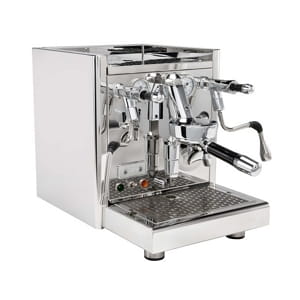
This is a rotary-pump HX that can run tank or plumbed. Plan on a short cooling flush after idle, then it becomes very repeatable.
Affiliate disclosure: Coffeedant is funded by affiliate links that may earn a commission at no extra cost to you.
ECM Technika V Profi PID
ECM’s flagship HX: classic E61 workflow, strong steam, and the calm feel of a rotary pump. The PID keeps boiler behavior tight and gives you a built-in shot timer, while the switchable water source makes it future-proof if you plan to plumb in later.
At a glance
Overview
Technika V Profi PID is the “I want this to live on my counter for years” HX. The rotary pump changes the whole vibe: quieter, calmer, and more stable under flow. The PID does the right job for an HX (boiler behavior, not magical brew-degree promises) and the built-in shot timer keeps your routine honest. Do the short cooling flush after long idle, and it turns into a very consistent machine.
Pros
- Quiet rotary pump with a smooth, steady feel
- Tank now, plumb-in later (switchable water source)
- Strong, dry steam from a big insulated boiler
- Clean PID with a built-in shot timer and ECO mode
- ECM casework and ergonomics feel genuinely premium
Cons
- HX means cooling flush after idle (part of the deal)
- Higher cost than vibration-pump HX machines
- PID does not directly set brew water temp like a dual boiler
- 28 kg is not “move it around the kitchen” weight
How the PID works on an HX
This PID manages boiler temperature, which sets steam pressure and influences the heat exchanger’s idle behavior. It does not behave like a dedicated brew boiler PID. Think of it as shaping the machine’s “temperament.”
- Baseline guidance in your write-up: 124°C (around 1.25 bar) as a sensible center point.
- Higher setpoint: more steam power, hotter idle behavior, often a slightly longer flush after idle.
- Lower setpoint: less steam, cooler idle behavior, sometimes shorter flush, but reduced milk throughput.
Cooling flush routine
After a long idle, HX brew water in the heat exchanger can drift hot. The fix is simple and repeatable: lift lever to flush to a steady stream, stop, lock in, pull.
- Medium roasts: short flush is usually enough.
- Light roasts: add a second or two to the flush.
- Back-to-back shots: often no flush needed because the HX has not heat-soaked.
Milk steaming
- Purge first to clear condensation, then stretch 6 to 8 seconds, then roll to temp.
- Quick-action valves make small corrections easy without over-shooting.
- If you entertain, a small PID bump can keep steam authority strong, then drop back for daily espresso.
Tank vs plumbed
The switchable water source is the sleeper feature. Run the 3 L tank now, plumb in later when your coffee corner becomes permanent.
- Tank: easy refills, easy cleaning, low commitment.
- Plumbed: best daily convenience, but your filtration and hardness control must be correct.
Maintenance loop
- Daily: purge and wipe steam wand, water backflush at session end.
- Weekly (daily users): detergent backflush, wipe screen and group area.
- On schedule: replace group gasket, keep shower screen clean, keep water within espresso-safe hardness.
The “hard truth” with machines like this is water quality. Getting water right is cheaper than valves, elements, and downtime.
Who it is for
- Home baristas who want rotary quiet and real steam without going full dual boiler.
- People who like E61 workflow and can live with a short, consistent cooling flush after idle.
- Buyers who want a machine that can start as tank-fed and become plumbed later.
Takeaway
Technika V Profi PID is ECM’s flagship heat-exchanger with a rotary pump and a switchable water source. It holds a 2.1 liter insulated stainless boiler, a three liter reservoir, and a PID that manages boiler temperature and doubles as a shot timer. The face keeps it simple: dual gauges, an E61 lever, quick-action steam and water valves, and ECM’s updated group with a stainless bell. If you want the classic E61 workflow with quiet pump feel, strong steam, and the option to plumb in later, this machine earns a permanent spot on the counter.
At a glance
- Architecture: E61 brew group, heat-exchanger boiler, rotary pump, dual manometers, PID control and shot timer. Water source is switchable between tank and direct line.
- Boiler and power: 2.1 liter stainless steel boiler with insulation, 1400 W element.
- Water: three liter tank with low-water indication or fixed water connection via switch under the drip tray.
- Dimensions and mass: 325 W × 475 D × 390 H mm, about 28 kg.
- Wands and valves: professional quick steam and hot-water valves, most current retail listings indicate cool-touch wands.
- Controls in the PID: boiler temperature, brew timer, ECO auto-off, and a group-cleaning reminder. Brew-pressure adjustment is accessible from beneath the chassis.
- Typical late-2025 pricing snapshots: United States around 2,499 dollars, European Union around 2,299 euros, Australia around 4,695 to 5,099 dollars AUD. Market promos and VAT move these numbers.
Build and design
Technika V Profi PID is an E61 box built the ECM way: polished stainless case, square shoulders, precise seams, and a layout that feels familiar from a bar station. The lever-actuated E61 group sits centered between two large gauges that read boiler and pump pressure. The quick steam and hot-water valves mount high, with short, smooth throws, and the PID sits discreetly under the right gauge. ECM’s current generation adds a stainless group bell inside the E61 assembly. That part improves corrosion resistance inside the group while keeping the thermosyphon heat path unchanged, which is exactly what you want on an HX platform.
Under the sheet metal sits a 2.1 liter stainless steel boiler with insulation, heated by a 1400 watt element. The heat-exchanger tube carries brew water through that steam boiler to the group. The stainless boiler and insulation are not marketing garnish; they slow heat loss, keep the cabinet temperature lower, and stabilize the boiler’s pressure cycling. The machine’s rotary pump sits on anti-vibration mounts, which means your kitchen stays quiet while the gauge climbs.
A defining feature is the water path. You can run Technika from its three liter reservoir or flip to direct water connection. The swap is simple and physical, not a menu trick, which makes it suitable for households today and a plumbed bar-height coffee corner later. The switch that disables the reservoir sensor lives under the drip tray, which is the right place for a control you touch rarely.
The case measurements are honest kitchen numbers: 325 mm wide, 475 mm deep, 390 mm tall, and roughly 28 kg. It fits under standard wall cabinets and has enough mass to stay planted when you lock in. The external proportions are similar to other prosumer E61 machines, but the pump note is the difference you hear every morning. Rotary is calm. Vibration is not. ECM made the calmer path standard here.
Workflow
Warm-up and readiness
From a cold start the machine rises to operating pressure in the 1.0 to 1.25 bar window, with an advised warm-up of about fifteen minutes before your first pull. Lock a portafilter during warm-up to bring the metal up together. ECM’s manual is explicit about that habit because the E61’s mass is a big part of your brew stability. If you need first-shot consistency for a tasting session, give the group and baskets extra time to soak.
PID, pressure, and what the numbers mean
The PID does not set brew temperature directly like a dual boiler’s brew PID. It sets the boiler’s steam temperature and pressure, which shifts the heat-exchanger’s idle state and, by extension, the group’s starting temperature. ECM recommends 124 C at roughly 1.25 bar as a sensible baseline, which the manual maps to an outlet temperature near 94 C at the group in steady use. Treat the PID as a tool for shaping the machine’s temperament rather than a magic number on the brew. The display also shows time during extraction, which makes tracking ratio and time easy without an external timer.
A separate control lives under the chassis: the brew-pressure adjuster. ECM locates the screw so a tech can dial your baseline pressure with a blind basket and a gauge without pulling panels. The manual frames that adjustment as a specialist task, which is the right guidance. Set a sane nine bar baseline and leave it alone. Chasing pump pressure will not fix distribution or grind.
Cooling-flush routine
Like every HX, Technika parks overheated water in the heat-exchanger tube during idle. The fix is short and repeatable. Lift the lever, vent to a steady stream, lower the lever, lock, and pull. For medium roasts this is brief. For dense, light roasts add a beat to the flush. When you are pulling back-to-back shots you often skip the flush because the HX has not had time to creep. Use the boiler gauge to judge where you are in the cycle. If it is at the top of its band after a long idle, add a second to your flush. If you have just steamed, you are near the low point and can pull straight in. The PID helps by tightening the band, which makes the flush length more consistent day to day.
Tank or line, same cadence
The reservoir workflow is painless. The tank lifts out under the cup tray for cleaning, the level is monitored, and brewing and autofill logic keep the boiler topped. If you plumb in later, the rotary pump earns its keep. It is quieter and steadier under flow than a vibration pump and keeps the pressure trace tidy even while steaming. Whole Latte Love’s description of the switch and the quiet pump sums up the user experience. This reads like marketing until you stand next to one. The difference is obvious.
Espresso performance
Stability you can count on
On an HX machine, the boring parts of your routine decide the shot. Technika gives you the tools to make boring a compliment. The insulated stainless boiler and rotary pump hold a tight loop as the pressurestat cycles inside the PID’s setpoint, the E61 group carries the heat bank you want, and the flush routine is short. Once you map your flush length for a given roast style, the machine repeats. ECM’s own guidance to leave the portafilter in the group and aim for the 1.0 to 1.25 bar warm window keeps the first shot on target instead of guessing.
Starting recipes
On a medium espresso blend, anchor at 18 g in a standard 58 mm double and aim for 36 g out in 27 to 31 seconds from pump on. After a long idle, run the short flush until the flow smooths, then lock and pull. For lighter roasts, extend the flush slightly, tighten grind, and run 1:2.2 in the low thirties. For darker roasts, shorten the flush and pull near 1:1.9 while watching the finish. Keep dose and yield steady as you move grind to center time. Use the PID’s shot timer instead of a phone. It is right in your line of sight and works every time.
What the cup looks like when you are on target
The E61 profile with mechanical pre-infusion leans toward mid-range sweetness and body, with a clean finish if you keep the tail tidy. On a balanced medium roast you get syrupy texture that stands up in milk. With a careful flush and a tighter grind, light roasts can be sweet and clear without astringency. This is the signature people buy prosumer HX machines for. It is easy to drink and forgiving across blends and roast levels.
Milk steaming
Steam is where Technika feels overbuilt for a home kitchen in the best possible way. A 2.1 liter steam boiler at roughly 1.2 to 1.3 bar produces dry, forceful steam with quick recovery. The quick-action valves have short throws, the wand articulation gives you proper pitcher angles, and the machine maintains its cadence through a couple of 12 ounce pitchers without feeling winded. Retailers and regional spec sheets list insulated or “no-burn” wands on current stock, which makes wipe-and-purge cleanup safer and faster.
The practical routine looks like this. Pull your shot, purge a quick burst to eject condensation, and stretch for the first 6 to 8 seconds. Transition to the roll, ride to temperature, wipe, purge again, and pour. If you practice latte art, start on a two-hole tip until your first eight seconds of air are consistent, then move to a higher-flow tip for throughput. Because the PID controls the boiler’s pressure band, you can nudge steam authority by a small temperature increase when you are entertaining and bring it back down on straight-espresso days. The manual’s recommended baseline near 124 C at 1.25 bar is a sensible center point.
Maintenance and reliability
Daily loop
This is the easy part. Purge and wipe the wand after every pitcher. Backflush with water at session end. Do a detergent backflush weekly if you pull daily. Clean the shower screen and swap the group gasket on schedule. The PID includes a cleaning reminder (CLn) that you can set in shot-count steps, which turns discipline into a small, quiet nudge instead of an afterthought.
Water decides your service story
Technika will run tank or line, which means your water plan matters. For the tank, use filtered water in an espresso-safe hardness and alkalinity band or a tested remineralized recipe that plays nicely with stainless and brass. On a plumbed install, protect the machine with a cartridge that softens and stabilizes alkalinity within spec. Scale is the number one destroyer of insulation, valves, and elements. ECM’s documentation and dealer sheets are blunt about hardness and cleaning, and the PID controls do not change the physics. You prevent scale. You do not react to it.
Access and parts
ECM publishes product pages, an official manual, and a 2024 Home Line catalog with the technical overview. Dealers in North America, the EU, and Australia carry inventory and parts, and the rotary pump, valves, safety stats, and gauges are all standard service items. A small service note matters to bench techs and owners alike: ECM exposes brew-pressure adjustment through a screw at the underside, so a tech can verify and set your baseline with a blind basket without opening the case.
Programming and controls
Here is what you actually adjust and why it matters.
- PID temperature. Sets boiler temperature, which sets steam pressure and the HX idle window. The manual suggests 124 C near 1.25 bar as a baseline. Lower settings reduce steam power and brew temperature; higher settings increase both. Give the group time to follow any change.
- Shot timer. The PID functions as a timer when you raise the lever. It is simple and reliable, which encourages consistent ratio and time.
- ECO mode. Program an automatic shutoff after inactivity. Factory default is 90 minutes. Range is broad so you can match your routine.
- Cleaning reminder (CLn). Set a shot-count reminder to prompt group cleaning. Think of it as a nudge for detergent backflush and screen care.
- Water source switch. Tank or line. There is a switch under the drip tray to disable the tank sensor when plumbed.
- Brew pressure adjust. Accessible screw under the chassis. Set it once to a sane nine bar baseline with a blind and leave it there. ECM flags this as a specialist adjustment.
Bench workflow: from unboxing to a calm service
1) Placement and water
Set the machine where the wands can swing and the portafilter pulls straight. For tank use, rinse and fill the reservoir and seat it fully. For direct water, connect to a filtered, softened line within spec and follow the manual’s steps for switching the sensor. Power to a dedicated outlet, no adapters.
2) Warm-up
Lock an empty portafilter in, power on, and wait for the boiler to settle in the 1.0 to 1.25 bar range. Plan on about fifteen minutes before you pull a first shot reliably. If you are tasting across coffees, give the group extra time to saturate.
3) PID setup
Set t1 to 124 C as your baseline. Pull three shots back to back while holding dose and yield steady and moving grind to hit 27 to 31 seconds from pump on. If you do more milk than straight shots, consider a slightly higher t1 on milk days. Remember that the group lags boiler changes, so judge after the second or third shot.
4) Baseline espresso
Dose 18 g in a 58 mm double, distribute honestly, tamp level. After an idle, perform the short flush until the flow smooths, lock, and pull to 36 g in 27 to 31 seconds. Finish the shot before the tail goes dry. Use the PID timer to keep notes honest.
5) Light-roast path
Extend the initial flush slightly, tighten grind, run 1:2.2, and mind the finish. If you taste astringency, cut earlier and revisit grind.
6) Milk cadence
Purge to clear condensation, stretch 6 to 8 seconds, roll to temperature, wipe, purge, and pour. Larger pitchers for guests are fine in sequence. If you entertain often, a slightly higher boiler setpoint will keep steam authority ready.
7) Cleaning loop
Water backflush at session end, detergent weekly for daily users, and use the CLn reminder as a prompt. Keep the reservoir clean if you run tank. Plumbed installs deserve filter changes on schedule.
Competitive comparisons
ECM Synchronika
Synchronika is ECM’s dual boiler with independent brew and steam PIDs, the same rotary pump, and a similar footprint. It removes the cooling flush for temperature control because the brew boiler’s PID owns the shot directly. Buy Synchronika if you want degree-level brew control and frequent light-roast work without leaning on HX discipline. Buy Technika if you prefer the straightforward HX cadence and a lower spend while keeping a rotary pump and a plumb-in path.
Rocket Mozzafiato Cronometro R
Mozzafiato Cronometro R is Rocket’s rotary-pump HX with a PID-managed boiler and a shot timer. The design language is different, the steam feels similar once both are in their set windows, and both plumb in. ECM counters with the stainless group bell, larger gauges, and the quick valves’ feel. Choosing between these two comes down to aftersales, the wand ergonomics you prefer, and which brand’s parts footprint you trust locally.
Profitec Pro 500 PID
Pro 500 PID is a stainless-boiler HX with a PID for boiler temperature and an integrated shot timer on newer revisions. It runs a vibration pump and is tank only. It costs less and keeps a similar steaming experience once warm. If you value the quiet of a rotary pump and the option to plumb in later, Technika is the stronger long-term platform. If you will always run a tank and want the cleanest value, Pro 500 PID stays attractive.
Quick Mill Andreja Premium Evo
Andreja is a classic HX with a Sirai pressurestat, a 1.8 liter brass boiler, and a vibration pump. It steams well and rewards careful routine, but it does not offer a rotary pump or a factory plumb-in path in standard U.S. trims. If you want a simpler, pressostat-driven face and can live with vibe-pump noise, Andreja saves money. If you want the quiet rotary, a stainless boiler, and simple plumbing later, Technika makes the case.
Lelit Bianca V3
Bianca is a dual boiler with paddle-based pressure profiling. It is for people who want to shape the shot curve actively and live at lighter roasts. Steam is strong and workflow is more technical by design. If your taste skews experimental, or if you want to drive extraction with pressure curves, Bianca is the right lane. If you want the reliable E61 HX cadence with a rotary pump, Technika is the calmer tool.
ECM Mechanika V Slim and Slim PID
Mechanika Slim is ECM’s narrow-body HX with a vibration pump and, on the Slim PID, a visible boiler PID and pre-infusion options. It trades width for capacity and price. Choose it if your cabinet dictates a 25 cm width and you do not need a rotary pump or plumbing. Choose Technika when you want the full-size case, rotary pump quiet, and the option to hardline water.
Real-world numbers and notes
- Boiler and power. 2.1 liter insulated stainless boiler, 1400 W element. HX architecture.
- Group and pump. E61 with ECM’s stainless bell, rotary pump on anti-vibration mounts, quiet under flow.
- Water. Three liter reservoir or fixed water connection, with a switch that disables the tank sensor when plumbed.
- Warm-up. Manual calls out 1.0 to 1.25 bar and about fifteen minutes before use, with the recommendation to keep a portafilter locked during warm-up.
- PID guidance. ECM’s manual maps a 124 C setting to about 1.25 bar and an outlet near 94 C at the group in steady use. PID doubles as a shot timer and offers ECO and CLn reminders.
- Dimensions and mass. 325 × 475 × 390 mm, about 28 kg.
- Wands and valves. Professional quick valves, with many listings specifying insulated “no-burn” wands. Verify local spec.
- Price snapshots, late 2025. US around $2,499, EU around €2,299, AU around A$4,695 to A$5,099 depending on retailer and promo.
Strengths
- Rotary pump with plumb-in option in an HX body. Quiet, steady pressure and easy future-proofing with a fixed water connection.
- Stainless, insulated boiler and tight pressure band. Predictable steam and short recovery for milk service.
- PID that helps, not hinders. Boiler temperature control, shot timer, ECO, and a cleaning reminder, all in a discreet display.
- Updated E61 internals. Stainless group bell and large, easy-to-read gauges make the front panel both durable and functional.
- Ergonomics that feel professional. Quick valves, proper wand articulation, and a deep drip tray make the daily loop fast.
Trade-offs
- HX discipline is still required. You manage a short cooling flush after idle and give the group time to follow PID changes.
- Cost over vibe-pump HXs. Rotary pumps and plumbing hardware add to price and mass. Budget HXs deliver similar shots with more noise and fewer features.
- Single boiler architecture. You cannot set brew temperature independently from steam pressure like a dual boiler can. If you live at very light roasts and want digits to match a profile, a dual boiler is the better fit.
Scores
- Build quality: 9.2
- Temperature stability: 8.8
- Shot consistency: 8.9
- Steaming power: 9.2
- Workflow and ergonomics: 9.1
- Maintenance and serviceability: 9.0
- Value: 8.8
Total: 9.0
Verdict
Technika V Profi PID is the grown-up HX for people who want rotary quiet, strong steam, and a clean face with just enough digital help. The boiler is stainless and insulated, the pump is calm, the PID keeps the steam band where you set it and gives you a timer in plain view, and the chassis will take daily use without complaint. You will do a short flush after long idles and you will give the group time to follow any PID change, which is the honest cost of entry for any HX. The reward is café cadence in a home box that can run tank or plumbed and does not clutter your morning with menus.
If you need independent brew temperature control and want to live at lighter roasts without the HX routine, Synchronika and other dual boilers earn their price. If you want the E61 lever experience with rotary pump feel, future plumbing, and a boiler control that keeps you on pace, Technika V Profi PID is a smart purchase that will outlast a stack of grinders and beans. It is a bar shift condensed into a quiet, well-built home frame.
TL;DR
Rotary-pump E61 heat exchanger with a 2.1 liter insulated stainless boiler, a three liter tank or direct line, and a PID that sets boiler temperature and acts as a shot timer. Quiet under flow, strong steam, short recovery, and a simple routine: brief cooling flush after idle, lock, pull, steam, purge, wipe. Dimensions 325 × 475 × 390 mm, about 28 kg. Typical late-2025 prices sit around $2,499 in the US, €2,299 in the EU, and A$4,695 to A$5,099 in Australia. For rotary quiet and a plumb-in path in an HX machine, this is the benchmark in its class.
Pros
- Quiet rotary pump with switchable tank-to-line plumbing
- Stainless, insulated 2.1 liter boiler with strong, dry steam and quick recovery
- PID with shot timer, ECO, and cleaning reminder in a discreet display
- Updated E61 internals and larger gauges for a clear, durable face
- Professional quick valves and widely listed cool-touch wands for practical milk service
Cons
- Requires a cooling flush after idle, like any HX
- Costs more than vibration-pump HXs that cannot plumb in
- Single-boiler HX cannot set brew temperature independently like a dual boiler
Who it is for
- Home baristas who want rotary-pump quiet and strong steam without moving to dual boilers
- Buyers who plan to plumb in later and want the switchable water source today
- Households that value a simple, durable control stack with a useful PID and shot timer
- People who enjoy the E61 lever rhythm and are comfortable with a short, repeatable cooling flush
Glanceable specs
- Group: E61 lever with ECM stainless bell
- Boiler: 2.1 liter stainless steel HX, insulated, 1400 W
- Pump: Rotary, quiet mounts, adjustable brew pressure via underside screw
- Gauges: Boiler and pump pressure, large dials
- PID: Boiler temperature control, shot timer, ECO auto-off, cleaning reminder
- Water: three liter tank or direct line, switch located under drip tray
- Size and mass: 325 × 475 × 390 mm, about 28 kg
- Wands and valves: Professional quick steam and hot-water valves, many markets list cool-touch wands
- Typical price, late 2025: US around $2,499, EU around €2,299, AU around A$4,695 to A$5,099