

Coffeedant score: 9.3 / 10 • Saturated-style brew path • Rotary pump • Brew-by-Weight ready
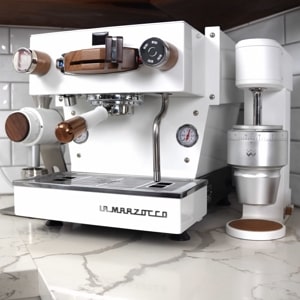
La Marzocco Linea Mini
A compact, commercial-leaning workhorse: the Linea Mini pairs a fast-responding saturated-style brew path with a big 3.0 L steam boiler, then adds genuinely useful modern tools (timer, app routines, and Brew-by-Weight support) without turning espresso into a gadget project.
Overview
The Linea Mini is built to feel like the small side of commercial: an integrated saturated-style brew path (0.17 L brew boiler), a big 3.0 L steam boiler, and a quiet internal rotary pump. The refresh adds an on-machine shot timer, cleaner pre-infusion hardware, app-first scheduling and maintenance, and Brew-by-Weight compatibility via La Marzocco’s Connected Scale.
Pros
- Saturated-style brew architecture with quick, predictable temperature response
- Strong, steady steam from a 3.0 L boiler with fast recovery
- Quiet internal rotary pump; tank use is easy, plumb-in is available
- Useful pre-brew + pre-infusion tools, plus hybrid mode when plumbed
- Built-in timer + app scheduling, rinse, and auto-backflush keep routine tight
- Brew-by-Weight compatibility (LM Connected Scale) for repeatable shot stops
Cons
- No native live flow-profiling paddle (it’s a baseline-tune platform, not a profiler)
- Premium pricing vs E61 dual boilers with similar steaming
- App and Brew-by-Weight require LM ecosystem hardware to unlock full benefits
- For long tasting sessions, full thermal equilibrium still benefits from extra soak
Features
- Type: dual boiler with integrated saturated-style brew group
- Boilers: 0.17 L coffee + 3.0 L steam, independent PID control
- Pump: internal rotary (quiet), tank or optional plumb-in
- Water: 2.5 L reservoir standard; official plumb-in kit available
- Pre-brew / pre-infusion: two-valve pre-infusion system; hybrid mode when plumbed
- Timer: built-in shot timer on the machine
- App: scheduling, temperature, stats, rinse mode, auto-backflush
- Brew-by-Weight: compatible with La Marzocco Connected Scale
- Steam: typically ~1.7–2.0 bar adjustable; cool-touch wand
- Size/weight: 38 H × 35.75 W × 54 D cm; ~30 kg
What to confirm before buying
- Voltage / region variant: confirm your market’s electrical spec and bundle contents.
- Plumb-in plans: if you want hybrid pre-infusion, budget for the official plumb-in kit + regulator + filtration.
- Brew-by-Weight: requires the LM Connected Scale (optional) to enable ABR behavior.
- Counter fit: measure depth (54 cm) and allow room for straight portafilter pulls and cup-tray access.
- Water plan: tank users still need proper softening/remineralization within LM spec.
Pricing
- USA (late-2025): ~$6,600 USD direct
- UK (official shop): ~£4,890 GBP (commonly listed)
- Australia (LM Home): ~A$8,499 AUD
- EU retailers: ~€5,025–€5,265 (varies by finish/shop/VAT)
- Note: promos and color availability can move totals—compare warranty and what’s bundled (scale, plumb kit, etc.).
FAQs
- Does it need an app to work?
- No. The paddle and timer handle daily shots. The app is for scheduling, temps, pre-brew/pre-infusion tuning, stats, rinse, and auto-backflush.
- Is Brew-by-Weight included?
- It’s platform support/compatibility. You’ll need the La Marzocco Connected Scale to run Brew-by-Weight behavior.
- Tank or plumb-in?
- Tank is easy for most homes. Plumb-in unlocks hybrid pre-infusion (pump-driven pre-brew + line-pressure soak) and a more “permanent bar” install.
- Is pump pressure a daily control?
- Think of it as a baseline tune per coffee style (e.g., 9 bar classic; 6–8 bar for some delicate light roasts), not a live profiling workflow.
Who it is for
- Home bars that want saturated-group stability and café-grade milk speed
- Buyers who value a quiet rotary pump and the option to plumb in later
- Families/teams who want scheduled readiness and tighter repeatability (timer + optional Brew-by-Weight)
- Enthusiasts who prefer simple, repeatable temperature and pre-infusion tools over daily paddle profiling
Who should avoid it
- Anyone whose #1 priority is live manual flow profiling every day
- Buyers who want the lowest-cost path to dual-boiler steam performance
- People who don’t want any ecosystem tie-ins (scale/app) for added features
Day-one workflow
- Schedule warm-up: use app on/off so the machine is ready when you are.
- Baseline shot: medium roast at ~93°C, short pre-brew + pause, pull 1:2 in the high-20s using the built-in timer.
- Light roast path: +1–2°C, longer pre-brew; if plumbed, enable (hybrid) pre-infusion for a gentler soak.
- (Optional) Brew-by-Weight: pair LM scale, set target beverage mass, let the machine stop shots automatically.
- Clean cadence: rinse mode after sessions; auto-backflush weekly; detergent backflush on a steady rhythm for daily use.
Takeaway
If you want a compact machine that behaves like a commercial platform at the handle, the Linea Mini is it. You get a saturated-style brew path with a tiny 0.17 liter brew boiler mated to a serious 3.0 liter steam boiler, a quiet internal rotary pump, real pre-brew and pre-infusion tools, and a connected app that covers scheduling, temperature, and maintenance. The recent refresh adds Brew-by-Weight compatibility with La Marzocco’s connected scale, a cleaner pre-infusion system, an on-machine shot timer, and easier pump-pressure adjustment. This is not a gadget machine. It is a tight, fast extractor with headroom for milk service and an ownership cadence that rewards discipline.
At a glance
- Format: Dual boiler with an integrated, saturated-style brew group. Internal rotary pump. Tank or optional plumb-in with hybrid pre-infusion.
- Boilers: Coffee 0.17 L. Steam 3.0 L. Independent PID control. Typical steam set near 1.7 to 2.0 bar and adjustable.
- Dimensions and weight: 38 cm H × 35.75 cm W × 54 cm D. About 30 kg.
- Water: 2.5 L reservoir standard; official plumb-in kit available.
- Controls and app: Built-in shot timer, two-valve pre-infusion system, Brew-by-Weight compatibility via the LM Connected Scale, auto backflush, rinse mode, and full app control for scheduling, temperature, and stats.
- Typical pricing by region: USA 6,600 USD direct. UK commonly around 4,890 GBP at the official shop. Australia 8,499 AUD at LM Home. EU retailers often list between 5,025 and 5,265 EUR depending on finish and shop. Real-world promos vary.
Build and design
La Marzocco designed the Linea Mini to act like a shrunken commercial rig. The brew architecture uses a small brew boiler coupled tightly to an integrated group, which mimics saturated-group behavior. In practice that means fast temperature changes at the setpoint and very consistent delivery at the puck. The brew boiler is just 0.17 liters, so temperature adjustments bite quickly. The steam boiler is 3.0 liters, which is generous for a home machine and the reason milk work feels unrushed even when guests show up.
The chassis is dense stainless with clean seams. The pump is a true internal rotary unit, which keeps sound levels calm and supports a direct-plumb install. If you stay on the tank, capacity is 2.5 liters and access is straightforward. If you plumb in, you unlock “hybrid mode.” That lets you combine app-controlled pre-brewing with line-pressure pre-infusion for an even softer start to the extraction.
The 2024 refresh modernized the front while keeping the familiar brew paddle. You now get a built-in shot timer, app-driven features like auto-backflush and rinse mode, a two-valve pre-infusion system with a self-cleaning flow restrictor, and factory-supported Brew-by-Weight with the La Marzocco Connected Scale. The pump-pressure adjustment is accessible from the top right under the cup tray, so you do not have to strip panels to make changes.
Dimensions are kitchen-friendly. At 35.75 cm wide and 54 cm deep, the machine sits comfortably on most counters. Weight is about 30 kg, which gives you the mass you want for confident lock-in without creeping the case. Measure cabinet clearance to accommodate the cup tray and a straight portafilter pull.
What stands out in the hardware
- Integrated, saturated-style brew group with tiny brew boiler for quick, precise temperature behavior at the puck.
- Oversized 3.0 L steam boiler for class-leading milk performance and recovery.
- Internal rotary pump with optional plumb-in and app-enabled hybrid pre-infusion.
- Built-in timer plus two-valve pre-infusion and Brew-by-Weight compatibility.
Workflow
Heat-up and readiness
The Mini comes to “shot-ready” quickly because the brew water path is compact. The small brew boiler and integrated group stabilize fast, so weekday espresso is realistic without long warm-soaks. For longer sessions and tasting flights, give the case extra time so baskets and the portafilter match group metal temperature. Use the app’s auto on/off scheduling to remove waiting from your routine.
Controls you actually use
The front paddle is a semi-automatic start/stop. The display gives you a clean shot timer. The app is the control room. You can set boiler temperature, choose pre-brewing times, enable or tune pre-infusion, view statistics, schedule wake and sleep windows, and trigger rinse or auto backflush cycles. These are not party tricks. They are the settings that speed you up and keep maintenance on rails.
Tank vs plumb
Tank operation is frictionless for most homes. If your kitchen layout supports it, plumbing the machine is the long-term win. Hybrid mode appears in the connected experience when plumbed in and lets you combine pump-driven pre-brew with a line-pressure soak. If you entertain or work with very light roasts, that extra control over the start of the shot is valuable.
Noise and ergonomics
Rotary pumps keep audio calm. You hear water movement and the hiss of steam, not a cheap pump rattle. The gauges are large. The wand clears pitchers with room for a proper angle. Fit and finish are commercial-leaning, which is what buyers expect at this price.
Espresso performance
Temperature stability and response
The Mini’s small brew boiler and integrated group deliver stable temperatures with quick response. Adjust a degree and you feel it in the cup on the very next shot. That is the main reason saturated-group architecture is the pros’ default in cafés. Dose honestly, distribute cleanly, and you can map taste to one-degree steps without fighting thermal lag.
Pre-brew, pre-infusion, and hybrid mode
You get two water-management tools before full pump pressure: pre-brewing and pre-infusion. Pre-brewing pulses the pump for a short wetting followed by a programmable pause. Pre-infusion is available once the machine is plumbed; it uses line pressure to soak the puck gently before full ramp. The current two-valve system was designed to be soft and self-cleaning at the restrictor. Hybrid mode lets you layer these behaviors into a repeatable routine. Together they tame channeling, especially on light roasts or tall doses in modern baskets.
Brew-by-Weight
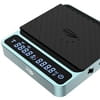
The “Connected Scale” extends the platform into ABR territory without adding brain load. Pair the LM scale and enable Brew-by-Weight in the app. Set your target beverage mass and the machine stops automatically. That removes shot-stop timing as a variable and smooths your grinder calibration loop. It is optional. Manual paddlers can ignore it. If you care about repeatability and small teams use the machine, Brew-by-Weight keeps everyone inside a tight window.
Pump pressure as a tool
La Marzocco officially documents quick pump-pressure changes from the top of the case. Target 9 bar for classic extractions, then experiment with 6 to 8 bar for delicate, high-solubility light roasts or for longer pre-brewing. Make adjustments while a shot is running to guarantee you are reading true resistance. This is not flow profiling. It is a baseline tune that many users set once per coffee style.
What it tastes like when it is right
For medium roasts, start at 93 Celsius with a short pre-brew, pull a straight 1:2 in 26 to 30 seconds, and taste. The platform rewards small, intentional changes more than dramatic ones. For Nordic-light roasts, raise brew temperature and extend pre-brew or use hybrid pre-infusion if plumbed. Lowering static pump pressure to 7 or 8 bar can soften the ramp into the puck and keep the finish cleaner. Tie those moves to the built-in timer and your notes will turn into repeatable patterns quickly.
Milk steaming
Steam is a clear strength. The 3.0 liter boiler paired with LM’s wand hits a documented 1.7 bar out of the box and can be tuned near 2.0 bar depending on region and preference. That produces commercial-speed texturing for 12 to 20 ounce pitchers with fast recovery. If you prefer a longer window for microfoam, lower the setpoint slightly or move to a lower-flow tip. The wand is cool-touch, so cleanup is immediate without scorched residue.
In a practical morning cadence, you can pull a shot, steam a cappuccino pitcher, wipe and purge, and be back at target without drama. The big steam reservoir means back-to-back lattes for guests do not require tip-dancing the valve. If your routine is mostly milk drinks, the Mini’s steam performance is a key reason to choose it over smaller dual boilers.
Maintenance and reliability
The connected experience is not just for novelty. Auto backflush and rinse mode are present to keep cleaning on schedule and reduce user error. The app also supports scheduling and stats, which nudges you to clean proactively and avoid leaving the machine idling all day. For mechanical service, the pump-pressure adjuster is accessible without pulling panels, and the platform is built with commercial sensibilities in mind.
That said, water is the decider. If you run the tank, use a proper softening cartridge or remineralized water within La Marzocco’s spec. If you plumb in, install a regulator and filtration at the wall. Stainless on the brew path helps, but scale is indifferent to brand history. Keep a detergent backflush in the weekly routine for daily users. Track your shot counter and build a cam-lube and gasket replacement cadence from it.
Programming and control
Your real control stack is simple. Set brew temperature. Choose a pre-brew time and pause. If plumbed, configure pre-infusion or hybrid behavior. Decide whether to use Brew-by-Weight. Set the auto on/off windows. Verify steam pressure if you want to widen or narrow your milk window. The timer on the face closes the loop so you do not juggle a phone while pulling shots. Together, those choices build a tight routine without turning espresso into a laptop session.
Bench workflow: dial-in, day two, and beyond
- Warm-up and heat strategy. The Mini reaches a usable brew condition quickly, but give it extra minutes for full equilibrium when you plan a long session. Schedule wake times in the app so the machine is truly ready when you are. A small purge before the first shot aligns the group and basket.
- Baseline espresso. For a medium roast, set 93 Celsius. Use a short pre-brew wetting and a brief pause. Pull a 1:2 in the high 20s seconds. Adjust grind to center your time at the ratio you prefer and note the shot seconds on the built-in timer.
- Light-roast path. Raise brew temperature a degree or two. Lengthen pre-brew. If plumbed, enable pre-infusion for a gentle line-pressure soak. Consider a lower static pump pressure for beans that punish fast ramps. Keep dose and ratio fixed for three shots while testing.
- Brew-by-Weight. When you want a hands-off stop, pair the LM scale and set your target beverage mass. The machine will end the shot automatically. This removes a human timing error, which shortens grinder calibration time on a new bag.
- Milk cadence. For single cappuccinos, you can keep steam near the default. For larger lattes or rounds for guests, raise the setpoint to approach the higher end of the machine’s range. Drop it back later to widen your texture window. The wand’s cool-touch finish speeds cleanup.
- Maintenance loop. Rinse mode after a session keeps the path tidy. Schedule auto backflush weekly and detergent backflush on a similar rhythm for daily use. Use the app’s stats and the shot counter to tie cleaning to real usage.
Competitive comparisons
La Marzocco GS3 AV/MP
The GS3 is the big brother. It runs a saturated group with larger boilers and a deeper chassis. The AV version adds volumetrics; MP provides a manual paddle. If you want full commercial ergonomics, larger water reservoirs, and the feel of a true café body, GS3 earns the premium. The Mini counters with smaller footprint, lower energy use, and the new Brew-by-Weight compatibility that covers many “set and forget” needs without volumetrics. Pricing spreads are significant. In the US, GS3 starts around 8,400 USD while the Mini sits at 6,600 USD.
La Marzocco Linea Micra
Micra is fast and tiny with strong steam for its size, but it is not built for plumb-in or extended milk rounds. Choose Micra if vertical space and heat-up speed are your only priorities. Choose Mini if you want bigger steam headroom, hybrid pre-infusion when plumbed, and the mass of a rotary pump platform.
Lelit Bianca PL162T
Bianca offers an E61 with a true needle-valve paddle and firmware low-flow modes from day one. If manual flow profiling is your non-negotiable, Bianca is the value leader. The Mini answers with saturated-group temperature behavior, faster response to temperature changes, and a larger steam headroom. Add Brew-by-Weight and hybrid pre-infusion, and you still keep the workflow simpler than riding a paddle each morning.
ECM Synchronika
A premium E61 dual boiler with stainless boilers, rotary pump, and plumb-in. Synchronika II adds fast heat-up and OLED scheduling. It is superb in the E61 lane. The Mini remains stronger on heat path design and steam headroom relative to size, plus the app’s rinse, auto-backflush, and Brew-by-Weight options. Pick ECM for the classic lever ritual and optional flow-control kit. Pick Mini for saturated-group extraction with modern automation tools.
Profitec Pro 700
Similar to Synchronika in concept. Stainless dual boilers, rotary pump, fast heat routine on current stock, and a PID timer. For buyers who like E61 ergonomics and plan to add a flow-control kit, the Pro 700 is a steady pick. The Mini wins if you value rapid temperature response, integrated app routines, and the optional ABR experience via a native scale.
Rocket R Cinquantotto (R58)
Dual boiler with rotary pump and a detachable control pod. Classic E61 feel and great steaming, but no native ABR and no saturated-group dynamics. Choose Rocket if you prefer a clean analog face with a stowable pod. Choose Mini for the integrated timer, app-first maintenance tools, and the more modern brew architecture.
Real-world numbers and observations
- Boilers and materials. Coffee 0.17 L. Steam 3.0 L. Independent PID. This pairing explains the Mini’s fast temp response and strong steam pace.
- Pressure behavior. Default steam around 1.7 bar in LM guidance and often tuned near 2.0 bar in newer manuals. Both are adjustable. Expect fast texture on 12–20 oz pitchers.
- Pump pressure. Quick adjustment under the cup tray, top right. Change during a shot for accurate readings. Use as a baseline tool, not a daily fiddle.
- Dimensions and mass. 38 H × 35.75 W × 54 D cm. Roughly 30 kg. Fit under most cabinets with room for the tray and a straight portafilter pull.
- Water path. 2.5 L tank standard. Plumb-in kit adds hybrid mode and line-pressure pre-infusion.
- Control layer. Built-in timer, app scheduling, pre-brew, pre-infusion, rinse, auto-backflush, and Brew-by-Weight with the LM scale.
- Price reality, late 2025. USA 6,600 USD direct. UK shop lists about 4,890 GBP. Australia 8,499 AUD. EU dealers often sit near 5,025 to 5,265 EUR depending on color and VAT. Promotions and inventory move these numbers.
Verdict
The Linea Mini is a rare machine that justifies its reputation. It is compact but not fragile, powerful but not loud, and configurable without becoming a science project. The saturated-style brew path makes temperature control simple and predictable. The steam boiler has real headroom. The app stitches scheduling, cleaning, and pre-brewing into a routine that helps, then gets out of the way. Brew-by-Weight support with LM’s scale pushes consistency even further for families or teams who share the bar. If daily flow profiling is your north star, an E61 with a manual paddle remains a different experience. If you want fast, clean extractions and café-grade milk from a platform that feels like the small side of commercial, the Mini is the long-term choice.