

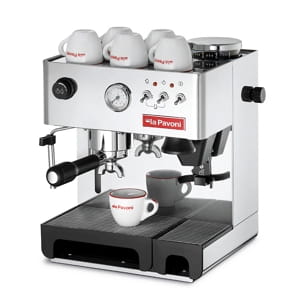
Coffeedant score: 8.0 / 10 • Single boiler + integrated grinder • 57 mm PF • 2.7 L tank
La Pavoni New Domus Bar
A compact stainless all-in-one that grinds, brews and steams in one footprint. The 7-step grinder, three-way solenoid, and front pressure gauge make medium-roast espresso and 1–2 milk drinks repeatable—so long as you follow the brew-then-steam cadence.
Overview
New Domus Bar combines a single-boiler machine, a quiet conical-burr grinder, a pump-pressure gauge, and a true three-way solenoid in one compact chassis. It excels with medium roasts and delivers credible milk texture for small pitchers. Treat the integrated grinder’s 7 detents as a macro tool, then fine-tune with dose and ratio.
Pros
- Compact stainless station: grinder + gauge + three-way valve
- Dry pucks and cleaner bench thanks to the solenoid
- Large 2.7 L tank extends refills
- On-demand grinding into the basket keeps workflow tidy
- Serviceable design with community repair knowledge
Cons
- 7-position grinder limits micrometric control (light roasts)
- 57 mm baskets/tools narrow accessory choice vs 58 mm
- Single-boiler cadence requires brew-then-steam sequencing
- Occasional minor leaks or seal wear with age—simple fixes
Features
- Type: single-boiler pump machine with integrated grinder
- Boiler: brass-forward single boiler (brew/steam modes)
- Pump: vibration, nominal 15 bar max
- Valve: three-way solenoid for dry pucks
- Portafilter: 57 mm double-spout; single & double baskets included
- Pods: ESE adapter in box
- Grinder: integrated conical set, 7-position collar
- Tank: 2.7 L removable
- Gauge: front pump-pressure gauge
- Body: stainless exterior with full top cup warmer
- Size/weight: ~300 W × 250 D × 370 H mm, ~10.5 kg
What to confirm before buying
- Grinder adjustment: current spec is 7 positions; if a listing claims stepless, ask for hardware confirmation.
- Included: single & double baskets + ESE pod insert.
- Voltage/plug: EU 220–240 V; US 110–120 V—avoid cross-border mismatches.
- Accessories: plan tamper/funnel/distribution tools in 57 mm.
Pricing
- EU: MSRP ~€799; street often €549–€699 (promos vary).
- UK: typically £549–£599 at established retailers.
- USA: recent listings ~$1,059–$1,069 (specialty shops).
- Small EU markets: can run €900–€980 when stock is thin.
FAQs
- Is the grinder stepless?
- No—current units are 7-step. Use ±0.5 g dose tweaks to split steps.
- How long is warm-up?
- Plan ~10 minutes for a heat-soaked group/portafilter before your first shot.
- Can it handle light roasts?
- Yes with patience, but the stepped grinder raises the skill floor. Medium roasts are its sweet spot.
- What’s the cleanest routine?
- Brew first → switch to steam and purge → texture milk → switch back to brew and run a short cooling flush.
Day-one workflow
- Warm-up: PF locked in ~10 min; a short blank to stabilize metal mass.
- Baseline double: 18 g in → 36–38 g out in 28–32 s from first drops.
- Gauge use: watch for a smooth rise and steady mid-shot; adjust grind/dose accordingly.
- Steam cadence: brew → flip to steam → purge → texture in a 12 oz pitcher (120–200 ml milk).
- Reset: switch back to brew and do a brief cooling flush before the next shot.
Who it is for / who should avoid it
Takeaway: The New Domus Bar is a tidy stainless all-in-one that combines a single-boiler espresso machine, a conical-burr grinder, a pump-pressure gauge, and a true three-way solenoid. It can produce balanced medium-roast espresso and credible milk texture once you learn its cadence. The built-in grinder is the make-or-break factor. It is convenient, quiet, and serviceable, yet its 7-position adjustment limits fine control for light roasts. Treat it as a compact, well-built starter workstation that favors straightforward recipes and rewards clean technique. Do not expect the flexibility of a separate premium grinder.
What the New Domus Bar is
La Pavoni’s New Domus Bar targets home users who want one stainless box that grinds, brews, and steams. The chassis is compact and finished cleanly. A front gauge shows pump pressure during extraction. A 57 mm double-spout portafilter ships with single and double baskets, plus an ESE pod insert for convenience. The water tank is oversized for the footprint, and the top panel doubles as a cup warmer.
Inside you get a single boiler with a vibration pump and a three-way valve. That valve vents pressure after a shot, which leaves dry, clean pucks and protects gaskets when you remove the portafilter. Owners moving up from basic thermoblocks notice the difference immediately.
Deals of the Week
Headline specs that matter in daily use
- Boiler system: single boiler, brew mode and steam mode
- Pump: vibration, nominal 15 bar maximum
- Portafilter: 57 mm, double spout, 1-cup and 2-cup baskets, ESE adapter
- Grinder: integrated conical set, 7-position adjustment
- Water tank: 2.7 L removable
- Size and weight: about 300 W × 250 D × 370 H mm, ~10.5 kg
- Chassis: stainless exterior with full top cup warmer
These figures are consistent across the brand page and current distributor listings.
Build, fit, and service posture
The body panels are stainless, the footprint is genuinely small, and the machine sits planted at roughly ten kilograms. The group, portafilter, and boiler components are brass-forward in this class, with routine access for gaskets and unions. Long-term owners report the expected Italian-appliance chores: replace the group seal when it begins to seep, snug a union that loosens with thermal cycling, clean the steam tip if holes slow. None of this is exotic, and step-by-step community repair guides exist for older Domus variants, which tracks with a design built to be serviced rather than sealed.
The integrated grinder, explained
This grinder is the New Domus Bar’s defining convenience and its clearest limit.
- Adjustment: the official spec is 7 positions. That is enough to dial medium roasts on a two-shot routine, yet it can feel coarse when you chase narrow windows with modern light roasts. Some third-party pages describe stepless behavior. That inconsistency appears to be regional or generational copy rather than hardware, since current brand and retailer pages specify seven detents. Verify at purchase if you are concerned.
- Burr set and drive: retailers list conical burrs around 38 mm at low RPM. It is quiet, it runs cool, and it doses on demand into the portafilter. Single-dosing by weight is possible if you run the hopper nearly empty.
- Cup impact: seven clicks are sufficient for chocolate-leaning, medium roasts. If a click is a touch too coarse, increase dose by 0.5 g to raise resistance. If a click is a touch too fine, reduce dose or accept a slightly shorter ratio. These micro-moves recover control that a stepless collar would normally give you. This is the practical way to live happily with the built-in grinder.
Community sentiment: Owners who value neat counters like the integrated path, and they highlight the low noise and speed from hopper to cup. Enthusiasts who want ultra-precise control for light roasts tend to recommend separates, not because the machine cannot pull a good shot, but because the grinder’s macro steps create larger jumps than they prefer. That split shows up often in forum buying threads.
Workflow: the disciplined single-boiler routine
Warm-up: allow a realistic 10 minutes for the group, basket, and portafilter to equalize. Leave the portafilter locked in to preheat. The gauge is not a brew-temp proxy. Use time and taste to confirm you are ready.
Dial-in for a house double: start with 18 g in the two-cup basket, target 36–38 g out in 28–32 seconds from first drops. Use the pump-pressure gauge as a diagnostic, not an obsession. You are watching for a smooth rise and a steady mid-shot, not a specific number. If the needle slams high with slow drips, you are too fine or overdosed. If it climbs lazily and crema is thin, you are too coarse.
Temperature management: after a shot the boiler must rise to steam temperature. Flip to steam, wait for pressure to build, purge condensation, steam milk, then drop back to brew mode. Run a short cooling flush to bring the group back into range before the next shot. The three-way valve vents pressure at the end of a shot, so knockouts are dry and quick. This keeps the bench tidy and shortens cleanup time.
Steaming feel: the wand produces dry steam appropriate for one or two cappuccinos. Establish a small whirlpool, stretch gently, then roll to your target temperature. If you run multiple pitchers back-to-back, give the boiler a brief recovery pause. Retail specs and owner notes align on “solid for the size” once fully hot.
Espresso performance
Medium roasts: the New Domus Bar sweet spot
The machine shines here. With a stable warm-up and the grinder near the center clicks, the shot is syrupy and straightforward. Expect heavy crema and a chocolate-forward mid-palate at 1:2. The gauge helps you hit repeatable resistance. The three-way valve prevents messy spurts when you unlock, which keeps workflows smooth.
Light roasts: possible with patience
You can reach clarity, but you must stack small wins. Give the machine extra warm-up, run a brief warming flush to stabilize metal mass, and use dose tweaks to split the grinder’s steps. Hold your ratio a touch longer, then taste for dryness in the finish. Community feedback makes the same point in different words. The machine will pull a bright shot if you do the work, although buyers who live on Nordic-lean coffees tend to upgrade the grinder path first.
Pods: fast and flat on purpose
The ESE adapter is a convenience mode for guests and late nights. It is reliable and clean. It is not a replacement for fresh grinding.
Milk and Steaming: What To Expect and How To Nail It
The New Domus Bar is a single-boiler machine. It brews at one temperature and steams at a higher one. You switch modes, wait for steam pressure to build, texture your milk, then bring the boiler back down to brew temperature. That cadence is simple once you practice it. The wand can produce glossy microfoam for cappuccinos and lattes in small and medium pitchers. It needs a short purge, a clean tip, and a steady hand.
Warm-up for Steam
- Finish your shot, flip to steam mode, and give the machine 20–40 seconds to build pressure once fully warmed.
- Purge the wand for 1–2 seconds to clear condensation.
- If the machine has idled, purge twice. Water collects in the wand during idle and will thin your foam if you skip this step.
Pitcher Size and Milk Volume
- Best range: 120–200 ml of cold milk in a 12 oz pitcher. The boiler can handle a larger pitcher, yet this volume hits a sweet spot for power and control.
- Milk choice: Whole milk gives you denser, silkier foam. Barista-style oat and soy work well for practice. Keep them cold to slow the temperature rise.
Technique: Stretch, Then Roll
- Stretch phase: Tip the wand just under the surface, off-center. Listen for a quiet paper-tearing sound. Keep stretching only until the milk reaches 30–35 °C.
- Roll phase: Submerge the tip slightly deeper and angle the pitcher to create a vortex. This rolls larger bubbles down and polishes the foam.
- Target temperature: Stop at 55–60 °C for latte art and 60–65 °C for cappuccino. Milk tastes flatter above 65 °C.
A good single-boiler will take 20–40 seconds to bring 150 ml of milk from fridge cold to pour-ready texture. Times vary with milk type, starting temperature, and how long you waited after switching to steam mode.
Sequencing: The Cleanest Workflow
- Brew first, then steam. Always.
- Purge before and after steaming. A quick blast of steam clears water before you start and milk residue after you finish.
- Wipe immediately. Use a damp microfiber cloth. Do not let milk bake on the tip.
- Return to brew. Switch back to brew mode. Run a short cooling flush into a cup to bring the small boiler out of steam range and stabilize it for the next shot.
Troubleshooting Texture
- Big bubbles or loud screeching: The tip is too high. Lower the wand a few millimeters and reduce the air entry.
- Flat, thin milk: You stayed too deep for too long. Spend a few seconds in stretch before the roll. Check that you purged condensation.
- Sputtering, watery foam: You skipped the purge. Purge, wipe, and start again with fresh milk.
- Stalled steam near the end: Give the boiler ten seconds to recover, then finish the roll. Single-boilers can sag if you push a very large pitcher from a cold start.
- Good foam, but no art: Your temperature is too high or the surface is still bubbly. Stop closer to 58–60 °C, polish with a brief roll, tap the pitcher, and give the vortex two gentle swirls before pouring.
Small Pitcher, Big Payoff
Single-boilers feel stronger with a 12 oz pitcher and 120–160 ml of milk. You get faster response from the wand, a tighter vortex, and fewer stalls. Scale up only after you can consistently stretch and roll at this size.
Pouring Notes
- For cappuccino, stretch a little longer early, stop around 60–65 °C, then pour with a slightly higher start to drop the foam, followed by a low, slow finish.
- For latte art, stretch briefly, keep the texture thin and glossy, stop near 58–60 °C, then pour low once the cup is half full to lay the pattern.
Care and Maintenance for the Wand
- Daily: Purge, wipe, and open the valve for one more short purge after you clean the tip.
- Weekly: Unscrew the tip and soak it in warm water. If holes slow down, clear them with a wooden toothpick.
- Monthly: Check the wand’s swivel joint and valve for weeping. A gentle snug on the nut or a fresh gasket keeps everything dry.
How To Keep Steam Consistent Shot After Shot
- Give the machine a full warm-up before any session that includes milk. A hotter system recovers faster.
- After one pitcher, wait 10–20 seconds with the valve closed to rebuild pressure.
- If you plan two milk drinks, steam both pitchers back-to-back before returning to brew mode. That avoids repeated transitions that sap heat.
Two Common Routines
Flat white routine
- Pull a 1:2 double.
- Switch to steam, purge, stretch to 32 °C, roll to 58–60 °C.
- Return to brew and flush for the next shot.
Cappuccino for two
- Pull two ristrettos back-to-back.
- Switch to steam, purge, stretch to 35 °C, roll to 62–65 °C in a 12 oz pitcher with 180–200 ml of milk.
- Split the milk evenly, then return to brew and flush.
Accessory Tips That Help
- Thermometer: A simple clip-on probe prevents overheated milk while you learn.
- Smaller tip: If your wand supports interchangeable tips, a smaller or fewer-hole tip increases control on micro-volumes.
- Pitcher spout: A sharp-spouted 12 oz pitcher improves accuracy for rosettas and hearts.
What “Good” Looks and Feels Like
Finish with a surface that is glossy and free of visible bubbles, and a pitcher that feels warm but not too hot to hold at the base. The foam should move like wet paint. If it looks dry or meringue-like, you introduced too much air or overheated. If it looks thin and watery, you did not stretch enough or you steamed with water trapped in the wand.
Use this section as your playbook. The New Domus Bar does not brute-force milk like a café HX or dual-boiler. It does not need to. With a short purge, a small pitcher, and a steady stretch-then-roll, it delivers clean, glossy microfoam on demand. The key is rhythm: brew first, steam second, clean as you go, and reset the boiler with a brief flush before the next shot.
What users consistently praise, and what they flag
Strong notes from owners
- Space saving and simplicity. One appliance, one switch-on, one warm-up. Fewer cables, less counter sprawl.
- Dry pucks and cleaner bench. The three-way solenoid vents pressure at the end of the shot. This is a real usability upgrade over entry machines that glue pucks to the screen.
- Stainless presence. The machine feels like a real appliance rather than a plastic toy. That comes up often in retail commentary and owner notes.
- Large tank. 2.7 L stretches refills and supports small gatherings without stress.
Consistent flags
- Grinder precision. Seven macros make dialing light roasts fussy. Dose tweaks help, yet some owners want stepless control and end up adding a separate grinder later.
- 57 mm ecosystem. Tool and basket variety is narrower than 58 mm. You can get what you need, but shopping requires attention to sizing.
- Occasional early maintenance. Reports of small leaks from unions or group gaskets appear from time to time, typically solved with a wrench or a seal swap. This is ordinary DIY care for a machine in this class.
Practical recipes that map to the grinder’s steps
Balanced double for daily use
18 g in. 36–38 g out. 28–32 s from first drops. Start at click 4 of 7, then adjust dose by ±0.5 g before jumping a whole click. This yields a sweet core with good crema on medium roasts.
Milk-forward ristretto
18.5 g in. 30–32 g out. 25–28 s. Keep the grinder one click finer than your house double. Steam immediately after the shot for tight microfoam in a 12 oz pitcher.
Clarity-leaning double
17 g in. 40–42 g out. 30–34 s. If a full click coarsens too much, stay at the finer click and drop dose to 16.5 g to widen flow without exiting your ideal window.
These recipes take advantage of dose as a fine control, which is the best way to resolve a stepped collar.
Reliability, parts, and ownership
The architecture is simple. A single boiler, a vib pump, a three-way solenoid, and an integrated grinder. Most fresh-from-the-box issues are minor and mechanical. A loose union or an aging gasket is a home fix for anyone comfortable with a wrench. Exploded diagrams and manuals are easy to find, and there is a long tail of community repair information for Domus-family machines. Expect to replace the group gasket, steam-wand seals, and burrs over a sensible multi-year horizon.
Descale policy and water: use moderately soft water, then descale at measured intervals. This protects the boiler, solenoid, and wands. Retailers recommend periodic descaling, which aligns with what you see in routine service.
Ergonomics and daily feel
The front gauge is readable. The switches are clear. The spouts land naturally over a demitasse on a scale. The steam wand produces a controllable vortex with a small tip. The cup warmer is actually useful across a narrow body, which is not always true at this price. The integrated grinder button sits exactly where you park the portafilter, so grinding into the basket feels natural. A simple on-demand dose discourages stale grounds piling up. A large tank at the rear extends refill intervals. The whole routine is calm once you learn the brew-steam-brew rhythm.
Specifications
| Item | Spec |
|---|---|
| Machine type | Single-boiler pump espresso machine with integrated grinder |
| Boiler | Single, brass-forward construction |
| Pump | Vibration, nominal 15 bar |
| Portafilter | 57 mm double spout, single and double baskets included |
| Pods | ESE adapter included |
| Grinder | Conical burrs, low RPM, 7-position collar |
| Water tank | 2.7 L, rear removable |
| Dimensions | ~300 W × 250 D × 370 H mm |
| Weight | ~10.5 kg |
| Gauge | Pump-pressure gauge on front panel |
| Body | Polished stainless, full top cup warmer |
| Sources: brand product page and current retailers. |
Scores and rationale
Espresso Quality: 7.9 / 10
Balanced, sweet medium-roast espresso is repeatable once warm-up and recipe are steady. The three-way valve protects puck integrity, which helps consistency. Light roasts are possible, yet the grinder’s macro steps raise the skill floor.
Milk/Steam: 7.6 / 10
For a compact single boiler, steam is dry and strong enough for a pair of cappuccinos, with quick recovery once fully hot. Technique matters more than brute power, and the wand delivers predictable texture with a small pitcher.
Workflow & Ergonomics: 8.3 / 10
One footprint, one warm-up, one routine. The gauge offers legible feedback. The grinder button and spout geometry make on-demand dosing painless. The single-boiler cadence asks for a steady sequence rather than rush.
Build & Reliability: 8.0 / 10
Stainless exterior, simple hydraulics, and available parts make this a sensible long-term appliance. Occasional early leaks or worn seals are normal DIY fixes, not red flags.
Features: 8.1 / 10
Integrated grinder, gauge, three-way valve, ESE capability, and a large tank are strong at this size. The 57 mm ecosystem narrows accessory choice compared with 58 mm.
Value: 8.2 / 10
For buyers who want a tidy, stainless station without hunting a separate grinder, the value is clear. Enthusiasts who plan to explore light-roast clarity will outgrow the grinder’s steps, which tempers the long-term calculus.
Overall: 8.0 / 10
Pros
- Compact stainless station with grinder, gauge, and three-way valve in one body
- Large 2.7 L tank extends refills and suits small gatherings
- On-demand grinding into the basket keeps workflow tidy and fresh
- Dry pucks and cleaner knockouts thanks to the solenoid
- Sensible access for routine service, with community repair knowledge available
Cons
- 7-position grinder limits micrometric control, especially on light roasts
- 57 mm baskets and tools reduce accessory breadth
- Single-boiler cadence requires brew-then-steam sequencing
- Occasional minor leaks or seal wear appear with age, usually simple to fix
Who it is for
- Home users who want a clean, self-contained setup that handles daily espresso and cappuccinos without a second appliance
- Buyers who value a pressure gauge and three-way valve for learning and cleanliness
- New enthusiasts who drink mainly medium roasts and prefer a compact, stainless aesthetic
Who it is not for
- Tinkerers who demand stepless grind control and a 58 mm toolchain
- Households that make multiple milk drinks back-to-back without pauses
- Light-roast specialists who expect narrow grinder moves for long, high-clarity ratios
Maintenance notes
- Daily: water backflush because you have a three-way valve, wipe the screen, purge and wipe the steam wand, empty the tray
- Weekly: detergent backflush, soak baskets and spouts, brush the chute and burr chamber
- Water: use moderately soft water to protect the boiler and solenoid, then descale at measured intervals per retailer guidance
- Wear parts: keep a spare group gasket and steam-wand seals, consider a burr refresh on a multi-year horizon
- DIY: if you see a small leak at startup or during shots, inspect and snug unions or replace the relevant gasket, which is a normal owner task for this platform
Buying guidance
- Confirm grinder adjustment. Current official copy lists 7 positions. If a listing claims stepless, ask the seller to verify the actual hardware. This is the single most important purchase variable.
- Check the basket set and ESE adapter. These should be in the box.
- Measure your space. The body is compact, but leave room to swing the wand and park a scale. ~300 × 250 × 370 mm is the working footprint.
- Plan accessories in 57 mm. Tamper, funnel, and distribution tool must match. Availability is good, but not as broad as 58 mm.
- Set expectations. Think balanced doubles, tidy workflow, and one or two milk drinks per session. Treat dose as your fine-tune when the grinder’s steps are large.
Pricing, Packages, and Regional Notes
Street price varies by region and retailer. Treat the figures below as current ranges, not fixed RRPs, since this model often swings with promotions.
- European Union: La Pavoni lists the New Domus Bar at €799 on the official store. Street prices fluctuate between €549 and €699 at mainstream EU retailers, with occasional spikes higher from boutique shops.
- United Kingdom: Typical pricing sits around £549 to £599 from established coffee retailers. Outliers north of £1,000 appear at specialty stores or when stock is thin, so compare before you buy.
- United States: Current listings cluster around $1,059 to $1,069 from smaller espresso specialists. Inventory can be intermittent, which explains why you will sometimes see a larger spread online.
- Ireland and smaller EU markets: Expect a premium at low-volume sellers. Listings around €900 to €980 are not unusual when stock is limited.
What to verify before you pay
- Grinder adjustment type. The New Domus Bar is currently specified with a 7-position integrated conical grinder. Some older or regional listings still claim stepless. Ask the retailer to confirm the hardware, since this directly affects dialing precision.
- Included baskets and ESE adapter. The box should include single and double baskets plus an ESE pod insert. Confirm these details in the product listing.
- Voltage and plug. EU stock is 220–240 V. US stock is 110–120 V. Buying cross-border without a compatible model can create service and warranty headaches.
- Returns and support. Favor sellers that list spare parts, gaskets, and clear return policies. Pricing is only a win if you can service the machine locally.
When to buy
This category sees the best discounts during seasonal sales. In the EU and UK the machine often drops below the brand MSRP at multi-brand retailers. In the US the price tends to be steadier due to limited distribution, so watch smaller specialty shops for coupon events rather than dramatic headline cuts.
Who should pay the premium
If you value the integrated, stainless look and the three-way valve, the official store price can be justified when bundled with accessories or extended support. If you are price sensitive and comfortable with third-party service, reputable retailers frequently undercut the official price by €150 to €250.
Comparisons: How the New Domus Bar Stacks Up
The fairest comparison set includes compact all-in-one machines with an integrated grinder. Each alternative takes a different path on temperature control, grinder precision, and boiler architecture.
La Pavoni New Domus Bar vs Lelit Anita PL042TEMD
Where they are alike: Both are compact Italian single-boilers with a three-way solenoid, a 57 mm portafilter, and an integrated conical grinder. Both target owners who want one stainless box rather than two.
Key differences that affect taste and workflow:
- Temperature control: The Anita includes PID control for brew and steam temperatures, which gives you more direct control over water temperature. The New Domus Bar relies on thermostat control without a front-panel PID. If you switch beans often, PID simplifies repeatability.
- Grinder precision: The Anita’s grinder is micrometric stepless with 38 mm conical burrs. The New Domus Bar’s grinder has 7 fixed steps. If you drink light roasts and chase narrow flow windows, stepless adjustment is easier to live with.
- Price: Anita street prices commonly sit around €650 to €750 in the EU, with outliers both below and above depending on region. The New Domus Bar ranges €549 to €799 depending on the seller. In practice they overlap, so buy on feature fit rather than sticker shock.
Verdict of the matchup:
Choose Anita if you value a PID and stepless grind for finer control across roasts. Choose New Domus Bar if you prefer La Pavoni’s styling, you drink mostly medium roasts, and you are comfortable using dose tweaks as your fine control on the 7-step grinder.
La Pavoni New Domus Bar vs Quick Mill Pegaso 3035
Where they are alike: Stainless chassis, integrated grinder, pressure gauge, and a design meant to be serviced at home.
Boiler and heat system: The Pegaso uses Quick Mill’s metal thermoblock system with thermostatic control and a copper heat-exchange path. Marketing sometimes calls the path HX, but the platform is not a traditional tank-style HX boiler. The practical takeaway is fast warm-up and robust steam for size, with different thermal behavior from a classic single boiler.
Grinder and dosing: Pegaso integrates a timed doser and larger 43 mm flat burrs in many listings, while the New Domus Bar uses a small conical set with seven macro steps. The Pegaso’s integration is more cafe-like, although the adjustment system and labeling vary by unit.
Price: Pegaso typically runs €850 to €949 in mainland Europe and CHF 800 to CHF 870 in Switzerland. That puts it above many Domus Bar street prices.
Verdict of the matchup:
Choose Pegaso if you want quicker heat, stronger steaming for its size, and a more elaborate grinder module with timer dosing. Choose New Domus Bar if you prefer a simpler single-boiler routine, a larger water tank, and a lower entry price in the EU and UK.
La Pavoni New Domus Bar vs Breville Barista Express
Where they are alike: Compact all-in-one form, integrated conical grinder, front gauge, and a solid starter workflow for espresso and milk drinks.
Key differences:
- Heater and readiness: Barista Express uses a thermocoil heater with PID control and heats quickly. New Domus Bar is a classic single-boiler that prefers a longer heat soak. The Express is faster from cold, the Pavoni is more traditional in thermal behavior.
- Portafilter size: Breville uses 54 mm. Pavoni uses 57 mm. Accessory ecosystems and basket geometry differ.
- Grinder range: Current Barista Express models advertise 16 grind settings on the built-in conical burrs. The New Domus Bar has 7 steps. This is the major control difference.
- Price: In the US, the Barista Express often sells between $550 and $750 depending on sales. The New Domus Bar lists near $1,060 from specialty retailers. That pricing gap is significant.
Verdict of the matchup:
Choose Barista Express if budget and speed to cup are the priorities and you are comfortable with a 54 mm system and a consumer-oriented interface. Choose New Domus Bar if you want Italian stainless styling, a three-way solenoid, a larger tank, and you accept the slower, more traditional single-boiler cadence.
La Pavoni New Domus Bar vs Breville Barista Pro
Where they are alike: All-in-one format with integrated grinder and modern UX.
What changes the feel:
- Heating system: Barista Pro uses ThermoJet and reaches brew temperature in seconds. That enables a fast routine for one or two drinks. New Domus Bar needs conventional warm-up.
- Grinder precision: Barista Pro integrates 30 grind settings, a clear step up in granularity over the Pavoni’s 7 steps.
- Interface: The Pro has an LCD with volumetrics and guided prompts, which helps beginners. The Pavoni is analog and simple.
- Price: In the UK, the Barista Pro’s best current prices hover around £628, with typical retail higher, while US pricing commonly sits in the $680 to $850 band. The Pavoni often costs more than a Pro in both markets.
Verdict of the matchup:
Choose Barista Pro if you want speed, a broader grind range, and a guided interface. Choose New Domus Bar if you prefer the mechanical simplicity and the stainless aesthetic, and you are content with seven grinder steps supplemented by dose adjustments.
Snapshot Comparison Table
| Model | Heater and temp control | Grinder and adjust | Portafilter | Three-way valve | Typical price region |
|---|---|---|---|---|---|
| La Pavoni New Domus Bar | Single boiler, thermostat control, analog gauge | Conical, 7-step | 57 mm | Yes | EU €549–€799, UK £549–£599, US $1,059–$1,069 |
| Lelit Anita PL042TEMD | Single boiler with PID for brew and steam | Conical, stepless micrometric, 38 mm | 57 mm | Yes | EU €650–€750 |
| Quick Mill Pegaso 3035 | Quick Mill metal thermoblock with copper HX path, fast steam | Integrated grinder, timer dosing, often 43 mm flats | 58 mm equivalent baskets vary by seller | Yes | EU €850–€949, CH CHF 800–870 |
| Breville Barista Express | Thermocoil with PID, faster heat | Conical, 16 settings, consumer UI | 54 mm | Yes | US $550–$750 |
| Breville Barista Pro | ThermoJet fast heat, LCD interface | Conical, 30 settings | 54 mm | Yes | UK £628–£730, US $680–$850 |
Figures synthesized from current brand pages and active retailer listings. The Pegaso’s heater is marketed as a metal thermoblock with Quick Mill’s heat-exchange path rather than a conventional boiler.
Which One Fits Which Owner
- You value precision and control across beans: Lelit Anita PL042TEMD feels more adjustable day to day, thanks to PID and stepless grind. It asks for the same space and offers a familiar Italian workflow.
- You want speed and a modern interface: Barista Pro wins on start-to-sip time and grind range, with a clear display and easy volumetrics.
- You want stronger steaming and fast heat in one box: Pegaso tilts toward faster readiness and punchy steam in this size class, with a more elaborate grinder module. Verify the specific grinder and control features since they vary by seller.
- You want the lowest cost of entry: Barista Express is usually the least expensive, especially during seasonal sales, and it covers the fundamentals with a friendlier budget.
- You want classic stainless style and a simple analog routine: New Domus Bar keeps the ritual calm and the counter tidy. Accept the 7-step grinder and use dose as your fine control to split the gaps.
Bottom Line on Comparisons
If your original interest in the New Domus Bar is the compact stainless look, the three-way valve, and one-box simplicity, it still makes sense. If you are already pushing into lighter roasts or you know you will chase small flavor changes week to week, the Anita’s PID and stepless grinder give you more headroom at a comparable price in the EU. If you prefer speed and a guided interface, the Barista Pro is the most beginner friendly. If you want a more aggressive steaming profile and quick readiness at a higher price, Pegaso belongs on the shortlist. Breville’s Barista Express remains the budget pressure release, with the broadest sale activity in the US.
Use these differences to choose by workflow and control, not just price. That is the path to a machine you will keep using after the first month.
Verdict
The La Pavoni New Domus Bar is a compact stainless workstation that makes sense when you want espresso, milk, and a small footprint with minimal clutter. The single boiler and three-way valve create a clean, learnable routine. The gauge shortens dialing. The large tank stretches refills. The built-in grinder is the strategic compromise. It delivers convenience and quiet operation, and it can absolutely land satisfying medium-roast espresso. It does not offer the micrometric precision that light-roast explorers crave.
Approach it with the right goals. If you want a neat, reliable machine that handles morning doubles and a couple of cappuccinos with minimal fuss, the New Domus Bar does the job and looks the part. If your ambitions lean toward high-extraction light roasts and constant recipe experimentation, plan a path to a separate grinder. Either way, the machine itself behaves predictably once warm, it rewards tidy technique, and it is built to be maintained over time.
TL;DR: Compact stainless all-in-one. Single boiler, vib pump, pressure gauge, three-way solenoid, and a 7-position conical grinder. Excellent for medium-roast espresso and simple milk drinks in a small space. The grinder’s macro steps are the ceiling. Verify adjustment at purchase, learn the brew-steam cadence, and enjoy balanced espresso with a calm, clean workflow.
We’ve categorized the best espresso machines for every kind of buyer
Find the right shortlist faster, whether you want convenience, a beginner-friendly setup, a smaller footprint, or better value at a given budget.
Best Superautomatic Espresso Machines
One-touch picks for speed and convenience.
Best Espresso Machines for Beginners
Easy-to-use machines with a smoother learning curve.
Best Small Espresso Machines
Compact machines for tighter kitchens and counters.
Best Espresso Machines With Built-In Grinder
All-in-one options with fewer extra pieces to buy.
Best Cheap Espresso Machines Under $500
Budget picks that still make sense for real espresso.
Best Prosumer Espresso Machines Under $1000
More serious machines with stronger value for the money.
Best Single Boiler Espresso Machines
Simple, space-saving picks for espresso-first routines.