

EU: typically €700–€900 • UK: about £600–£750 • NA: availability varies by region.
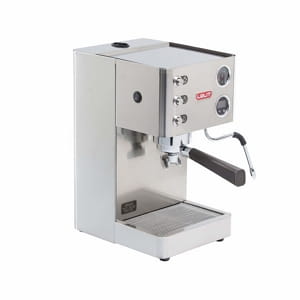
Lelit Grace PL81T
Compact PID single boiler in Lelit’s VIP line: 57 mm hardware, LCC control with degree-level brew & steam temps, menu-set preinfusion, and tidy one-drink steam that outperforms its size.
Overview
Grace is the “small but serious” Lelit: 250 ml brass boiler, 57 mm group, LCC PID with degree-level brew & steam, menu preinfusion, backlit brew manometer, and a multi-directional steam/hot-water wand. Warm-up is genuinely short (<10 min). Steam is one-drink-at-a-time but tidy, and the PID makes dialing straightforward.
Pros
- PID brew control in LCC + adjustable steam temp
- Programmable preinfusion in the menu
- Backlit brew-pressure gauge & useful status prompts
- Compact footprint with a 2.5 L tank
- 3-way solenoid for dry pucks & proper backflushing
Cons
- Internal OPV adjustment (remove panels)
- 57 mm accessories differ from 58 mm commercial standard
- Small boiler limits back-to-back milk service
- US availability/pricing can be inconsistent
Features & Specs
- Type: Single boiler, dual use
- Boiler: 250 ml brass • ~1000–1050 W (region)
- Group: 57 mm • single/double baskets + ESE pod basket
- Control: LCC PID (brew temp), steam temp, programmable preinfusion, standby
- Pump/valves: Vibe pump • 3-way solenoid
- Gauge: Backlit brew-pressure manometer
- Water: 2.5 L reservoir • low-water alert on LCC
- Wand: Multidirectional steam & hot water
- Warm-up: <10 min to brew-ready (LCC)
- Size/Weight: ~22.5 W × 27 D × 38 H cm • ~7.4 kg
Workflow & Dial-In
- Warm up: PF parked in group; LCC shows ready—do a short rinse to heat the path/cup.
- Setpoints: Pick brew temp; set steam temp to taste; enable preinfusion (2–4 s to start).
- Pull: Watch the LCC chronometer if you want consistent timing.
- Steam: Tap steam; wait for prompt; purge to dry steam and texture one pitcher.
- Return: Switch back to coffee and do a brief cooling flush to hit brew setpoint quickly.
- OPV: Adjust internally once to ~9–10 bar under blind; then leave it.
Steaming & Hot Water
Small-boiler honesty: clean, controllable steam for a 150–200 ml pitcher. Purge generously, aerate briefly, then roll. Use the wand for hot water as needed (Americanos/rinses). Raise steam temp in LCC if you prefer a snappier ramp.
Maintenance & Water
- Daily: Water backflush after sessions; wipe & purge the wand every use.
- Weekly: Detergent backflush (3-way valve).
- Scale: Keep water in a friendly hardness band; descale per Lelit guidance.
- Parts: Good availability for gaskets, OPV, wands—check Lelit parts houses.
Comparisons
- Lelit Victoria PL91T: Bigger sibling, 58 mm & more headroom; keeps LCC/PID/preinfusion.
- Profitec GO: 58 mm, PID + shot timer, external OPV; simpler pressure setup, no menu preinfusion.
- ECM Casa V: Easy-access OPV & front gauge but no PID—requires surfing cadence.
- Bezzera Hobby: Punchy boiler single sans PID; Grace wins on digital control.
- Ascaso Steel UNO PID: Thermoblock + PID & fast recovery; different thermal feel/maintenance.
- Gaggia Classic Pro: Budget/mod platform; Grace is the cleaner out-of-box PID option.
Pricing & Availability (Nov 2025)
- UK: typically £600–£750 at specialty shops.
- EU: commonly €700–€900 with periodic promos.
- Canada/NA: boutique availability, region-specific warranty; confirm voltage/plug.
FAQs
- PID?
- Yes—LCC controls brew temp; you can also set steam temp.
- Preinfusion?
- Yes—menu-set, pump-managed wetting (timed).
- Portafilter size?
- 57 mm (confirm tamper/baskets; many accessories exist).
- OPV access?
- Internal—remove panels to set once at ~9–10 bar.
- Shot timer?
- LCC chronometer view (latest firmware) for on-machine timing.
- Back-to-back milk?
- One pitcher comfortably; let boiler recover for a second round.
Takeaway
Grace sits in Lelit’s VIP line as the “small but serious” machine. It is a single-boiler platform with a 250 ml brass boiler, a 57 mm group and portafilter, Lelit's LCC control system with PID temperature control, a backlit brew-pressure gauge, a multidirectional steam and hot-water wand, and an adjustable preinfusion routine in the menu. The footprint is tight and warm-up is genuinely short for a boiler machine. Steam is one drink at a time but clean and predictable. If you want a compact stainless box that gives you digital temperature control and a menu-set preinfusion without moving up to a larger E61 chassis, Grace is the point. Core specs and LCC functions are documented in the official user manual and current retailer pages.
At-a-Glance Specs
- Type: Single boiler, dual use
- Boiler: 250 ml brass, about 1000 to 1050 W element by market
- Group and baskets: 57 mm group and portafilter, single and double baskets included, ESE pod basket included
- Temperature control: Lelit Control Center PID with adjustable brew temperature, adjustable steam temperature, programmable preinfusion, standby mode
- Pump and valves: Vibration pump, 3-way solenoid for dry pucks
- Pressure display: Backlit brew-pressure manometer
- Water: 2.5 L reservoir with low-water alert on the LCC display
- Wand: Multidirectional steam and hot water
- Dimensions and weight: roughly 22.5 W x 27 D x 38 H cm, about 7.4 kg
- Warm-up: under 10 minutes quoted by sellers, with the LCC showing ready state
These details are consolidated from the Lelit PL81T manual and consistent retailer spec sheets.
Price and Availability
Grace is sold broadly in the EU and UK, with uneven distribution in North America. Real-world pricing floats across promotions. Current examples: UK specialist shops list PL81T in the six-hundreds to low-seven-hundreds of pounds when in stock; several EU sellers publish list prices in the 700 to 900 euro band and run periodic discounts; Canadian retailers show availability with regional warranty and typical boutique-shop pricing. These bands align with current listings from Fixpresso, CoffeeItalia UK, and Canadian retailers. If buying outside the EU and UK, confirm voltage and plug.
Deals of the Week
Build
Materials, layout, and footprint
Grace is a stainless chassis with tidy panel fit. The 250 ml brass boiler is compact and heavily leveraged by the LCC PID to hit set temperature quickly and repeatably. The group standard is 57 mm, which is Lelit's smaller portafilter ecosystem used on Anna-class machines and this Grace chassis. The face carries three backlit rocker switches and a backlit brew manometer. The LCC screen sits above the drip tray and exposes brew temp, steam temp, preinfusion, and status prompts. The wand is on a ball joint and serves both steam and hot water. Tank access is top-load with a published 2.5 L capacity. Dimensions around 22.5 x 27 x 38 cm keep the footprint friendly for real kitchens. All of this is supported by the user manual and retailer spec sheets.
The 57 mm choice is worth calling out. It is not a limitation for daily use and there is a healthy accessory market for baskets and bottomless portafilters in this size, but it is different from the 58 mm commercial standard you see on many prosumer machines. Confirm basket and tamper sizing when you kit out. Third-party parts listings, Lelit's own parts docs, and retailer catalogs confirm the 57 mm spec and accessory availability.
Controls and information
The LCC is clear and practical. You set brew temperature in single-degree steps, set steam temperature, toggle preinfusion, and the display gives status prompts for steam mode, hot-water mode, and low water. The latest LCC update adds a chronometer-style shot-time view, along with reserve mode that lets you complete a shot if the tank hits empty mid-pull. These are documented in Lelit’s updated manual notes.
Service access and OPV
Pump pressure is governed by an adjustable OPV. On Grace, access is internal. You remove the top and rear shrouds to reach the brass valve and set your ceiling against a blind basket. It is not difficult, but it is not the “pop the tray and twist a screw” convenience you see on some rivals. Multiple owner guides and reviews walk through the nine-bar adjustment process on PL81T.
Workflow
Warm-up and readiness
Grace warms quickly for a boiler machine. Sellers quote less than ten minutes and that tracks with a 250 ml brass boiler under PID. Lock the portafilter in during warm-up so you are heating metal and not just water. The LCC shows the rising temperature and gives you the “OK” indicator when the setpoint is reached. At that point a short blank rinse through the group will equalize the dispersion path and heat your cup. The user manual covers the start-up sequence and the LCC ready prompt.
Temperature control and preinfusion
This is where Grace earns its name. A lot of small single boilers force you into temperature surfing because control is thermostatic. Grace runs a PID. You pick a brew temperature, you get a repeatable thermal behavior, and you can nudge by a degree or two to suit the coffee. LCC also exposes a preinfusion setting. On Grace this is a timed, low-power pump wetting rather than a line-pressure soak. It is still useful. With light and medium-light roasts, the machine’s preinfusion helps reduce early channeling and gives a calmer start to flow. You can also adjust steam temperature independently, which speeds or slows the ramp into steam mode based on your preference. The LCC menu supports all three functions.
A practical daily cadence
- Warm up with the portafilter parked in the group.
- Run a short empty rinse to settle the group and heat the cup.
- Grind, prep, and lock in.
- Start the shot. Watch the LCC time if you use it for consistency.
- If steaming, press steam, wait for the LCC steam prompt, purge the wand, and texture.
- Cut steam, switch back to coffee, and run a short cooling flush to bring the boiler down to brew temperature.
These steps mirror the official sequence for brew, steam, and hot-water functions.
Pressure setup
Set your OPV once. Out of the box many small machines arrive around 10 to 11 bar under blind. Grace gives you an internal OPV that you can tweak to land in the nine to ten bar window. Do this once with the machine fully warm, a blind basket locked in, and the gauge as reference. The “how” is widely documented by PL81T owners. Once set, leave it alone.
Espresso Performance
Shot stability
A small brass boiler under PID control with a short water path is a recipe for steady in-shot temperature in the home context. You do not have the heavy thermal mass of an E61, but you make up for it with quick heat transfer and a tight loop between setpoint and group. The useful part is repeatable behavior. Pick a brew setpoint and a preinfusion time, keep your puck prep clean, and Grace will give you consistent shots without a surfing ritual. Lelit's manual and the LCC documentation make the temperature and preinfusion capabilities explicit.
Flavor expectations
With a baseline 17 to 18 g in and 34 to 36 g out in 25 to 30 seconds, expect classic medium-roast sweetness and body with clear chocolate and nut. Medium-light espresso roasts benefit from a one to two degree higher brew temp and a short preinfusion. The machine is responsive to small setpoint changes, so it is easy to tune taste without changing grind every time. Lelit’s materials give you the tools here: PID step control and on-off preinfusion. Third-party notes confirm users regularly adjust brew and steam temps and use the preinfusion toggle.
Flow and pressure feel
The 57 mm group has a slightly different feel when you lock in the portafilter compared to 58 mm, but the hydraulics across puck area are consistent with a good basket. If you upgrade to a precision double, you will notice a cleaner decline in pressure as the puck opens. The backlit gauge is not a lab instrument. It is good enough to confirm that your puck resistance is in a healthy band and that your OPV adjustment is still where you set it. Lelit’s spec calls out the brew gauge, and accessory catalogs show deep 57 mm basket support.
Milk Steaming
Power and pace
A 250 ml boiler is not a café steamer, but Grace does not pretend to be. From brew to steam is a short hop when you drive the steam temperature in the LCC. Give the element a moment to complete the climb, purge the wand until dry steam, and texture a 150 to 200 ml pitcher to 60 to 65 C without drama. For a second drink, let the boiler recover. The manual outlines the steam sequence and specifically calls out the LCC’s steam mode prompts.
Technique on a small boiler
- Purge generously at the start so you are not injecting water.
- Keep aeration short at the top of the pitcher, then set a controlled vortex and finish at temp.
- After steaming, wipe and purge the wand immediately, drop back to coffee on the panel, and run a short cooling flush to pull the boiler down to brew setpoint.
Lelit’s manual guidance mirrors these steps and reminds you to cap latte finishing temps near 65 C for best texture.
Maintenance and Water
Daily and weekly care
Grace has a 3-way solenoid, so you should do proper detergent backflushes in addition to water rinses. Wipe and purge the wand after every use. Empty the tray before it rides high. The official manual covers cleaning and maintenance schedules, including the steps for steam and hot-water hygiene.
Descaling and water quality
Small brass boilers scale if you feed them hard water. Keep hardness in a friendly band and descale on a schedule that matches your source. Lelit publishes descaling procedures and general cautions and several retailers host downloadable guides and manuals for the PL81T. The LCC’s low-water warnings and reserve mode give you a safety net during shots but do not remove the need to manage water.
Parts and service
Exploded diagrams and spares for Grace are readily available from Lelit-focused parts houses and regional service partners. You can get gaskets, OPV valves, wands, and cosmetic parts by part number. If you keep machines for years, this ecosystem matters. 1st-Line Coffee hosts parts diagrams and supports common wear items for PL81T.
What Stands Out
- PID control and LCC in a compact boiler machine
Many sub-E61 singles at this size still rely on thermostats. Grace gives you degree-level control and a menu you actually use every day. The LCC also lets you raise steam temperature to taste and engage or disengage preinfusion. That bundle of control is why Grace exists. - Timed preinfusion
The preinfusion in LCC is not line pressure. It is a pump-managed wetting. It still calms puck start-up on light roasts and helps you extract more evenly when you pair it with good puck prep. The setting lives in LCC with on-screen confirmation. - Small-boiler honesty
Steam is one-drink-at-a-time. Brew to steam and back feels quick because the boiler is small and the LCC actively manages state. But if you are serving multiple milk drinks repeatedly, you will be happier in Lelit's heat-exchanger or dual-boiler family. The manual’s brew, steam, and hot-water instructions underscore the expected cadence. - Internal OPV adjust
You can set brew pressure to taste. You just need to pop the case to do it. The work takes minutes and is well documented by owners, but it is not external. If you want tool-free pressure tuning, pick a machine with top-side access.
Competitive Set
Lelit Victoria PL91T
Victoria is the bigger sibling in the same VIP line with a 58 mm group and improved thermal capacity. It keeps LCC PID, preinfusion, and the same general workflow, but adds a more robust platform for consecutive shots and steam. Choose Victoria if you want Lelit’s interface with 58 mm hardware and more headroom.
Profitec GO
Compact single boiler with a ring group, full PID, a built-in shot timer, a front gauge, and an externally accessible OPV. Similar footprint, faster to set pressure, and a 58 mm ecosystem. It lacks a hot-water spout and its preinfusion is manual rather than menu-driven. Choose GO if you want 58 mm hardware and a dead-simple path to nine bar.
ECM Casa V
Stainless single boiler with ring group, front gauge, and easy-access OPV. No PID. You rely on a consistent cadence to land brew temperature. Casa V heats fast for a boiler machine and offers strong build, but you lose the LCC’s digital control and preinfusion.
Bezzera Hobby
Another compact boiler single with a 58 mm commercial-style group and punchy steam for its size. No PID in common trims. Faster warm-up than E61 designs and a robust chassis, but you give up Grace’s LCC and preinfusion. Pricing often favors Hobby in the EU.
Ascaso Steel UNO PID
Thermoblock with PID, programmable preinfusion, and external OPV. It is quick to temperature, recovers rapidly, and has a different maintenance profile. UNO PID is attractive if you want digital control with thermoblock speed rather than a small brass boiler feel.
Gaggia Classic Pro
Lower-priced boiler single with a 58 mm group and a vast mod community. Stock machines ship without PID and with basic thermal control. If you plan to mod, Classic is the value track. If you want PID and preinfusion out of the box in a clean stainless case, Grace is the cleaner start.
Testable Expectations and Workflow Benchmarks
These are realistic day-one checks that owners can repeat.
- Heat-up
From cold, Grace should display brew-ready on LCC within ten minutes. If your room is cold, allow a couple extra minutes for the group and portafilter to soak heat. The Amazon and retailer listings that cite “less than 10 min” align with the 250 ml boiler size. - Brew to steam
From brew-ready, press steam. The LCC will show the steam icon and a prompt to open the valve when steam is available. Expect a short minute-scale delay, then purge water and steam one pitcher. The manual’s sequence describes the prompt and cut-off. - Steam to brew
After steaming, cut steam and switch back to coffee. Run a 3 to 5 second cooling flush through the group and watch the LCC return to the brew setpoint. The small boiler makes this quick. The manual documents returning to coffee mode automatically after idle. - Preinfusion effect
Toggle preinfusion on, start with a short two to four second wetting, then let the pump ramp. Taste for calmer acidity and reduced early channeling on medium-light roasts. Preinfusion lives in the LCC menu. - OPV setting
With a blind basket and the machine fully heat-soaked, expect a factory setting around 10 to 11 bar on many units. Adjust to nine to ten bar internally if you prefer. Reference owner guides before you open the case.
Scores
- Build and materials: 8.2/10
Stainless case, brass boiler, 57 mm metal where it counts, tidy backlit switches, and a clean gauge. The small footprint is a win. The internal OPV access costs a fraction of a point. - Workflow and usability: 8.6/10
PID control, menu-set preinfusion, adjustable steam temperature, and a clear display put the basics at your fingertips. Warm-up is short. The shot-time chronometer and reserve-mode touches are thoughtful. - Espresso consistency: 8.4/10
Stable shots at a given setpoint with predictable behavior across roasts. Preinfusion helps the lighter end. A precision 57 mm basket tightens results further. - Milk steaming: 7.6/10
Clean, controllable steam for one drink with quick return to brew. The physics of a 250 ml boiler limit back-to-back milk service. The LCC steam temperature setting helps you tailor pace. - Maintenance and serviceability: 8.0/10
Straightforward cleaning, 3-way valve for proper backflushing, and good parts availability. Water quality management remains critical for longevity. - Value: 8.3/10
EU and UK pricing positions Grace well against non-PID singles and even some PID rivals that lack preinfusion or the same level of menu control. US availability is spottier, which can shift the value equation.
Final Verdict
Lelit Grace PL81T is a compact, metal-forward single boiler that actually lets you control the variables that matter. PID for brew temperature. Adjustable steam temperature. A simple, menu-set preinfusion. A backlit gauge for quick read on resistance. A clear path to set brew pressure, even if you need to open the case to do it. It heats quickly, fits normal counters, and moves between brew and steam with minimal fuss.
It is not a machine designed for milk-drink marathons or for buyers who want a massive E61 presence. It is designed for people who want a small stainless machine that reaches readiness quickly, gives them digital control of brew and steam, and produces clean espresso with predictable behavior across roasts. If you know you want a 58 mm universe and an external OPV, or you need more steam headroom, look to Profitec GO or to Lelit’s Victoria or Elizabeth. If you want a compact boiler machine with smarter controls than most of its size class, Grace belongs on your shortlist. The numbers and functions behind this verdict are supported by Lelit’s manuals and current retailer documentation.
TL;DR
Grace is a small stainless single boiler with a 250 ml brass boiler, 57 mm group, LCC PID control, menu-set preinfusion, a backlit brew gauge, and a multidirectional steam and hot-water wand. It warms quickly, steams one drink neatly, and returns to brew with a short cooling flush. If you want compact size with real temperature control and preinfusion in the menu, Grace delivers.
Pros
- PID brew control with degree-level adjustment in LCC
- Programmable preinfusion and adjustable steam temperature
- Backlit brew-pressure gauge and clear status prompts
- 57 mm ecosystem with widely available baskets and bottomless portafilters
- Compact footprint with 2.5 L tank and fast warm-up for a boiler machine
Cons
- Internal OPV adjustment requires removing panels
- 57 mm means a different accessory path than 58 mm commercial standard
- Small boiler limits multi-drink milk sessions
- US availability and pricing are inconsistent relative to EU and UK
Who It Is For
Home baristas who want a compact single boiler with real digital control. If you pull a few shots a day, steam a cappuccino here and there, and prefer to set brew temperature from a menu rather than surf a thermostat, Grace is an easy machine to live with. If you regularly serve multiple milk drinks or insist on 58 mm hardware with tool-free pressure adjustment, go up a size or step to a different platform.
Variant and buying notes
- Portafilter size: 57 mm on PL81T. Confirm baskets and tamper fit and consider a precision double early.
- Boiler spec: 250 ml brass boiler. Element around 1000 to 1050 W depending on region.
- LCC features: PID brew temp, steam temp, preinfusion, shot-time chronometer, reserve mode.
- Dimensions and tank: roughly 22.5 x 27 x 38 cm with a 2.5 L tank and 7.4 kg weight.
If you want a head-to-head grid that stacks Grace against Lelit Victoria, Profitec GO, and ECM Casa V on heat-up, steam time to 60 C for a 150 ml latte, OPV access, and long-term cost of ownership, I can build that next.
We’ve categorized the best espresso machines for every kind of buyer
Find the right shortlist faster, whether you want convenience, a beginner-friendly setup, a smaller footprint, or better value at a given budget.
Best Superautomatic Espresso Machines
One-touch picks for speed and convenience.
Best Espresso Machines for Beginners
Easy-to-use machines with a smoother learning curve.
Best Small Espresso Machines
Compact machines for tighter kitchens and counters.
Best Espresso Machines With Built-In Grinder
All-in-one options with fewer extra pieces to buy.
Best Cheap Espresso Machines Under $500
Budget picks that still make sense for real espresso.
Best Prosumer Espresso Machines Under $1000
More serious machines with stronger value for the money.
Best Single Boiler Espresso Machines
Simple, space-saving picks for espresso-first routines.