

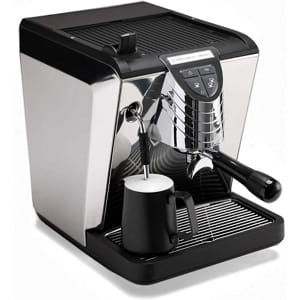
US: $1,650 • UK: £799–£890 • EU: €799 • AU: $1,799–$1,849 AUD.
Nuova Simonelli Oscar II
A compact heat-exchanger with real steam, two timed brew buttons, and a tough, café-leaning workflow—built for milk-forward homes and small pop-ups that want speed and repetition.
Overview
Oscar II is Nuova Simonelli’s stripped, sturdy path into HX ownership: a 2 L copper boiler, timed single/double buttons, a fast, forgiving push-pull steam wand, and a compact ring-group brew path. No PID, no on-face gauges, no hot-water tap—just café-like milk performance and a repeatable routine for households and small bars.
Pros
- Serious steam from a 2 L copper HX in a small chassis
- Two programmable time-based buttons keep users consistent
- Push-pull steam lever + cool-touch wand
- 58 mm commercial portafilter; quick warm-up ring group
- Direct-connect variant available for permanent installs
Cons
- No on-face gauges, no PID, no shot timer
- No hot-water tap—use a kettle for Americanos
- Time-based dosing needs quick re-programming after grinder changes
- OPV/“Professional Pack” availability varies by region
Features & Specs
- Format: Single-group HX • copper boiler 2 L • vibration pump • ring-group (non-E61)
- Controls: Two programmable brew buttons (time-based) • push-pull steam • cool-touch wand
- Water: 3 L internal reservoir (pour-over) • direct-connect variant available
- Notable omissions: No hot-water tap • no PID • no on-face gauges/shot timer
- Dimensions: US ~12 W × 16 D × 16 H in • EU 300 W × 400 D × 408 H mm
- Group/Baskets: 58 mm portafilter • bottomless compatible
- Professional Pack: Some retailers add OPV + pro pressostat (region-dependent)
- Typical pricing (late 2025): US ~$1,650 • UK £799–£890 • EU €799 • AU $1,799–$1,849
Workflow & Dial-In
- Warm-up: Let the group/portafilter heat-soak; run a short blank; purge wand.
- Cooling flush: From idle, 2–3 s for medium roasts; a touch longer for light.
- Program buttons: Enter programming, pull to taste/ratio, stop, save (time stored).
- Recipes: Start 18 g in → 36 g out in ~27–31 s; for light roasts try 1:2.2 in low-30s.
- Milk cadence: Purge → short aeration → roll; wipe/purge immediately after.
Milk & Steam
2 L copper HX = steady steam and quick recovery. The push-pull lever makes feathering air easy; a two-hole tip is beginner-friendly, while a higher-flow tip speeds larger pitchers. Expect café-like milk pacing in a compact box.
Maintenance & Water
- Daily: Wipe/purge wand after steaming • water backflush after sessions.
- Weekly: Detergent backflush • soak screen and brush dispersion.
- Water: Tank—use softened/recipe water. Plumbed—3/8″ cold line, ~0.5 GPM, ≤36 PSI + filtration/regulator.
- Parts: Widely available; commercial lineage simplifies service.
Comparisons
- NS Musica: Step-up face and volumetrics; Oscar II is smaller/cheaper with similar steam feel.
- Lelit MaraX: Easiest HX for no-flush living; Oscar II wins on steam headroom and timed dosing.
- Profitec Pro 400: More gauges/presets; Oscar II is simpler, stronger steam.
- Rocket Appartamento: E61 style + lever; Oscar II favors timed buttons + fast ring-group warm-up.
- Rancilio Silvia Pro X: Dual-boiler PID precision; Oscar II is faster for milk at lower cost.
Pricing & Availability (Nov 2025)
- US: about $1,650.
- UK: usually £799–£890.
- EU: commonly €799.
- Australia: typically $1,799–$1,849 AUD.
- Voltage, color, and “Professional Pack” (OPV/pressostat) vary by retailer—confirm inclusions.
FAQs
- Does it have gauges or a PID?
- No—Oscar II is intentionally minimal; you work by routine/ratio.
- Hot-water tap?
- No. Keep a kettle handy for Americanos or tea.
- Timed dosing = volumetric?
- It repeats time, not flow. Re-program after big grind/bean changes.
- Plumb-in option?
- Yes—direct-connect variant. Follow NS install spec for pressure/filtration.
- OPV available?
- Often via “Professional Pack” (region-dependent). Ask your retailer.
Takeaway
Oscar II is Nuova Simonelli’s stripped, sturdy path into heat-exchanger ownership. You get a 2 liter copper boiler, a fast and forgiving steam wand, timed single and double buttons, and a ring-group brew path that is built for repetition. There is no PID, no built-in gauge stack, and no shot timer. You do get a tough case, an ergonomic push-pull steam lever, cool-touch hardware, and the option to buy a direct-connect model if you want a permanent install. It is a practical tool for milk-forward homes and small pop-ups that want café-like steaming without paying dual-boiler money.
At a glance
- Format: Single-group heat-exchanger (HX). Copper boiler 2 L. Vibration pump. Ring-group brew path. Pour-over or direct-connect variants.
- Water: 3 L internal reservoir on the pour-over model. Direct-connect version available through Nuova Distribution.
- Controls: Two programmable brew buttons that dose by time, not by flow. Push-pull steam. Cool-touch wand. No on-face brew or boiler gauge. No shot timer.
- Dimensions and mass: About 12 W × 16 D × 16 H in the US spec. EU listings: 300 W × 400 D × 408 H mm. Roughly 13 kg shipping weight around 39–44 lb boxed.
- Notable omissions: No hot-water tap. No Soft Infusion System on this model.
- Typical pricing by region: USA commonly around 1,650 USD. UK retail often sits around 799 to 890 GBP. EU listings frequently show 799 EUR. Australia typically 1,799 to 1,849 AUD. Street prices move with color and pro-pack bundles.
Build and design
Oscar II’s shell looks modern in a sensible way. Stainless front. ABS side panels in red or black. The footprint is genuinely compact. On a US counter it is 12 inches wide, 16 inches deep, 16 inches tall. In EU specs you will see 300 × 400 × 408 mm. Either way, it slides under standard cabinetry with room to tilt a pitcher and to pull a straight shot without bumping the backsplash. The cup tray lifts for fast reservoir access. The drip tray is large enough to catch shot purges and steam purges without babysitting.
Deals of the Week
Inside the case you get a copper heat-exchanger boiler rated at 2 liters. That is a real steam reserve in a small chassis and the main reason milk service feels calm. The brew group is Nuova Simonelli’s compact ring group, not an E61. It locks a 58 mm portafilter and gives you a consistent thermosyphon loop without the soak-heavy warm-up E61s demand. The pump is a standard vibratory unit. It ramps cleanly, and with the ring group’s pre-infusion geometry it delivers a gentle start that helps with consistency when more than one person pulls shots at home.
The interface is intentionally minimal. Two soft-touch brew buttons sit above the group. You program them by time. There is no dedicated manual brew switch. The steam control is a push-pull lever that reduces wrist fatigue during longer sessions. The wand hardware is cool-touch, which makes cleanup immediate and safer around families. There are no boiler or brew pressure gauges on the face. If you require live numbers, this is not your machine. If you want a tough HX that favors repetition and speed, this design choice makes sense.
Nuova Simonelli sells pour-over and direct-connect versions. The pour-over runs from a 3 liter tank with low-water protection. The direct-connect version is designed for a regulated, filtered water line and follows the company’s install spec, which calls out a 3/8 inch cold line, 0.5 GPM minimum flow, and max line pressure of 36 PSI. If you plan a permanent bar, the plumbed model removes reservoir chores and stabilizes supply temperature.
Finally, a market note that matters: the “Professional Pack.” Some retailers bundle an OPV and a heavier-duty pressostat, advertising adjustable brew pressure and tighter boiler control. The base machine already performs well, but if you value an OPV for tuning, confirm whether your regional seller includes the pack or sells it as an upgrade.
Workflow
Heat-up and readiness
From a cold start, Oscar II warms quickly for an HX. Give the group and portafilter time to reach steady state. If you pull a tasting flight, let the case soak a bit longer so accessories match metal temperature. The thermosyphon circuit stabilizes the group without the long E61 ritual. Before your first shot of the day, perform a brief cooling flush to ensure you are not sending overheated HX water to the puck. Two or three seconds is a practical starting point for medium roasts; longer for light roasts.
Timed dosing in practice
You do not have manual start-stop on a third button. You do have timed single and timed double. Program them once per coffee: hold to enter programming, start the shot, stop it at the flavor point you like, and the machine stores the duration. You are not metering water volume. You are repeating a time. That is exactly what many cafés do on mid-tier volumetrics because it keeps hands free for steaming and reduces human variance. If you need a manual override now and then, re-program the “single” temporarily for your test and restore it later.
Ergonomics that speed you up
The push-pull steam lever matters more than it sounds. On smaller HX machines a knob can feel twitchy and fatiguing. The lever is quick, predictable, and forgiving. The wand’s full articulation lets you angle pitchers properly. The portafilter has clearance for a bottomless if you want to audit puck prep. You will not find a hot-water tap. If your routine involves Americanos from the machine, that is a limitation. Use a kettle.
Pour-over reality
On the tanked unit, the 3 liter reservoir keeps you from topping up constantly. The low-water protection is conservative, which is how it should be on an HX. Keep a small funnel near the bar and refill when the light trips. If your space allows, the direct-connect variant removes this chore and pairs cleanly with an inline softener and regulator.
Espresso performance
Temperature behavior
An HX’s job is to provide stable brew water and strong steam without juggling two boilers. Oscar II does that with fewer quirks than classic E61 boxes. Once heat-soaked, a short cooling flush normalizes brew water for medium roasts. Between back-to-back shots you will often skip the flush entirely. For lighter roasts, lengthen the initial flush a touch and tighten your prep to keep the tail clean. The ring group’s smaller mass means recovery is quick and you are not waiting for the group to come back to you after a milk round.
Pressure and pre-infusion basics
The stock machine uses a vibration pump with a relatively soft ramp. That helps with puck wetting even without a programmable pre-infusion routine. If your market offers the Professional Pack with an OPV and an upgraded pressostat, you can tune brew pressure at the valve and slightly tighten boiler behavior. Either way, set a sensible 9 bar on a blind, then leave pressure alone and move your flavor with dose, grind, and ratio.
Timed dosing and repeatability
Because the machine doses by time, not by flow, repeatability depends on your grinder and your prep. The upside: once you are dialed, anyone can press the programmed double and land in a tight window. The downside: significant puck resistance changes will tilt output weight, so re-calibrate after grinder moves or bean changes. For households with multiple users, that trade is a net positive. The machine enforces cadence while you control the upstream variables.
Starting recipes
For a medium roast, set the grinder for 18 g in a standard 58 mm double, aim for 36 g out in 27 to 31 seconds from pump on, and program the double button to stop near your target. For modern light roasts, keep dose similar, extend the cooling flush slightly, and push a 1:2.2 ratio in the low 30s seconds. If shots run bitter on a darker roast, shorten the ratio to 1:1.8 and minimize the initial flush. The machine is not fussy. It rewards steady prep and small, honest changes rather than menu gymnastics.
What it tastes like when it is right
Oscar II leans toward the classic HX flavor profile: dense mids, generous body, and steady sweetness. With light roasts you can pull clarity without astringency if you respect the flush routine and keep the tail short. In milk the shots hold shape. That is the headline for this platform. Your espressos do not vanish into foam even at 8 to 12 ounce drink sizes.
Milk steaming
This is where Oscar II earns its keep. A 2 liter copper boiler with pressostat control provides a steady head of steam and quick recovery. The wand is cool-touch and fully articulated. A standard two-hole tip is friendly when you are learning texture. A higher-flow tip will speed 12 to 20 ounce pitchers when guests are waiting. The push-pull lever makes feathering air easy for the first seconds, then settling into the roll with one hand while you watch your espresso stream. In a typical morning cadence you can pull a shot, steam a cappuccino pitcher, wipe and purge, and be back on deck for the next drink without waiting on pressure to recover. If you come from a small dual boiler, the milk speed difference is obvious.
For households that live mostly in milk, this is the right lane. If your day is two flat whites and a weekend round of lattes, Oscar II will feel like a miniature café head rather than a hobby box.
Maintenance and reliability
Daily loop
Purge and wipe the wand immediately after steaming. Water backflush at session end. Soak and brush the dispersion screen weekly if you pull daily. With no on-face gauges, the machine does not nudge you with numbers; build habits. Timed dosing keeps you honest if you watch the shot for blonding and keep an external scale nearby for the first week on any new coffee.
Water decides the story
Tank users should feed the reservoir softened or properly remineralized water that lands near espresso-safe hardness and alkalinity. Plumb-in owners need a shutoff, a pressure regulator, and filtration at the wall. Nuova Distribution’s spec for the direct-connect model calls out a 3/8 inch cold line, 0.5 GPM minimum flow, and line pressure no higher than 36 PSI. That is the right install profile to protect a copper HX and keep service drama to a minimum.
Service access and parts
Nuova Simonelli is a commercial brand first, which means parts and documentation exist across regions. The Oscar line is common in the US, UK, EU, and Australia, so valves, pumps, wands, and gaskets are easy to source. If you want a pump or boiler gauge later, third-party kits and DIY threads exist, though adding a gauge is a modification that should be done by someone comfortable opening a case and plumbing a T-fitting.
Programming and control
Your control stack is intentionally short:
- Timed single and double. Enter programming, run a shot, stop it at the taste you want, and the machine stores duration. It is simple, effective, and fast for families.
- Steam lever. Push-pull actuation for on and off. Fine control becomes second nature after a day.
- Pour-over or direct-connect. Tank routine with a 3 L reservoir on the pour-over unit, or a proper water line and drain on the plumbed version. Choose early and install properly.
- No hot water tap. Keep a kettle nearby for Americanos or tea.
There is no app layer. No PID menu. The machine expects you to control flavor with dose, grind, ratio, and a short cooling flush. That is not a downgrade. It is a design choice that fits many homes.
Competitive comparisons
Nuova Simonelli Musica
Musica is the step up inside the same brand. You get a similar HX boiler, LED trim, and a more feature-rich face, typically with volumetric dosing by flow rather than pure time. If you want the signature Simonelli steam feel but prefer a classic café aesthetic and more status feedback, Musica is the upgrade path. Oscar II answers with a lower price and the same core heat and steam capacity in a smaller body.
Lelit MaraX PL62X
MaraX is the easiest HX to live with if you fear flushing. Its thermostatic logic manages temperature at the group, which makes it behave like a patient dual boiler for singles and small rounds. Steam is good, not as aggressive as a 2 liter copper tank. Choose MaraX if you want simplified temperature behavior and a quieter vibe pump. Choose Oscar II if you want bigger steam headroom and timed dosing that keeps multiple users inside the rails.
Profitec Pro 400
Pro 400 is a compact HX with three boiler temperature presets, a pre-infusion toggle, a dual gauge, and a published flush map. It is a great on-ramp for new HX owners who want more visible control and gauges. Oscar II trades the gauges for a simpler face and gives you stronger steam with a 2 liter copper boiler and a fast lever wand. If your household likes analog speed and a commercial wand feel, Oscar II is the simpler tool. If you want gauges and preset temperature steps, the Pro 400 is hard to beat.
Rocket Appartamento
Appartamento is the style leader in compact HX machines with a 1.8 liter copper boiler, an E61 group, and the Rocket finish. It asks you to live the classic E61 flush rhythm and offers no timed dosing. If you want an E61 lever, a timeless look, and do not mind managing the routine, Rocket is a joy. If you prefer timed buttons, a ring group that warms quickly, and a tougher, more utilitarian stance, Oscar II hits that mark.
Rancilio Silvia Pro X
Different architecture. Silvia Pro X is a dual boiler with PID control and a small footprint, built for espresso-first users who want degree-level brew control. Milk rounds are slower than a 2 liter HX. If your routine is mostly straight shots and you want precise brew temperature at the panel, Silvia Pro X is an alternative. If your mornings revolve around milk and speed, Oscar II is the better fit at a lower price.
Nuova Simonelli Oscar Mood
The Mood variant updates the look and adds options across the line, but sits higher on price. If you want a dressed-up Oscar with the same service posture and more design latitude, consider it. If you are buying for function and budget, Oscar II remains the entry.
Real-world numbers and notes
- Boiler: 2 L copper heat-exchanger.
- Water: 3 L internal reservoir on the pour-over unit. Direct-connect variant available with specific install requirements.
- Dimensions and mass: US spec 12 W × 16 D × 16 H inches. EU spec 300 × 400 × 408 mm. Shipping weight roughly 39 to 44 lb depending on retailer.
- Controls: Two programmable brew buttons (time based), push-pull steam lever, cool-touch wand. No face gauges. No hot-water tap.
- Group and baskets: 58 mm. Ring group architecture, not E61.
- Professional Pack: Retailer option with OPV and professional pressostat for adjustable brew pressure and tighter boiler control.
- Price reality, late 2025: USA about 1,650 USD. UK around 799 to 890 GBP. EU commonly 799 EUR. Australia 1,799 to 1,849 AUD. Verify voltage, color, and whether OPV/pressostat are included.
Bench workflow: how I would run Oscar II from day one
1) Water and warm-up
If you are on the tank, fill with a softened or remineralized recipe inside espresso-safe hardness. Power on. Give the machine enough time to heat the brew path and the portafilter. Purge the wand and run a short blank shot to settle the circuit. If you are direct-connected, confirm line pressure and filtration match spec before the first run.
2) Map your cooling flush
From a full idle, open the group and flush until sputter smooths and the stream settles. For most medium roasts that is a couple seconds. For lighter roasts, add a beat. On fast back-to-back shots, you can often pull without a flush. Note the sound and feel. This is the only “ritual” that matters on an HX.
3) Program timed buttons
Enter programming. Pull to a 1:2 ratio near 28 to 30 seconds and stop. Save that as your double. Program the single to a smaller double for testing, or leave it open for a ristretto program. Your household now has two consistent buttons.
4) Dial with ratio, not myths
When taste leans sour on a light roast, extend the flush slightly and raise output to 1:2.2 while holding time in the low 30s seconds. When bitterness creeps in on a dark roast, shorten the ratio and keep flush minimal. Keep dose steady while you test.
5) Milk cadence
Practice with a two-hole tip until you can nail an eight-second stretch and a clean roll. Move to a higher-flow tip when you are making 12 to 20 ounce pitchers. The lever makes feathering air straightforward and prevents over-aeration in the first seconds.
6) Cleaning rhythm
Wipe and purge immediately after steaming. Water backflush at the end of a session. Detergent backflush weekly for daily users. Drop the screen for a soak every week or two. Small habits keep timed dosing honest because they keep the path clean.
Where Oscar II excels
- Steam power in a small box. A 2 liter HX and a lever wand mean fast, repeatable milk without waiting.
- Timed buttons that keep teams consistent. Dose by time is simple to train and quick to adjust.
- Compact footprint with commercial parts. 58 mm portafilter, real wand, and hardware that feels like the brand’s café gear.
- Direct-connect option. A proper plumbed install is available if you want it.
Clear trade-offs
- No gauges, no PID, no shot timer. You work by routine and taste, not by numbers on the face.
- No hot-water tap. Keep a kettle for Americanos or tea.
- Time-based dosing. It is excellent for cadence, but big grinder moves require a quick re-program.
- OPV and pressostat upgrades vary by region. Confirm whether the Professional Pack is included.
Scores
- Build quality: 8.8
- Temperature stability: 8.5
- Shot consistency: 8.5
- Steaming power: 9.0
- Workflow and ergonomics: 8.7
- Maintenance and serviceability: 8.6
- Value: 8.9
Total: 8.7
Verdict
Nuova Simonelli aimed Oscar II at a very specific buyer and hit the mark. It is compact, sturdy, and fast. The steam performance sits at the front of the home HX class. The timed buttons shift the workload to the grinder and to puck prep, which is exactly where it belongs. The ring-group heat path stabilizes quickly, the wand hardware is kind to learners, and the case is built for long, low-drama ownership if you feed it the right water. You give up gauges, a hot-water tap, and a PID. You gain a small, professional-feeling tool that repeats shots for households or small bars that value milk speed and predictable cadence. If you want degree-level brew control and on-face data, look to a dual boiler with PID. If you want café milk and simple repetition without a big footprint or a big bill, Oscar II is a smart buy.
TL;DR
Copper 2 L heat-exchanger with a 3 L tank on the pour-over model, or an optional direct-connect version for a plumbed install. Two timed brew buttons, push-pull steam, cool-touch wand, and a compact 12 × 16 × 16 inch body. No gauges, no PID, and no hot-water tap. Strong milk performance, quick warm-up, and a workflow that keeps multiple users consistent. Typical pricing: about 1,650 USD in the US, 799–890 GBP in the UK, 799 EUR in the EU, and 1,799–1,849 AUD in Australia.
Pros
- Serious steam from a 2 L HX in a compact chassis
- Two programmable timed buttons that keep households consistent
- Push-pull steam lever and cool-touch wand
- 58 mm commercial portafilter and quick warm-up ring group
- Direct-connect option for permanent installs
Cons
- No gauges, PID, or shot timer
- No hot-water tap
- Time-based dosing needs quick re-programming after grinder changes
- OPV and pro pressostat vary by region and retailer
Who it is for
- Milk-forward homes that want café-speed steaming in a small footprint
- New baristas who prefer two consistent buttons over manual start-stop
- Small pop-ups or back-bar installs that need a reliable single group with plumb-in potential
- Buyers who prioritize durability and cadence over displays and data
Glanceable specs
- Group: Nuova Simonelli ring group, 58 mm portafilter
- Boiler: 2 L copper heat-exchanger
- Pump: Vibratory
- Dosing: Two programmable time-based buttons
- Steam: Push-pull lever, cool-touch wand
- Water: 3 L reservoir on pour-over model, optional direct-connect variant
- Dimensions and mass: 12 W × 16 D × 16 H inches (US), or 300 × 400 × 408 mm (EU). About 13 kg
- Notable omissions: No hot-water tap, no on-face gauges, no PID
We’ve categorized the best espresso machines for every kind of buyer
Find the right shortlist faster, whether you want convenience, a beginner-friendly setup, a smaller footprint, or better value at a given budget.
Best Superautomatic Espresso Machines
One-touch picks for speed and convenience.
Best Espresso Machines for Beginners
Easy-to-use machines with a smoother learning curve.
Best Small Espresso Machines
Compact machines for tighter kitchens and counters.
Best Espresso Machines With Built-In Grinder
All-in-one options with fewer extra pieces to buy.
Best Cheap Espresso Machines Under $500
Budget picks that still make sense for real espresso.
Best Prosumer Espresso Machines Under $1000
More serious machines with stronger value for the money.
Best Single Boiler Espresso Machines
Simple, space-saving picks for espresso-first routines.