
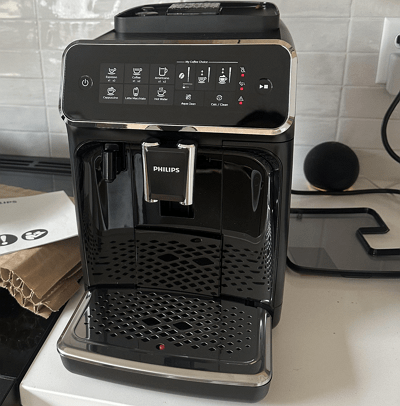
Philips 2200 LatteGo
Three drink LatteGo starter with tube free milk carafe
Philips 2200 LatteGo takes you into bean to cup territory with three core drinks, a 12 step ceramic grinder, and a removable brew group that you can rinse in the sink. The star is the two piece LatteGo carafe that has no milk tubes, snaps off the front, and rinses clean in seconds. You get a 1.8 liter tank, a 275 gram hopper, AquaClean filtration that can push descaling far out, and a panel that keeps everyone in the house on the same page. You do not get profiles or a long menu. For espresso, coffee, and cappuccino with minimum cleanup at a sharp price, it fits the brief.
Philips 2200 LatteGo – scores and quick fit
Score breakdown
Overall score: 8.3 / 10Description in plain terms
Philips 2200 LatteGo is a compact, owner friendly super automatic built around three everyday drinks. You get espresso, coffee, and cappuccino on dedicated icons, a 12 step ceramic grinder, a removable brew group that slides out for a quick rinse, and AquaClean filtration that can push descaling very far into the future when you keep up with filter swaps. LatteGo is the main reason this trim exists. The two piece, tube free carafe docks on the front, makes stable foam for cappuccinos, snaps apart, and rinses under the tap in seconds or goes straight in the dishwasher. The 1.8 liter tank, 275 gram hopper, and roughly 12 puck waste drawer fit a family morning, and the footprint stays small enough for most kitchens. You do not get profiles, you only get three one touch drinks, and light roasts will sit at the edge of what the brew group can handle. For households that just want straightforward espresso, coffee, and cappuccino with very low cleaning friction at a sensible price, the 2200 LatteGo hits the target.
Who it is for
- Households that mostly drink espresso, long coffee, and cappuccino and do not need a long specialty menu
- People who will happily rinse a milk system when that rinse takes about fifteen seconds at the sink
- Owners who like the idea of a removable brew group they can see, clean, and grease themselves
- Medium roast drinkers who want balanced, repeatable cups more than intense ristretto experiments
- Buyers who prefer a compact chassis and fair pricing instead of paying extra for profiles and big screens
Who should avoid it
- Light roast and single origin fans who want to push dense coffees into high extraction ratios
- Households that want a long menu of one touch drinks like flat white, latte macchiato, cortado, and iced routines
- Users who need separate user profiles for different people in the house
- People who want manual steam wand control and latte art texture rather than automatic frothing
- Shoppers who already know they will upgrade to Philips 3200, 4300, or 5400 for the richer menu and interface
Main features
- Bean to cup super automatic with simple touch panel and three core coffee drinks
- LatteGo tube free milk carafe with two parts, a cyclonic frothing chamber, and integrated spout
- 12 step, 100 percent ceramic burr grinder with hopper top adjustment ring
- Three aroma strength levels via My Coffee Choice that move dose inside the brew unit
- Three temperature levels accessible through the settings menu
- Removable brew group that unclips behind a side door for sink rinsing
- 1.8 liter water reservoir that slides out from the front of the machine
- 275 gram bean hopper and a grounds bin that holds around 12 pucks
- 0.26 liter LatteGo carafe volume and cup clearance around 150 mm on most retailer specs
- AquaClean CA6903 filter compatibility with up to 5,000 cups between descales when you replace eight filters on time
- Compact footprint at roughly 246 mm wide, 371 mm tall, and 433 mm deep, about 7.5 to 8 kg in weight
- Bypass doser for pre ground decaf activated through the aroma button hold sequence
Pros
- Tube free LatteGo milk carafe snaps apart into two pieces and genuinely rinses clean in seconds
- Removable brew group gives you direct control over hygiene and helps long term reliability
- 12 step ceramic grinder with three strength levels covers everyday blends well at home volumes
- 1.8 liter water tank and 275 gram bean hopper reduce how often you refill for a family morning
- AquaClean filtration can delay descaling for thousands of cups when you swap filters on schedule
- Simple touch panel with three drinks keeps first time use and daily operation low friction for everyone
- Good value in the Philips line when you care about cleaning and do not need the bigger drink list of 3200 or 4300
Cons
- Only three one touch coffee drinks on LatteGo trims, so no dedicated flat white or latte macchiato buttons
- Macro grinder steps mean you cannot fine tune very light roasts with the precision that hobbyists enjoy
- No user profile system, so the whole house shares the same strength and volume presets
- Americano style drinks require adding hot water manually to espresso if you want a specific long routine
- Not the right platform for people who want deep shot tinkering or manual milk texture control
Philips 2200 LatteGo is the entry point into Philips’ tube-free milk system. It is built for households that want straightforward espresso, coffee, and cappuccino without a learning curve. The pitch is clean and honest. You get an intuitive touch panel, a 12-step ceramic grinder, a removable brew group you can rinse in the sink, and an AquaClean filter that can delay descaling for thousands of cups when replaced on schedule.
LatteGo is the reason to choose this trim over the steam-wand versions. The carafe has only two parts and no milk tube, so you can snap it apart and wash it under the tap in seconds or place it in the dishwasher. The 1.8 liter tank and 275 gram hopper cover a family morning without constant refills, and the waste bin holds around a dozen pucks.
If you want deep customization or a long menu, move up the Philips ladder. If you want a reliable three-drink machine with very light milk cleanup and owner-serviceable internals, the 2200 LatteGo earns its place on the counter.
At a glance
- Format. Bean-to-cup superautomatic with a touch control panel and a removable brew group.
- Drinks. Three core beverages on the LatteGo trim: espresso, coffee, and cappuccino, plus hot water.
- Milk system. LatteGo two-piece carafe with no tubes that cleans under the tap in roughly 15 seconds and is dishwasher-safe.
- Grinder. 100 percent ceramic burrs with 12 macro steps and a durability claim of at least 20,000 cups.
- Capacities and size. 1.8 liter water tank, 275 gram bean hopper, about 12-puck dregs drawer, 0.26 liter carafe. Body 246 W × 371 H × 433 D mm.
- Filtration. AquaClean filter; with eight timely filter changes the system targets up to 5,000 cups before a descale is required.
- Origin. Current EP2231 production listings cite Romania.
Glanceable specs
- Pump. 15 bar vibration pump
- Heat. Thermoblock brew system
- Beverage controls. Three strength levels via My Coffee Choice, three temperature levels, programmable top volume per drink
- Grinder. 12 steps, ceramic, hopper-top adjustment
- Milk. LatteGo carafe 0.26 L, two pieces, no tube, dishwasher-safe
- Capacities. Water 1.8 L, beans 275 g, grounds drawer about 12 servings
- Footprint. 246 × 371 × 433 mm, about 7.5–8.0 kg depending on trim
- Brew group. Fully removable for sink rinsing
- Filtration. AquaClean CA6903 compatible
All items above are listed on Philips product pages and technical sheets for the EP2230 and EP2231 LatteGo variants, with the cup-before-descale claim provided on the AquaClean page.
Build and design
Philips keeps the 2200 LatteGo compact and purposeful. The rectangular body fits under upper cabinets and leaves space in front for cup handling. The 246 mm width and 371 mm height make it easy to place on standard 60 cm deep counters with enough clearance to lift the hopper lid. The 433 mm depth gives room for a straight-pull brew group bay and a stable drip tray. The unit weight sits around eight kilograms on EP2231 spec sheets and about seven-and-a-half kilograms on retailer listings for EP2230, which tracks with a plastic chassis reinforced by metal sub-frames at high-stress points.
The interface is simple. The panel uses backlit icons for the three core drinks and hot water. Strength and volume are adjustable through the My Coffee Choice indicator lights. This keeps first-use friction low. Family members can walk up, choose espresso, coffee, or cappuccino, and get what they expect.
LatteGo is the visual tell. Instead of a stainless wand or a ribbed carafe with internal tubes, LatteGo uses a cyclonic chamber and a short spout molded into a two-piece container with a lid. It docks at the front, draws milk through a short channel, and delivers directly into the cup. There are no silicone tubes to pull apart, no small connectors to scrub, and nothing hidden inside an opaque housing. Philips states you can rinse the two parts under the tap in about 15 seconds, and both parts are dishwasher-safe. This is the primary reason many buyers pick the 2200 LatteGo over classic-wand trims.
Access is friendly. The water tank slides out from the front. The brew group lives behind a side door and unclips with one latch. The drip tray and grounds drawer come out together. This is a platform that expects the owner to participate in maintenance rather than relying on sealed components.
The grinder sits under the bean hopper lid with a 12-step adjustment collar. It is a ceramic flat-burr set with a durability claim of 20,000 cups in Philips documentation, which is sensible at home volumes with medium roasts. Adjustments are macro steps, which is typical at this price.
Workflow
Startup and rinses
On power-up, the machine runs an automatic rinse to heat the path and clear the spouts. Let it finish. If you plan to pull short espressos, pre-warm your cup with the hot water function or a splash from the spouts during the rinse. Philips’ product pages describe the rinse routines and the Aroma Extract logic that aims to keep water between 90 and 98 °C while managing flow. That logic stabilizes early-shot behavior on a compact thermoblock.
Strength, volume, and temperature
Use My Coffee Choice to select one of three aroma strengths, which moves dose inside the brew unit. Set drink volume using the quantity selector. Temperature offers three levels and can be set in the menu. The user manual documents programming the highest default quantity for each drink and selecting temperature in three steps, with model notes for which panels expose a temperature icon versus a settings-menu change.
Grinder and beans
Set grind while the grinder is turning. Start one click finer than the center of the 12-step ladder for espresso. If shots run fast and taste thin, go one click finer. If bitterness appears with muddy crema, go one click coarser and reduce temperature. The machine is tuned for medium roasts and classic Italian blends. Light Scandinavian profiles are possible, but you will be working at the fine end of the ladder with short volumes. Philips lists the 12-step grinder on the EP2230 and EP2231 pages and ties flavor stability to the ceramic burr set.
LatteGo for cappuccino
Snap the carafe in, fill to the mark, place a cup under the spouts, and press cappuccino. LatteGo uses cyclonic frothing to create foam quickly and consistently. When the drink finishes, press the LatteGo quick clean or simply undock the carafe and rinse the two parts. For many households this makes the difference between drinking cappuccino daily and giving up on milk because cleaning is a chore.
Bypass doser for decaf
The manual documents a pre-ground mode activated by holding the aroma strength icon. Use a single level scoop for decaf. When pre-ground is active you cannot change aroma strength. This is a safe way to offer decaf to a guest without feeding ground coffee to the burrs.
Espresso performance
Flavor target
The 2200 LatteGo aims for balanced, repeatable cups. With a sensible grind and middle strength, espresso shows a compact crema and moderate body. The Aroma Extract routine that toggles temperature and flow seeks a sweet spot between 90 and 98 °C, which helps avoid the hollow center you sometimes get from small thermoblocks. This is not a ristretto machine. It produces clean, approachable espresso at normal volumes with minimal fuss.
Dose window and repeatability
Three strength levels give a narrow but meaningful dose window inside the brew unit. Use strength first when you want more presence. Use grind next to manage flow. Use temperature to trim finish and bitterness. Because the grinder steps are macro, small single-step changes are audible in the cup. One click is often enough. Philips sets expectations on the macro-step nature by advertising 12 positions, not micrometric control.
Espresso versus coffee
On the 2200, “coffee” uses a longer volume than espresso. If you prefer large mugs with clarity, use Americano by adding hot water after an espresso rather than pushing a single “coffee” volume past the point where the compact brew group struggles. The user manual and EP2231 page document hot water access and three core beverage icons, and the EP2230 LatteGo trim lists cappuccino as the third one-touch coffee alongside espresso and coffee.
Light roasts
Very light roasts are outside this platform’s design target. If you insist, keep volumes short, use the top strength setting, run at high temperature, and accept that body and texture will not match a 58 mm manual system. For typical supermarket and specialty medium roasts, the 2200 sits in a comfortable zone.
Milk performance
LatteGo texture
LatteGo produces a fine, glossy foam suitable for cappuccinos. The system uses a high-speed cyclonic chamber to entrain air into milk and eject it through a short spout. Philips documentation describes “silky smooth froth” and positions LatteGo as the fastest to clean milk system because there are only two parts and no tubes. This is more than copy. In daily use, fewer parts and no internal tube means owners actually rinse the system after each milk drink.
Temperatures and volumes
Milk volume and coffee volume at the top preset can be reprogrammed. The manual shows how to set the highest default for a drink by holding the icon for three seconds, then stopping the cycle at the point you like so the machine stores that amount for future use. Temperature is a three-step global setting on the 2200 series. While you cannot choose “foam texture” in numeric steps, LatteGo’s default foam is consistently medium-dry for cappuccino.
Plant milk behavior
Philips notes that LatteGo produces foam from dairy and plant-based alternatives when fat and protein are appropriate. In practice, barista-formulated oat and soy behave best. The short path and rinse-and-go design keep off-flavors from lingering if you switch milk types. Philips positions LatteGo as able to froth various milks and highlights the cyclonic design as a contributor to consistent texture.
Wand versus carafe context
If you want to stretch and roll for latte art, you will want a manual wand. If you want a cappuccino before work with minimal cleanup, LatteGo is the correct tool. The 2200 LatteGo is intentionally the “easy milk” pick inside the family.
Maintenance and reliability
Brew group care
Remove the brew group weekly. Rinse it under warm water. Let it air-dry. Apply food-safe grease to the rails and cam periodically. Philips designs the brew group to be owner-serviceable and shows it explicitly on the EP2231 page. This is the heart of long-term reliability because you control hygiene instead of relying on sealed software routines.
AquaClean filtration
Fit an AquaClean filter and tell the machine in the menu. Philips documents up to 5,000 cups between descales if you replace the filter eight times as prompted. This reduces scale in the thermoblock and stabilizes cup temperature. It also reduces the frequency of descale cycles that many owners postpone. The claim and replacement cadence are documented on the AquaClean product page.
LatteGo cleaning cadence
Rinse after each milk session. Dishwasher the two parts regularly. There are no tubes, so there is no per-use milk cleaner cycle. The EP2231 product page states the two-part design cleans in as little as 15 seconds under the tap and that LatteGo is dishwasher-safe. This simplicity is the reason foam quality stays consistent over time.
Descale and tablets
When the machine prompts a descale, run the guided program. Use the brew-path cleaning tablets per Philips’ schedule to keep screens clear if you favor darker or oilier beans. Accessories like grease, tablets, and the filter are listed as related items on the EP2231 page.
Real numbers you can trust
- Water 1.8 liters
- Beans 275 grams
- Waste about 12 pucks
- Carafe 0.26 liters
- Dimensions 246 × 371 × 433 mm
- Cup height up to about 150 mm on retailer specs
- Power 1500 W
- Weight approximately 7.5–8.0 kg
All are pulled from Philips EP2230 and EP2231 technical sheets and retailer listings.
Competitive comparisons
Philips 1200 Series EP1220
The Philips 1200 with a classic milk frother costs less. It trades LatteGo for a steam wand and drops cappuccino one-touch convenience. If you rarely make milk drinks and you prefer manual control, the 1200 is the budget play. If you want easy cappuccino and the fastest milk cleanup, 2200 LatteGo is the smarter option. Philips lists the 1200 with a classic wand and two coffee drinks plus hot water.
Philips 3200 LatteGo
The Philips 3200 series steps up the drink count and adds menu items like Americano and often latte macchiato depending on the exact regional code. If you want more one-touch variety and the same tube-free carafe, the 3200 is the logical upgrade. If you only drink espresso, coffee, and cappuccino, the 2200 gets you there for less with the same cleaning advantages. Philips’ LatteGo lineup pages and manuals show the expanded recipes on 3200 compared to the 2200’s three.
Philips 4300 and 5400 LatteGo
These trims push drink variety much further and add richer UI elements. They keep LatteGo. The 5400, for example, lists up to 20 drinks in Philips materials. You pay significantly more for that flexibility. If your household wants macchiatos, flat whites, travel-mug profiles, and iced variants, the Philips 4300 or Philips 5400 families are worth the money. If you want simplicity, the 2200 stays focused.
De’Longhi Magnifica Evo
Magnifica Evo is the obvious competitor in this price bracket. De’Longhi’s LatteCrema carafes produce tall foam and offer more presets on some trims. Daily cleaning is a little more involved than LatteGo’s two-piece rinse, and espresso signature differs due to grinder and flow logic. If you prioritize a larger preset list at the same spend, Evo is attractive. If you value the fastest milk cleanup with a removable brew group, the 2200 LatteGo holds an edge. General Evo roundups and feature sheets provide the context; specific numbers vary by regional trim.
Gaggia Cadorna Prestige
Cadorna Prestige sits a tier up in price with four user profiles, a larger drink list, and an integrated carafe with quick and deep clean cycles. Cleanup is still easy, but it is more involved than LatteGo’s rinse-and-go. If your budget allows and you want profiles and a broader menu, Cadorna is compelling. If you want the least friction on milk with three core drinks, 2200 LatteGo remains the cleaner choice.
Pricing and variants by market, November 2025
Prices move with promotions, bundles, and availability. These snapshots illustrate typical ranges seen recently.
- United States. EP2230/14 lists at premium retailers, often seen between about 399 and 649 USD depending on sales and whether new or factory-refurbished. Best Buy and specialty dealers list EP2230/14 with fluctuating promo pricing, and refurbished units frequently land near 399 USD.
- Canada. Canadian appliance dealers commonly promote EP2230/14 in the 489 to 899 CAD band, with aggressive discounts during holiday windows. Examples include TA Appliance and Home Coffee Solutions listings.
- United Kingdom. Stock appears across major marketplaces for EP2231/40 with wide variance by seller and condition. Marketplace prices range broadly and can sit near 500 to 700 GBP for new units when available, with some outliers. Always validate warranty and plug type.
- Australia and New Zealand. Philips NZ lists EP2231/40 and highlights local specs, with pricing carried by regional retailers rather than the Philips page. Market prices swing with import cycles and color codes. Use the official listing to confirm specs and parts.
Bundle contents vary. A water filter and a test strip are common in-box items. Some channels add cleaning tablets or a spare filter. Philips lists accessory compatibility on the EP2231 page.
Scores
- Build quality: 7.8
- Temperature stability and brew consistency: 7.9
- Grinder quality: 8.0
- Milk system performance: 8.4
- Workflow and ergonomics: 8.6
- Cleaning and maintenance: 9.1
- Value: 8.5
Overall: 8.3
Deep dive: what the 2200 gets right
LatteGo’s two-piece logic
Fewer parts reduce friction. With no silicone tubes, owners actually rinse after service. That matters more than any single “feature” because it keeps the milk path clean and foam quality steady. Philips’ claim of a 15-second rinse tracks with real workflow because you remove two pieces, separate them, rinse, and set to dry. The dishwasher option gives a periodic deep clean without effort.
Owner-serviceable brew group
The brew group pops out without tools. You see and feel what you are maintaining. That visibility is the foundation of long service life, and Philips makes it part of the core value story for the 2200.
AquaClean reduces descale frequency
Descaling is the task many owners skip. AquaClean delays it dramatically when used as specified. The reduced scaling helps keep thermoblock output predictable and protects taste. The “up to 5,000 cups” claim requires timely filter changes. Philips publishes the number and the replacement cadence.
Right-sized controls
Three strength levels, three temperature levels, a programmable top volume, and a 12-step grinder are enough levers for consistent results on everyday blends. More is not always better on a compact brew unit. Philips lists the controls plainly.
Trade-offs you should expect
- Limited drink list. Three coffee buttons plus hot water keep things simple. If you want latte macchiato, flat white, or Americano on a dedicated button, look at the 3200 and above. The EP2230 LatteGo lists espresso, coffee, and cappuccino as the one-touch options.
- Macro grind steps. Twelve steps are coarse compared to a manual setup. This is normal for the class. Treat grind as flow control and strength as the first flavor lever.
- Not a light-roast specialist. Very light roasts at small ratios ask more of the brew chamber than it was designed to deliver. This is a general truth for compact superautomatics.
- No profiles. The 2200 does not store separate user profiles. Higher trims add profiles and larger menus. The EP2231 tech table shows “Profiles: No.”
Who it is for
- Households that want espresso, coffee, and cappuccino on a tight routine
- People who will actually rinse a milk carafe when the rinse takes seconds
- Owners who value a removable brew group and clear, low-effort maintenance
- Medium-roast drinkers who like balanced espresso and repeatable cups
- Buyers who prefer clean, compact design and a fair price over a long menu
Setup checklist I recommend
- Install AquaClean. Fit the CA6903 filter, prime it, and confirm in the menu so the machine tracks capacity. This reduces descaling frequency and stabilizes taste.
- Baseline espresso. Start one click finer than mid grind. Select middle strength, medium temperature, and the middle cup icon for volume. Taste, then change one parameter at a time.
- Program top volumes. For each drink, hold the drink icon for three seconds to enter programming, then stop the flow at the cup level you want so the machine stores it at the top quantity setting.
- Dial cappuccino. Keep milk cold, fill the LatteGo to the lower mark, and adjust the stored top milk volume to avoid flooding the cup. Rinse LatteGo immediately after service.
- Weekly brew-group rinse. Pull the group, rinse under warm water, and let it air-dry. Grease the rails every month or two.
- Respect prompts. Replace filters when prompted. Run descale and brew-path tablet cycles on time. Keep a small stock of filters and tablets on hand.
Final verdict
Philips 2200 LatteGo is a practical superautomatic that respects a busy kitchen. The three-drink panel is honest. The grinder is stable at home volumes, and the brew logic targets stable temperature and flow. The removable group and AquaClean keep maintenance realistic. LatteGo is the clincher. A two-piece carafe with no tubes means milk cleanup takes seconds and actually happens. That is what keeps foam quality steady in the real world. If you want a longer menu, upgrade within the Philips line. If you want the fastest path to espresso, coffee, and cappuccino with minimal cleanup and a serviceable core, the 2200 LatteGo is a smart buy.
TL;DR
Three one-touch drinks. A 12-step ceramic grinder. A removable brew group. AquaClean filtration that pushes descale way out. LatteGo’s two-piece carafe rinses under the tap in seconds. If your kitchen needs straightforward espresso, coffee, and cappuccino without cleanup drama, the 2200 LatteGo does the job very well for the money.
Pros
- Tube-free LatteGo carafe cleans in about 15 seconds and is dishwasher-safe
- Removable brew group puts hygiene in your hands
- 12-step ceramic grinder and simple strength and temperature controls
- 1.8 L tank and 275 g hopper reduce refills for a family morning
- AquaClean filter can delay descaling up to 5,000 cups with timely replacements
Cons
- Only three one-touch drinks on LatteGo trims
- Macro grinder steps limit fine tuning of very light roasts
- No user profiles
- Americano requires manual hot-water addition if you want a dedicated “long” routine on this trim
Competitive pricing context by market
- USA. New EP2230/14 units typically appear between about 399 and 649 USD depending on promotions and whether refurbished.
- Canada. Recent promotions place EP2230/14 commonly in the 489 to 899 CAD range.
- UK. EP2231/40 availability shifts by seller, with broad ranges on marketplaces. Validate warranty terms and seller status.
- ANZ. Philips lists EP2231/40 in New Zealand with complete specs and features; retail pricing varies by chain.
Always check the model code on the box. EP2230 is the common North American LatteGo code. EP2231 and EP2235 are regional variants with the same core platform and three-drink logic. Philips’ regional pages show the differences in color, accessories, and small line items like included milk container size.
Philips 2200 LatteGo – frequently asked questions
Short answers to the questions people actually ask before buying this machine.
Is Philips 2200 LatteGo good for daily cappuccinos and coffee?
Yes. This trim is built exactly for that espresso, coffee, cappuccino triangle. The 12 step ceramic grinder and Aroma Extract logic handle typical medium roasts easily, the LatteGo carafe makes stable foam for a morning cappuccino, and the 1.8 liter tank plus 275 gram hopper give enough capacity for several drinks before you refill. It does not pretend to be a full cafe menu. It just keeps those three drinks consistent and fast.
How easy is LatteGo to clean compared with tube based milk systems?
Cleaning is the whole point of LatteGo. There are two parts that slide off the front and snap apart. There are no hidden tubes or small rubber connectors. Philips claims you can rinse it under the tap in about fifteen seconds and real owners back that up. Both parts are dishwasher safe as well. That simplicity is why foam quality stays stable after the first month, because people actually clean it instead of putting it off.
Can Philips 2200 LatteGo make Americano or long coffee in a big mug?
You have a few options. The coffee button runs a longer extraction through the brew group. For large mugs, the cleaner approach is to pull an espresso or coffee and then top it up with hot water from the machine, which gives an Americano style drink without over working the small brew chamber. The 2200 does not have a dedicated Americano icon, so you do that part manually. Higher Philips trims add Americano and longer profiles as separate recipes.
How well does Philips 2200 LatteGo handle light roast specialty coffee?
It can make light roasts drinkable but this is not what the platform is optimized for. The compact brew group and 12 macro grind steps work best with medium and classic Italian style blends. With very light, dense beans you will sit near the finest settings, top strength, and higher temperature with short volumes and still get leaner texture than a dedicated manual setup. If light roast espresso is the main hobby, you want different hardware or a separate grinder and machine.
Is the AquaClean filter worth using or can I skip it to save money?
If your local water is even moderately hard, AquaClean is worth it. With eight timely filter changes, Philips claims up to 5,000 cups before a descale is needed. In practice that means the thermoblock stays cleaner, temperature stays more stable, and you run the messy descale cycle far less often. Filters cost money, but skipped descales and scale related repairs cost more. If you already use very soft or custom brewed water you can consider running without AquaClean and adjusting descale frequency based on hardness.
How noisy is the grinder on Philips 2200 LatteGo in a quiet kitchen?
It is a typical home super automatic noise level. The ceramic grinder is not silent, yet its tone is less sharp than some steel sets. You will hear a clear grind cycle for a few seconds per drink followed by pump noise during extraction. It is quiet enough to use in the morning without waking the entire house if the machine is not right next to a bedroom wall. If absolute silence is critical, no bean to cup machine with an internal grinder will make you happy.
What regular maintenance does Philips 2200 LatteGo need to last for years?
Daily, empty the drip tray when full, dump the puck drawer when prompted, and rinse LatteGo after milk drinks. Weekly, pull the brew group, rinse it under warm water, and let it dry. Every month or so, apply a little food safe grease to the brew group rails and run a brew path cleaning tablet if you use darker or oily beans. When the machine asks for a new AquaClean filter or a descale, do it. This is a low effort schedule and is the difference between a machine that lasts a couple of years and one that runs happily past the five year mark.
How does Philips 2200 LatteGo compare to Philips 3200 LatteGo and 4300 LatteGo?
All three share the same core ideas: ceramic grinder, removable brew group, AquaClean, and LatteGo. The 2200 is the simple three drink option. The 3200 keeps LatteGo but adds more recipes like Americano and, on some codes, latte macchiato. The 4300 and 5400 go further with bigger menus, nicer displays, and profiles. If your kitchen runs on espresso, coffee, and cappuccino and you like a lower price, 2200 makes sense. If you want a one touch menu that looks like a cafe board and you are willing to pay for it, move up the stack.
Where is Philips 2200 LatteGo made and does that matter for quality?
Current EP2231 listings cite Romania as the manufacturing origin. What matters more than the flag is the platform design and the parts ecosystem. Philips has built this family to be owner serviceable with a removable brew group, easily sourced filters, and widely available seals and cleaning supplies. Build is mostly plastic with metal where it counts, which is exactly what you expect in this price band. For the money, fit and finish are solid enough and everyday function is where it should be.
Should I buy Philips 1200, 2200 LatteGo, or DeLonghi Magnifica Evo at this price level?
Philips 1200 is the budget pick with a basic steam wand and fewer comforts, best if you rarely drink milk or want to learn manual steaming. Philips 2200 LatteGo costs more but gives you the two piece carafe, one touch cappuccino, and the easiest milk cleanup of the three. DeLonghi Magnifica Evo leans into a larger preset list on some trims and a different milk system but does not match LatteGo on cleaning speed. If your main pain point is milk cleanup, 2200 LatteGo is the smartest choice. If you care less about cleanup and more about extra presets, Evo is worth a look.