

Typical street (late-2025): $1,599 (US) • £1,279 (UK) • ~€1,500 (EU). Tank-only HX with presets, preinfusion, and strong steam.
Profitec Pro 400
Compact HX control for real kitchens: three PID-governed boiler presets, a preinfusion toggle, stainless internals, and honest steam—without stepping up to dual-boiler pricing.
Overview
Pro 400 turns the classic HX ritual into a repeatable routine. Choose one of three boiler presets (with documented puck temps after a short flush), flip preinfusion on for forgiveness, and enjoy strong steam from a compact, tank-only chassis. Stainless boiler and stainless mushroom favor clean service over years.
Pros
- Three useful boiler presets with real-world brew-temp mapping
- Switchable preinfusion improves consistency with modest effort
- Strong, quick-recovering steam for a compact HX
- Stainless boiler + stainless mushroom for cleaner long-term ownership
- Dual gauges and accessible OPV make setup and checks easy
Cons
- Reservoir only—no plumb-in option
- Vibration pump is louder and feels different than rotary
- Still an HX flush routine (simplified by presets)
- Temps in three steps, not degree-by-degree like dual-boiler PID
Features & Specs
- Format: Heat-exchanger espresso machine
- Boiler: 1.6 L stainless, insulated • Power: 115 V 1500 W / 230 V 1400 W
- Group: E61-class Profitec brew group with stainless mushroom
- Pump: Vibration with adjustable OPV (target ~9 bar on blind)
- Water: 2.8 L reservoir, auto low-water shutoff (tank only)
- Controls: 3 boiler temp presets • Preinfusion on/off • ECO mode on/off
- Gauges: Dual manometer (boiler & pump)
- Size/weight: 228 W × 448 D × 372 H mm • 21.5 kg
- Included: 2 spout PFs, 7 g & 14 g baskets, blind disc, 58 mm tamper, brush, colored disclets
- Options: Compatible with Profitec E61 flow-control kit
Temperature presets & flushing guide
Day-one workflow
- Warm-up: heat machine; lock PF; soak cups. Short 2 s flush on first shot.
- Preset: II for mediums; I for darks; III when doing milk rounds.
- Preinfusion: enable for smoother starts and fewer early channels.
- Baseline recipe: 18 g in → 36 g out in ~27–31 s (preset II).
- Steam: texture a 12 oz pitcher easily; use preset III for max steam.
FAQs
- Plumb-in?
- No—reservoir only. Use filtered/soft water and mind hardness/alkalinity.
- Is preinfusion worth it?
- Yes—adds forgiveness and helps consistency across users and beans.
- OPV adjustment?
- Yes—set to ~9 bar on a blind; leave flavor tuning to grind/dose.
Pricing & where it sits
- US: around $1,599 • UK: ~£1,279 • EU: ~€1,500 (VAT varies)
- Competes with Lelit MaraX and Rocket Appartamento; wins on presets + preinfusion clarity.
Takeaway
The Profitec Pro 400 is a compact heat exchanger that takes the fuss out of HX ownership. It gives you a stainless 1.6 liter boiler, a vibration pump, an E61-class brew group with a stainless steel mushroom, a dual manometer, and a three-position “convenience” switch on the underside that sets one of three PID-controlled boiler temps, toggles preinfusion on or off, and enables an ECO mode. It runs from a 2.8 liter tank only. The footprint is narrow, the chassis is tidy, and the machine ships with small quality-of-life touches like a blind basket holder under the tray and colored knob inserts. In short, it is a pragmatic HX for people who want café milk and stable espresso in a tight space without stepping up to a dual boiler price.
At a glance
- Boiler and type: 1.6 liter stainless steel heat exchanger, insulated.
- Control: Three preset boiler temperatures via underside switch, preinfusion on or off, ECO mode on or off.
- Group: Profitec brew group with stainless steel mushroom, E61-class ergonomics.
- Pump: Vibration, adjustable brew pressure through expansion valve.
- Reservoir: 2.8 liter tank, automatic low-water shutoff, reservoir only.
- Dimensions and mass: 228 W x 448 D x 372 H mm without portafilter, 21.5 kg. That is about 9 by 17.6 by 14.6 inches.
- What is in the box: Single and double spout portafilters, 7 g and 14 g baskets, blind filter, 58 mm tamper, group brush, three pairs of colored disclets.
- Typical pricing, late 2025: USA often 1,599 USD. UK about £1,279. EU around 1,500 EUR depending on VAT and seller.
Build and design
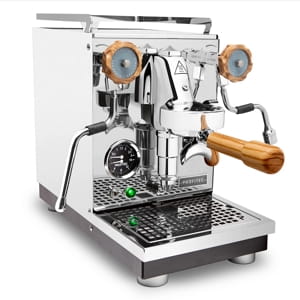
Profitec builds the Pro 400 as the small HX of the lineup. The casework is stainless, panels fit square, and the layout is logical. The face carries a dual gauge so you can watch pump and boiler pressure independently, which is useful for diagnosing grind errors and for verifying your OPV setpoint after adjustments. The brew group is Profitec’s E61-class unit with a stainless steel mushroom, a nice durability note that also keeps the internal parts looking cleaner over time. The boiler is stainless, 1.6 liters, and insulated. The wands are high quality, with low-wear rotary valves on the knobs. The colored disclets for the steam and hot water knobs are cosmetic, although they do make the machine look less clinical and they come in the box.
The chassis is truly compact. At about 9 inches wide, 17.6 inches deep, and 14.6 inches tall, it fits on shallow counters and under standard upper cabinets. The cup tray on top is removable, which makes tank refills simple. The machine weighs a little over 21 kg, so it will not skate when you lock in a portafilter. The tank is the only water option. There is no plumb-in. Plan on filtered water or a cartridge in the reservoir.
The underside multifunction switch is the party trick. Instead of hiding HX behavior behind folklore, Profitec exposes three fixed boiler temperatures and lets you flip preinfusion and ECO mode. The company even publishes approximate brew temperatures those boiler setpoints yield after a short flush. This makes dialing predictable and keeps HX ownership from turning into guesswork.
Workflow
Heat-up and readiness
The machine follows the standard HX rhythm. Heat up, give the group and portafilter a little time to soak, then flush lightly before the first pull if needed. Profitec’s manual sets expectations clearly. It shows three switch positions that correspond to boiler temperatures of 120, 124, and 128 Celsius. After warm up and a short two-second flush, those map to approximate brew temperatures of about 90, 94, and 98 Celsius at the puck. Use positions I or II for espresso. Keep position III in reserve when you want maximum steam output for milk service.
Choosing a temperature preset
Treat the underside switch like a three-gear box. Position I for darker roasts and chocolate-heavy coffees. Position II for medium roasts and most blends. Position III when you need steam priority for multiple back-to-back cappuccinos. The manual even echoes this guidance and ties the positions to taste outcomes. You can move between them without diving into a menu.
Preinfusion on or off
The Pro 400 lets you activate a preinfusion routine that wets the puck before full extraction. Profitec describes it as a process to moisten grounds so they expand evenly and close channels before the shot. The feature is off by default and can be enabled or disabled through the same switch logic, confirmed by the green LED. It is a simple way to add a margin of forgiveness to your puck prep, especially if you are using a standard double basket and a medium grind.
Tank management and ergonomics
The 2.8 liter reservoir is generous for a compact machine. Automatic low-water shutoff prevents dry-firing. The removable cup tray gives you quick access. The bracket under the drip tray that holds a blind disc is a small but appreciated touch that makes daily water backflushing smoother. The rotary valves for steam and hot water have a gentle action that new users prefer over stiff levers.
Espresso performance
Temperature behavior you can trust
HX machines raise lots of questions about flushing and stability. Profitec narrows the range of outcomes by exposing boiler temps and publishing a starting flush routine. With the Pro 400 warmed and the switch at position II, perform a short two-second flush to clear overheated water from the heat exchanger. You land near a 94 Celsius brew temperature and can pull a straight 1:2 without drama. If taste leans bitter, drop to position I. If shots run sour on a light roast, step to position II or even III and add a moment more flush based on the audible hissing at the group. This is HX made simple rather than mystical.
Preinfusion as a stabilizer
Switchable preinfusion is not a gimmick. On compact HX machines it smooths the initial ramp into the puck, which helps with medium and light coffees that punish sloppy prep. Profitec positions it as a way to allow the coffee bed to swell before full pressure. On the bar, that translates to fewer early channels and slightly more consistent shot times when multiple people use the machine. If you change coffees often, leave it on. If you like short ristrettos from darker roasts, you may prefer it off for a more immediate hit.
Pressure and flow basics
The Pro 400 uses a vibration pump. You set brew pressure through the expansion valve. The dual manometer lets you see boiler and pump pressures live. In practice, set the OPV to a sensible 9 bar on a blind and then leave it. Let grind and dose move flavor. The E61-class group keeps temperature stable once you are in a routine, and the stainless mushroom resists the ghostly green patina that some owners discover later in brass components.
Starting recipes
Use the machine the way it is designed. On position II, preinfusion on, target a classic 18 g in and 36 g out in roughly 27 to 31 seconds from pump on. On position I with a darker roast, reduce temperature and let the shot run a touch shorter to preserve body and suppress bitterness. On position III, increase your flush slightly, then enjoy the steam headroom for milk without losing consistency on back-to-back pulls. Profitec’s own tables in the manual justify the idea of temperature stepping by roast level.
Milk steaming
This is where HX machines earn their keep. The Pro 400’s 1.6 liter stainless boiler keeps a stable head of steam and recovers quickly for a compact chassis. The wand is responsive and the rotary valve gives you fine control. On position II you can texture a 12 ounce pitcher for two cappuccinos with time to spare, then follow with a second pitcher without the needle sagging into a stall. If your mornings are milk-forward, position III provides maximum steam output. Profitec even notes that position III is the choice when your focus is steam power, which aligns with experience.
If you are teaching someone to steam, fit a two-hole tip and keep boiler temperature in position II. The roll is easier to hold and the transition from aeration to texturing is less abrupt. As skills improve or when entertaining, raise the setpoint to position III and step up to a higher flow tip for speed.
Maintenance and reliability
Daily loop
Wipe and purge the wand after every pitcher. Backflush with water at the end of the day. The blind disc holder under the tray removes the friction of daily cleanup, which means it actually gets done. Weekly detergent backflush is sensible for daily users. The dual manometer makes it easy to spot idle boiler pressure behavior and pump pressure movements that hint at scale or OPV drift.
Water and descaling
It is a reservoir machine. Your water recipe and filter discipline decide how much service you will do. Use filtered and properly softened water that meets espresso machine specs for hardness and alkalinity. The stainless boiler and stainless mushroom are not excuses to ignore water quality. They are there to make cleaning easier and corrosion less likely. Profitec lists basic water and cleaning guidance in the manual, and the ECO mode helps limit idle time that concentrates minerals.
Brew pressure adjustment
Profitec documents manual brew pressure adjustment. Set your OPV with a blind disc and a gauge reading, then resist the urge to chase it. If you see notable deviation on the pump gauge during extractions that you cannot explain with grind or dose, confirm with a blind and adjust. The combination of a visible pump gauge and an accessible expansion valve makes this a five-minute job.
Programming and controls
The Pro 400 keeps the interface minimal and physical. There is no touchscreen. Everything that matters lives on one switch and a few lights.
- Three temperature presets. 120, 124, or 128 Celsius at the boiler. After warmup and a short flush, those correspond to about 90, 94, or 98 Celsius at the puck. Choose a preset by roast rather than by superstition.
- Preinfusion toggle. Off by default, on when you want to build a margin of forgiveness into your shots. Activation is confirmed by the green LED and described clearly in the manual.
- ECO mode toggle. Factory enabled. Disable when testing or entertaining, re-enable for daily life. The switch logic covers this too.
- Dual gauge. Boiler pressure for steam readiness, pump pressure for brew. Use both during setup and to spot issues.
Real-world numbers and observations
- Footprint. 228 x 448 x 372 mm without portafilter, 21.5 kg. The width is the headline. It is a true narrow-body HX.
- Boiler and power. 1.6 liter stainless boiler, insulated, 1400 to 1500 W depending on region.
- Reservoir. 2.8 liters, automatic low-water shutoff, reservoir only.
- Group and internals. Profitec brew group with stainless mushroom, stainless heating element, low-wear rotary valves.
- Accessories that matter. Blind disc bracket under the tray, colored disc lets included, removable cup tray for tank access.
- Optional upgrades. Compatible with Profitec’s E61 flow control device if you want to experiment with profiling later. US retailers also bundle third-party kits at times.
Competitive comparisons
Lelit MaraX PL62X
MaraX is the HX designed to act like a dual boiler in daily life. Its control logic auto manages brew temperature at the group to reduce flush dependence. Pro 400 takes a simpler route. It gives you three boiler setpoints and publishes approximate brew temps after a short flush, then lets you run it like a classic HX. If you want automation that flattens the flush curve, MaraX is compelling. If you want manual control with clear presets and stronger steam in the top setting, Pro 400 feels more traditional.
Profitec Pro 300
Pro 300 is a compact dual boiler with a ring group and PID. It is faster to brew temperature and does not need an HX flush routine. It sacrifices some peak steam headroom compared to a larger HX, and it costs more in some markets. If espresso-first with occasional milk is your routine, Pro 300 is tidy. If milk drinks are frequent and you value a classic E61 lever feel, the Pro 400 hits the mark.
Rocket Appartamento
Appartamento is the good-looking HX rival with a 1.8 liter copper boiler. It lacks user-selectable temperature presets and switchable preinfusion. Pro 400 answers with stainless internals, a published temp map, and the same compact counter footprint category. If you like Rocket’s aesthetic and do not mind a classic flush-and-go routine, Appartamento remains a favorite. If you want HX convenience features and a dual gauge, Pro 400 is the more controlled choice.
ECM Mechanika VI Slim
Mechanika VI Slim is another narrow HX with a bigger boiler. Depending on trim, it offers a similar convenience switch for temp and eco mode. The choice here is ecosystem and price in your region. Profitec and ECM share family DNA. Buy on price, local support, and which face you prefer on your counter.
Scores
- Build quality: 8.9
- Temperature stability: 8.6
- Shot consistency: 8.5
- Steaming power: 8.8
- Workflow and ergonomics: 8.7
- Maintenance and serviceability: 8.6
- Value: 8.8
Total: 8.7
Verdict
The Profitec Pro 400 is HX done right for small kitchens. It is narrow but stable, simple but not bare, and flexible without a maze of menus. The three temperature presets, the clear guidance on flush behavior, and a real preinfusion toggle reduce the learning curve, which is the usual barrier for HX machines. The stainless boiler and stainless mushroom are smart choices for long-term ownership. The tank-only design keeps the install easy, and the steam output on the higher preset makes milk service feel like a bigger machine. It will not replace a dual boiler for people who want independent brew and steam temperatures with degree-level control, and it will not match the silence or torque of a rotary pump. It does not need to. In its lane, the Pro 400 is a balanced, reliable tool that turns the old HX ritual into a repeatable routine.
TL;DR
Compact heat exchanger with a 1.6 liter stainless boiler, E61-class group with stainless mushroom, dual gauge, vibration pump, and a three-position switch that sets boiler temperature, toggles preinfusion, and enables ECO mode. Reservoir only. Clear, published brew temperature behavior after a short flush makes dialing straightforward. Strong steam for its size and a neat footprint for small kitchens. Pricing sits near 1,599 USD in the US, about £1,279 in the UK, and roughly 1,500 EUR in the EU depending on VAT.
Pros
- Three useful temperature presets with documented brew temp outcomes after a short flush
- Switchable preinfusion that improves consistency with modest effort
- Strong steam for a compact HX and fast recovery
- Stainless boiler and stainless mushroom in the group
- Dual pressure gauges and accessible OPV for easy setup
- Compact footprint and thoughtful touches like a blind disc holder and removable cup tray
Cons
- Reservoir only, no plumb-in option
- Vibration pump is louder and has a different feel compared to rotary
- Still requires an HX flush routine, even if simplified by the presets
- Temperature control is in three steps rather than degree-by-degree like a dual boiler PID
Who it is for
- Home baristas who want a compact machine with real steam and predictable HX behavior
- Milk-forward households that still care about shot quality
- First-time E61 owners who want a forgiving on-ramp, not a science project
- Enthusiasts who plan to add an E61 flow control kit later without paying for a dual boiler now
Glanceable specs
- Format: Heat exchanger espresso machine with underside convenience switch
- Boiler: 1.6 liter stainless, insulated
- Group: Profitec brew group with stainless steel mushroom
- Pump: Vibration, adjustable expansion valve
- Reservoir: 2.8 liter tank with auto low-water shutoff
- Controls: Three boiler temps, preinfusion on or off, ECO mode on or off
- Gauges: Dual manometer for boiler and pump
- Dimensions and mass: 228 W x 448 D x 372 H mm, 21.5 kg
- Power: EU 230 V 1400 W, US 115 V 1500 W
- Included: Two portafilters, 7 g and 14 g baskets, blind disc, tamper, group brush, colored knob disclets
Pricing and where it sits
Recent retail snapshots show the Pro 400 around 1,599 USD in the United States, about £1,279 in the UK, and near 1,500 EUR in the EU with VAT variation by country and seller. That places it squarely against Lelit MaraX and Rocket Appartamento on price, with a feature tilt toward HX usability through presets and an explicit preinfusion toggle.
If you want this adapted into a region-targeted buyer’s guide, I can layer in warranty norms by market, voltage options, and cross-links to grinder picks and water guides so it ranks and converts.