
Typical late-2025 pricing varies by region and promos. Check live listings for current bundles and warranty terms.
Profitec Pro 500 PID
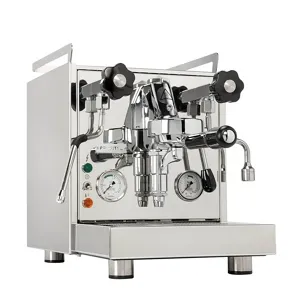
A disciplined E61 heat exchanger that prioritizes repeatable routine and real steam power, with a front-facing PID and shot timer you actually use.
Overview
The Pro 500 PID is the E61 heat exchanger that behaves like a real tool. You get a 2.0 L stainless HX boiler, a quiet vibration pump, dual gauges, cool-touch wands, and (since the 2022 revision) a front PID display plus a shot timer. It won’t give you brew temperature to the half-degree, but it will give you a fast, repeatable routine and steam power that feels “small café,” while still fitting under standard cabinets.
Pros
- Strong, steady steam from a 2.0 L stainless HX boiler
- Front PID + shot timer (2022) improves daily usability
- Dual gauges for boiler and brew pressure (useful diagnostics)
- Cool-touch, fully articulated steam and hot water wands
- Optional E61 flow-control upgrade path
Cons
- HX workflow requires a short cooling flush after long idle
- PID controls boiler temp, not direct brew temp setpoint
- Tank only (no stock plumb-in)
- Vibration pump feel and sound remain vs rotary platforms
Features
- E61 group with mechanical pre-infusion chamber
- Heat exchanger architecture with stainless boiler
- PID boiler temperature control (maps to steam pressure and influences HX brew behavior)
- Front-mounted PID display + shot timer (2022 update)
- Dual pressure gauges (boiler + brew)
- Cool-touch steam and hot water wands
- Quiet-tuned vibration pump
- Top-access reservoir with low-water shutoff
- Optional E61 flow control kit (dealer-installed or DIY)
Glanceable specs
- Architecture: E61, heat exchanger, vibration pump
- Boiler: 2.0 L stainless steel HX, 1400 W
- Water: internal reservoir only, about 2.8–3.0 L (market listings vary)
- Gauges: boiler pressure + brew pressure
- Dimensions: about 30 × 45 × 39 cm (varies slightly by market)
- Weight: about 23–24 kg
- Portafilter size: 58 mm
- Notes: PID controls boiler temperature, not a dedicated brew boiler
Workflow
- Warm up: boiler heats quickly, E61 benefits from extra soak time (leave portafilter locked in)
- Cooling flush: after long idle, flush until sputter turns into a steady stream
- PID use: pick a sensible weekly “band” (lower for darker / espresso-first, higher for heavy milk days)
- Cadence: use the shot timer to keep extractions consistent across household users
Starting recipes
- Medium roast: 18 g in, 36 g out, 27–31 s (from pump on). Mid PID band, short flush after long idle.
- Light roast: raise PID slightly, extend first flush after full idle, aim ~1:2.2 yield in low-30s seconds.
- Darker roast: lower PID a touch, tighten yield (~1:1.9), keep flush minimal.
Who it is for
- Milk-heavy homes that want real steam and fast back-to-back service
- E61 fans who want a compact, serviceable HX with visible controls
- Buyers who prefer “simple, proven, repairable” over screens and apps
- People who may add flow control later rather than buying a profiling machine first
Who should avoid it
- Anyone who refuses HX flush routines (even small ones)
- Buyers who want direct brew-temperature control on the face
- People who need plumb-in capability out of the box
Pricing
- Pricing varies by region, VAT, and promotions. Many markets list it in the “upper midrange” prosumer tier.
- When comparing, note whether listings include flow control, wood kits, and local warranty coverage.
Takeaway
If you want a classic E61 heat exchanger that behaves like a grown-up tool, the Profitec Pro 500 PID is the template. You get a 2.0 liter stainless steel HX boiler, a quiet vibration pump, dual pressure gauges, cool-touch wands, and a PID that actually helps. The 2022 revision moved the PID to the front and added a shot timer, which turned a hidden control into something you will use every day. It is tank only with a 2.8 to 3.0 liter reservoir, and it fits under standard cabinets while steaming like a small café head. It will not give you brew temperature by the half degree. It will give you a fast, repeatable routine with honest steam power and a clean E61 lever feel. The numbers are real. Boiler volume is 2.0 liters at 1400 watts in stainless. The tank is roughly 3.0 liters. The footprint lands around 30 by 45 by 39 centimeters with a weight near 23 kilograms. The PID controls boiler temperature, which sets steam pressure and nudges HX brew behavior. Those are the facts that matter for ownership and they line up across the manual and major dealers.
At a glance
- Architecture. E61 group, heat exchanger boiler, vibration pump, dual manometer for boiler and brew pressure.
- Boiler. 2.0 liter stainless steel HX, 1400 watt element.
- PID and controls. PID sets boiler temperature and includes a shot timer on the 2022 update, with the display visible on the face. The PID on an HX maps to steam pressure and influences brew temperature at the group.
- Water. Internal reservoir only, about 2.8 to 3.0 liters, with low water shutoff. Not plumbable in stock form.
- Dimensions and weight. About 11.9 inches wide, 17.6 inches deep, 15.5 inches tall, roughly 51 to 52 pounds. Metric listings cluster at 30 x 45 x 39 centimeters and about 23 to 24 kilograms.
- Options. Many dealers sell an optional flow control needle valve for the E61, installed or as a kit. Wood accent kits are common.
- Typical pricing near late 2025. United States around 1,899 dollars. Australia commonly lists around 3,599 dollars AUD depending on trim and retailer. Regions vary with VAT and promos.
Build and design
Profitec builds compact machines that feel dense rather than hollow. The Pro 500 PID is a good example. The casework is stainless with clean seams and a grate that does not rattle. The E61 group sits proud of the face with the classic lever action and pre-infusion chamber. The geometry is standard, which means bottomless portafilters and 58 millimeter baskets fit the way they should. Wands are cool-touch and fully articulated. The valves are quick to open and close without forcing your hand into odd angles. It is not a vanity piece. It is a tidy box that tolerates daily use.
Under the skin you find a 2.0 liter stainless steel heat exchanger boiler at 1400 watts. Stainless helps long term service and is paired with a sensible element wattage that avoids spiky recovery while still producing compelling steam. The brew circuit follows the HX model. Brew water routes through a heat exchanger tube inside the steam boiler and picks up heat as it travels to the group. Profitec’s implementation is stable for an HX once you build a simple cooling flush routine. The dual manometer gives you the two numbers you actually use. Boiler pressure tells you steam readiness and how hot the HX path may be after idle. Brew pressure tells you what your pump and over pressure valve are doing during extraction. This is a practical diagnostic pair for any E61 user.
Deals of the Week
The PID was the Pro 500’s main usability complaint before the 2022 update. It lived behind the drip tray, which meant it was out of sight and out of mind. The revision moved the PID to the front and added a visible shot timer. That changed behavior. People now set steam pressure band on day one and use the timer to keep cadence tight. The manual is clear about what the PID controls. It is not a brew boiler PID. It sets boiler temperature, which sets steam pressure, which in turn influences HX brew water temperature and group behavior. Treat it like a three speed gearbox rather than a chemistry set. Lower for darker roasts and espresso first. Middle for everyday blends and light milk use. Higher when you are steaming for a crowd or pushing dense light roasts.
The water path is a tank. No plumb-in port. The reservoir capacity is around 2.8 to 3.0 liters depending on the listing and market, with a low water sensor that cuts the heater. Top fill is straightforward because the cup tray lifts cleanly. Clive Coffee’s specs show the reservoir details for the US build and spell out the low water shutoff. If you want a permanent line, this is not your platform. If you want the cleanest tank routine in a compact HX, this is it.
Dimensions matter on small counters. The Pro 500 lives near 11.9 inches wide, 17.6 inches deep, 15.5 inches tall in US spec. Australian spec sheets convert to 30 by 44.7 by 39 centimeters without the portafilter. Weight lands around 23 kilograms. It will not skate when you lock a portafilter. It will slide under typical cupboards with room to pour.
Workflow
Warm-up and readiness
The manual quotes a heat up near 15 minutes. In real life, the boiler comes up quickly and the E61 group needs a few extra minutes to soak. Lock a portafilter during warm-up so the mass equalizes. If you plan a tasting flight, let the casework and baskets settle longer. For weekday espresso you will be pulling within that quoted window, then the machine settles into a steady state as you prep and grind. The new front PID makes it easy to confirm the setpoint and watch the shot timer on your first dial-in.
Cooling flush without games
Heat exchangers store overheated water in the HX tube during idle. A short cooling flush pulls the brew path back into a sweet zone. On the Pro 500 a practical routine is simple. After idle, open the group until the hiss and sputter smooth into a steady stream, then stop and pull. That may be two to three seconds for a medium roast, more for very light roasts. Between back-to-back shots you often skip the flush entirely because the HX has not had time to overheat. Use boiler pressure as a guide. If it is higher than your normal range after a long idle, add a beat to the flush. If you have been pulling a line of drinks, lock and brew. HX ownership is not hard if you treat it like this.
PID as a daily control
A PID on an HX is about steam pressure and the temperature of water parked in the boiler, not a direct brew temperature setpoint. Profitec spells this out in the manual. Pick a band and leave it alone for the week. For medium roasts and two cappuccinos a morning, set the PID in the middle, then forget it. For guests and 12 ounce pitchers, raise the setpoint to build a bit more steam headroom. For straight espresso on darker roasts, drop the setpoint and keep your flush minimal. Small changes in setpoint make sense if you change coffee style. Constant fiddling does not.
Ergonomics and cadence
The Pro 500 feels like a small café machine. The E61 lever action is short and smooth. The wand swings with full travel, which matters if you like to set your pitcher angle precisely. The hot water tap runs clean for Americanos or rinses. The dual gauges sit high, so you do not have to bend to read them. The shot timer is visible and immediately useful for anyone who wants to keep extractions consistent in a family environment. Tank access from the top is quick. The drip tray holds real purges. These are small touches that make a workflow feel calm.
Optional flow control
If you want to experiment with declining flow or to rescue tricky light roasts, the optional E61 flow control kit is a known upgrade path. Whole Latte Love and other dealers sell the Pro 500 with a preinstalled needle valve on the group cap. It is not mandatory to enjoy the machine. It does open a research path if you like to shape flavor with flow rate rather than just dose and ratio.
Espresso performance
Temperature behavior you can trust
Get warm, map a simple flush, set a sensible PID band, and the Pro 500 delivers consistent shots in the 27 to 31 second window. Because the boiler is stainless at 2.0 liters and the element is 1400 watts, recovery is steady rather than spiky. You avoid the scorched first shot people associate with neglected HX routines. Give the portafilter a minute to be honest, flush until smooth, lock and pull. Treat brew pressure as a baseline, not as a flavor knob. If your blind disk reads nine bar and your extractions match your target ratio in time, then the machine is doing its job.
Pre-infusion and ramp
Using the tank, you get the mechanical pre-infusion from the E61 cavity and the gentle ramp of a vibration pump. The combination wets the puck predictably before full pressure. Paired with clean puck prep you will see fewer screaming channels and more steady streams under a bottomless portafilter. If you fit a flow control, you can extend pre-infusion or shape the ramp by hand. The stock behavior is sufficient for most coffees and keeps the routine fast.
Starting recipes
On a house medium roast, dose 18 grams in a standard 58 millimeter double and aim for 36 grams out in 27 to 31 seconds from pump on. PID in the middle band, small cooling flush after a long idle. On a light roast, bump the PID two to three degrees, extend the first flush slightly after a full idle, and move the yield to 1:2.2 in the low 30s seconds. Keep dose steady while you adjust grind. If bitterness creeps in with a darker roast, lower the PID a touch and shorten the ratio to 1:1.9 while minimizing the flush.
What it tastes like when it is right
The Pro 500 offers the classic E61 HX cup. Medium roasts come out sweet through the midrange with a good coat on the tongue and a clean finish. Light roasts can be clear and juicy without astringency if you keep the tail honest and your flush routine tidy. The shot character holds shape in milk, which is what most home buyers want. It is not chasing ultra high clarity like a saturated group with extreme profiling. It is delivering balanced espresso consistently, which is the entire point of this platform.
Milk steaming
If you are buying a heat exchanger, it is likely because you care about milk speed. The Pro 500 earns its place here. The 2.0 liter boiler and the 1400 watt element produce a steady head of steam with quick recovery. Clive and Whole Latte Love both frame the Pro 500 as a strong HX steamer with real back-to-back capacity. You can pull a shot and texture a 12 ounce pitcher without watching the gauge dive into a stall. If you have guests and larger pitchers, raise the PID band and the machine will keep up better than many small dual boilers.
The wand is cool-touch and fully articulated. That combination makes cleanup immediate and lets you move between stretching and rolling without fighting the angle. A two hole tip is a good place to start if you are learning. It gives you time to find the roll. A higher flow tip will speed service once you have muscle memory. The push-pull rhythm on the valve is quick to master. Steaming is one of the reasons this machine is easy to recommend for milk heavy homes.
Maintenance and reliability
Daily routine
Purge and wipe the wand immediately after steaming. Backflush with water at session end. Detergent backflush weekly if you pull daily. Drop and soak the shower screen on a schedule. Keep the basket and the group clean, especially if you do a lot of milk rounds. The three way valve in the group exhausts pressure at shot stop, which leaves a drier puck and keeps the path from getting swampy. The dual gauges make it simple to spot a wandering pressostat or an OPV setpoint that has drifted.
Water sets the story
This is a tank only machine. The reservoir is roughly 2.8 to 3.0 liters and there is a low water shutoff to protect the element. Your water recipe and your cleaning cadence decide how service free your life will be. Use filtered and softened water or a remineralized recipe inside espresso safe hardness and alkalinity. You can run small in tank softeners in some markets. Better yet, feed the tank with pre filtered water. Do not rely on stainless steel to save you from scale. The boiler may forgive more than copper, but limescale does not read spec sheets.
Service access and parts
Profitec builds for service. The pump is a familiar Ulka vibration unit. The valves and gaskets are common across ECM and Profitec. The parts diagrams and manuals are public and easy to read. Whole Latte Love and Clive both host support content, including internal tours, setup guides, and troubleshooting. This matters for long term ownership. You are not betting on a boutique orphan.
Programming and controls
The control list is short and everything earns its place.
- PID and shot timer. On the 2022 update the display sits on the face and the shot timer starts with the pump. Set a sensible boiler temperature for your week and use the timer to keep extractions consistent across users.
- Dual gauges. Boiler pressure reflects steam readiness and idle state. Brew pressure on a blind disk confirms your OPV baseline.
- E61 lever. Mechanical pre-infusion cavity with a gentle ramp from the vibration pump. This is the lever feel people want at home.
- Reservoir. Top fill, around 3 liters, low water shutoff. No line in port. Plan your water regimen accordingly.
There is no touch screen layer or app. That is a feature, not a missing badge. Fewer failure points, fewer distractions.
Bench workflow: how to run the Pro 500 from day one
- Water and placement. Put the machine where the wand can swing and the portafilter can clear the backsplash. Fill the reservoir with filtered and softened or remineralized water. Make sure the low water sensor is working by lifting the tank for a moment so you know what the indicator looks like when it trips.
- Warm-up. Lock in an empty portafilter. Set the PID mid range. Power up. Purge the wand briefly to clear condensation. Give the group an honest soak. The manual’s 15 minute window is realistic for a first shot. For a long session, give accessories extra time.
- Baseline espresso. Dose 18 grams, distribute cleanly, tamp level. After a long idle, flush until the stream smooths. Pull to 36 grams in 27 to 31 seconds. Adjust grind first. Repeat three shots while holding dose and yield to confirm you are centered.
- Light roast path. Raise the PID a small step. Extend the first flush a hair after full idle. Keep dose steady and target 1:2.2 in the low 30s seconds. Taste the tail. Cut the finish if astringency creeps in.
- Milk routine. Leave the PID mid to high for milk days. Pull your shot and steam a 12 ounce pitcher immediately. Wipe and purge, then go again. If you are entertaining, raise the PID a couple of points and use a higher flow tip to increase throughput.
- Cleaning loop. Water backflush daily, detergent weekly for daily users. Soak the screen and baskets on schedule. Empty and rinse the tank rather than topping indefinitely. These habits keep steam dry and the HX behavior predictable.
Competitive comparisons
ECM Technika V Profi PID
Technika V Profi PID is the sister machine in the ECM line with a rotary pump and optional plumb-in on certain variants. It carries an HX boiler with PID and a premium face. If you value a rotary pump’s feel and the ability to connect to a line later, ECM is a step up in price and install complexity. Pro 500 PID remains the cleaner tank machine with a similar cup and a quieter maintenance story. ECM and Profitec share family DNA in parts and service.
Rocket Mozzafiato Cronometro R
Mozzafiato R brings a rotary pump and a plumb option in a compact HX body, with a PID and Rocket’s shot timer. It is made for buyers who want plumbing and a rotary signature. If you do not have a line or you prefer a lower price with similar steaming and an honest tank routine, Pro 500 PID is the better value. If a silent rotary and plumbing are non negotiable, Rocket is the fit.
Lelit MaraX PL62X
MaraX is the HX that acts like a brew first machine. Its double probe logic holds group temperature and flattens the flush curve. It is quiet and friendly and usually cheaper. It does not steam with the same authority as a 2.0 liter boiler when you push larger pitchers. Choose MaraX if espresso first convenience is your top priority and you like the idea of three simple temperature choices. Choose Pro 500 PID if you want a traditional HX with a bigger steam tank, dual gauges, and a visible shot timer.
Profitec Pro 300
Pro 300 is a compact dual boiler with a ring group and PID for brew and steam. It is fast to brew temperature and needs no flush routine. Steaming is less muscular than a 2.0 liter HX. If your life is mostly straight shots with occasional cappuccinos, Pro 300 is tidy. If milk rounds are frequent and you like E61 ergonomics, Pro 500 PID is a better long term fit.
Profitec Pro 600
Pro 600 is a dual boiler with PID on both boilers and a different personality. The steam boiler is around 1 liter and can run higher pressure. Users sometimes chase 2 bar on Pro 600 for microfoam speed at the expense of capacity per boiler volume. The Pro 500 has more total steam volume at the same counter width. If you want a dual boiler for exact brew temperature, the 600 wins. If you want larger steam reserves in a simpler machine, the 500 wins.
Quick Mill Rubino
Rubino is a compact E61 HX with a copper boiler and Quick Mill’s pulsor on the vibration pump that softens the sound. It is more analog. The Pro 500 PID gives you on face PID, a shot timer, and stainless boiler construction. If you prefer fewer electronics and the pulsor’s quieter signature, Rubino is a solid choice. If you want the PID band and visible timer for training a household, Pro 500 PID earns its higher price.
Real world numbers and notes
- Boiler and power. 2.0 liter stainless steel HX at 1400 watts. This is the heart of the machine. The combination is why steam feels strong and recovery feels steady without tripping breakers.
- Reservoir. Around 2.8 to 3.0 liters, internal only, with low water shutoff documented in the US spec.
- Dimensions and weight. About 11.9 by 17.6 by 15.5 inches and roughly 51 to 52 pounds in US listings. Metric retail pages cluster around 30 by 45 by 39 centimeters and near 23 kilograms. Plan depth for a straight portafilter pull.
- PID behavior. The controller sets boiler temperature which maps directly to steam pressure and indirectly to brew temperature. The manual spells out the programming and the logic. Use it to choose a band, not to chase digits mid shot.
- 2022 update. External PID and integrated shot timer. That is not a small change. It makes the machine easier to live with and to teach.
- Price reality, late 2025. In the United States the machine is commonly listed at about 1,899 dollars. Australia often shows around 3,599 dollars AUD depending on finish and retailer. Always check local VAT and promos.
Clear strengths
- Steam power in a compact chassis. A 2.0 liter HX at 1400 watts with cool touch hardware gives you speed and repeatability.
- Visible PID and timer. The 2022 revision brought the PID to the front and added a shot timer, which turned a hidden control into a daily tool.
- Honest E61 workflow. Mechanical pre-infusion and a gentle vibe pump ramp keep puck wetting predictable.
- Dual gauges that matter. Boiler for steam and HX state, brew for OPV sanity and extraction diagnostics.
- Parts and documentation. Public manuals and diagrams and dealer support that spans regions.
Trade offs to consider
- Tank only. No built in plumb in option. Your water discipline decides the service story.
- HX behavior. You still perform a small cooling flush after long idle for delicate straight shots. The PID helps but does not change physics.
- Vibration pump. Quieter than many, yet it is still a vibe signature rather than a rotary glide.
- No numerical brew PID. You set a boiler temperature and work by routine and taste at the group.
Scores
- Build quality. 9.0
- Temperature stability. 8.7
- Shot consistency. 8.7
- Steaming power. 9.0
- Workflow and ergonomics. 9.0
- Maintenance and serviceability. 8.8
- Value. 9.0
Total. 8.9
Verdict
The Profitec Pro 500 PID is the heat exchanger that earns your trust by doing the basics correctly. The boiler is stainless and sized right. The pump is quiet for its class. The dual gauges give you useful feedback. The visible PID and shot timer turn the 2022 revision into a better machine without changing its spirit. It is a tank only E61 with a repeatable flush routine and a strong steam story. If you want degree level brew numbers on the face, you are shopping for a dual boiler. If you want a compact machine that pulls balanced espresso and steams for a family breakfast without drama, this is the tool.
What continues to stand out is how calm the daily cadence feels once you stop chasing myths. Set a sensible PID band. Warm up correctly. Map a short cooling flush after idle. Keep dose, ratio, and time honest. The Pro 500 will give you sweet, steady shots and milk texture with room to grow into flow control later if you catch the profiling bug. There is a reason so many prosumer bars have a Pro 500 or its ECM sibling still working years later. The platform is simple, documented, and built to be serviced. That is what you want when you plan to keep a machine for a decade.
TL;DR
E61 heat exchanger with a 2.0 liter stainless boiler and a quiet vibration pump. Dual gauges, cool touch wands, internal reservoir around 3 liters with low water shutoff. The 2022 update put the PID and a shot timer on the face. The PID sets boiler temperature, which sets steam pressure and influences HX brew behavior. You still do a short cooling flush after long idle, then enjoy café grade steaming in a compact body. Typical late 2025 pricing sits around 1,899 dollars in the US and roughly 3,599 dollars AUD in Australia.
Pros
- Strong, dry steam and quick recovery from a 2.0 liter stainless boiler
- External PID with shot timer for real daily control and cadence
- Dual pressure gauges and cool touch hardware in a compact footprint
- Tank routine with low water shutoff, simple top fill
- Optional flow control path for profiling down the road
Cons
- Tank only with no factory plumb option
- HX requires a small cooling flush after long idle for straight shots
- Vibration pump sound and feel are present compared to a rotary
- Boiler PID is not a direct brew temperature control
Who it is for
- Home baristas who want a classic E61 lever workflow with a real steam reserve
- Milk forward households that need back to back pitchers without waiting
- Buyers who value visible controls, a shot timer, and practical diagnostics over a menu maze
- Enthusiasts who may add E61 flow control later rather than buying a pricier profiling platform out of the gate
Glanceable specs
- Group. E61 with mechanical pre-infusion and 58 millimeter portafilter
- Boiler. 2.0 liter stainless steel heat exchanger at 1400 watts
- Pump. Vibration, OPV adjustable
- PID. Boiler temperature control, visible display with shot timer since 2022 update
- Gauges. Dual manometer for boiler and pump pressure
- Water. Internal reservoir only, about 2.8 to 3.0 liters, low water shutoff
- Size and weight. Around 30 x 45 x 39 centimeters, about 23 kilograms. US spec 11.9 x 17.6 x 15.5 inches, 51 pounds
- Options. Flow control kit, wood accent kits
- Price snapshot. US near 1,899 dollars. AU near 3,599 dollars AUD depending on retailer and finishes
We’ve categorized the best espresso machines for every kind of buyer
Find the right shortlist faster, whether you want convenience, a beginner-friendly setup, a smaller footprint, or better value at a given budget.
Best Superautomatic Espresso Machines
One-touch picks for speed and convenience.
Best Espresso Machines for Beginners
Easy-to-use machines with a smoother learning curve.
Best Small Espresso Machines
Compact machines for tighter kitchens and counters.
Best Espresso Machines With Built-In Grinder
All-in-one options with fewer extra pieces to buy.
Best Cheap Espresso Machines Under $500
Budget picks that still make sense for real espresso.
Best Prosumer Espresso Machines Under $1000
More serious machines with stronger value for the money.
Best Single Boiler Espresso Machines
Simple, space-saving picks for espresso-first routines.