

Typical street (late-2025): $11,580 (US) • £11,190 (UK) • A$15,000–16,000 (AU). Built-to-order and finishes affect totals.
Slayer Single Group
Needle-valve flow control that turns low-flow pre-brew into repeatable sweetness—on a saturated dual-boiler platform with real steam and a tactile three-position paddle.
Overview
Slayer’s Single Group is the original restricted-flow pre-brew machine. A saturated 1.1 L brew boiler tracks PID steps tightly; a 3.3 L steam boiler provides café-pace milk. The three-position paddle puts a calibrated needle-valve in the center position (target 40–60 g/30 s clear water), then full flow on the left for extraction. Plumb-in is ideal; external-reservoir + removable tray keeps installs flexible. The result: fast, stable extractions and a tactile way to push sweetness without chasing software pressure curves.
Pros
- Built-in, calibrated low-flow pre-brew via needle valve
- Saturated brew path makes 1°C changes meaningful shot-to-shot
- 3.3 L steam boiler delivers café-grade milk texture and recovery
- Commercial stance: plumb & drain ready; external reservoir capable
- Shot mirror + Teflon dispersion screen are practical, cleanable touches
Cons
- Premium price versus capable E61 dual boilers with flow kits
- 23" depth and ~110 lb demand space and a thoughtful install
- Requires valve calibration and disciplined puck prep to shine
- Rotary vs gear pump variants exist—verify your exact configuration
Features & Specs
- Group: saturated; three-position actuator (right off, center restricted flow, left full flow)
- Needle-valve pre-brew: calibrate to 40–60 g in 30 s (clear water); avoid tightening below 40 g/30 s
- Boilers: 1.1 L brew @ 600 W; 3.3 L steam @ 1,300 or 2,000 W; independent PID
- Pump: rotary vane per current spec (some units noted with magnetic gear pump)
- Water: plumb-in intended; can draw from external reservoir
- Drain/Tray: designed to drain; optional removable drip tray for non-drained installs
- Size/weight: 18.5 W × 23 D × 13 H in (~110 lb)
- Electrical: 120 V 60 Hz 13 A 1.6 kW or 220–240 V 50/60 Hz 10 A 2.1–2.4 kW
- Extras: shot mirror; Teflon-coated dispersion screen; customizable panels/woods
Pricing & Availability (late-2025)
- USA: ≈ $11,580
- UK: ≈ £11,190 (incl. VAT)
- Australia: ≈ A$15,000–16,000
- Status: Often built to order; finish and freight impact totals
FAQs
- Do I have to plumb it?
- Plumbing + drain is ideal, but the pump can sip from an external reservoir and a removable tray is available.
- How is pre-brew different from pre-infusion?
- Slayer’s center position restricts flow (not pressure). The circuit sits at brew pressure while wetting the puck gently.
- Rotary or gear pump?
- Current spec lists rotary; some Single Group units use magnetic gear pumps. Confirm with your seller if the pump type matters to you.
- Volumetric auto-stop?
- No—the paddle is manual. Use the built-in timer to repeat dwell and total time.
Who It Is For / Who Should Skip
Bench workflow (day one)
- Water & install: Plumb with shutoff + regulator + filtration; otherwise set a sealed external reservoir and slot the removable tray.
- Warm-up: Let boilers stabilize; give baskets/portafilter time to match; quick purge before first pull.
- Calibrate valve: Remove screen; center position for 30 s ×3 with clear water; aim 40–60 g/30 s; adjust in small steps; reinstall screen.
- Baseline espresso: 93 °C, short pre-brew dwell, left to full flow; 1:2 in the high-20s seconds. Repeat shot x3 to center grind.
- Light-roast path: +1–2 °C, extend pre-brew, optional finish back in center to soften the tail.
- Cleaning: Water backflush at session end; detergent weekly; purge/wipe wand; treat the needle valve like an instrument.
Comparisons & positioning
- LM GS3 MP/AV: saturated + LM ecosystem; AV adds volumetrics. Slayer counters with calibrated low-flow center position.
- Rocket R Nine One: programmable pressure curves. Slayer = tactile restricted-flow lane, not saved graphs.
- Linea Mini: compact saturated workhorse; no native low-flow center. Slayer gives that by design.
- Lelit Bianca: great value needle-valve paddle on E61; Slayer adds saturation + bigger steam + set center position.
Takeaway
Slayer’s Single Group is the original low-flow, high-control machine for people who want to shape shots at the group without adding third-party mods. It pairs a saturated brew path and independent dual boilers with a three-position paddle and a patented needle valve that restricts pre-brew flow by design. You get a 1.1 liter brew boiler, a 3.3 liter steam boiler, an internal PID, a rotary pump, and a chassis that is meant to be plumbed like a small commercial rig, with an optional removable drip tray if you prefer a non-drained install. The result is a platform that rewards disciplined puck prep and lets you move flavor by managing wetting flow rather than chasing pressure hacks.
At a glance
- Format: Saturated-group, dual-boiler single group with three-position paddle and patented needle-valve pre-brew flow control.
- Boilers and power: Brew tank 1.1 L at 600 W. Steam tank 3.3 L at 1,300 W or 2,000 W depending on configuration. Independent PID control.
- Pump: Rotary vane pump per current official spec, with factory literature and support notes acknowledging magnetic gear pump variants on some Single Group units. Verify on the sales quote if the pump type matters to you.
- Actuation: Three-position group actuator, center for restricted-flow pre-brew, left for full flow, right for off.
- Water and drain: Intended to be plumbed. The pump can draw from an external reservoir, and a removable drip tray option exists for non-drained installs.
- Dimensions and weight: 18.5 in W × 23 in D × 13 in H, about 110 lb. Measurements exclude overhang from portafilter, paddle, and cup rails.
- Typical price by region: USA commonly near 11,580 USD; UK around £11,190; Australia roughly 15,000 to 16,000 AUD depending on finish and seller. Availability and customs vary by market.
Build and design
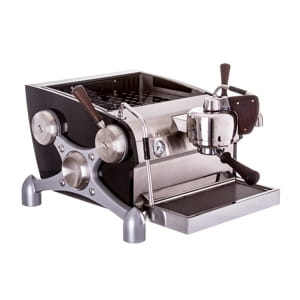
The Single Group is a compact piece of commercial DNA. The brew architecture is saturated. That means the 1.1 liter brew boiler is thermally coupled to the group so the water that reaches the puck tracks the PID tightly and reacts to small temperature changes predictably. You feel this when you move a degree and taste it on the very next shot instead of waiting for a remote group to catch up. Slayer’s spec lines it out plainly and pairs the brew tank with a 3.3 liter steam boiler sized for café-like steaming at home or behind a small bar.
The bodywork is stainless with powder-coated panels and wood accents that can be customized. Fit and finish are solid, and there is mass where it counts. At about 50 kilograms dry, the machine does not creep on the counter when you lock in a portafilter. The cup tray is wide and the stance is low. The front face stays clean because you do not have a fixed touchscreen; instead, Slayer leans on the paddle, the brew gauge, and a hidden control logic for PID and timers. Retailers call out a shot mirror and a Teflon-coated dispersion screen, both practical touches that help you manage channeling and cleanup.
The pump story deserves clarity. Slayer’s current product page lists a rotary vane pump for the Single Group. Some support notes and owner documentation refer to a magnetic gear pump on Single Group “Classic” units. If you care about pump acoustics or the specific ramp behavior, check your exact configuration with the seller. For most users, the control that defines this machine does not come from the pump curve; it comes from the needle-valve pre-brew and the three-position paddle that toggles between restricted flow and full flow.
Plumbing is the intended install. The Single Group is happiest on a filtered, regulated water line with the tray drained. Slayer also provides for realities outside perfect cafés. The rotary pump can sip from an external reservoir, and there is an optional removable drip tray basin so you can collect waste when a drain is not possible. If you are building a permanent bar, plumb and drain. If you are in a rental or a studio, the reservoir plus removable tray makes ownership feasible without a bucket under the counter.
Workflow
The paddle, the positions, and what they mean
The three-position group actuator is the daily interface and it is the reason people buy this machine. Right is off. Center is restricted-flow pre-brew, controlled by a needle valve you calibrate to a target clear-water flow. Left is full brew, which bypasses the valve for full flow from the pump. Slayer’s support docs underline a key point that many miss: pre-brew is restricted flow, not reduced pressure. The brew circuit still sits at brew pressure. You are changing the rate at which water wets the puck, not the pressure target. That distinction is what makes Slayer’s shots taste different.
Calibrating the needle valve
Before you chase flavors, you must set the pre-brew flow. Slayer’s calibration guide has you remove the dispersion screen, run clear water in pre-brew for 30 seconds, and measure the output on a scale. You repeat and average the results, then adjust the blue needle-valve knob in small steps until you are inside Slayer’s recommended window, which is 40 to 60 grams over 30 seconds. Do not crank the valve shut under 40 g per 30 seconds; the company warns that over-tightening can damage the needle. This takes ten minutes, not an afternoon. It is mechanical setup, not a ceremony, and it is worth doing right away because the flow rate is the foundation for the flavor moves you will make later.
Heat-up and readiness
Because the brew path is saturated, the machine becomes shot-ready faster than a thermosyphon E61 that needs the group to soak. That said, your best tastings still happen after the portafilter, baskets, and case have warmed. The PID-controlled brew and steam tanks stabilize quickly, then the system behaves like a small café head. Use the machine’s scheduling and timers if your dealer preconfigures them, or simply budget a short pre-session idle while you grind and distribute. You are rewarded with repeatability that does not fight you.
Tank, line, and tray reality
A fixed water line with proper filtration and a drained tray is the grown-up install. If that is not possible today, the pump can pull from an external reservoir and the removable drip tray lets you operate without a drain. Many US sellers will bundle a braided water line and a drain hose. The chassis is designed to behave like a commercial tool even when you are running it at home.
Ergonomics and counter fit
Depth catches people more than height. The spec is 23 inches deep and excludes overhang from the portafilter and the paddle. Plan honest clearance behind the case for braided lines and a straight portafilter pull. At 18.5 inches wide and 13 inches tall, the Single Group fits under most cabinets but rewards an open bar where you can work pitchers without elbow clashes. Weight is about 110 pounds. That heft translates to a solid feel on the handle and a stable machine when you purge and purge again during service.
Espresso performance
Saturated-group temperature behavior
The brew tank sits next to the group. Temperature changes at the PID show up in the cup quickly. One degree steps are meaningful and repeatable. With a 1.1 liter brew tank you have enough thermal buffer for back-to-backs while retaining the quick response that makes saturated groups the default in serious cafés. If you come from an E61 where offset management and long soak times are normal, the Single Group will feel direct and simple by comparison.
Pre-brew as a flavor tool
Slayer’s core trick is to swap line-pressure preinfusion for restricted-flow pre-brew. Pre-brew saturates the puck gently at a flow you set, then you switch to full flow for the main extraction. The company’s docs explicitly state that the circuit is at brew pressure during pre-brew; you are restricting flow, not pressure. That nuance delivers a distinctive cup. You can extend wetting to push sweetness and reduce the violence of the initial ramp into the puck, which reduces early channeling on dense, high-grown light roasts. You can also move back to pre-brew before the end to soften the tail. The paddle makes these moves tactile and fast.
A practical dialing routine
Start by calibrating the needle valve into the 40 to 60 g per 30 s window. Put a medium roast on at 93 Celsius. Use pre-brew for a short soak, then shift to full flow and pull a straight 1:2 in the high-20s seconds. Keep dose and ratio fixed for three shots while you center grind. With a light roast, raise temperature a degree or two, lengthen the pre-brew, and consider finishing with a brief return to pre-brew before you cut the shot. These are simple, repeatable moves tied to a known flow rate and a known temperature. They remove guesswork.
Manual control without chaos
You can pull fully manual Slayer shots by riding the paddle between pre-brew and full flow. You can also add timing and consistency by using the on-machine timer and repeating your pre-brew dwell. If you like volumetric auto-stops, the Single Group is not your tool. If you like to use your hand and eyes to fix taste while removing variables elsewhere, this platform meets you there. Prima’s overview lines up with this reality and adds everyday quality-of-life details, like the glass control interface for PIDs and schedules, the brew-pump pressure adjust, and the Teflon dispersion screen that stays cleaner.
What it tastes like when it is right
Slayer’s reputation for dense, syrupy shots is deserved when your puck prep is honest. The restricted-flow wetting can coax sweetness from medium roasts that taste flat on faster ramps, and it can unlock floral top notes on light roasts without the sandpaper finish you get when fines go mobile early. The saturated heat path and the controlled wetting let you chase flavor rather than wrestle temperature gremlins or overactive ramps.
Milk steaming
The Single Group’s steam tank is 3.3 liters and it has real authority for a domestic chassis. Steam pressure is controlled by PID and the 1,300 or 2,000 watt element selections give you headroom. Prima’s description makes the same point in less technical words: expect café-like steaming that turns a 20 ounce pitcher quickly and recovers between drinks without a sag. If your household runs a lot of milk, nudge the setpoint up for guest service, then bring it down a touch for daily pours so your texturing window is a bit wider. The wand is fully articulated and clean to purge.
One practical detail: wand discipline is still everything. The machine will give you power and time; you give it short, precise aeration and a committed roll. If you are teaching newer baristas at home, start with a slower two-hole tip, then move to higher-flow options once they can hold a roll for eight seconds without tearing. The large tank hides small inconsistencies, which is handy when people are learning.
Maintenance and reliability
The daily loop
Backflush with water at the end of sessions, wipe and purge the wand, and keep the shower screen clean. The shot mirror tells you the truth about your puck prep, and it also tells you when the screen needs attention. Use a detergent backflush weekly if you pull daily. The machine is built like a small café head, which means it likes being treated that way in cleaning and care.
Water decides the story
A plumbed Single Group with filtration and a regulator lives a long, low-drama life. Stainless on the brew path helps, but scale and chloramines are indifferent to brand badges. If you run from an external reservoir, feed it the same water you would send through a line. In other words, use a proper softening or a remineralized recipe inside Slayer’s spec, not whatever is in the sink today.
Valve and pump care
The needle valve is a precision part. Adjust in small increments when you calibrate. Slayer warns against cranking the valve below the 40 g per 30 s threshold because you can damage the needle. Treat the pre-brew calibration as a scheduled check rather than something you spin daily. For pump adjustments, Slayer’s service notes cover both rotary and magnetic gear configurations on Single Group units. The safe guidance is simple. Set pump pressure once during install with a blind basket, log the number, and leave it alone unless you have a clear reason to change it.
Programming and control
There is no front-mounted computer to live on here. Instead you get practical controls where they count. The PID holds brew and steam temperatures. A timer makes pre-brew dwell repeatable. The needle valve sets your restricted-flow rate for the center position. The paddle lets you move between center and left on taste. Retailers note that the internal interface also covers scheduling and basic housekeeping, which helps keep the machine ready without leaving it idling for hours. It is a simple control stack that rewards routine and removes clutter.
Competitive comparisons
La Marzocco GS3 MP and AV
GS3 is the saturated-group reference at this size. AV adds volumetrics. MP gives you a manual paddle that manipulates flow in a different way from Slayer’s restricted-flow pre-brew. Both GS3 variants steam with authority and carry La Marzocco’s service network. Slayer counters with the calibrated, needle-valve center position that many shot-shapers prefer for coaxing sweetness and floral clarity without chasing app logic. Pricing, boiler sizing, and footprint are all in the same neighborhood. Pick GS3 if you want LM’s ecosystem and either volumetrics or a true manual paddle with a different feel. Pick Slayer if you want the restricted low-flow lane and a more tactile three-position routine. (
Rocket R Nine One
R Nine One is a saturated-group, dual-boiler machine with a programmable gear pump and a live paddle. It writes and repeats pressure curves at the screen. If you want to draw pressure over time and save five profiles, Rocket is the right tool. If you want manual low-flow wetting and a simple paddle that toggles restricted flow rather than tracing a pressure graph, Slayer is cleaner. Steam capacity is strong on both. Your choice is software-defined pressure curves versus Slayer’s signature needle-valve pre-brew.
La Marzocco Linea Mini
Mini is compact, saturated, and now supports Brew-by-Weight with LM’s connected scale. It does not offer a native low-flow center position. If your north star is fast warm-start, app scheduling, and compact footprint with big steam, Mini is brilliant. If you value a three-position paddle with a calibrated, restricted pre-brew state, Slayer delivers that texture out of the box.
Lelit Bianca PL162T
Bianca is the value leader for people who want a manual needle-valve paddle at the group on an E61. It is great for feeling out flow by hand at a much lower price. Slayer counters with a saturated brew path, bigger steam headroom, and a design that bakes the restricted-flow center position into muscle memory instead of a free-hand needle-valve sweep each shot.
ECM Synchronika II with flow kit
Synchronika II offers stainless dual boilers, scheduling, and fast warm-start on an E61. Add ECM’s flow kit for manual profiling and you have a strong enthusiast platform without stepping into saturated architecture. Slayer’s difference is the integrated restricted-flow center position, the saturated heat path, and the commercial stance in a single-group frame. If you want a classic lever ritual with optional flow control, Synchronika is superb. If you want Slayer’s pre-brew lane and a saturated head, the Single Group is the more specialized tool.
Slayer Steam Single
New for 2025, the Steam Single is a different product line. It brings an internal fresh-water reservoir, a removable drip tray basin, and a smaller boiler set aimed at home users who want plug-and-play more than a plumbed install. It is the most accessible Slayer yet and worth a look if you need a tank inside the chassis. The Espresso Single Group reviewed here remains the flagship for low-flow pre-brew on a saturated head in a heavier frame.
Real-world numbers and observations
- Boilers and power. Brew 1.1 L at 600 W. Steam 3.3 L at 1,300 W or 2,000 W. Independent PID control on both.
- Dimensions and mass. 18.5 in W × 23 in D × 13 in H, about 110 lb. Measurements exclude overhang. Plan true depth for a locked-in portafilter and hose slack.
- Pump and water. Rotary vane per current spec, with support articles indicating gear pump adjustments for some Single Group units. Plumb-in is intended; pump can draw from an external reservoir; removable drip tray option exists for non-drained installs.
- Pre-brew calibration. Target 40–60 g in 30 s with clear water through the needle-valve path. Do not tighten below 40 g per 30 s to avoid damage.
- Pricing reality, late 2025. USA around 11,580 USD. UK around £11,190. Australia often 15,000 to 16,000 AUD. Expect variance with finish and freight.
Scores
- Build quality: 9.5
- Temperature stability: 9.4
- Shot consistency: 9.3
- Profiling and flow control: 9.4
- Steaming power: 9.4
- Workflow and ergonomics: 9.1
- Maintenance and serviceability: 9.1
- Value: 8.6
Total: 9.3
Verdict
The Slayer Single Group is not about bells and whistles. It is about a very specific way of managing water at the puck. The saturated brew path gives you quick, predictable temperature behavior. The needle-valve center position gives you a controlled wetting phase that you can calibrate and repeat. The paddle lets you work by feel inside that structure. The steam tank makes milk service simple. The chassis expects a proper install and rewards it with a calm, long ownership story. If you live for saved pressure curves and on-screen graphs, look to a gear-pump machine with programmable profiles. If you want a tactile, disciplined path to dense, sweet espresso that holds up in milk and sings in a demitasse, this is the tool.
TL;DR
Saturated-group single with a 1.1 L brew boiler and a 3.3 L steam boiler. Rotary pump. Three-position paddle with a patented needle-valve center position for restricted-flow pre-brew. Built to be plumbed and drained, with external reservoir capability and an optional removable drip tray. Fast, stable extractions and strong steam, provided you calibrate the needle valve and respect puck prep. Pricing sits well above E61 dual boilers, which reflects the architecture and the build.
Pros
- Calibrated low-flow pre-brew that is built in, not bolted on
- Saturated heat path makes one-degree changes show up immediately
- Big, stable steam from a 3.3 L tank
- Commercial stance with plumb-and-drain support in a single-group footprint
- Optional removable drip tray and external reservoir capability for non-drained installs
Cons
- Premium price versus capable E61 dual boilers with add-on flow control
- Depth and weight demand a serious counter and a thought-out install
- Requires calibration and disciplined puck prep to shine
- Multiple pump variants in the wild can confuse buyers, so confirm configuration
Who it is for
- Home baristas and prosumers who want restricted-flow pre-brew and saturated-group temperature behavior
- Small bars or carts that can plumb and drain a single-group tool with real steam capacity
- Houses that mostly drink espresso and flat whites and value repeatable sweetness over software-driven pressure curves
- Enthusiasts who are comfortable calibrating a valve once and then driving by taste
Setup, dial-in, and daily rhythm
- Location and water. Place the machine where the paddle clears and the wand can swing. If you can plumb, install a shutoff, a pressure regulator, and filtration at the wall. If you must run off a reservoir, pick a container with a food-safe lid and use a proper water recipe, not tap water. Slot the removable tray if you cannot drain. This respect for water and waste is the difference between a happy machine and service tickets.
- Warm-up and heat strategy. Let the machine come to temperature, then give it a few extra minutes for baskets and the portafilter to match the group. A quick purge settles the path. The saturated design makes this efficient compared to thermosyphon warm-ups.
- Calibrate pre-brew flow. Remove the screen. Run clear water in pre-brew for 30 seconds three times, average the yield, and adjust the needle valve in small steps to land between 40 and 60 grams in 30 seconds. Reinstall the screen. Log the date and the result so you have a baseline to return to. Do not over-tighten below 40 g per 30 s.
- Baseline espresso. Start a medium roast at 93 Celsius. Center position for a short wetting. Left for full flow. Aim for a 1:2 in the high-20s seconds. Use the machine’s timer to keep pre-brew dwell tight. Adjust grind before you touch temperature. The saturated head makes one-degree changes meaningful, so move in small steps.
- Light-roast path. Raise brew temperature a degree or two. Extend pre-brew. Consider a finish that returns to center briefly to soften the tail. Keep dose and ratio fixed while you test. These are the Slayer moves that tame channeling and preserve fruit without sandpaper.
- Milk cadence. For daily cappuccinos, run your default steam setpoint with a moderate-flow tip. For guest service and 12 to 20 ounce pitchers, raise steam temperature or fit a higher-flow tip. Wipe and purge immediately. The 3.3 liter tank recovers without drama.
- Maintenance loop. Water backflush at session end. Detergent backflush weekly if you pull daily. Keep the dispersion screen and the shot mirror clean so you can see puck behavior. Treat the needle valve like an instrument. Calibrate occasionally, not constantly. Service pump pressure on a calendar, not by mood.
Market notes and variants
As of November 2025, US retail commonly shows the Slayer Single Group around 11,580 USD. UK listings land near £11,190 including VAT. Australia runs roughly 15,000 to 16,000 AUD depending on finish and freight. Stock is often built to order. Out-the-door totals move with customs, shipping, and any custom panels or woods. There is also a distinct product, the Slayer Steam Single, which adds an internal reservoir and a different boiler set for a plug-and-play home install at a lower price point. Check both if you are deciding between a plumbed tool and a tanked one.
Glanceable specs
- Group: Saturated brew group with three-position actuator and patented needle-valve pre-brew
- Boilers: 1.1 L brew at 600 W, 3.3 L steam at 1,300 W or 2,000 W, independent PID control
- Pump: Rotary vane pump per current spec, with some Single Group variants noted with magnetic gear pumps in support literature
- Water: Plumb-in intended; can draw from an external reservoir; optional removable drip tray for non-drained installs
- Dimensions and mass: 18.5 in W × 23 in D × 13 in H, about 110 lb
- Electrical: 120 V 60 Hz 13 A 1.6 kW, or 220–240 V 50/60 Hz 10 A 2.1–2.4 kW
- Extras: Shot mirror and Teflon-coated dispersion screen are commonly noted by retailers; customization of panels and woods available through Slayer