
You come to Coffeedant for answers. Not hype. This page explains exactly how we test espresso machines, grinders, and beans so our reviews are repeatable, comparable, and useful for real buying decisions. Every protocol below has been refined by bar service, repair work, and hundreds of hours on the bench. We publish the same numbers you would track at your own bar or brew bar at home.
The short version. We standardize water, baskets, prep, and recipes. We measure heat, pressure, flow, and extraction. We score milk performance with timed, temperature-tracked steams. We push gear with stress runs and long idle tests. We blind taste across multiple coffees and log extraction yields. We document faults and fixes. Then we weight everything into the [PRODUCT RATING] you see at the top of each review.
What follows is the long version. This is the exact playbook.
Test Bench Standards
Test Water
Water skews everything. We use a controlled brew water that protects boilers while keeping flavor neutral.
- Target hardness: 50 to 70 mg/L as CaCO3
- Target alkalinity: 35 to 45 mg/L as CaCO3
- Target TDS: 110 to 140 mg/L
- pH near 7.2
- Source: either mixed mineral packets in RO or a lab-mixed concentrate in RO. We verify with titration kits and a calibrated TDS meter at setup and mid-test.
Why this range matters. It supports extraction, reduces scale risk, and keeps steam performance stable. If a machine requires its own cartridge or proprietary filter, we test it with our bench water and with the vendor’s recommended setup, and we publish both results.
Environment
- Room temperature: 20 to 23°C
- Humidity: 35 to 55 percent
- Bench power: dedicated 230 V or 120 V line as relevant, measured with an inline power meter
- Noise floor: measured before each run
Consumables and Prep
- Baskets: precision ridgeless baskets in 18 g and 20 g sizes. We document if a machine ships with non-standard baskets.
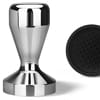
- Tamper: calibrated tamper that applies 15 kg force.
- Distribution: WDT with 0.30 to 0.35 mm needles, three passes, followed by a leveler set to the basket rim height.
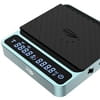
- Scales: 0.01 g accuracy for dose and yield.
- Shot timer: independent optical or scale-based timer.
- Milk: 2 percent cow’s milk and a barista-labeled oat option, both tested at 4 to 6°C starting temperature.
Coffee Set
Every machine and grinder is tested with a matrix of coffees to reveal strengths and blind spots.
- Washed medium roast espresso blend
- Washed light espresso roast
- Natural process medium-light espresso roast
- Decaf medium roast
- A retail supermarket whole-bean medium roast to simulate common buyer behavior
We rest coffees to their best window. Medium roasts usually 5 to 14 days off roast. Light roasts usually 7 to 28 days. We document the rest day for each test.
How We Score
Coffeedant uses a 100-point composite with weights that match real user priorities. We score separately for espresso machines, grinders, and beans. Each review shows the category subscores inside the [PRODUCT RATING] box.
Espresso Machines
- Espresso performance: 30
- Milk steaming: 20
- Workflow and ergonomics: 15
- Temperature and pressure stability: 15
- Build quality and serviceability: 10
- Efficiency, noise, and warm-up: 5
- Value and warranty: 5
Grinders
- In-cup performance and clarity: 35
- Consistency and repeatability: 20
- Retention and workflow: 15
- Grind speed and heat rise: 10
- Alignment and burr quality: 10
- Noise and static management: 5
- Value and support: 5
Beans
- Espresso performance across recipes: 35
- Flavor quality and balance: 25
- Consistency bag to bag: 15
- Milk performance: 10
- Freshness window and degas behavior: 10
- Value and availability: 5
Panel tasters score sensory categories on a 10-point scale. Instrument data and timed tests map to score ranges. We publish the raw tables in each review when space allows.
Espresso Machine Protocols
Warm-Up and Thermal Stability
Goal
Verify that the group and brew path reach a stable operating temperature and stay there.
Method
- We log heat-up from cold with a thermofilter or group probe.
- Warm-up is the time from power-on to within 1°C of final stabilized brew temperature at 1.0 bar simulated backpressure.
- Idle stability is tracked for 15 minutes with no shots, then for 10 minutes while we pull six doubles at 30-second intervals.
- Heat recovery is the delta between first and last shot temperature in that six-shot run.
- For machines with active group control, we repeat at two setpoints that bracket common use, usually 92°C and 94°C.
What earns top marks
Under 10 minutes to first stable shot for single boilers with thermoblocks. Under 20 minutes for heat exchangers. Under 30 minutes for saturated groups and dual boilers. Recovery within 2°C across a six-shot set.
Pressure and Flow Control
Goal
Confirm that brew pressure and flow match the set profile and remain consistent.
Method
- We measure pump pressure at the group with a calibrated gauge.
- For machines with programmable profiles, we run a straight 9 bar profile and the machine’s default pre-infusion profile.
- We log flow rate with a high-resolution scale and calculate flow from mass over time.
- We evaluate pressure overshoot and settling time, plus consistency over three back-to-back shots with identical prep.
What earns top marks
Minimal overshoot, stable 8.5 to 9.5 bar under puck load, repeatable flow curves.
Shot Quality and Extraction
Goal
Quantify how well the machine supports tasty extractions with different coffees.
Recipes
- Medium roast: 18 g in, 36 g out in 25 to 32 seconds at 93°C.
- Light roast: 18 g in, 40 g out in 28 to 36 seconds at 94°C to 95°C.
- Natural process: 18 g in, 38 g out, same temperature as medium.
- Decaf: 18 g in, 32 g out, 92°C.
Method
- We pull three shots per coffee recipe.
- We measure TDS with a calibrated refractometer, then compute extraction yield.
- We log channeling events visually and with a bottomless portafilter when possible.
- We taste blind in flights, scoring clarity, sweetness, acidity quality, texture, balance, and aftertaste.
What earns top marks
Extraction yield in the target range with low variance, minimal prep sensitivity, and no harshness when pushed coarser or finer.
Milk Steaming
Goal
Measure steam power, control, and milk texture quality.
Method
- Start milk at 4 to 6°C in a 350 ml pitcher with 200 ml fill.
- Time to 55°C with a fast digital thermometer. We stop steaming at 60°C and record time, pressure behavior, and the need to purge.
- We evaluate microfoam texture on a 1 to 10 scale for gloss, bubble size, and drink integration.
- We repeat with oat milk to observe tip design and turbulence behavior.
What earns top marks
55°C in under 25 seconds for dual boilers and HX, under 45 seconds for single boilers with thermoblocks, smooth pressure ramp, and microfoam suitable for basic art without hot spots.
Workflow and Ergonomics
Goal
Assess efficiency, comfort, and reliability during single-drink use and a short rush.
Method
- Single drink flow: grind to sip time with espresso only, and with a milk drink.
- Rush simulation: three drinks back to back. Espresso, flat white, espresso. We record total time, misses, purge behavior, and clean-down.
- Ergonomics checklist: portafilter fit, handle angle, basket lock point, steam lever action, wand reach, hot water spout splash, cup clearance, and drip tray capacity.
- Noise: we record dBA at 1 meter during idle, brew, and steam.
What earns top marks
Logical controls, clean line of sight under the group, tidy purge, smooth wand with a safe pivot range, and low mess.
Build, Serviceability, and Safety
Goal
Inspect parts quality, assembly, and the ease of long-term care.
Method
- Exterior fit, internal layout, and fastener choices.
- Access routine: group gasket and screen removal time, water tank access, and descale access where relevant.
- Electronics: board layout, strain relief, connector quality.
- Over-temperature and low-water behavior.
- Spare parts availability and documentation quality.
- Warranty scope and regional coverage.
What earns top marks
Quality metals, clean wiring looms, parts labeling, easy access to wear items, and a manual that actually helps.
Energy Use
Goal
Quantify idle draw, warm-up draw, and typical daily consumption.
Method
- Inline power meter.
- From cold: energy to stable brew state.
- Idle: two hours with and without eco mode.
- Workday simulation: four double shots and two milk drinks spaced over 45 minutes.
- We publish kWh and projected monthly cost at typical tariffs.
Grinder Protocols
Burr Prep and Alignment
Goal
Ensure the grinder we test is operating within spec.
Method
- Burrs are cleaned and seasoned with 500 g of sacrificial coffee unless the vendor specifies otherwise.
- We inspect mounting surfaces and run a basic marker test or dial indicator where accessible to check for parallelism.
- If a grinder offers factory alignment shims, we document the as-received condition and any correction steps.
What earns top marks
Even contact pattern or verified parallelism, no burr rub at espresso settings, and a clean zero point.
Retention and Single Dosing
Goal
Measure how much coffee the grinder holds and how much purging is required for repeatable shots.
Method
- Espresso setting tuned for 18 g in, 36 g out at 28 to 32 seconds on the medium roast.
- Ten single-dose runs of 18.0 g. We record in and out to 0.01 g.
- We calculate average retention, peak retention, and the purge mass needed to bring the next dose within 0.2 g of target.
- We repeat with RDT and without if the grinder is prone to static.
What earns top marks
Average retention at or under 0.3 g with predictable purge behavior.
Grind Speed and Heat Rise
Goal
See how fast the grinder works and whether it heats the coffee.
Method
- We time ten 18 g grinds at the espresso setting and publish grams per second and variance.
- We record burr carrier temperature before and after a 10-shot string and the bean temperature delta if accessible.
- If speed control exists, we test at low and high RPM.
What earns top marks
Fast enough for home use without flavor penalties. Minimal heat rise and stable RPM.
Particle Behavior
Goal
Understand grind distribution tendencies that influence clarity and body.
Method
- We use a set of coffee sieves for a coarse cut of distribution and repeatability.
- We note fines proportion changes when chasing shots finer or coarser.
- We connect distribution notes to taste outcomes across the coffee set.
What earns top marks
Tight repeatability and a fines profile that supports either clarity or texture as advertised.
Workflow and Ergonomics
Goal
Rate the day-to-day experience.
Method
- Dose cup design, magnet strength, and spout geometry.
- Static and clumping with and without RDT.
- Adjustment range and resolution.
- Noise at 1 meter and tone quality.
- Cleaning routine and tool access.
What earns top marks
Predictable dial, low mess, easy cleaning, and a design that does not scatter grounds.
In-Cup Performance
Goal
Tie everything back to flavor.
Method
- Pull identical recipes on the test machine with the grinder under review and a control grinder.
- We taste blind and track extraction yields.
- We document where the grinder excels. Clarity. Texture. Chocolate weight. Floral definition. We also document where it struggles.
What earns top marks
Clear gains over a solid control grinder or distinct value at a lower price point.
Coffee Bean Protocols
Intake and Data
Goal
Capture roast details and check for defects.
Method
- We log roast date, variety info, process, altitude if listed, and packaging valve type.
- We check for quakers and visual defects.
- We note roast uniformity and color using a roast color meter where available.
Degassing and Freshness Window
Goal
Find the sweet spot for espresso and milk drinks.
Method
- We open one bag on day three and pull shots daily until day 21.
- We track crema behavior, channeling tendency, and shot time range at a standard ratio.
- We record TDS and extraction yield every other day to see solubility changes.
What earns top marks
A wide usable window with stable shots and clear flavor progression rather than sudden staling.
Espresso Performance
Goal
Test how the coffee behaves across common ratios and temperatures.
Method
- Medium roast: 1 to 2 ratio at 93°C base temperature.
- Light roast: 1 to 2.2 ratio at 94°C to 95°C, then a 1 to 2.5 variant.
- We pull three shots per recipe, calculate extraction yield, and taste blind in flights.
- We score sweetness, acidity quality, texture, and finish.
Milk Performance
Goal
See how the coffee cuts through milk.
Method
- We build 150 ml milk drinks with both dairy and oat.
- We taste for chocolate base, caramel lift, and bitterness carry.
- We score integration and aftertaste.
Consistency and Value
Goal
Check if the experience holds across bags and price.
Method
- If possible we source a second bag two to four weeks later.
- We note any significant batch variation.
- We calculate cost per usable shot based on extraction success rate.
Sensory Panel and Blind Testing
Panel Setup
- Three to five tasters calibrated on a set of reference espressos.
- We taste flights in black demitasses with numeric labels.
- We randomize order.
- Panelists spit and rinse with low-TDS water.
Scoring and Notes
- Categories: clarity, sweetness, acidity quality, texture, balance, aftertaste, and milk integration where relevant.
- Scale: 1 to 10, half points allowed.
- Panel leads compile notes and reconcile outliers. If a session shows high variance, we rerun it.
Bias Controls
- The person who prepares shots does not pour flights.
- We rotate the starting taster to avoid order effects.
- We keep grinders and machines identical across comparative flights unless the product under test is the variable by design.
Stress, Reliability, and Safety Testing
Espresso Machines
Short Stress
- Six doubles in three minutes. We log temperatures, shot times, and any cutouts.
- Milk after espresso stress: a 350 ml steam cycle followed by a double shot and recovery timing.
Long Idle
- Four-hour idle with periodic shots. We note scale on wands, hissing valves, or stability drift.
- We test auto-sleep and wake behavior.
Protection Tests
- Low tank water: verify prompts and cutoffs.
- Over-temperature behavior: verify shutdown or alarms.
Real-world Faults
- We run a slightly off grind for two shots to see how the machine copes with choked or racing shots.
- We test water with a slightly lower alkalinity to check how PID and pressure respond.
Grinders
Duty Cycle
- Ten consecutive doses at espresso fineness. We watch for thermal throttling and burr rub.
- We test coarse range quickly to see if there is reverse migration or dial slip.
Static Season
- We purposely do not use RDT for a set to observe worst-case mess. Then we add RDT and note changes.
Assembly and Wear
- We inspect threads, collars, and anti-popcorn parts after the full test cycle.
- We check runout again at the end to detect shift.
Data Capture and Tools
We work to publish numbers you can reproduce. Our bench relies on:
- Precision scales to 0.01 g for dose and yield
- Independent shot timers
- Refractometer for TDS and extraction yield calculations
- Thermofilter or group thermocouple for brew temperature
- Inline power meter for energy and warm-up profiles
- Contact thermometer for milk, verified in ice bath
- dBA meter at 1 meter for noise
- Sieve set for grind distribution snapshots
- Calipers and dial indicator for alignment checks where accessible
We calibrate instruments on a schedule and cross-check between units.
The Review Day Flow
Here is how a typical full-day session runs for an espresso machine with its matching grinder.
- Warm-up and baseline
- Power on. Log warm-up temperature curve. Check group temperature with the thermofilter.
- Pull a few purge shots to season the path.
- Verify brew pressure on a blind basket.
- Dial-in
- Use the medium roast. Set 18 g in, 36 g out, target 28 to 32 seconds.
- Adjust grind to hit time and taste.
- Lock the burr setting and do not change it for the baseline set.
- Baseline shots
- Three shots on medium roast. Log TDS, EY, and tasting notes.
- Repeat for natural and light roasts with the recipe changes listed earlier.
- Note any channeling incidents under a bottomless portafilter.
- Milk tests
- Time and temperature the 200 ml steam routine.
- Assess microfoam and repeat with oat.
- Workflow and rush
- Log grind-to-sip times.
- Run the three-drink rush simulation with espresso, flat white, espresso.
- Note mess, purge, and clean-down.
- Stress and recovery
- Six doubles in three minutes. Watch temperature drift.
- Steam immediately after and then pull a recovery shot.
- Energy and idle
- Log kWh for warm-up and a 45-minute simulated session.
- Idle for an hour and capture standby behavior.
- Panel tasting
- Prepare blind flights with control shots from a known reference machine and grinder.
- Score and reconcile notes.
- Tear-down
- Inspect gaskets, screens, wands, and internal layout if accessible.
- Note serviceability, fastener quality, and any wear.
We repeat sections on another day if results look inconsistent. For grinders the flow is similar with a focus on retention, speed, and in-cup deltas against a control grinder.
How We Compare Products
A machine is only as good as the benchmark you hold it to. We run head-to-head comparisons when products share price bands or buyers.
- Same price, different design
Dual boiler vs heat exchanger at a similar price. We compare steam power, heat-up, stability, and cup results directly. - Premium vs value
A high-end prosumer machine against a strong mid-tier unit. We weigh the real gains per euro or dollar. - Feature leader vs simple workhorse
Flow-profiling machines against fixed-profile machines. We examine whether the extra control lands in the cup for each coffee type.
We always disclose the exact comparison units and any accessories used. We keep the grinder constant when the machine is the variable, and keep the machine constant when the grinder is the variable.
Interpreting Our Scores
Numbers matter when they reflect the cup and the user’s day. Here is how to read the common ranges.
- Espresso performance 27 to 30
The machine makes balanced shots across the coffee set with low fuss. Light roasts are no problem at reasonable ratios. - Milk steaming 17 to 20
Real microfoam on demand with fast heat recovery. Oat milk does not split. Purge is clean. - Workflow 13 to 15
Easy reach controls, consistent portafilter lock, good cup clearance, and a tidy drip tray design. - Stability 13 to 15
Temperature recovery inside 2°C across stress runs and predictable pressure behavior. - Build 8 to 10
Sound internal layout, accessible parts, and thoughtful fasteners. Spare parts are available and documented.
For grinders the top ranges indicate exceptional clarity or texture at their price, minimal retention, and a dial that makes sense day to day. For beans a top flavor score reflects sweetness, clean structure, and a finish that invites another sip.
Edge Cases We Check
Not all buyers pull the same shots we do. We test outside the median so you know what happens if you do too.
- Very short ratios
Ristretto style shots at 1 to 1.5 ratio. We watch for pump behavior and channeling risk. - Very long ratios
1 to 3 espresso on lighter roasts. We check if flow holds stable or if it surges. - Pre-ground in pressurized baskets
On entry machines we confirm whether pressurized baskets can rescue pre-ground coffee for new users and how fast you will outgrow them. - Single-dose workflow on hopper grinders
We try single dosing on a hopper grinder and document the variance so buyers know if it is viable. - Super-automatic baseline
Where relevant we run a super-automatic against a manual setup for the same bean, so convenience buyers see the tradeoffs.
Fairness, Repeatability, and Limits
Loaners, Purchases, and Disclosure
We buy some units, borrow others from retailers or brands, and sometimes receive review samples. We never accept money to change a verdict. If a brand-loaned machine needs repair during review, that becomes part of the story.
Multiple Units When Needed
If a result looks like an outlier, we try a second unit. If performance changes, we note unit variance.
Software and Firmware
If a machine updates during testing, we re-run affected sections. We note firmware versions and changes in the review.
Human Limits
We drink a lot of espresso during testing but we do not rely on a single taster. Panel tasting and blind flights reduce bias. We also include a control machine and control grinder in flights so you can anchor our notes to a known performer.
Frequently Asked Questions About Our Methods
Why do you publish extraction yield when taste is what matters?
Taste leads. Extraction yield shows whether a recipe sits in a reasonable window and whether a machine or grinder can reach it without extreme prep. Yield is one tool, not the verdict.
Do you test with aftermarket baskets, shower screens, or flow kits?
We start stock. If an affordable, widely used upgrade changes performance in a meaningful way, we add a clearly labeled section. Scores reflect the stock configuration unless stated.
How do you handle water differences across regions?
We test with controlled bench water and disclose the spec so readers can reproduce it. If a machine requires a specific cartridge to stay in warranty, we test both ways.
What if my kitchen is colder or hotter than your lab?
Very cold rooms extend warm-up and alter stability. Our stability section shows drift margins and recovery. Use those numbers to adjust expectations for your space.
Do you test pods or capsules?
Only when the machine is designed for them. We do not score pod performance in a dedicated espresso machine review unless the brand markets that feature as primary.
How This Shows Up In Reviews
When you see a Coffeedant review, the top of the page includes:
- [PRODUCT BOX] with what is in the box, key specs, and regional variants
- [PRODUCT RATING] with the category scores and a quick fit summary for who should buy and who should avoid
- Comparisons to sibling models and key competitors so you know the alternatives up front
- Deep dive sections that follow the same order and methods described here
Because our process is consistent, you can line up two machines and compare the numbers directly. If the scores are close, read the workflow notes and the blind taste sections. That is where character and preference come through.
Reproducing Our Tests At Home
If you want to replicate our results, here is the minimal kit and plan.
- A good scale to 0.1 g for brewing and to 0.01 g for dosing
- A timer
- A basic water kit or mineral packets to bring your water close to our spec
- A refractometer if you want extraction numbers, otherwise taste and consistency notes
- A thermometer for milk
- A notebook or a simple spreadsheet
Run our baseline recipes with your coffee set. Taste blind if you can. Change one variable at a time. Most of the value comes from discipline, not fancy gear.
The Payoff For You
This process takes time. It saves you money. When we say a heat exchanger holds stable through a six-shot run, or a conical grinder needs 0.5 g purge after every shot to stay on target, or a light roast needs 95°C on a specific machine to open up, you can trust that it came from test-bench work, not a single Saturday morning.
If you ever want to see a raw table that did not make the review page, ask us. We keep our logs. We are happy to share the numbers that shaped a verdict.
Change Log
We update this page when our methods improve. If we add a new measurement, you will see it in the next review with a note in the methodology section.
Bottom Line
The Coffeedant bench treats every espresso machine, grinder, and bag of beans with the same respect you give your morning shot. Control what you can. Measure what matters. Taste blind. Publish the numbers. That is how we write reviews that help you buy once and enjoy for years.