
Buyer decision
Decide what replaces the pump
The shortlist is for a US buyer with no convenient outlet at the espresso station. The brewer must operate without its own electric pump or heater, have a currently identifiable US configuration, and solve a different workflow. We selected the current Flair Classic kit with two portafilters and the 9Barista Mk.2 Standard configured for the buyer’s stove. Both have existing Coffeedant full reviews. We excluded plug-in manual levers such as an electrically heated Flair 58 and did not treat every moka pot as an espresso maker. [1] [3]
Neither choice makes a whole setup powerless by itself. The Flair needs separately heated water. The 9Barista needs a compatible burner or stove; an electric stove still consumes power, just away from the brewer body. Both require a separate milk method. This distinction matters more than a marketing claim of “no electricity.”
The existing small-machine guide is about counter footprint across pump and manual designs. This comparison is specifically about how heat and pressure are supplied when the brewer has no plug. We do not rank by an unverified price or assume that a small device is easy to travel with.
Before ordering
Audit the heat source and grinder
Flair says the Classic needs boiled water and includes a Flow Control portafilter plus a Bottomless 2-in-1 portafilter in the current kit. The restricted-flow option lowers the grinder threshold; the bottomless option calls for espresso-fine adjustment and fresh coffee. The direct lever and gauge put pressure timing in your hands. Older Classic reviews may describe a different bundle, so check the current box list. [1] [2] [5]
9Barista sells the Mk.2 in Standard and Pro configurations and asks buyers to select their stove type. The machine body is the same across induction and non-induction options, but the supplied heat plate differs. This guide covers Standard; Pro basket and portafilter claims do not apply to it. A 9Barista is a hot metal vessel after brewing. Let it cool and follow its instructions before disassembly. [3]
A scale, fresh coffee and a repeatable grind are useful for both, but no grinder, kettle, burner or milk frother is included in the comparison price. Check the current US cart for the exact hardware, shipping and taxes. No current price or discount is asserted here.
Two distinct methods
Quick comparison
| Exact pick | Best for | Required heat | Skip if |
|---|---|---|---|
| Flair Classic, current two-portafilter version | A lever station with shot control | Boiled water from a separate kettle or other safe heat source | You need the brewer itself to heat water, or you regularly make several drinks back to back. |
| 9Barista Mk.2 Standard, matched to your stove | A stovetop routine with no separate kettle | A compatible stove or burner and the heat plate selected for it | You lack a compatible heat source, want to shape pressure manually, or need rapid consecutive shots. |
Reasons to choose
The two defensible picks

A lever station with shot control
Flair Classic, current two-portafilter version
Why: You press the lever and watch the included gauge; the Flow Control and Bottomless 2-in-1 portafilters suit different grinder setups
Tradeoff: The brew head, basket and separate water heating add steps to each shot. There is no milk steamer.
Skip if: You need the brewer itself to heat water, or you regularly make several drinks back to back.
Image: Flair Espresso. Official product imagery identifies the model; no Coffeedant test photograph.
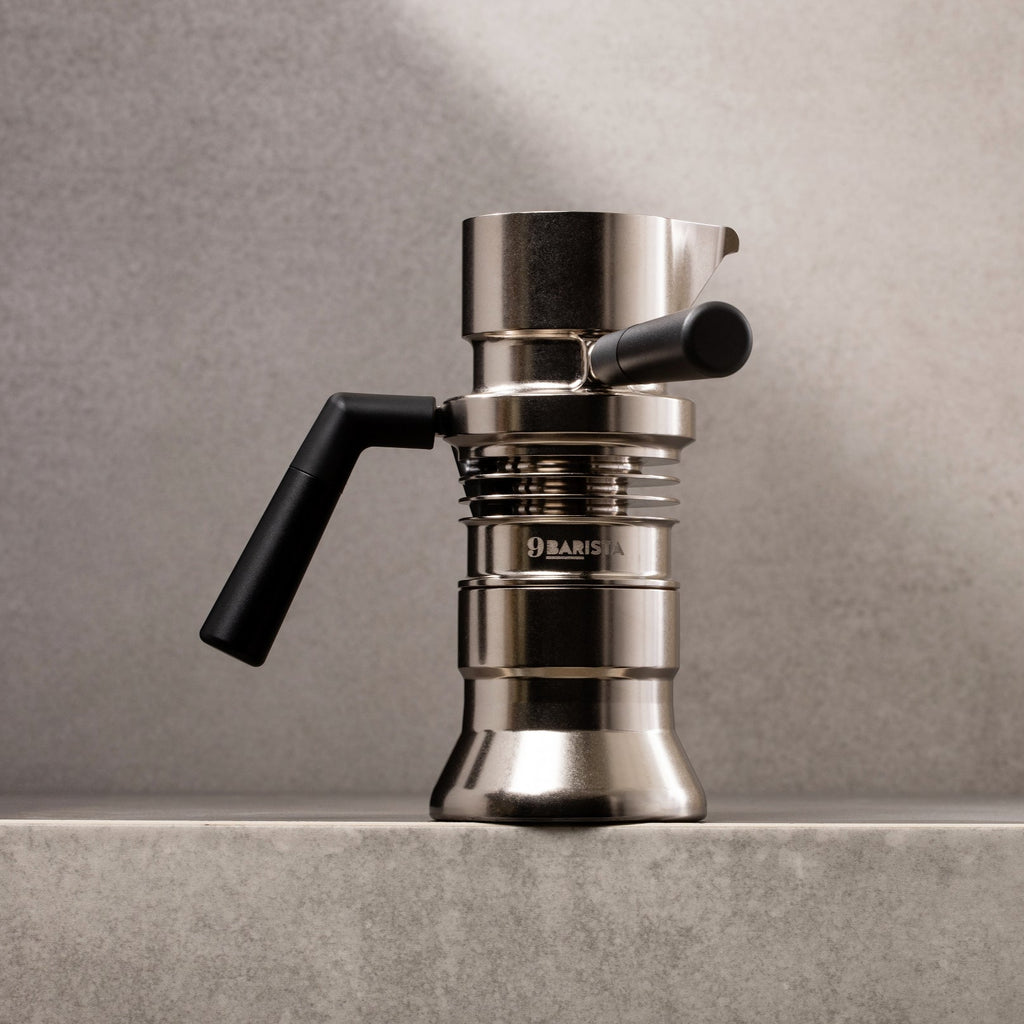
A stovetop routine with no separate kettle
9Barista Mk.2 Standard, matched to your stove
Why: Stove heat drives the brewer; choose the Standard or Pro hardware deliberately. This pick is the Standard.
Tradeoff: The hot metal must cool before safe disassembly and the next cycle; milk needs a separate method.
Skip if: You lack a compatible heat source, want to shape pressure manually, or need rapid consecutive shots.
Image: 9Barista. Official product imagery identifies the model; no Coffeedant test photograph.
The practical distinction
Detailed comparison
| Factor | Flair Classic | 9Barista Mk.2 Standard |
|---|---|---|
| Heat | Boil water separately and pour into the brew cylinder | Heat the assembled brewer on a compatible stove with the selected plate |
| Pressure | Human-operated lever with included gauge | Stovetop thermal system; no pressure-shaping lever |
| Grinder path | Flow Control portafilter tolerates a wider grind; bottomless rewards espresso-capable adjustment | Standard basket and portafilter; dial-in still matters |
| Between drinks | Prepare and refill the portafilter and cylinder | Allow hot metal to cool before disassembly and another cycle |
| Milk | No integrated steamer | No integrated steamer |
| Variant risk | Check current two-portafilter kit versus older Classic bundles | Select Standard or Pro and the correct stove plate deliberately |
Ownership
When either pick is the wrong setup
The separate heat source is the first cost and safety question. If the only outlet is far away, a safe stovetop position may favor the 9Barista; if you already boil water for another method, the Flair can share that routine. Do not use an unsuitable hot plate, improvised burner or unstable camping setup. Match the manufacturer’s instructions to the actual heat source. [1] [3]
Independent accounts help frame the effort, but they are not comparable lab measurements. GearLab’s earlier Classic review describes the lack of built-in water heating and milk steaming; its kit predates the current two-portafilter bundle. Tom’s Guide reviewed a Mk.2 unit and discusses its stovetop workflow. Owner posts describe extra steps for multiple Classic shots and one Mk.2 dial-in struggle. Those are single experiences, not rates or proof that either product will behave the same for every buyer. [4] [5] [6] [7]
If the usual order is several cappuccinos, a pump machine with a steam wand may be a better purchase even if it needs an outlet. If you mainly want an occasional manual shot and pressure feedback, start with the Flair. If you want a self-contained stovetop extraction mechanism and already have the compatible heat source, inspect the 9Barista Standard configuration. For a different budget decision, use the under-$500 guide; for footprint first, use the small-machine guide.
Evidence and limits
How this guide was made
We compared current US manufacturer pages, exact kit and variant choices, third-party evaluations, owner discussions and Coffeedant’s existing full reviews. The selection criterion was a brewer with no integrated electrical requirement, plus a distinct pressure and heat workflow. We excluded uncertain bundle equivalence and did not infer prices, reliability rates, extraction performance or taste from manufacturer copy or anecdotes.
Coffeedant did not buy, operate or measure either brewer. Product images come from the makers and identify the hardware. Check the live product pages and manuals again before purchase because bundles, stock and compatibility can change.
Quick answers
No-plug espresso FAQ
Do these espresso makers need any electricity?
The brewers themselves do not. You still need a safe way to heat water for the Flair or to heat a compatible stove for the 9Barista; an electric kettle or stove would use electricity.
Can I use pre-ground coffee?
The current Flair Classic includes a Flow Control portafilter that Flair says can work with pre-ground coffee. Its bottomless portafilter and the 9Barista Standard reward an espresso-capable grinder.
Does either make milk foam?
Neither pick includes an integrated steam wand. Plan a separate milk-heating and frothing method if milk drinks are the goal.
Which one is easier for back-to-back drinks?
Neither is designed around rapid service. The Flair requires repeated basket and cylinder preparation; the 9Barista must cool enough to handle safely before disassembly and another cycle.
Will an induction stove work with the 9Barista?
9Barista asks buyers to choose a stove type. The induction option supplies an induction adaptor plate; confirm your exact stove and selected plate before ordering.
Is the 9Barista Mk.2 Pro the same pick?
No. This comparison uses the Mk.2 Standard. The Pro changes the portafilter, basket and basket cap; do not transfer those parts or claims to the Standard.
Did Coffeedant test either brewer?
No. These are research-led fit judgments from current manufacturer records, independent accounts, owner context and Coffeedant’s linked full reviews.
Attributable evidence
Sources checked November 5, 2026
- Flair Classic US product page ↗ — Current two-portafilter kit, pressure gauge, water and grinder requirements, dimensions and no-plug operation. Checked November 5, 2026.
- Flair Classic product guide ↗ — 2025 revision context; check the live kit before ordering. Checked November 5, 2026.
- 9Barista Mk.2 US product page ↗ — Current Mk.2 Standard/Pro distinctions and stove-specific heat plate. Checked November 5, 2026.
- Tom’s Guide: 9Barista Mk.2 review ↗ — Independent hands-on account of the Mk.2 workflow; one reviewer, not a durability rate. Checked November 5, 2026.
- GearLab: Flair Classic review ↗ — Independent review of an earlier Classic; useful workflow context, not confirmation of the revised kit. Checked November 5, 2026.
- Flair owner discussion ↗ — One owner of the updated Classic describes extra work for multiple shots; anecdote only. Checked November 5, 2026.
- 9Barista owner discussion ↗ — One Mk.2 owner describes dial-in difficulty; anecdote only. Checked November 5, 2026.