
02Start with the decision
Philos in one honest frame
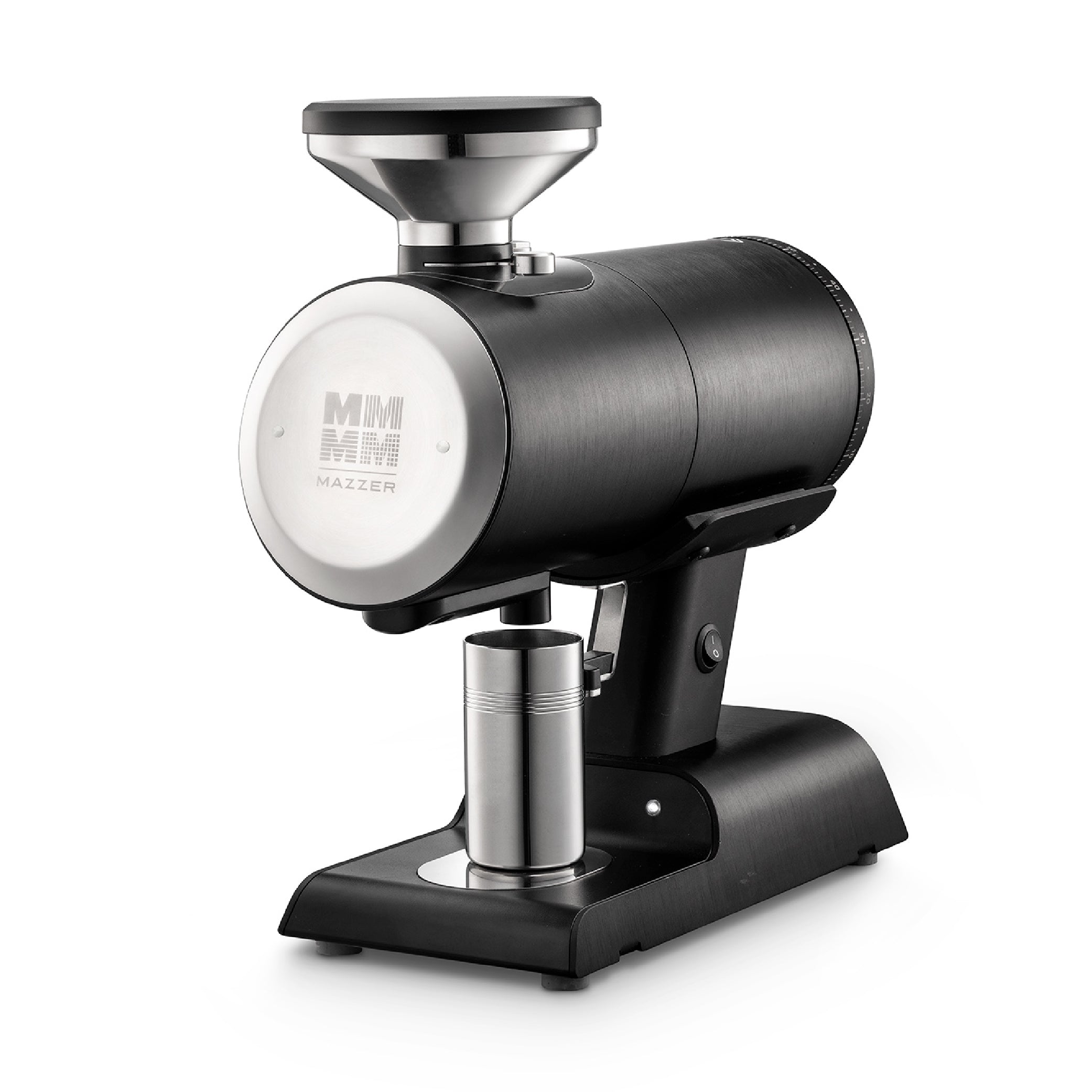
Mazzer Philos is a heavy 64 mm flat-burr single-dose grinder with a front-access burr chamber, 60 g hopper, 58 mm canister and a dial that can run stepped or stepless. The US shop lets buyers choose I200D for clearer light-to-medium coffee or I189D for a fuller traditional espresso brief. Those are materially different choices. This review evaluates the I200D option and labels external observations by the burr actually tested. The official US page displayed unavailable at this check, so a displayed catalog figure is not treated as a purchasable offer. [source] [source] [source] [source] [source] [source]
The US Philos page offers I200D and I189D. Mazzer describes I200D as a clarity-oriented light-to-medium burr and I189D as a fuller traditional medium-to-dark burr. WIRED used I200D; one owner account about I189D is context for the choice, not confirmation of the reviewed cup. The factory technical dimensions apply to the model family; verify voltage on the delivered US nameplate.
The strongest reason to choose it: A dial and cleaning path designed around measured single doses and frequent coffee changes. The main reason to pause: The burr choice materially changes the target cup, while the official US listing did not offer a confirmed purchase at this check.
03The first week
Set up the whole station, not only the machine
Select I200D or I189D before ordering and verify the delivered US nameplate, canister and finisher. Mazzer says factory zero leaves burr clearance; never force touching burrs. Use its broad 10–40 espresso setting range only as a start, then weigh input and output for one coffee. Allow front access and 351 mm counter depth. Begin by matching the rating plate, manual, water guidance, included parts, and seller invoice to the exact delivered unit. Wash the removable food-contact parts as directed, install any supplied filter correctly, complete the documented rinse or prime sequence, and keep packaging until the machine has completed several normal cycles without an issue. [source] [source] [source]
- Day one: learn filling, startup, shutdown, warnings, and waste paths.
- Days two and three: repeat one coffee and recipe, changing one variable at a time.
- Days four and five: make the normal household order, including the refill and cleanup.
- Days six and seven: perform routine care and decide whether the station still feels convenient.
Water is both an ingredient and a maintenance variable. Follow manufacturer and local-service guidance rather than assuming that very hard, completely demineralized, distilled, or generic bottled water is automatically suitable. If flow changes abruptly, a leak appears, a protection device trips, or the machine smells hot in an abnormal way, stop and arrange qualified diagnosis instead of repeatedly restarting it.

04Rating deep dive
Espresso: control the variables the machine leaves to you
I200D targets clarity in lighter coffee. WIRED described sweet, full espresso and precise dialing on one I200D sample; Coffeedant has not tasted it. Six-micron dial increments describe burr-gap movement, not particle distribution. Roast age, basket and coffee change the useful setting. Mazzer documents optional stepless conversion for a tight shot window. [source] [source] [source] A useful starting recipe is a controlled experiment, not a promise of flavor. Keep the coffee, dose, target beverage, preparation, cup, and starting machine state consistent while changing the grind or documented strength setting in one small step.
Taste should decide the next move. Thin, sharp coffee often asks for more extraction through a finer grind or a different ratio. Dry, hollow, or harsh coffee often asks for less extraction. Those are general directions, not universal rules. Dark roast, light roast, decaf, water chemistry, basket geometry, bean age, and milk can all change the best recipe. The documented controls determine how directly Philos lets the owner respond.
Repeatability deserves more weight than one dramatic cup. Make the same recipe on several ordinary mornings, record the useful settings, and judge whether the machine makes the desired result easier to reproduce. That is the practical meaning behind the 8.3 out of 10 editorial score.
Espresso assessment
Espresso evidence translated into daily use
The Philos score is an editorial judgment from documented design, independent demonstrations, owner context, and the dated market position. It is not a bench result from Coffeedant.
| Signal | What the evidence says | Buying consequence |
|---|---|---|
| Brew architecture | 64 mm I200D steel flats. | I200D 64 mm burrs and fine marked control target precise espresso adjustment. |
| Control available | 6-micron stepped movement. | Sweetness and clarity reports belong to independent samples, not our shots. |
| Recipe consequence | No Coffeedant tasting or particle measurements. | Treat this as part of the Philos buying decision, not a promise of identical results in every kitchen. |
Evidence note: Unknowns stay unknown. Variations in coffee, water, milk, setup, firmware, regional package, wear, and technique can change the experience described by these sources.
05Rating deep dive
Filter brewing: speed only matters when texture stays controllable
This grinder dimension covers filter brewing. Mazzer says both burr sets span espresso to batch brew and suggests 80–120 as a filter start. WIRED found its I200D sample easier to justify for espresso than drip. Filter-first buyers should compare a smaller dedicated grinder and actual cups. The 60 g hopper is for a measured dose, not bean storage. [source] [source] [source] [source] Milk performance is a combination of heat delivery, air control, circulation, recovery, cleaning, and operator attention. A fast system can frustrate a beginner if it gives little time to correct position, while a slower system can frustrate a household making several drinks.
Use cold milk, a consistent quantity, and the recommended vessel or container. With a manual wand, purge condensate, add a controlled amount of air near the beginning, then position for circulation and stop before overheating. With an automatic milk path, start from a conservative documented setting, keep the sensor or hose arrangement consistent, and change temperature or texture one step at a time. Alternative milks differ by formulation, not only plant type.
The cleaning step belongs in the milk rating. Wipe and purge a wand immediately. Rinse or refrigerate a removable container as directed. Complete any prompted milk-path rinse instead of postponing it. Dried milk can narrow openings, change texture, create odors, and turn a convenient system into a recurring maintenance problem.
Filter brewing assessment
Filter brewing evidence translated into daily use
The Philos score is an editorial judgment from documented design, independent demonstrations, owner context, and the dated market position. It is not a bench result from Coffeedant.
| Signal | What the evidence says | Buying consequence |
|---|---|---|
| Steam or milk system | Manual gives 80–120 filter start. | A single ring covers coarse filter positions as well. |
| Operator input | 60 g measured-dose hopper. | Filter-first value is less clear at this size and cost. |
| Queue consequence | No Coffeedant filter cup. | Treat this as part of the Philos buying decision, not a promise of identical results in every kitchen. |
Evidence note: Unknowns stay unknown. Variations in coffee, water, milk, setup, firmware, regional package, wear, and technique can change the experience described by these sources.
06Rating deep dive
Workflow: count every touch from cold start to a clean counter
Weigh a dose, load the removable hopper, use the slide and collect in the 58 mm canister. Mazzer describes a vertical path and pre-breaker that limit retained grounds; the knocker and chute finisher are part of the stated low-retention procedure. WIRED reported very small input-output differences during its I200D test, but dose exchange, static and grounds left behind are different quantities. Repeat a regular-to-decaf transition with a documented purge if carryover matters; no source establishes a caffeine-free subsequent dose. The front panel and carrier can be removed for dry cleaning without losing the rear setting, provided the user follows the manual. [source] [source] [source] Marketing often times one internal event, such as heater readiness, while the owner experiences the whole drink. Grinding, dosing, warming, extracting, steaming, refilling, rinsing, knocking out coffee, wiping, and returning milk all belong in the clock.
Map the station before purchase. Confirm cabinet clearance, tank and bean access, door or brew-unit travel, portafilter movement, carafe removal, drip-tray path, cord location, ventilation, grinder footprint, and a safe landing place for wet parts. A machine can fit by published dimensions and still be awkward under a cabinet or beside a wall.
The most revealing home trial is the busiest normal order from a cold start. Make it in the sequence people actually request it, then restore the machine to a clean ready state. If the routine feels coherent, the workflow score is meaningful. If one repeated task causes resentment, a rival with a lower headline specification may deliver more value every day.
Workflow assessment
Workflow evidence translated into daily use
The Philos score is an editorial judgment from documented design, independent demonstrations, owner context, and the dated market position. It is not a bench result from Coffeedant.
| Signal | What the evidence says | Buying consequence |
|---|---|---|
| Cold-start routine | Vertical burr path. | Knocker, finisher and front access support frequent dose changes. |
| Drink sequence | Chute finisher is a separate action. | Very low measured dose difference cannot certify zero carryover. |
| Cleanup load | Retention methods differ. | Treat this as part of the Philos buying decision, not a promise of identical results in every kitchen. |
Evidence note: Unknowns stay unknown. Variations in coffee, water, milk, setup, firmware, regional package, wear, and technique can change the experience described by these sources.
07Rating deep dive
Build and service: judge access, support, and failure response
Mazzer lists anodized aluminum, brass and stainless components, 12.5 kg mass, factory burr-alignment checks and 400 W power. These document construction choices, not lifetime failure rates. WIRED praised the serviceable appearance after a month; an owner’s year-long report provides a longer individual view but no population denominator. Check shelf support, front access and power placement. Keep water away from the motor and follow Mazzer’s prescribed cleaning cycle. A commercial-style body is useful only if the household can move and maintain it safely. [source] [source] [source] [source] Material descriptions can help set expectations, but ownership depends more on stable controls, accessible daily-care parts, documented service, and the availability of the exact component for the exact revision.
Mazzer directs dry cleaning of hopper, canister, chute and burr chamber with power disconnected. Follow its finisher procedure and keep carrier contacts clean. Front access should preserve the setting. Electrical repairs and replacement burr service require qualified support. Removable does not mean maintenance-free, and a cleaning program does not inspect every seal, hose, valve, burr, sensor, or heating component. Use only procedures and products permitted by the manual. Boiler, mains-voltage, pressure, refrigerant, or internal-water work belongs with a qualified technician unless the manufacturer explicitly defines an owner procedure.
Unplug and seek authorized service for abnormal motor, vibration or interlock behavior. A separate grinder is safer for strict caffeine separation than a zero-retention claim. Self-selected reports can reveal useful inspection points, but they do not provide the denominator needed for a defect rate. The build score therefore rewards documented construction and support while preserving uncertainty about long-term incidence.
Build assessment
Build evidence translated into daily use
The Philos score is an editorial judgment from documented design, independent demonstrations, owner context, and the dated market position. It is not a bench result from Coffeedant.
| Signal | What the evidence says | Buying consequence |
|---|---|---|
| Core construction | 12.5 kg body. | Machined metal body and front carrier have a clear service path. |
| Access and care | 400 W motor family. | Mass and price do not establish a lifetime failure rate. |
| Support boundary | Setting-retaining front access. | Treat this as part of the Philos buying decision, not a promise of identical results in every kitchen. |
Evidence note: Unknowns stay unknown. Variations in coffee, water, milk, setup, firmware, regional package, wear, and technique can change the experience described by these sources.

08Rating deep dive
Features: separate daily help from brochure decoration
The marked ring, stepless option, knocker, finisher and front access each serve a distinct task. The optional 53 mm canister differs from the supplied 58 mm version. Hopper-free feeding can accept up to 24 g with the slide closed; this differs from the 60 g hopper capacity. Factory zero is not permission to run touching burrs. Check fit before buying. [source] [source] [source] A useful feature removes a repeated burden, exposes a meaningful variable, or makes maintenance clearer. A feature has limited value when it duplicates a scale or timer, depends on an unsupported region, or hides a decision the owner would rather control.
Read feature names literally. A PID can regulate one heater without measuring coffee-bed temperature. A pressure gauge can report boiler pressure rather than extraction pressure. A saved beverage can repeat programmed time or volume without correcting grind. An automatic milk setting can repeat a selected routine without knowing whether the espresso beneath it tastes balanced.
For connected products, check app availability, accounts, network requirements, firmware policy, privacy preferences, and useful operation without a phone. For manual products, verify that the desired timer, temperature display, low-pressure stage, or volumetric stop is documented for the exact model.
Features assessment
Features evidence translated into daily use
The Philos score is an editorial judgment from documented design, independent demonstrations, owner context, and the dated market position. It is not a bench result from Coffeedant.
| Signal | What the evidence says | Buying consequence |
|---|---|---|
| Useful control | I200D versus I189D. | Stepped or stepless dial and two burr choices offer deliberate configuration. |
| Missing control | 6-micron steps. | Choosing the wrong burr for the buyer’s preferred cup weakens the case. |
| Buyer relevance | Optional 53 mm canister. | Treat this as part of the Philos buying decision, not a promise of identical results in every kitchen. |
Evidence note: Unknowns stay unknown. Variations in coffee, water, milk, setup, firmware, regional package, wear, and technique can change the experience described by these sources.
09Rating deep dive
Value: compare complete ownership on the same date
The official US shop showed a catalog figure but marked Philos unavailable, so no active numeric offer is claimed. Value depends on using the chosen burr, repeatable dial and front cleaning. Independent reviewers used different samples and prices. Compare a live US invoice, warranty, tax and shipping with smaller electric grinders and a dedicated filter option. The checked price context was No active US offer at check on October 22, 2026. It is a dated reference, not a promise of today's checkout total, availability, finish surcharge, tax, delivery, bundle, or local warranty. [source]
A dial and cleaning path designed around measured single doses and frequent coffee changes. That benefit deserves payment only when it is used often. The burr choice materially changes the target cup, while the official US listing did not offer a confirmed purchase at this check. If the limitation would trigger an early replacement, the apparently lower price is false economy. If the strength removes a daily frustration for years, a higher price can be rational without claiming the product is inexpensive.
Value assessment
Value evidence translated into daily use
The Philos score is an editorial judgment from documented design, independent demonstrations, owner context, and the dated market position. It is not a bench result from Coffeedant.
| Signal | What the evidence says | Buying consequence |
|---|---|---|
| Checked price | No active official-US offer. | A specialized high-end workflow may justify the spend for frequent use. |
| Total station | Large counter footprint. | Official US page was unavailable; delivered total is unverified. |
| Long-term fit | Check exact burr and warranty. | Treat this as part of the Philos buying decision, not a promise of identical results in every kitchen. |
Evidence note: Unknowns stay unknown. Variations in coffee, water, milk, setup, firmware, regional package, wear, and technique can change the experience described by these sources.
10Put the alternatives beside it
Philos versus the closest practical choices
A useful comparison keeps architecture and buyer intent visible. A cheaper product may demand more technique, a faster product may expose fewer controls, and a traditional product may ask for more warmup and care. The rows below summarize the decision rather than pretending every specification carries equal weight.
| Machine | Price position | The quick decision |
|---|---|---|
| Mazzer Philos I200D | Verify live US checkout | Choose clarity-oriented 64 mm flats and setting-retaining front cleaning. |
| Eureka Mignon Zero 65 AP | Check current US price | Choose a smaller flat-burr single-dose platform with a different dial and bellows. |
| Baratza Encore ESP Pro | Check current US price | Choose a lower-cost control panel and accessible service path. |
| 1Zpresso K-Ultra | Check current US price | Choose portable hand grinding with lower counter commitment. |
DetailsOpen the technical and workflow comparison
| Machine | Dimensions | Heating | Coffee setup | Milk workflow | Best fit |
|---|---|---|---|---|---|
| Mazzer Philos I200D | 153 × 351 × 361 mm | 400 W motor | I200D; stepped or stepless | 60 g single dose, chute finisher | Espresso-first multi-coffee use |
| Eureka Mignon Zero 65 AP | 357 × 133 × 215 mm | 310 W factory | 65 mm blind flats, stepless | 45 g hopper and bellows | Compact switcher |
| Baratza Encore ESP Pro | Compact | 70 W US listing | 40 mm M2 conical | Hopper or single dose | Value and flexible dosing |
| 1Zpresso K-Ultra | Handheld | No electrical supply | 48 mm conical hand grinder | Manual dose | Travel and quiet |
These are different burr geometries, power and dose routines, not a shared Coffeedant blind-taste ranking. Confirm current US price, stock, warranty and selected burr before making a value comparison.
11Owner evidence in proportion
What owner discussions add, and what they cannot prove
Self-selected owners discuss chaff, cleaning and burr choice; they establish no defect rate. Identify the tested burr before applying any cup claim. [source] [source] Repeated themes are useful because they point to the moments a specification page rarely explains: filling awkwardly under cabinets, learning a milk path, clearing a prompt, waiting between jobs, hearing a pump, or finding local service.
Unplug and seek authorized service for abnormal motor, vibration or interlock behavior. A separate grinder is safer for strict caffeine separation than a zero-retention claim. Forum participants choose to post, machines and regions differ, and a thread can overrepresent either enthusiastic early ownership or a difficult fault. One report can prove that an event happened to one person. It cannot show how often it happens across all units.
Use owner evidence to create questions. Ask the seller to demonstrate tank access, cleaning, milk disassembly, saved settings, grinder adjustment, error recovery, and the exact warranty route. Ask a service provider whether the specific model and revision are supported. Those answers turn anecdote into a practical pre-purchase check.
12Choose by routine
Four routes from this decision
There is no universal upgrade path. Choose the card that fixes the most important daily mismatch, then read the full review before treating it as a recommendation for your counter, coffee, region, and budget.
Smaller flat-burr switcher
Eureka Mignon Zero 65 AP
Compare the bellows and dial if the Philos footprint and stock are poor fits.
Read Eureka reviewLower-spend electric
Baratza Encore ESP Pro
Its control and service route may be enough without a large premium grinder.
Read ESP Pro reviewPortable manual
1Zpresso K-Ultra
A hand grinder is a distinct quiet and travel option rather than a like-for-like motor substitute.
Read K-Ultra reviewBean switching
Regular and decaf grinder guide
Keep low-retention claims separate from strict caffeine separation.
Read switching guide13Questions before buying
Philos FAQ
Which burr option does this review mean?
I200D on the official US Philos selection. Mazzer also sells I189D, a fuller medium-to-dark roast direction; independent impressions cannot be silently transferred.
Is the Philos stepped or stepless?
Both are possible. Its marked ring ships stepped in 6-micron increments and Mazzer documents conversion to stepless.
Is the official US listing available?
The page displayed unavailable on October 22, 2026. Check a legitimate seller for exact burrs, electrical rating and live checkout.
Does it truly retain zero grounds?
No universal zero is established. Mazzer supplies a knocker and chute finisher; WIRED observed very low dose differences on one I200D sample.
Can I brew filter coffee?
Mazzer supports espresso through batch brew and gives a broad 80–120 filter range. WIRED’s reviewer found its value stronger for espresso.
Will my portafilter fit the dosing canister?
The supplied canister is designed for nominal 58 mm baskets, with an optional 53 mm version. Confirm actual basket and workflow fit.
Can I clean the burr chamber myself?
Mazzer documents front access with power disconnected, dry cleaning and retention of the rear dial setting. Follow the supplied manual and use authorized service for repairs.
Is I189D an easy future swap?
Mazzer describes front burr access and optional burr choice, but a swap changes the cup target and may require recalibration. Confirm parts and service terms.
Why I trust the verdict
What the evidence lets me say with confidence
I began with the exact model identity and official documentation, then separated factory claims from independent observation and self-selected owner reports. Conflicting regional or revision details were not averaged. Price was checked on October 22, 2026; stock, finishes, tax and warranty can change. Video supplies visual context, not Coffeedant testing. Community material informs questions, never failure rates. Missing measurements and long-term incidence data remain unknown.
Check the evidence
Sources and further reading
- Mazzer official US Philos listing
Burr selection, model, dimensions, components, official image and unavailable state checked October 22, 2026.
- Mazzer Philos operating manual
Factory setting ranges, zero, chamber cleaning and safety procedure; use supplied revision if different.
- Mazzer burr-selection FAQ
Factory I200D and I189D target profiles, not a Coffeedant blind taste.
- WIRED Philos I200D review
February 2026 one-month independent I200D sample, retention and espresso impressions; no universal result.
- Tom’s Guide Philos review
Independent sieve, retention and use account; protocol and tested burr must be checked before transferring figures.
- Bon Appétit Philos review
January 2026 independent household account after months of use; may use different coffee or burr.
- Mazzer factory 2023 Philos data sheet
64 mm, electrical, hopper, canister and body family specification.
- Owner: year in review with Philos
Self-selected year-long use report; no fleet reliability denominator.
- Owner: I189D burr account
October 2026 short-term I189D sample; different burr from reviewed I200D.
- Mazzer US shop product photography
Official black Philos image identity and credit.
- Toms Grinder Lab three-month Philos video
January 19, 2025 independent sample and two-burr comparison; blind tasting is the creator’s, not Coffeedant’s.
- Di Pacci US Philos electrical listing
Retailer specifies 120 V / 60 Hz US plug; verify the delivered nameplate and selected burr.
The buying decision
Choose the burr and verify the actual purchase path
I200D Philos offers a strong documented espresso-first workflow with independent sample support for fine dialing and low retained-dose differences. The design makes a real attempt to simplify cleaning and repeatable switching.
Those strengths do not make I189D tasting evidence interchangeable with I200D, nor do they prove zero carryover or lifelong reliability. A filter-first buyer should compare a smaller grinder.
Because the official US listing was unavailable at this check, obtain a current legitimate invoice for the exact burr and 120 V unit before deciding whether the large footprint and premium cost earn their place.
Search Amazon